

A brand-new HVAC system sitting in your attic or mechanical room is not automatically doing its job well. Many homeowners and property managers across Southwest Florida install top-tier equipment, pay for professional labor, and then watch their energy bills stay stubbornly high while certain rooms never quite reach the right temperature. The missing piece is almost always commissioning, a verification process that confirms your system is designed, installed, and tuned to actually perform the way it was meant to. This guide walks through what commissioning is, how it works, why it matters in a punishing Florida climate, and what you risk by skipping it.
Table of Contents
- What is HVAC commissioning?
- Phases and steps of the commissioning process
- Commissioning methods and tools: What actually happens?
- Why commissioning matters in Southwest Florida
- The real cost of skipping commissioning: An expert take
- Ready to upgrade your comfort and efficiency?
- Frequently asked questions
Key Takeaways
| Point | Details |
|---|---|
| Assures correct system operation | Commissioning ensures your HVAC system is designed, installed, and working as intended. |
| Maximizes efficiency and savings | Proper commissioning reduces energy use and prevents costly system errors. |
| Solves climate-specific issues | Especially in Florida, commissioning guards against humidity and airflow problems. |
| Protects long-term comfort | Commissioning helps maintain air quality and comfort throughout your building’s life. |
What is HVAC commissioning?
To understand why commissioning matters, let’s clarify what the term actually means.
Most people hear the word “commissioning” and picture a simple test-run before a contractor hands over the keys. In reality, it is far more involved than that. HVAC commissioning is a quality assurance process that verifies and documents that HVAC systems in buildings are designed, installed, and operating correctly according to the owner’s project requirements, basis of design, and applicable standards. That is the Department of Energy’s definition, and every word matters.
The phrase “owner’s project requirements” (OPR) is worth pausing on. This is a documented statement of what the building owner actually needs from the system. How much cooling does each zone require? What humidity levels must be maintained? What are the ventilation targets? The OPR becomes the benchmark against which everything else is measured. The “basis of design” (BOD) then explains how the engineer plans to meet those requirements. Commissioning is the process of verifying the gap between those two documents is zero.
Understanding the HVAC basics behind how these systems work helps clarify why the gap between “installed” and “performing correctly” can be surprisingly large. Equipment can be wired slightly off-spec. Ductwork can be undersized by a previous contractor. Controls can be programmed with factory defaults that don’t match the building’s actual layout. None of these problems trigger an error light. They just quietly drain money and comfort.
Here is what commissioning actually covers:
- Verifying that equipment matches the design specifications, not just the closest available model
- Checking refrigerant charge levels, which affect efficiency dramatically when they drift
- Testing airflow through every duct and register, confirming balanced distribution across zones
- Reviewing control sequences, making sure thermostats, sensors, and building automation systems behave as designed
- Documenting every result, creating a baseline for future troubleshooting and maintenance
“Commissioning is not a final punch-list item. It is a quality assurance framework that starts before the first piece of equipment is ordered and continues well after the last technician leaves the site.”
Commissioning applies to both new installations and existing building retrofits. If your commercial property in Fort Myers just underwent a major HVAC upgrade, or if you added a new wing to your Naples home, commissioning is just as relevant as it would be for a ground-up construction project. Existing systems can also go through “retro-commissioning,” which identifies performance drift that has accumulated over years of operation.
Phases and steps of the commissioning process
With the definition clarified, let’s examine the step-by-step process that underpins effective commissioning.
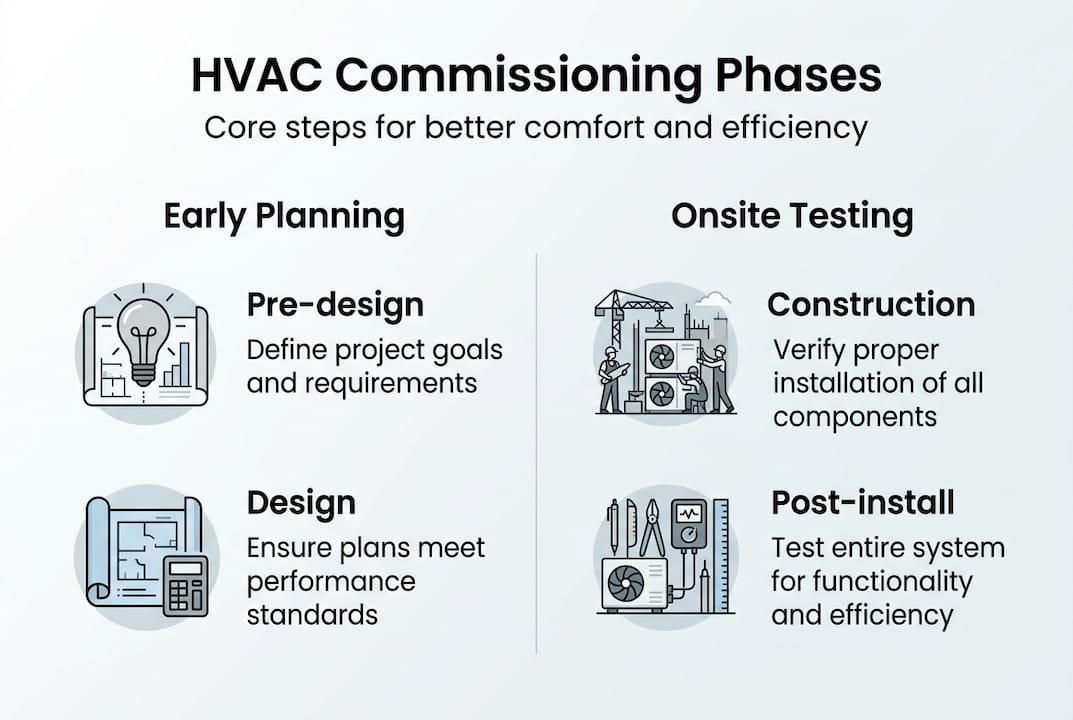
The process spans multiple phases: pre-design, design, construction, and post-occupancy. Each phase has specific deliverables that build on the previous one, creating a chain of accountability from the first planning meeting to years after move-in.
Here is how those phases break down in practice:
- Pre-design phase: The commissioning authority (CxA) joins the project team and helps develop the OPR. Goals for energy use, comfort, humidity control, and ventilation are documented before any equipment is specified.
- Design phase: Engineers develop the BOD and the commissioning plan. The CxA reviews design documents to catch specification conflicts, undersized equipment, or missing controls sequences before anything is built.
- Construction phase: Installation checks confirm equipment was placed and connected correctly. Pre-functional checklists (PFCs) verify mechanical and electrical connections before systems power up. Functional performance tests (FPTs) then confirm each piece of equipment responds correctly to commands under real operating conditions.
- Occupancy and post-occupancy phase: Building staff receive training on how to operate and maintain the system. A systems manual documents everything. Seasonal verification visits confirm the system handles both peak summer load and mild winter conditions correctly.
This last step is especially important for Southwest Florida properties. Following best practices for efficiency means acknowledging that a system tested in March may behave very differently in August when outdoor temperatures hit 95°F and humidity tops 85%. A thorough commissioning process schedules follow-up checks that capture seasonal performance data.
| Phase | Key activity | Primary goal |
|---|---|---|
| Pre-design | Develop OPR | Define performance targets |
| Design | Review BOD and Cx plan | Catch spec conflicts early |
| Construction | PFCs and FPTs | Verify correct installation |
| Post-occupancy | Training and seasonal checks | Sustain long-term performance |
The benefits of consistent AC maintenance extend everything commissioning starts. Think of commissioning as the foundation and maintenance as the ongoing structure built on top of it. Without a solid foundation, even perfect maintenance cannot compensate for a system that was never properly verified.
Pro Tip: Ask your contractor specifically whether functional performance testing is included in the project scope. Many proposals include startup and startup only. Startup confirms a unit turns on. Functional performance testing confirms it responds correctly to every control input under realistic conditions. Those are very different things.
Commissioning methods and tools: What actually happens?
Now that you know the process phases, let’s look at the hands-on methods and tests involved.
When a commissioning authority shows up on site, they carry a specific set of tools and methodologies. Key methodologies include submittal reviews, pre-functional checklists, testing, adjusting, and balancing, as well as functional performance testing and issues log resolution. Each of these serves a distinct role.
Submittal reviews happen during design and procurement. Before equipment ships to the job site, the CxA reviews product submittals to confirm the actual equipment matches the specifications. This sounds administrative, but it catches problems like a contractor substituting a unit with a lower SEER rating or a different refrigerant type.
Pre-functional checklists are hands-on inspections before power-up. A technician walks through every component, checking that wiring is correct, sensors are calibrated, and filters are clean. These take time but prevent the most embarrassing and costly startup failures.
Testing, adjusting, and balancing (TAB) is where airflow gets measured and corrected at every register and return. TAB is often the step that fixes those rooms that are always too hot or too cold. If one zone is receiving 40% more airflow than the design specifies, that is both a comfort problem and an efficiency problem.
Functional performance testing is the most rigorous step. The CxA runs the system through scripted scenarios, forcing every control sequence to execute. They might simulate an occupied building, an overnight setback, an economizer cycle, or a cooling emergency. Any sequence that fails to perform correctly generates an issue that must be resolved before the system is accepted.
Here is a side-by-side comparison of what a basic startup looks like versus thorough commissioning:
| Activity | Basic startup | Full commissioning |
|---|---|---|
| Equipment powers on | Yes | Yes |
| Refrigerant charge verified | Rarely | Always |
| Airflow balanced by zone | No | Yes |
| Control sequences tested | No | Yes, all sequences |
| Documentation provided | Limited | Full systems manual |
| Seasonal follow-up | No | Scheduled |
Refrigerant charge errors alone reduce system efficiency by 5 to 20 percent, and startup inspections rarely catch them. A unit running on a low refrigerant charge struggles to remove humidity effectively, which is a serious issue in a place like Cape Coral where summer humidity can make 78°F feel unbearable.
Common findings during commissioning include:
- Stuck dampers that block airflow to entire zones
- Overridden thermostat setpoints left from construction
- Sensors positioned incorrectly, skewing temperature readings
- Control sequences that were never programmed, leaving systems in manual mode
Knowing these HVAC warning signs before they become expensive repair calls is exactly why commissioning pays for itself.
Why commissioning matters in Southwest Florida
With commissioning methods understood, let’s bring it back home, literally, to Florida’s unique climate challenges.
Southwest Florida is not a friendly environment for HVAC systems. The combination of intense solar heat gain, extreme humidity, and near-constant cooling demand for most of the year creates performance stresses that other regions simply don’t face. A system that tests adequately in a mild climate can collapse under Florida conditions within its first full summer.
For Southwest Florida’s humid climate, commissioning ensures proper humidity control, economizer function, and ventilation, preventing common faults like stuck dampers or overridden controls that waste energy. Humidity control is perhaps the single most important factor here. A system that removes heat but not humidity leaves occupants miserable even at the right temperature. Commissioning verifies that dehumidification sequences are functioning and that ventilation rates are not pulling in more unconditioned outdoor air than necessary.
Homeowners gain lower bills and comfort, while commercial managers achieve compliance with ASHRAE 90.1, shorter paybacks of one to three years, and fewer faults impacting indoor air quality. That payback timeline is remarkable. For a commercial building in Naples spending $50,000 per year on cooling, even a 10% efficiency gain returns $5,000 annually, which means commissioning costs are recovered quickly and the savings continue for the life of the system.
“In Florida’s climate, humidity and heat together are the real test. Commissioning is what confirms your system is built for both, not just one.”
Here are the specific benefits local property owners gain from commissioning:
- Lower monthly energy bills through verified equipment efficiency and correct refrigerant charge
- Better dehumidification, reducing the risk of mold growth in walls and ceilings
- Improved indoor air quality by confirming ventilation rates meet design targets
- Compliance with local and state energy codes, reducing liability for commercial managers
- A documented baseline that makes future troubleshooting faster and cheaper
The latest Florida HVAC trends show growing adoption of variable-speed systems and smart controls. These technologies deliver spectacular efficiency gains when properly commissioned and often underperform when they are not. A variable-speed compressor that hasn’t been tuned to the building’s actual load profile will short-cycle, wear out faster, and fail to control humidity. Commissioning is what unlocks what these systems were designed to do.
Pro Tip: If you manage a commercial property, schedule retro-commissioning every three to five years. Controls drift, sensors fail quietly, and setpoints get overridden by well-meaning staff. Regular commissioning catches these issues before they become years of wasted energy bills. Local expert tips for comfort consistently point to commissioning as one of the highest-return investments a property manager can make.
The real cost of skipping commissioning: An expert take
Many property owners in Southwest Florida make the same calculation: commissioning adds time and money to a project, and the equipment comes with a warranty anyway, so why bother? That logic has real costs.
A system that was never properly commissioned often looks fine for the first year. Then the bills creep up. Then a zone starts struggling in July. Then a mold complaint appears in a rarely-visited storage room. None of these issues are dramatic enough to trigger an immediate service call, but together they represent thousands of dollars and years of degraded performance.
Engaging a commissioning authority early, prioritizing independent verification for large systems, and planning for ongoing recommissioning every three to five years are the practices that separate properties with consistently great performance from those that are always playing catch-up. The word “independent” matters here. A contractor commissioning their own work has a conflict of interest. An independent CxA has none.
The most underappreciated cost of skipping commissioning is control drift. Digital building management systems can have hundreds of setpoints. Over time, manual overrides accumulate. Sensor calibrations slip. Schedules don’t get updated when occupancy patterns change. Retro-commissioning is not about fixing broken equipment. It is about restoring the intelligent behavior a system once had before years of small changes eroded it. Staying on top of HVAC maintenance helps, but it is not a substitute for the systematic verification commissioning provides.
Ready to upgrade your comfort and efficiency?
If you’re ready to see the benefits firsthand, here are your next steps.
At Ultra Air Heating and Cooling, we work with homeowners and commercial property managers across Naples, Fort Myers, and Cape Coral to make sure HVAC systems actually deliver what they promise. That means more than installing great equipment. It means verifying performance, addressing imbalances, and setting your system up for long-term reliability in Florida’s demanding climate.
Whether you need consultation on a new installation, testing and verification for an existing system, or guidance on improving your indoor air quality, our team brings the local expertise to do it right. We also offer flexible HVAC financing options so that commissioning and high-performance upgrades are accessible without a large upfront investment. Reach out to Ultra Air today and get a system that works as hard as it should.
Frequently asked questions
What does HVAC commissioning actually involve?
It involves planning, reviewing designs, testing equipment, verifying performance, fixing issues, and providing training and documentation across multiple project phases from pre-design through post-occupancy.
How long does commissioning take for a typical building?
Commissioning can take from a few days to several weeks depending on system size, number of zones, and how many issues the process uncovers during functional performance testing.
Does HVAC commissioning increase project costs?
Commissioning adds about 0.5 to 1.5 percent to upfront costs, but the investment pays back quickly through lower energy bills, fewer repair calls, and longer system lifespan.
Is commissioning necessary for existing buildings or just new ones?
Commissioning benefits both new and existing HVAC systems by verifying they perform as designed. Retro-commissioning for older buildings often uncovers years of accumulated drift and control overrides.
What can go wrong if HVAC systems aren’t commissioned?
Without commissioning, buildings face higher energy bills, comfort problems, and poor humidity control. Refrigerant charge errors reduce efficiency by 5 to 20 percent alone, and control sequence failures are among the most common and costly problems in uncommissioned systems.