

When you call an HVAC technician and they start talking about SEER2 ratings, Manual J calculations, or sensible heat ratios, it’s easy to nod along and hope for the best. But in Southwest Florida, where your air conditioner runs hard for nine or ten months a year, misunderstanding these terms can mean overpaying for a system that doesn’t actually keep you comfortable, missing out on energy rebates, or watching mold creep into your walls because your unit wasn’t sized correctly. This guide cuts through the jargon so you can have real, confident conversations with any HVAC contractor.
Table of Contents
- Decoding HVAC basics: Key terms every homeowner needs
- Energy efficiency standards and ratings: What is SEER, SEER2, and why do they matter?
- Humidity and dehumidification: Managing moisture with HVAC systems
- Sizing and system selection: Matching HVAC to your home or business
- Why most buyers misunderstand HVAC terminology—and how to get it right in Southwest Florida
- Explore customized HVAC solutions for Florida homes and businesses
- Frequently asked questions
Key Takeaways
| Point | Details |
|---|---|
| Know your SEER rating | SEER and SEER2 ratings determine your HVAC unit’s efficiency and affect energy costs in Florida homes. |
| Humidity matters most | Controlling humidity is essential for comfort and health in Southwest Florida, beyond just cooling power. |
| Proper sizing is critical | Manual J calculations and BTU/ton matching prevent overworked or inefficient HVAC systems. |
| Ask about dehumidification | Always check how your system manages moisture along with temperature for best results. |
| Expert help saves money | Understanding terminology and options lets you make smarter HVAC investments and avoid costly mistakes. |
Decoding HVAC basics: Key terms every homeowner needs
Let’s break down the most common HVAC terms you’ll hear from contractors and technicians, starting with the fundamentals.
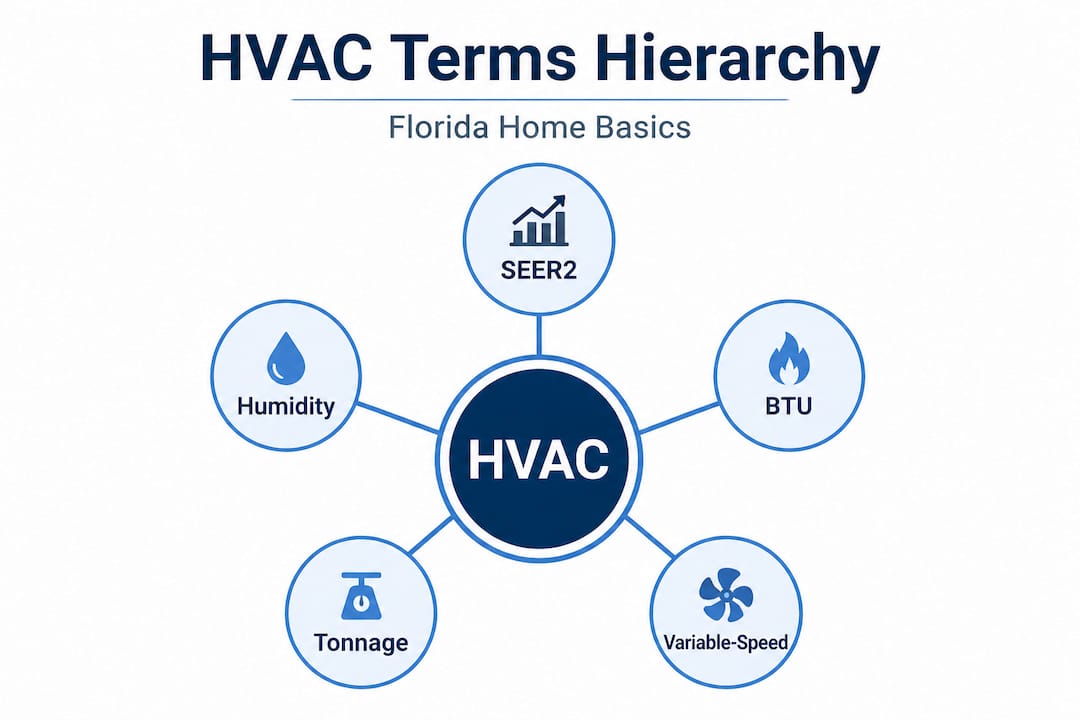
HVAC stands for Heating, Ventilation, and Air Conditioning. It’s the umbrella term for every system that controls temperature, airflow, and air quality inside your home or business. In Southwest Florida, the heating part gets less attention than in northern states, but ventilation and air conditioning are absolutely critical given the region’s intense heat and humidity.
Here are the most important terms you need to know right away:
- Split system: The most common residential setup, with one unit outside (the condenser) and one inside (the air handler). The two units work together to move heat out of your home.
- Mini-split: A ductless version of a split system. It’s great for room additions, older homes without ductwork, or spaces like garages and offices where you want independent temperature control.
- Heat pump: A system that moves heat rather than generating it. In Florida, heat pumps double as both air conditioners and heaters, making them highly practical since our winters are mild.
- SEER/SEER2: The efficiency rating for your AC system. More on this below, but know that Florida has specific minimum requirements that are stricter than many other states.
Understanding HVAC basics for Florida homes is the first step toward making a smart purchase decision. Coastal climates like Naples and Fort Myers bring salt air, high humidity, and intense UV exposure that all affect how HVAC equipment performs and how long it lasts.
Pro Tip: When shopping for a new system, ask your contractor to show you the SEER2 rating on the equipment label. Higher ratings may qualify you for utility rebates or HVAC financing options that make the upgrade more affordable upfront.
The SEER minimum for Florida split systems is 14.3 to 15 SEER2, with ratings between 16 and 20 recommended for meaningful long-term savings. If a contractor quotes you a system below that range, ask questions immediately.
Energy efficiency standards and ratings: What is SEER, SEER2, and why do they matter?
With the basics clear, let’s go deeper into one of the most important factors in HVAC: energy efficiency.
SEER stands for Seasonal Energy Efficiency Ratio. It measures how much cooling your system produces per unit of electricity consumed over an entire cooling season. Think of it like miles per gallon for your car. A higher number means less electricity burned for the same amount of cooling.
SEER2 is the updated version of this measurement, introduced by the Department of Energy to reflect more realistic operating conditions. It uses a slightly different testing standard, which means a SEER2 number will look a bit lower than the old SEER number for the same equipment. Don’t let that confuse you. A system rated at 15 SEER2 is still highly efficient and meets Florida’s current code requirements.
Here’s a practical comparison of how SEER ratings translate into real costs for a typical Southwest Florida home:
| SEER2 rating | Estimated annual cooling cost | Relative savings vs. minimum |
|---|---|---|
| 14.3 (minimum) | ~$1,400/year | Baseline |
| 16 | ~$1,250/year | ~$150/year |
| 18 | ~$1,100/year | ~$300/year |
| 20 | ~$980/year | ~$420/year |
These numbers are estimates for a 2,000 square foot home running roughly 2,800 cooling hours per year, which is typical for the Naples and Fort Myers area. The savings compound over a 15 to 20 year system lifespan.
“For Southwest Florida homeowners and business managers, prioritize SEER2 16 or higher, strong SHR for humidity, Manual J/D calculations, and variable-speed technology over single-stage systems for better dehumidification.”
The three biggest ways SEER affects your daily life:
- Monthly utility bills: A higher SEER system directly reduces what you pay Florida Power and Light every month, especially during summer peak hours.
- Indoor comfort: Higher-efficiency systems often use variable-speed compressors that run longer at lower capacity, which removes more humidity and creates steadier temperatures.
- Tax credits and rebates: Qualifying energy efficiency tax credits are available for systems that meet specific SEER2 thresholds, and high-efficiency AC credits can offset a significant portion of your installation cost.
Staying current with HVAC efficiency trends in Florida also helps you anticipate upcoming code changes before they affect replacement costs.
Humidity and dehumidification: Managing moisture with HVAC systems
Efficiency isn’t the only consideration. Humidity can make or break comfort in Southwest Florida, and it’s an area where many homeowners get blindsided.
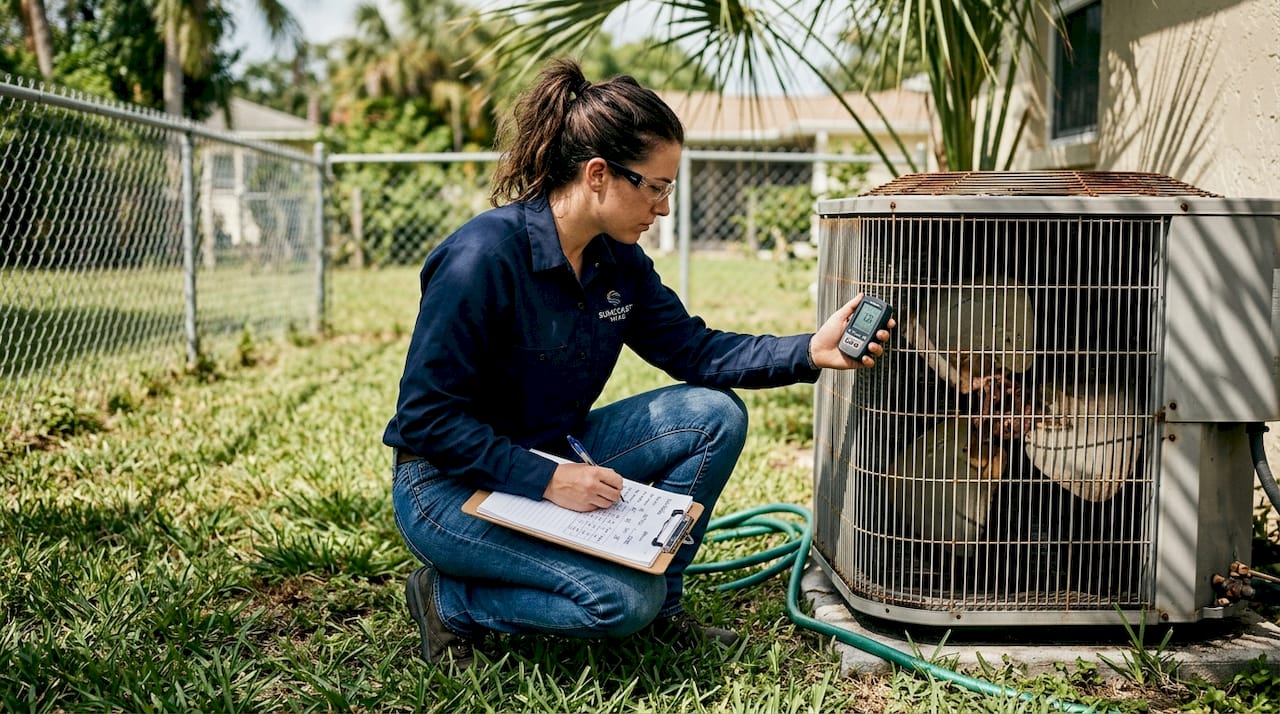
Humidity refers to the amount of moisture in the air. Southwest Florida regularly sees outdoor relative humidity above 80%, which means your HVAC system has to work hard just to keep indoor levels below 60%, the threshold above which mold and dust mites thrive.
SHR (Sensible Heat Ratio) is a term you may not have heard before, but it matters a lot here. It measures how much of your system’s cooling capacity goes toward lowering temperature versus removing moisture. A lower SHR means more moisture removal. In a humid climate like ours, you want a system with a lower SHR because raw cooling power without dehumidification just creates a cold, clammy space.
Here’s how different system types compare on moisture management:
| System type | Moisture removal rate | Best suited for |
|---|---|---|
| Central AC (single-stage) | Moderate | Larger homes with consistent loads |
| Central AC (variable-speed) | High | Most Southwest Florida homes |
| Mini-split (standard) | Moderate to high | Rooms, additions, small spaces |
| Mini-split (undersized/longer run) | High | Airtight, well-insulated homes |
Mini-splits dehumidify well when undersized at around 88% load, running longer cycles that pull more moisture from the air. However, this approach works best in airtight homes with an Energy Recovery Ventilator (ERV) to manage fresh air intake without flooding the space with humid outdoor air.
Steps for optimizing moisture management in your home:
- Schedule a Manual J calculation before any system installation to confirm proper sizing for your specific floor plan and insulation levels.
- Check your system’s SHR in the product specs. Ask your contractor directly if you can’t find it.
- Seal air leaks around doors, windows, and attic hatches before upgrading your system. Leaky homes undermine even the best dehumidification equipment.
- Consider a whole-home dehumidifier as a supplement if your current AC runs short cycles and leaves the air feeling muggy.
- Monitor indoor humidity with a simple digital hygrometer. Keep levels between 45% and 55% for comfort and mold prevention.
Pro Tip: If you’re considering a mini-split for a new addition or converted garage, ask your installer about intentionally sizing it slightly under the calculated load. In a tight, well-insulated space, this can dramatically improve dehumidification without sacrificing comfort. Review your best HVAC systems for Florida options before committing to one approach.
Reviewing an AC sizing guide specific to Florida conditions will also give you a clearer picture of what your home actually needs before you talk to a contractor.
Sizing and system selection: Matching HVAC to your home or business
With humidity managed, the next critical step is getting the size and system selection right for your property.
BTU (British Thermal Unit) is the basic unit of heating and cooling capacity. One BTU is the energy needed to raise one pound of water by one degree Fahrenheit. In practical terms, a typical Florida home needs roughly 20 to 25 BTUs of cooling capacity per square foot, though that number shifts based on insulation, ceiling height, window area, and sun exposure.
Tonnage is how HVAC capacity is typically sold. One ton equals 12,000 BTUs per hour. A 2,000 square foot home in Southwest Florida might need anywhere from 3 to 5 tons depending on its specific characteristics.
Manual J is the industry-standard calculation that accounts for all those variables to arrive at the right system size. Manual J/D calculations are essential for Southwest Florida properties where heat gain from intense sun, high humidity, and poor insulation can dramatically increase the required capacity.
Factors to consider when sizing your HVAC system:
- Square footage and ceiling height: Higher ceilings mean more air volume to condition.
- Window area and orientation: West-facing windows in Naples absorb intense afternoon sun.
- Insulation quality: Older Florida homes often have inadequate attic insulation, increasing heat gain significantly.
- Occupancy: A busy restaurant or retail space generates far more internal heat than a single-family home.
- Storm shutters and impact glass: These affect how much solar heat enters the building.
- Ductwork condition: Leaky ducts can reduce system efficiency by 20% to 30%, making proper sizing even more critical.
Variable-speed technology is worth understanding here too. Unlike single-stage systems that run at full blast or not at all, variable-speed compressors and air handlers modulate their output based on real-time demand. This means longer, gentler run cycles that remove more humidity, maintain steadier temperatures, and use less electricity overall. For a professional HVAC service provider, recommending variable-speed technology for Southwest Florida is standard practice, not an upsell.
Why most buyers misunderstand HVAC terminology—and how to get it right in Southwest Florida
After absorbing the essentials and nuances, here’s what most people, and even some pros, overlook in Southwest Florida.
Sales teams often lead with SEER ratings because they’re easy to compare on a spec sheet. A 20 SEER2 system sounds impressive, and it is, but if that system is oversized for your home, it will short-cycle. Short-cycling means the unit reaches the thermostat’s set temperature quickly and shuts off before it has time to pull moisture from the air. You end up with a cold, clammy house and a mold problem developing behind your walls. The warning signs of HVAC problems like musty odors and condensation on walls often trace back to this exact mistake.
We’ve seen this pattern repeatedly in the Naples and Fort Myers market. A homeowner replaces an aging system with a high-efficiency unit, pays a premium price, and then calls us six months later wondering why the house feels humid even when the AC is running. Nine times out of ten, the system was oversized and nobody ran a proper Manual J calculation.
The uncomfortable truth is this: SEER rating is just one dimension. Get humidity control and sizing wrong, and even the best efficiency rating won’t deliver the comfort you paid for.
“The uncomfortable truth: SEER rating is just one dimension. Get humidity and sizing wrong, and even the best efficiency won’t matter.”
Our advice is to shift your focus. Before asking “what’s the SEER rating,” ask your contractor three questions. First, did you run a Manual J calculation for my specific home? Second, what is the SHR of this system? Third, does it use a variable-speed compressor? If a contractor can’t answer all three confidently, keep looking.
Prioritizing SEER2 16 or higher alongside strong humidity performance is the right framework for Southwest Florida. But the rating only matters if the system is properly sized and installed. Brand names matter far less than correct sizing and quality installation.
Explore customized HVAC solutions for Florida homes and businesses
Understanding the terminology is powerful, but applying it correctly requires local expertise and hands-on assessment.
At Ultra Air Heating and Cooling, we serve homeowners and business managers across Naples, Cape Coral, and Fort Myers with HVAC solutions built specifically for Southwest Florida’s demanding climate. From energy-efficient system installations to indoor air quality improvements and repair services, our team runs proper Manual J calculations, evaluates your home’s humidity needs, and recommends systems that actually perform in our heat and moisture. Explore your Florida HVAC system options or contact us today to schedule a consultation and get a system that delivers real comfort, not just impressive numbers on a spec sheet.
Frequently asked questions
What does SEER mean for my air conditioner in Florida?
SEER shows how efficiently your AC cools over a season, and Florida requires a SEER2 of at least 14.3 to 15 for split systems, with higher ratings saving more on energy bills over time.
How does a mini-split system control humidity compared to central AC?
Mini-splits dehumidify effectively when slightly undersized and allowed to run longer cycles, but they perform best in airtight homes paired with an ERV for fresh air ventilation.
What does Manual J mean for HVAC sizing?
Manual J is a load calculation that factors in your home’s square footage, insulation, windows, and local climate to determine the correct system size, and Manual J/D is essential for accurate sizing in Southwest Florida.
Should I prioritize SEER or humidity control for comfort?
Both matter in Southwest Florida. Prioritize SEER2 16 or higher for energy savings, but pair it with a system that has strong humidity control and a low SHR to prevent mold and maintain genuine comfort.