
HVAC systems account for over 40% of the typical Florida utility bill, making them the single largest energy expense for most homeowners and businesses in the region. That number is even harder to ignore when you realize Southwest Florida’s brutal heat, relentless humidity, and salt-laden coastal air push systems to work harder and wear out faster than almost anywhere else in the country. Whether you own a beachside condo in Naples, a small business in Fort Myers, or a family home in Cape Coral, the decisions you make about your HVAC system have a direct effect on your comfort, your wallet, and the long-term health of your property.
Table of Contents
- Why HVAC matters more in Southwest Florida
- How coastal climate challenges HVAC systems
- The most effective HVAC technologies for Southwest Florida
- Maintenance and energy-saving strategies for local comfort
- The overlooked truth about Southwest Florida HVAC care
- Upgrade your HVAC for Florida’s coastal climate
- Frequently asked questions
Key Takeaways
| Point | Details |
|---|---|
| HVAC has outsized energy impact | In Southwest Florida, HVAC accounts for upwards of 40 percent of energy bills. |
| Coastal climate means faster wear | Salt air accelerates corrosion, cutting HVAC lifespan and requiring special protection for systems near the coast. |
| High-efficiency systems save more long-term | Upgrading to SEER2 15–16+ systems offers significant cost savings and increased comfort. |
| Regular maintenance is essential | Frequent coil cleaning, filter changes, and humidity control extend HVAC life and lower bills. |
| Smart upgrades boost comfort | Adding heat pumps or energy recovery ventilators provides all-season efficiency for homes and businesses. |
Why HVAC matters more in Southwest Florida
Southwest Florida is not a typical American climate. The cooling season runs roughly nine to ten months per year, with outdoor temperatures routinely hitting 90°F or higher and humidity levels that stay elevated even after sunset. Your air conditioner does not get a summer break; it works almost every day of the year.
That prolonged demand explains why HVAC systems represent more than 40% of local utility bills, and why upgrading to a higher SEER2 (Seasonal Energy Efficiency Ratio) rating can cut cooling costs by up to 40% over a season. Those are not small numbers. For a household spending $250 a month on power, an inefficient system could be burning $100 or more every month just in wasted energy.
Beyond raw cost, your HVAC system carries a heavier workload than it would in a northern state:
- Humidity control: Southwest Florida’s average relative humidity hovers around 75%, and without proper dehumidification, indoor air can feel sticky, encourage mold, and damage wood furniture and flooring.
- Air filtration: Coastal air carries more particulates, salt particles, and allergens than inland air, so clean indoor air is a real health issue, not just a comfort preference.
- Reliability: A failed system in July is not just uncomfortable; it can become dangerous for seniors, young children, and anyone with respiratory conditions.
Understanding HVAC basics for Southwest Florida homes is the first step toward spending less and breathing easier. Businesses face even higher stakes, where equipment failure can affect productivity, customer experience, and perishable inventory. That is why thoughtful commercial HVAC practices are not optional; they are part of running a sound operation in this region.
“The best HVAC investment a Southwest Florida property owner can make is choosing the right system for the local climate and then protecting it consistently.”
How coastal climate challenges HVAC systems
Salt air is invisible, but its damage is not. Within about 1,500 feet of tidal water, airborne salt deposits settle on outdoor HVAC components, particularly the aluminum fins and copper coils of the condenser unit. Salt accelerates a process called galvanic corrosion, where two dissimilar metals in close contact corrode faster than they would separately. The result is pitting, flaking, and eventually complete failure of the coil.
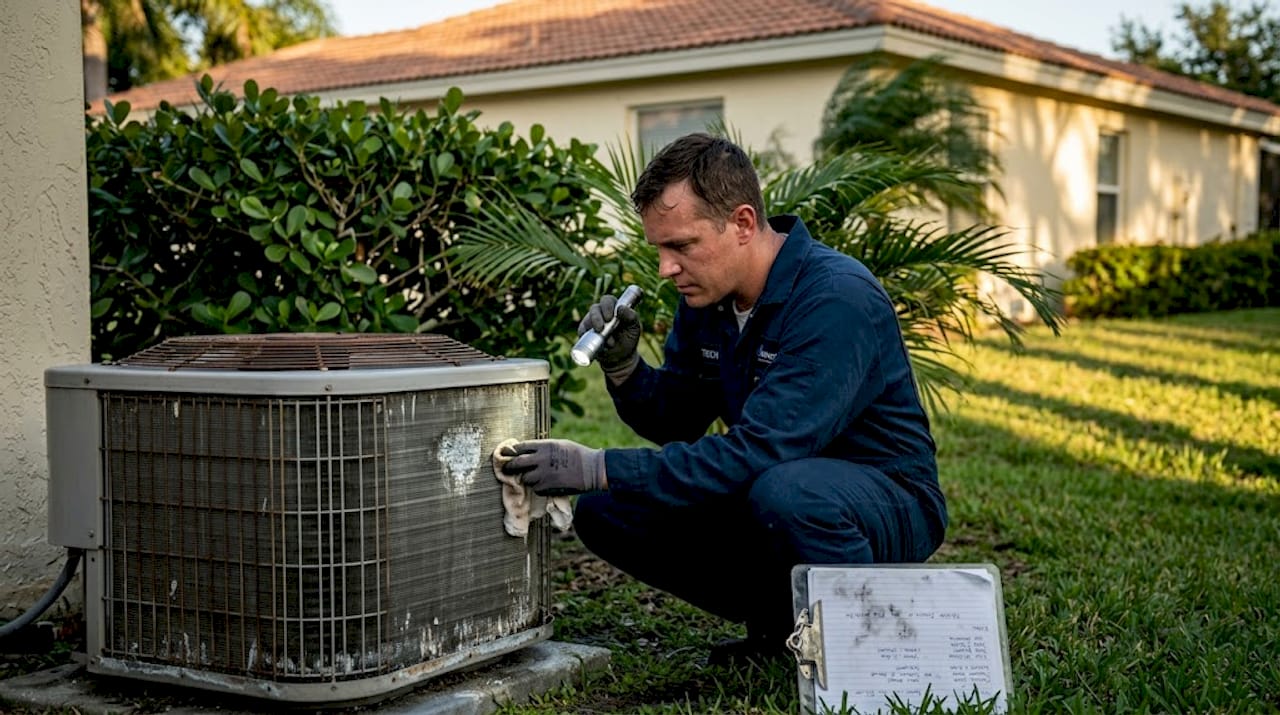
According to data on coastal salt air corrosion, unprotected HVAC coils and cabinets can degrade in as little as three to five years when exposed to coastal air. Contrast that with the 15 to 20-year expected lifespan of the same system installed inland, and you can see how geography alone shapes your HVAC budget. Coastal systems often need replacement in 8 to 12 years, sometimes sooner without proper precautions.
Here is how the difference plays out across common system components:
| Component | Inland lifespan | Coastal lifespan (unprotected) | Coastal lifespan (protected) |
|---|---|---|---|
| Condenser coils | 15-20 years | 3-5 years | 8-12 years |
| Cabinet/casing | 20+ years | 5-7 years | 12-15 years |
| Fan blades | 15 years | 7-10 years | 12-14 years |
| Electrical connectors | 15 years | 5-8 years | 10-13 years |
Protecting your investment starts with choosing the right equipment. Look for:
- Coated coils: Units with factory-applied epoxy or polymer coatings rated to ASTM B117 1000-hour salt spray standards hold up far longer than bare aluminum.
- Stainless steel hardware: Screws, brackets, and fasteners made from stainless resist salt attack far better than zinc-plated or cadmium-coated alternatives.
- Enclosed electrical compartments: Sealed wiring reduces moisture and salt penetration that causes shorts and corrosion in connection points.
Pro Tip: If your outdoor condenser is within a few blocks of a bay, canal, or the Gulf, rinse it gently with fresh water from a garden hose every month during the dry season and every two weeks during summer rains. This simple step literally washes away the salt before it can settle in and start corroding fins.
You can find detailed guidance on salt air corrosion tips specific to Cape Coral and other coastal communities in the region. The habits you build now will directly determine whether your next system replacement comes in eight years or fifteen.
The most effective HVAC technologies for Southwest Florida
Choosing the right type of system matters as much as choosing the right brand. In Southwest Florida’s climate, three technologies consistently outperform the rest: high-SEER2 split systems, inverter-driven heat pumps, and energy recovery ventilators, often called ERVs.
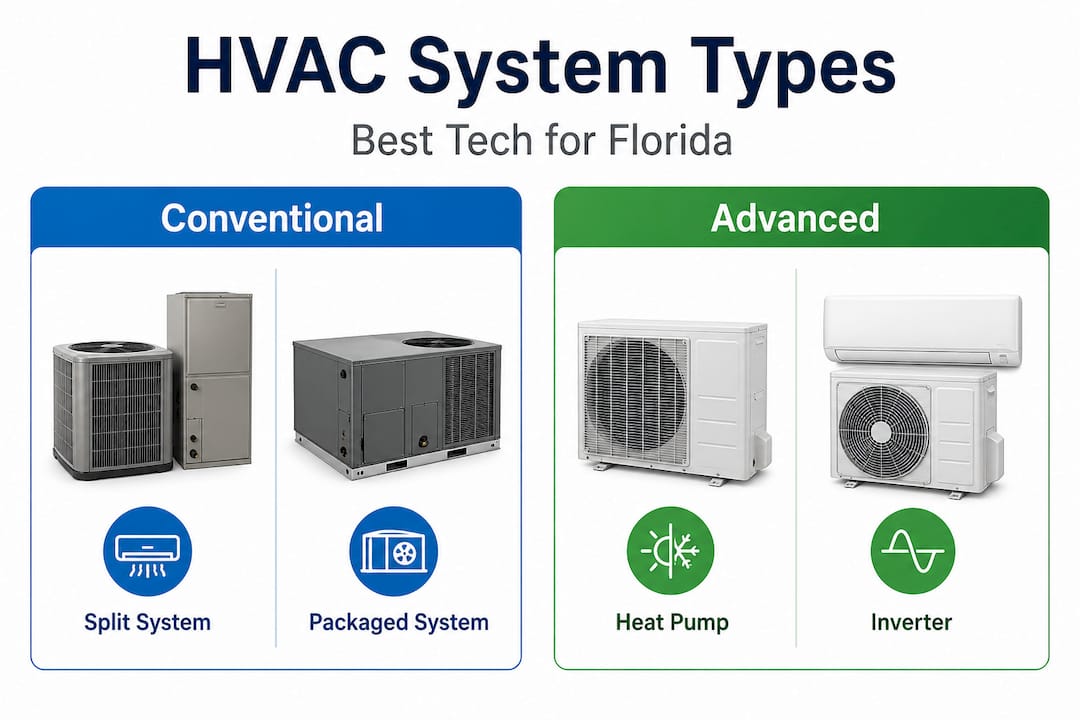
Here is a direct comparison of the main options:
| System type | Best for | SEER2 range | Key advantage | Key limitation |
|---|---|---|---|---|
| Standard split system | Most homes | 14.3 to 17 | Affordable, widely serviced | Fixed-speed, less efficient at part load |
| Inverter heat pump | Homes and small businesses | 17 to 22+ | Efficient year-round, mild heat | Higher upfront cost |
| Mini-split / ductless | Additions, offices | 18 to 26+ | No duct losses, flexible zoning | Higher install cost per zone |
| Central heat pump (ducted) | Larger homes, commercial | 15 to 20+ | Efficient all-season solution | Duct maintenance required |
Florida now requires a minimum SEER2 of 14.3 for split systems in hot-humid climates, but a rating of 15 to 16 or higher is strongly recommended for Southwest Florida’s extended cooling seasons. Every point of SEER2 you add translates into real savings over a system’s life, particularly when your system runs almost every day of the year.
Consider these steps when evaluating your technology choices:
- Calculate your annual runtime. Southwest Florida homes typically run cooling systems 2,500 to 3,000 hours per year compared to the national average of around 750 hours. Higher runtime amplifies the value of every efficiency point.
- Prioritize inverter technology. Inverter-driven compressors modulate speed rather than cycling fully on and off. This reduces energy spikes, maintains steadier temperatures, and handles humidity far better than single-speed units.
- Factor in your duct condition. If your home has older or leaking ductwork, even a high-SEER2 system loses efficiency. Address ductwork before or during a system upgrade.
- Add an ERV if fresh air is a concern. Energy recovery ventilators bring in fresh outdoor air while transferring heat and moisture from the outgoing air stream, keeping indoor air healthy without spiking humidity.
Explore the best HVAC types for Florida homes to match your specific square footage, construction type, and budget to the right system.
Pro Tip: Heat pumps are often dismissed in Florida because people assume they are only for cold climates. The opposite is true. In mild-winter climates like Southwest Florida, heat pumps run at their highest efficiency because they never have to work against extreme cold, making them one of the smartest investments you can make here.
Maintenance and energy-saving strategies for local comfort
Owning an efficient system is only half the equation. How you operate and maintain it determines whether that efficiency holds up for years or erodes within a few seasons. Southwest Florida’s climate makes certain maintenance habits non-negotiable, while others simply accelerate your savings.
Start with these quick wins that most homeowners can do themselves:
- Change air filters every 30 days during peak season, not the 90-day schedule that works in milder climates. Coastal dust and mold spores clog filters faster here.
- Set your thermostat at 78°F or higher when you are home, and a few degrees warmer when the house is empty. Every degree below 78°F adds roughly 8% to your cooling costs.
- Use ceiling fans alongside your AC. Fans do not cool air, but they make 78°F feel like 72°F, letting you keep your thermostat setting higher without discomfort.
- Seal gaps around doors, windows, and attic hatches. Unconditioned air sneaking in forces your system to work harder and drives up humidity.
For outdoor units in coastal areas, the frequent rinsing of unprotected fins is the single most cost-effective maintenance habit you can build. Fins degraded by salt lose their ability to transfer heat efficiently, which makes your compressor work harder and shortens its life.
Schedule these professional maintenance steps at least annually, ideally every six months in coastal zones:
- Coil cleaning and inspection: Technicians remove built-up dirt and salt from both evaporator and condenser coils, restoring heat transfer efficiency.
- Refrigerant level check: Low refrigerant forces the compressor to work harder and can cause the evaporator coil to freeze.
- Electrical connection inspection: Salt-accelerated corrosion at electrical terminals is a leading cause of coastal HVAC failures.
- Drain line flush: Florida’s humidity means condensate drain lines fill with algae and mold faster than in dry climates; a blocked drain can cause water damage inside your home.
- Humidistat calibration: If your system includes a whole-home dehumidifier or humidistat, verify the settings and sensor accuracy seasonally.
“A homeowner who spends $200 twice a year on professional HVAC maintenance will almost always spend less over ten years than one who skips service and faces a $4,000 compressor replacement.”
For a step-by-step breakdown of what to do when something goes wrong, the HVAC repair steps guide covers Southwest Florida-specific diagnostics in clear, plain language. And if you want proven HVAC success tips from local professionals, there is a wealth of region-specific advice that addresses the exact issues Cape Coral, Naples, and Fort Myers homeowners face every summer.
The overlooked truth about Southwest Florida HVAC care
Here is something most guides will not tell you plainly: following standard HVAC maintenance schedules is not enough on the coast. The textbook says change filters quarterly, schedule annual tune-ups, and call for repairs when you hear strange noises. That advice was written for climates with mild humidity, clean air, and cool winters. It does not account for the relentless aggression of Gulf Coast salt air, 10-month cooling seasons, and humidity that never fully retreats.
We have seen it repeatedly in Southwest Florida homes and businesses. A system that would have run 18 years in Ohio lasts 9 years here because the owners followed generic maintenance advice. Meanwhile, a neighbor with the same equipment year pushes 14 years out of their system because they rinse the outdoor unit every two weeks, schedule coil inspections every six months, and replace corrosion-vulnerable hardware on a proactive schedule rather than waiting for failure.
The real insight from working with local properties is this: the gap between a $2,000 repair bill and a $7,000 replacement often comes down to $400 worth of consistent annual care. That is not a metaphor. We watch it play out across Naples, Cape Coral, and Fort Myers every year. The properties that hold their systems longest are rarely those with the most expensive equipment. They are the ones where owners treat HVAC maintenance the way they treat oil changes, as a scheduled, non-negotiable routine rather than a reaction to problems.
There is also an indoor air quality dimension that gets overlooked. Coastal humidity invites mold growth inside air handlers and ductwork that inland homeowners rarely face. Properties that invest in UV air purifiers, ERVs, and regular duct inspections spend less on allergy medications, experience fewer respiratory symptoms, and avoid the costly mold remediation that hits neglected systems hard. That is a return on investment that never shows up in an energy efficiency chart but matters enormously to real families living in these homes.
If you want to understand how the best-performing local HVAC operations are staying ahead of these challenges, the HVAC growth strategies page offers an interesting look at what forward-thinking property owners and businesses are doing differently in 2026.
Upgrade your HVAC for Florida’s coastal climate
If this article has shown you anything, it is that Southwest Florida HVAC decisions deserve local expertise, not generic advice from a national chain. The right system, installed correctly, protected proactively, and maintained on a coastal schedule, delivers years of reliable comfort and real dollar savings on your utility bills.
Ultra Air Heating and Cooling specializes in exactly this kind of region-specific service across Naples, Cape Coral, and Fort Myers. Whether you are planning a new installation and want to review the HVAC installation guide for Fort Myers homeowners, curious about the latest HVAC trends shaping efficiency and comfort in 2026, or looking to improve the air quality inside your home or commercial space through indoor air quality services, our team is ready to help you take the right next step. Financing options are available, so there is no reason to put off an upgrade that will start saving you money from day one.
Frequently asked questions
What SEER2 rating is recommended for HVAC in Southwest Florida?
A minimum SEER2 of 14.3 is now required by Florida code, but a rating of SEER2 15 to 16 or higher is recommended for Southwest Florida’s long cooling seasons, where the extra efficiency pays back quickly.
How does salt air affect HVAC lifespan near the coast?
Salt air can nearly cut your system’s lifespan in half, with coastal systems lasting 8 to 12 years compared to 15 to 20 years inland, making protective coatings and regular rinsing essential for any property within 1,500 feet of tidal water.
How can I reduce my HVAC costs in Southwest Florida?
Set your thermostat to 78°F or higher, use ceiling fans to extend comfort at that setting, and keep filters and coils clean so your system runs at peak efficiency rather than working harder to compensate for dirty components.
Is a heat pump a good option for my Florida property?
Yes. Heat pumps perform best in mild winters, which is exactly what Southwest Florida delivers, making them one of the most efficient and cost-effective choices for both residential and commercial properties throughout the region.