

When your air conditioner fails in Southwest Florida at 2 p.m. in August, you have minutes before indoor temperatures become dangerous. A reliable HVAC emergency response checklist is not a nice-to-have item you put together after the crisis. It is the difference between a contained situation and a full system shutdown that costs thousands in equipment damage, spoiled inventory, or medical risk. This article walks you through every critical step, from the first moment you detect a problem to full system recovery, with actions designed for the heat and humidity realities of Naples, Cape Coral, and Fort Myers.
Table of Contents
- Essential criteria for an effective HVAC emergency response
- Step-by-step HVAC emergency response actions
- Common HVAC emergency signs and initial homeowner actions
- Comparing emergency response options and temporary cooling solutions
- Documenting and recovering from HVAC emergencies
- Why treating HVAC emergencies like incident management transforms your response success
- Partner with Ultra Air Heating and Cooling for dependable HVAC emergency support
- Frequently asked questions
Key Takeaways
| Point | Details |
|---|---|
| Response speed matters | Notify key contacts and assess HVAC failures within five minutes to prevent major damage. |
| Know warning signs | Recognize early signals like warm air, strange noises, or odors to act before emergencies escalate. |
| Use temporary cooling | Deploy portable cooling units or reduce load to protect critical spaces during repairs. |
| Document everything | Detailed records of failures and repairs help ensure proper recovery and future prevention. |
| Plan like incident management | Define zones, thresholds, notifications, and logs to transform emergency response effectiveness. |
Essential criteria for an effective HVAC emergency response
Having introduced why a checklist matters, let’s define the essential criteria that make your emergency response effective.
Not all emergency responses are equal. A disorganized reaction wastes the critical first minutes and turns a manageable failure into a catastrophic one. Before you ever face an emergency, your plan needs to meet these foundational criteria.
The five-minute threshold is real. Faster escalation and documented zone logging separate managed incidents from catastrophic loss in critical facilities. That standard applies equally to a restaurant kitchen in Fort Myers, a medical office in Naples, or a multi-family residence in Cape Coral.
Your hvac emergency preparedness list must cover these core criteria:
- Zone definition: Know exactly which areas of your building rely on each HVAC unit. Map it in advance, not during the failure.
- Critical temperature thresholds: Set a clear number, typically 85°F or above for occupied residential spaces, lower for server rooms or medical storage, where the emergency protocol activates.
- Designated contacts: Name a primary and backup contact for every role, owner, technician, and building manager, along with their cell numbers.
- Documented timelines: Every action in your emergency plan must include a time window. Vague instructions like “notify someone soon” fail under pressure.
- Backup system verification: Know whether you have a secondary unit or portable backup, where it is stored, and its last tested condition.
Your response also needs a quick risk assessment at the outset. Are occupants at medical risk from heat? Is sensitive equipment at stake? Those answers determine how aggressively you escalate.
Pro Tip: Keep your HVAC emergency crisis checklist posted near your thermostat and shared digitally with everyone responsible for your property. A checklist you can’t find in 30 seconds is useless.
Step-by-step HVAC emergency response actions
Now that you know the criteria, let’s walk through the exact emergency response steps to follow in order.
The first five minutes of an HVAC emergency determine whether you contain the situation or escalate into full system shutdown. Every person responsible for a property should know these steps before an emergency happens.
When your AC fails during intense summer heat, every minute counts. Follow this sequence without skipping steps:
- Confirm the alarm or complaint source. Walk to the thermostat and verify the unit is actually calling for cooling. Rule out a simple thermostat setting error before escalating.
- Check current indoor temperature against your critical threshold. If you are already at or near 85°F with occupants inside, treat this as an immediate life-safety situation.
- Verify backup system status. Is a secondary unit operational? Does a portable unit exist on site and ready to deploy?
- Log the exact failure onset time. Write it down. You will need this for your service call, insurance documentation, and any compliance reporting.
- Notify your facility manager, property owner, or HVAC emergency contact within five minutes. Not ten. Five.
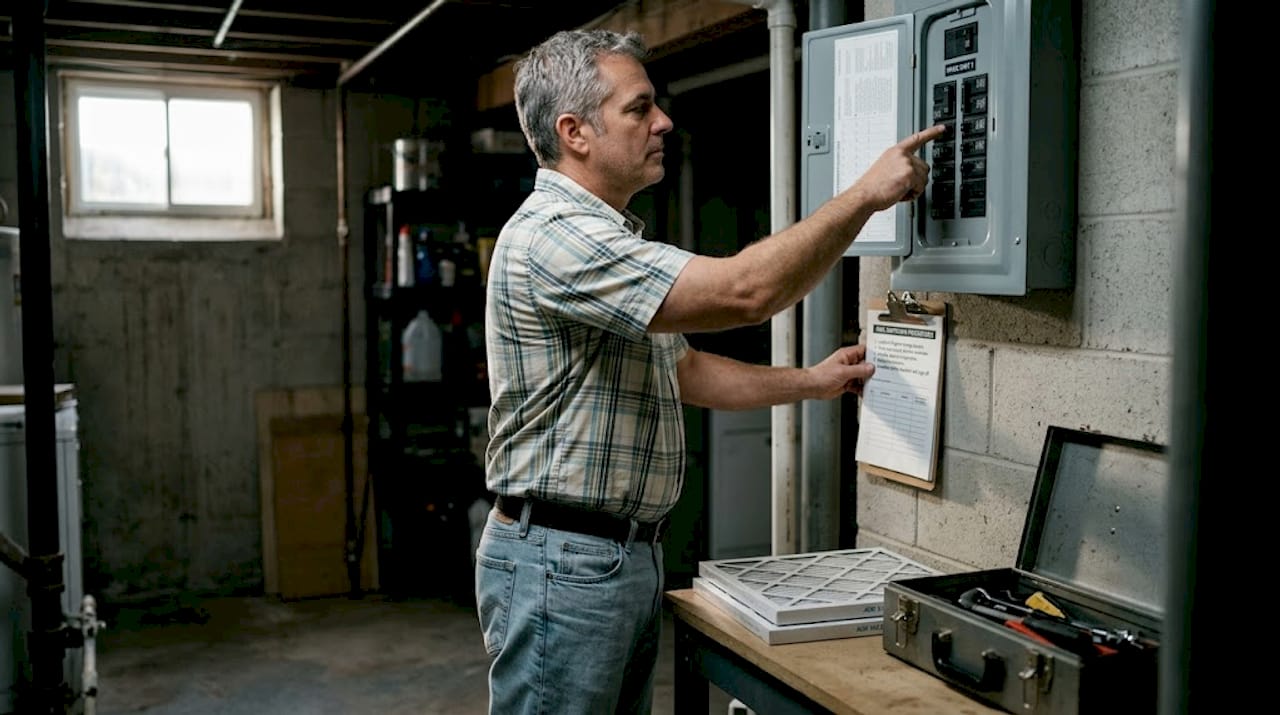
- Diagnose the likely failure cause with a rapid check: Is there power to the unit? Has a breaker tripped? Is the air filter visibly blocked? Is there ice on the coils or water pooling near the unit?
- Implement temporary cooling measures if the repair timeline is more than 30 minutes. Open interior doors to balance air, close blinds to reduce solar heat gain, and deploy portable units if available.
- Document every action with a timestamp as you go. A running log on your phone works perfectly.
- Coordinate with your HVAC professional using your HVAC repair step-by-step guide as a reference for communicating symptoms accurately.
Pro Tip: Pre-save your HVAC company’s emergency line as a contact in your phone labeled “HVAC Emergency” so you are not searching for it when you’re already stressed and the temperature is climbing.
Common HVAC emergency signs and initial homeowner actions
Recognizing these signs lets you act fast. Here are common red flags and the first safe steps you can take.
Most HVAC emergencies do not appear without warning. The system sends signals for days or weeks before a total failure. Catching them early is the cheapest form of emergency response.
Common warning signs include warm air despite a cooling setting, uneven airflow, unusual noises, foul odors, short cycling, water leaks, high humidity, and energy bill spikes. In Southwest Florida’s year-round heat, any one of these deserves same-day attention, not a “let’s see if it fixes itself” attitude.
Here is what to watch for specifically:
- Warm or weak airflow despite the thermostat calling for 72°F is a refrigerant or compressor issue until proven otherwise.
- Strange grinding, banging, or clicking from the air handler or outdoor unit usually means a mechanical component is failing.
- Persistent musty or burning smells from vents. Musty points to mold in the ductwork. Burning is urgent.
- Short cycling, meaning the unit turns on and off every few minutes, puts enormous stress on the compressor and accelerates full failure.
- Frozen evaporator coils or water pooling near the indoor unit, which signals restricted airflow or a refrigerant issue.
- Unexplained spikes in your electric bill without a change in usage habits, often the first measurable sign of a struggling system.
If you smell burning, turn the system off immediately at the thermostat and the breaker. That smell is a fire hazard, not an operational quirk. Ventilate the space, relocate occupants if the smell is strong, and call for service before turning anything back on.
Reviewing your HVAC problem warning signs periodically keeps you ahead of failures before they become emergencies.
Pro Tip: Take a 60-second walk-around of your outdoor condenser unit every month. Bent fins, debris accumulation, or frost on the refrigerant lines tell you something is wrong before the system fails entirely.
Comparing emergency response options and temporary cooling solutions
If repair isn’t immediate, choosing the right temporary cooling option is critical. Let’s compare the available solutions.
In Southwest Florida’s heat and humidity, a building without cooling becomes unsafe fast. Knowing your temporary options in advance, not during the crisis, means you can act within minutes rather than spend an hour researching rental companies while temperatures climb.
Deploying portable DX cooling units and spot coolers are the frontline contingency measures for HVAC emergencies. Here is how the main options compare:
| Cooling solution | Best use case | Setup time | Cooling capacity | Cost range |
|---|---|---|---|---|
| Portable DX unit | Whole rooms or open floor plans | 30 to 60 minutes | High | $150 to $400/day rental |
| Spot cooler | Server rooms, medical equipment, focused areas | 15 to 30 minutes | Targeted | $100 to $250/day rental |
| Window unit (owned) | Residential backup, single room | 10 to 20 minutes | Medium | No additional cost |
| Load reduction only | Short-term or overnight low-occupancy situations | Immediate | None | Free |
Beyond choosing equipment, your hvac crisis management response should include these supporting actions:
- Close off unoccupied zones to concentrate cooling where it is needed most.
- Shut down heat-generating equipment like computers and kitchen appliances where possible.
- Pre-source a rental equipment contact before a crisis. In peak summer, portable units get claimed fast across Southwest Florida.
- Document all temporary measures deployed, including serial numbers and deployment times, for your incident report and potential insurance claim.
A pre-arranged equipment rental agreement with a local supplier, renewed annually, is one of the smartest investments a business owner in this region can make. It turns a frantic search into a single phone call.
Pro Tip: Review your SWFL HVAC hurricane preparation checklist as a companion document. Many of the same temporary measures and contacts you need for storm-related failures apply directly to summer equipment emergencies.
Documenting and recovering from HVAC emergencies
Once restored, proper documentation and recovery steps close the incident effectively and prevent future emergencies.
Getting the system back online is not the end of an HVAC emergency. Proper recovery procedures determine whether you have a one-time incident or a recurring problem that will cost you again in six months. Thorough documentation protects against disputes and supports smarter maintenance decisions going forward.
Follow this recovery sequence after every HVAC emergency:
- Verify repaired components under full system load, not just a short bench test. Run the system for at least 20 minutes and confirm all functions are stable.
- Confirm the indoor temperature is within 2°F of setpoint before removing any temporary cooling equipment. An early pullout often reveals the repair was incomplete.
- Verify all safety cutouts and alarms have reset and are functioning. This includes high-pressure switches, low-pressure switches, and float switches on drain pans.
- Document the root cause with a specific category: electrical failure, mechanical failure, refrigerant loss, control board issue, or maintenance neglect. Vague notes like “system was broken” are useless for future planning.
- Log all replaced parts including part numbers, vendor names, and dates. This data is invaluable when verifying repaired component operation in future service visits.
- Generate a written incident report covering timeline, actions taken, costs, and outcome. For businesses, this supports compliance and insurance documentation.
- Create preventive maintenance orders for any deferred items your technician identified during the repair but did not address immediately.
Your HVAC maintenance checklist for Southwest Florida gives you a structured framework to keep documented maintenance current so the next failure is less likely.
Why treating HVAC emergencies like incident management transforms your response success
Most homeowners and small business owners think of HVAC emergencies in reactive terms: something breaks, you call someone, you wait. That framing is exactly why the same building can lose cooling three times in a summer while a comparable property next door hasn’t had an unplanned outage in years.
Treating HVAC emergencies like structured incident management means defining affected zones and temperature thresholds in advance, assigning notifications within strict time windows, and logging timestamps for full continuity. This is the standard used in hospitals, data centers, and food distribution facilities. There is no reason a Naples restaurant or a Fort Myers office building shouldn’t apply the same thinking.
The mindset shift changes three things. First, you stop making decisions under pressure and start executing a pre-made plan. Second, every action becomes traceable, which matters when dealing with insurance adjusters, property managers, or equipment warranties. Third, you build an incident history that reveals patterns. If your compressor fails every July, your maintenance log will show you why, whether it is dirty coils, inadequate electrical supply, or a refrigerant leak that was patched but never properly repaired.
For homeowners, this doesn’t require a formal IT-style incident management system. It requires a one-page document, stored somewhere findable, that answers: Who do I call? What do I do first? What are my temperature limits? Where is my backup option? Those four answers, written down in advance, make you more prepared than 90% of property owners in this region.
The uncomfortable truth is that most HVAC failures are not sudden. They are the end point of a long, documented warning history that nobody was reading. An incident management mindset means you read those signals and act before they become a 95-degree afternoon emergency.
Partner with Ultra Air Heating and Cooling for dependable HVAC emergency support
When an HVAC crisis hits in Southwest Florida, having a trusted local team on speed dial is as important as the checklist itself. Ultra Air Heating and Cooling provides 24-hour emergency HVAC repair across Naples, Cape Coral, and Fort Myers, with technicians who know the demands of this climate firsthand.
Whether you need fast diagnostics on a failed compressor, guidance through a full HVAC system installation, or support improving your indoor air quality after a humidity-related incident, Ultra Air is equipped to handle it. Our local expertise means faster response times and solutions built for Southwest Florida’s unique heat and storm conditions. Contact Ultra Air today to get your emergency plan and your system in the best shape possible before the next crisis arrives.
Frequently asked questions
What should I do immediately when my HVAC system fails in Southwest Florida?
Turn the system off at the thermostat and breaker, especially if you detect a burning smell, and contact your HVAC service right away to prevent further damage or safety risk.
How quickly must I notify someone when an HVAC emergency occurs in a commercial or critical facility?
Notify the facility manager or on-call supervisor within the first five minutes of confirmed failure to contain risks and initiate repairs before temperatures or equipment losses escalate.
What are common signs that indicate my air conditioner needs immediate repair?
Warning signs include warm air blowing, weak airflow, unusual noises, foul odors, short cycling, ice on coils, rising energy bills, and water leaks near the indoor unit.
Can temporary cooling solutions help during an HVAC emergency?
Yes. Portable DX units and spot coolers provide targeted relief while repairs are underway, protecting occupants and critical equipment from dangerous heat exposure.
Why is detailed documentation important after an HVAC emergency?
Documenting root cause, replaced parts, and repair timelines supports compliance, backs insurance claims, and reveals failure patterns that prevent the same emergency from happening again.