

Most homeowners spend a lot of energy adjusting their thermostat and almost none thinking about airflow. That’s a problem, because why is airflow important in HVAC is exactly the question that unlocks better comfort, lower energy bills, and longer equipment life. Your HVAC system doesn’t just heat or cool air. It moves air. When that movement is restricted, unbalanced, or poorly designed, your home pays the price in hot and cold spots, humidity swings, dusty rooms, and a system that never quite keeps up. This article explains exactly what’s happening and what you can do about it.
Table of Contents
- Key takeaways
- Why is airflow important in HVAC systems
- How airflow affects HVAC efficiency and energy use
- Airflow, indoor air quality, and comfort
- Common causes of poor airflow
- Practical ways to improve your HVAC airflow
- My honest take on why airflow gets ignored
- Let Ultraairswfl optimize your airflow today
- FAQ
Key takeaways
| Point | Details |
|---|---|
| Airflow drives system performance | Without adequate airflow, your HVAC cannot condition or distribute air effectively, no matter how powerful it is. |
| Poor airflow wastes energy | Restricted airflow forces longer runtimes and higher electricity use, directly raising your monthly bills. |
| Comfort depends on distribution | Uneven airflow creates hot and cold spots that no thermostat setting can fully correct. |
| Filter choice affects airflow | High-efficiency filters can reduce airflow if your system wasn’t designed to handle the added resistance. |
| Maintenance prevents problems | Regular filter changes and vent checks protect airflow and prevent costly system strain. |
Why is airflow important in HVAC systems
Airflow is the mechanism that actually delivers comfort. Your HVAC system conditions air at a central unit, but that conditioned air only reaches you through a network of ducts, vents, and registers. Airflow is the movement of that air through the entire system. When it’s working correctly, every room gets the right amount of treated air at the right time.
Here’s where most people get confused. They assume that setting the thermostat to 72 degrees means every corner of the house will be 72 degrees. It won’t, not if the airflow is off. Poor circulation reduces balanced temperature and humidity control across your home, leaving some rooms too warm and others too cold regardless of what the thermostat reads.
Airflow also plays a central role in humidity management. In Southwest Florida, where humidity is relentless, a system that can’t move enough air through the evaporator coil will struggle to dehumidify your living space. The result isn’t just discomfort. It’s the kind of muggy indoor environment that promotes mold growth and makes 74 degrees feel like 80.
One related concept worth knowing is static pressure. Think of it as the resistance your HVAC fan has to push against to move air through your ducts. Every filter, bend, duct fitting, and register adds resistance. When static pressure gets too high, airflow drops even if the fan is running at full speed.
- Dirty or clogged filters raise static pressure instantly, cutting airflow volume
- Undersized ducts create bottlenecks the fan can’t overcome
- Closed or blocked vents redirect pressure and unbalance the whole system
- Long duct runs with multiple bends accumulate resistance throughout the path
Pro Tip: Have an HVAC technician measure static pressure during your next service visit. If your system is running above the manufacturer’s recommended pressure rating, airflow is being throttled somewhere in your system.
How airflow affects HVAC efficiency and energy use
The connection between airflow and your energy bill is direct and measurable. When airflow is restricted, your HVAC system can’t complete its heating or cooling cycle efficiently. Restricted airflow causes the system to run longer to reach the thermostat setpoint, and longer runtimes mean higher electricity consumption.
There’s also the fan side of the equation. Your air handler fan has to generate enough pressure to push air through every foot of ductwork, past every filter, and through every register in the building. Underestimating static pressure causes the fan to fail to deliver the required airflow volume, which creates both comfort and efficiency problems at once.
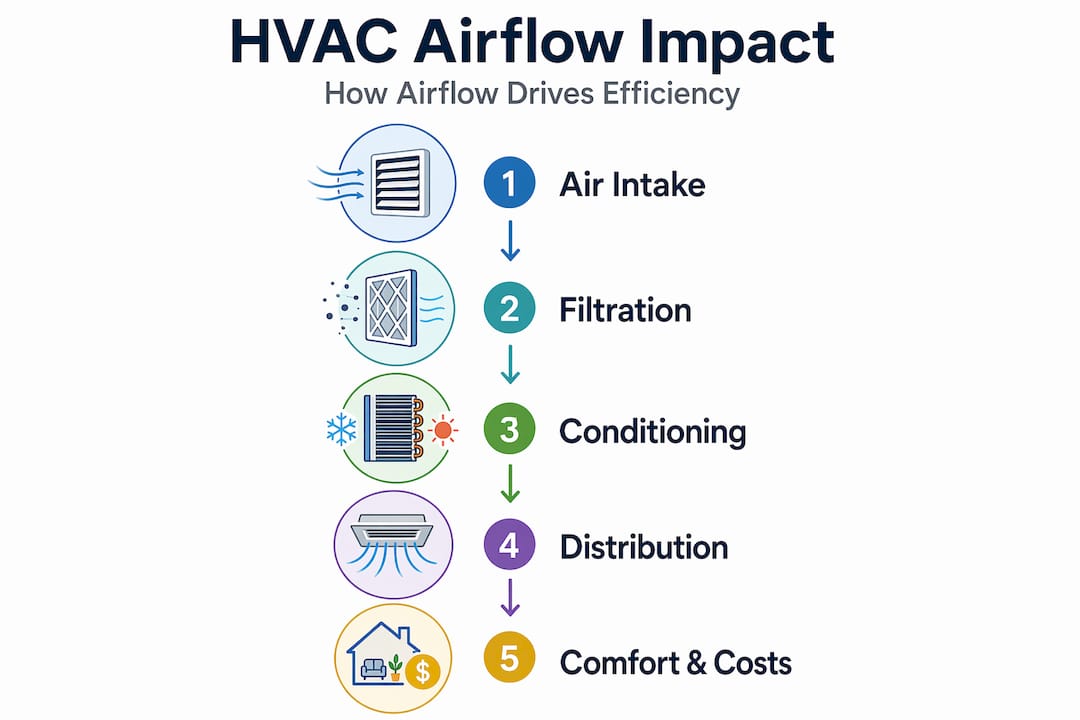
Here’s a number that changes how you think about this topic. A 50% airflow reduction in a variable air volume system can save approximately 87% of fan power. That relationship, known as the affinity law, means that small airflow improvements translate into outsized energy savings. The reverse is also true. Small restrictions compound into big energy waste.
The practical takeaways for efficiency are clear:
- Replace filters on schedule. A clogged filter is the single most common cause of reduced airflow and elevated system pressure.
- Check that all supply and return vents are fully open and unobstructed by furniture, rugs, or drapes.
- Request a duct pressure test if you suspect leaks. Leaky ducts bleed conditioned air into unconditioned spaces like attics and crawl spaces.
- Ask about your fan’s operating pressure when scheduling service. Poor duct routing increases static pressure, making fans work harder over the system’s entire lifetime.
- Consider upgrading to a system with variable speed fan control, which adjusts airflow to actual demand instead of running at one fixed speed.
For larger commercial properties, variable air volume systems deserve serious consideration. ASHRAE 90.1 requires VAV on buildings over 25,000 square feet for energy performance credits, and the efficiency gains are significant at real-world part-load conditions. Typical commercial offices operate at just 30 to 60 percent of their peak cooling load most of the time, meaning a fixed-volume system is constantly wasting fan energy.
Airflow, indoor air quality, and comfort
Proper airflow doesn’t just move air. It moves filtered air. Every time conditioned air passes through your HVAC system, it runs through a filter designed to catch dust, pollen, pet dander, and other particles. But that filtration only works if air is actually moving through the filter at the right volume and velocity.

Restricted airflow reduces filter effectiveness because less air gets cleaned per hour. Rooms become dustier, allergens accumulate, and occupants notice stale or stuffy air. In a home where someone has asthma or seasonal allergies, this difference is not subtle.
Here’s where filter selection gets tricky. Many homeowners upgrade to higher-MERV filters thinking better filtration is always better. That’s not always true.
| Filter type | Airflow impact | Best for |
|---|---|---|
| MERV 1 to 4 | Minimal resistance, maximum airflow | Basic dust and debris capture |
| MERV 8 to 11 | Moderate resistance, good balance | Most residential HVAC systems |
| MERV 13 to 16 | High resistance, reduced airflow | Systems specifically designed for high-efficiency filtration |
Higher-efficiency filters raise energy consumption and can reduce system lifespan if the HVAC unit wasn’t designed to handle the added pressure drop. Before swapping to a MERV 13 filter, confirm with your technician that your system can handle it. The right filter is the one that balances air quality with the pressure your fan can actually manage.
Airflow also controls humidity. In a well-balanced system, conditioned air cycles through regularly enough to remove excess moisture and prevent the humidity swings that cause discomfort. When airflow is sluggish, humidity lingers. Learning about balancing airflow at home gives you practical tools to address these problems before they compound.
Pro Tip: If some rooms in your home always feel more humid or stuffy than others, the problem is almost certainly airflow distribution, not your thermostat. Check whether the return vents in those rooms are open and unblocked.
Common causes of poor airflow
Recognizing airflow problems early prevents minor inefficiencies from becoming expensive repairs. Signs of poor airflow include uneven temperatures between rooms, noisy or laboring fans, dusty surfaces, and a system that cycles on and off too frequently.
The causes behind these symptoms fall into a predictable set of categories:
- Dirty filters. A filter that hasn’t been changed in months creates massive airflow restriction. This is the most common culprit and the easiest to fix.
- Blocked or closed vents. Furniture pushed against a register, or a vent manually closed in a “unused” room, throws the entire system out of balance. Closing vents does not save energy. It actually raises static pressure and stresses your equipment.
- Leaky ductwork. Gaps or holes in ducts allow conditioned air to escape before reaching its destination. This reduces airflow at the register and wastes the energy used to condition that air.
- Undersized duct runs. If the ductwork was poorly designed or modified during a renovation, some runs may be too small to carry the airflow volume the system produces.
- Fan and motor issues. A worn or failing blower motor reduces fan output, cutting airflow even when everything else in the system looks fine.
- Dirty evaporator coils. A coil caked with dust acts as a physical barrier to airflow, reducing the volume of air that can pass through the air handler.
Understanding the real role of HVAC filtration helps you make smarter maintenance decisions that protect both air quality and system performance.
Practical ways to improve your HVAC airflow
Most airflow improvements don’t require major investments. Many start with things you can do today.
- Change filters on a consistent schedule. Regular filter replacement is the most impactful and lowest-cost maintenance step for protecting airflow and indoor air quality. In dusty environments or homes with pets, monthly changes may be necessary.
- Open every supply and return vent. Walk through your property and confirm that every register is fully open and that no furniture, rugs, or curtains are blocking airflow. This takes ten minutes and costs nothing.
- Schedule a duct inspection. Duct leaks are invisible without testing but can account for significant airflow losses. A professional can pressure-test your duct system and seal leaks that are bleeding conditioned air into unconditioned spaces.
- Ask about system balancing. A qualified technician can adjust dampers and airflow settings to distribute conditioned air more evenly across all zones. Proper duct design and system balancing minimize pressure losses and reduce fan energy waste.
- Consider zoning or variable-speed equipment. If certain areas of your home consistently get too much or too little air, HVAC zoning can help. Understanding how HVAC zoning works gives you a clear path to targeted comfort improvements without overworking your system.
- Request a static pressure assessment. If your technician hasn’t measured static pressure in your system, ask for it. It takes minutes and tells you immediately whether airflow is being restricted somewhere in the system.
My honest take on why airflow gets ignored
I’ve watched homeowners invest in brand-new high-end HVAC equipment and still complain about comfort problems six months later. Almost every time, the issue wasn’t the equipment. It was the airflow.
The pattern I keep seeing is this: people call for a new system when the real problem is a dirty coil, an undersized return duct, or vents that have been closed for years. A new unit installed into a broken airflow path performs just as poorly as the old one did. The thermostat gets blamed. The equipment gets replaced. The root cause stays untouched.
What I’ve learned is that airflow is the single most overlooked variable in residential HVAC. It’s not exciting to talk about, and it’s harder to visualize than a temperature reading on a screen. But in my experience, fixing airflow problems delivers more noticeable comfort improvement per dollar than almost any equipment upgrade you can make. If your home never quite feels right, don’t assume you need a bigger system. Start by asking whether the air is actually moving the way it should.
— albert
Let Ultraairswfl optimize your airflow today
If you’ve recognized any of the signs described in this article, such as uneven temperatures, stuffy rooms, or a system that runs constantly without catching up, Ultraairswfl can help you find out exactly what’s going on. Our team serves homeowners and property managers across Naples, Cape Coral, and Fort Myers with professional HVAC assessments, duct evaluations, and system balancing services.
From heating solutions to indoor air quality improvements, we combine technical expertise with practical advice to deliver real, measurable results. Whether you need a static pressure test, a duct inspection, or a full system upgrade, we’ll give you honest answers and a clear plan. Contact Ultraairswfl today to schedule your airflow assessment and start experiencing the comfort your system was designed to deliver.
FAQ
Why is airflow important in HVAC systems?
Airflow delivers conditioned air from your HVAC unit to every room in your home. Without adequate airflow, the system cannot maintain balanced temperatures, control humidity, or filter the air effectively, regardless of thermostat settings.
What are signs of poor airflow in my home?
The most common signs include uneven room temperatures, rooms that feel stuffy or humid, dusty surfaces that accumulate quickly, and a system that cycles on and off more frequently than normal.
Can closing vents improve airflow in other rooms?
No. Closing vents increases static pressure throughout the duct system, which stresses the fan and reduces overall efficiency. Every vent should remain open to maintain proper system balance.
How does a dirty filter affect HVAC airflow?
A clogged filter raises the resistance the fan must overcome, directly reducing airflow volume. This causes longer runtimes, higher energy use, and reduced filtration effectiveness throughout your home.
How often should I replace my HVAC filter?
Most systems perform best with filter changes every one to three months. Homes with pets, high dust levels, or occupants with allergies may need monthly replacements to maintain proper airflow and air quality.