
Types of HVAC certifications fall into three distinct categories: federally mandated credentials, voluntary industry-recognized programs, and state or local licenses. The EPA Section 608 certification is the legal baseline every technician must hold before touching refrigerants, while credentials from NATE and HVAC Excellence signal mechanical skill to employers. State licenses govern who can pull permits and operate as an independent contractor. Understanding how these credentials stack, overlap, and differ is the fastest way to map a clear path forward in your HVAC career.
1. EPA Section 608 certification: the mandatory starting point
EPA Section 608 certification is federally mandated for anyone who services, maintains, repairs, or disposes of appliances containing refrigerants. No other credential replaces it, and working without it exposes both the technician and the employer to federal penalties. This makes it the non-negotiable first credential on every HVAC technician’s list.
The certification divides into four types based on the equipment you work on:
| Type | Equipment covered | Exam format |
|---|---|---|
| Type I | Small appliances (under 5 lbs of refrigerant) | Open-book, online allowed |
| Type II | High-pressure systems (residential AC, heat pumps) | Proctored, in-person |
| Type III | Low-pressure systems (large chillers) | Proctored, in-person |
| Universal | All of the above | Proctored, in-person |
One detail most new technicians miss: the Core exam for Universal certification must be proctored even if you previously passed the Type I Core open-book online. You cannot substitute an online result for Universal credentials. That distinction trips up a lot of people who assume their online Type I score covers them.
Exam costs typically range from $10 to $40 depending on the testing provider, and the certification never expires. No renewal, no continuing education requirement attached to it.
Pro Tip: Go straight for Universal in one proctored sitting. It covers all four types at once, costs roughly the same as taking individual exams, and makes you eligible for every refrigerant-related job in the field.
2. NATE certification: the industry’s voluntary gold standard
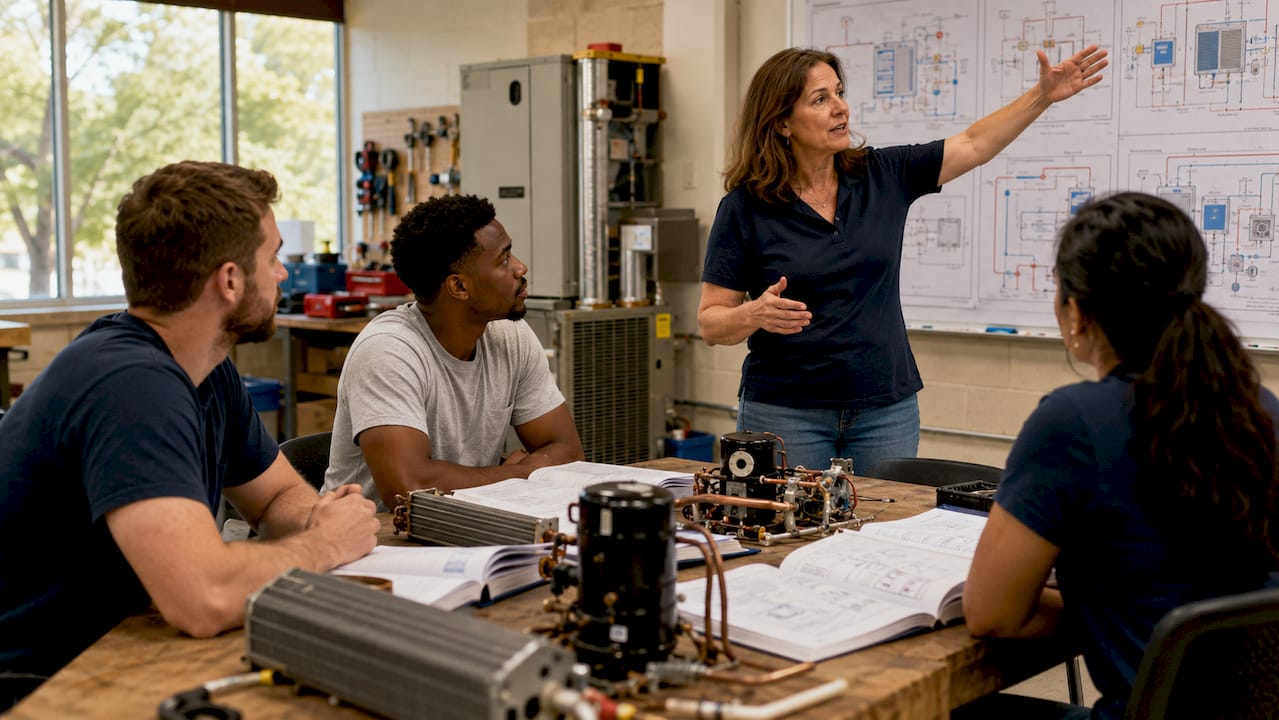
NATE (North American Technician Excellence) is the most widely recognized voluntary certification for HVAC technicians in the United States. Employers value NATE because it validates mechanical skill, something EPA 608 does not measure at all. Passing EPA 608 proves you can legally handle refrigerants. Passing NATE proves you know how to diagnose and repair a system correctly.
The structure requires passing a Core exam first, then one or more specialty modules covering areas like air conditioning, heat pumps, gas heating, or commercial refrigeration. Renewal happens every two years through continuing education hours or retesting. That renewal cycle keeps certified technicians current with evolving equipment and refrigerant standards.
Employers in competitive markets, including Southwest Florida where Ultraairswfl operates, increasingly list NATE certification as a preferred or required qualification. Technicians with NATE credentials routinely negotiate higher starting pay than those without it.
Pro Tip: Choose your NATE specialty module based on the equipment you work on most. If you service residential split systems in a hot climate, the Air Conditioning specialty is your highest-return credential.
3. HVAC Excellence certification: structured levels for every career stage
HVAC Excellence offers a tiered certification structure that maps directly to career progression. The three levels are Employment Ready, Professional, and Master. Employment Ready suits entry-level technicians finishing a training program. Professional targets working technicians with hands-on experience. Master is the top tier, covering advanced systems and requiring demonstrated expertise across multiple disciplines.
HVAC Excellence certifications are recognized by employers and training programs nationwide. The multi-level structure makes them particularly useful for technicians who want a clear, documented path from apprentice to senior technician. Unlike NATE, which focuses on a single specialty at a time, HVAC Excellence credentials can span multiple system types within one certification level.
4. State and local HVAC licenses: what they cover and why they differ from certifications
State HVAC licenses and federal certifications are separate credentials that serve completely different legal purposes. 36 states require a statewide HVAC contractor license; the remaining states defer to county or city-level licensing requirements. Florida, where Ultraairswfl serves Naples, Cape Coral, and Fort Myers, has its own contractor licensing structure administered through the Florida Department of Business and Professional Regulation.
The distinction between a technician license (often called a journeyman license) and a contractor license matters enormously for career planning. A journeyman license allows you to perform HVAC work under a licensed contractor. A contractor license allows you to pull permits, run your own business, and take on jobs independently. You need the contractor license to operate as an independent business, not just to work in the field.
Typical state licensing requirements include:
- Two to five years of documented journey-level experience
- Passing a state licensing exam covering trade knowledge and business law
- Proof of general liability insurance, often $300,000 to $500,000 in coverage
- A surety bond to protect clients against incomplete or faulty work
- Application fees ranging from $135 to $800 depending on the state
Licensing fees and experience thresholds vary significantly by state, so verifying your specific state’s requirements early in your career planning saves you from surprises later. Licensing is always in addition to EPA 608, never a substitute for it. You can learn more about how these requirements interact with local permit rules in Ultraairswfl’s guide to HVAC permit requirements in Cape Coral.
5. Specialty certifications for advanced or niche roles
Beyond the core credentials, several specialty certifications exist for technicians pursuing advanced or niche career paths. These credentials signal expertise in specific technologies or system types that general certifications do not cover.
The most recognized specialty credentials include:
- ASHRAE Certified HVAC Designer (CHD): Targets engineers and advanced technicians involved in system design, load calculations, and energy modeling. ASHRAE is the American Society of Heating, Refrigerating and Air-Conditioning Engineers, and its CHD credential carries significant weight in commercial and industrial settings.
- RSES Certifications (Refrigeration Service Engineers Society): Cover refrigeration systems in depth, including commercial refrigeration and specialized cooling applications. RSES offers multiple certification levels from Member to Certified Member.
- UA STAR Certification: Administered by the United Association of Plumbers and Pipefitters, UA STAR certifies technicians on specific equipment brands and system types. It is particularly common in union environments.
- NC3 Credentials: The National Center for Construction Education and Research’s credential arm, NC3, offers certifications tied to specific manufacturer equipment, which is useful for technicians who specialize in particular brands.
- A2L Refrigerant Training: Not a formal certification in all cases, but training on low-GWP A2L refrigerants is becoming a practical requirement as the industry phases out older high-GWP refrigerants. Technicians without this training will find themselves locked out of newer residential and commercial equipment.
Pursuing specialty credentials makes the most sense after you have secured your EPA 608 Universal and at least one voluntary certification like NATE. They add depth rather than breadth, and they position you for roles in commercial HVAC, system design, or emerging refrigerant technology.
6. How to choose the right certifications for your career goals
The essential first step for every HVAC technician is obtaining EPA 608 certification, specifically the Universal type, before pursuing anything else. Without it, you cannot legally handle refrigerants, which means you cannot perform most field service work. Everything else builds on top of that foundation.
Here is a practical framework for sequencing your credentials:
| Career goal | Priority certifications | Why |
|---|---|---|
| Entry-level technician | EPA 608 Universal | Legal requirement; no experience needed to test |
| Competitive job market | EPA 608 + NATE | Voluntary certifications signal skill and justify higher pay |
| Independent contractor | EPA 608 + State contractor license | Required to pull permits and run your own business |
| Commercial or design roles | EPA 608 + ASHRAE CHD or RSES | Validates advanced technical and design knowledge |
| Specialized equipment | EPA 608 + UA STAR or NC3 | Brand-specific expertise for union or OEM work |
The most common mistake beginners make is treating EPA 608 as their only credential and stopping there. EPA 608 authorizes refrigerant handling. It says nothing about whether you can correctly diagnose a failing compressor, size a duct system, or troubleshoot a variable-speed air handler. Voluntary skills certifications fill that gap and are what employers actually use to compare candidates.
A second common mistake is confusing certification with licensing. You can hold every certification listed in this article and still be legally prohibited from pulling a permit or operating as a contractor in your state without the appropriate license.
Pro Tip: Check your state’s licensing board website before you plan your credential sequence. Some states accept specific certifications as partial credit toward licensing exam requirements, which can shorten your path to a contractor license.
Key takeaways
HVAC career success requires stacking mandatory federal credentials, voluntary skills certifications, and state licenses in the right sequence for your specific goals.
| Point | Details |
|---|---|
| EPA 608 Universal is non-negotiable | It is the legal baseline for refrigerant handling and costs as little as $10 to $40 to obtain. |
| Voluntary certifications prove skill | NATE and HVAC Excellence validate mechanical expertise that EPA 608 does not measure. |
| State licenses are separate credentials | 36 states require a statewide contractor license; fees range from $135 to $800. |
| Specialty credentials add career depth | ASHRAE CHD, RSES, and A2L training open doors in commercial and advanced technical roles. |
| Sequence matters | Start with EPA 608, add a voluntary certification, then pursue licensing or specialty credentials. |
Why I think most technicians underestimate the credential gap
After years of working alongside HVAC professionals in Southwest Florida, one pattern stands out clearly. Most technicians treat EPA 608 as the finish line rather than the starting block. They pass the exam, get their card, and assume they are credentialed. They are legally compliant. They are not necessarily competitive.
The HVAC field in 2026 is shifting fast. A2L refrigerants are replacing older high-GWP options across residential and commercial equipment lines. Employers hiring for newer systems want technicians who have trained on these refrigerants specifically, not just someone who passed an exam written before the transition accelerated. NATE’s specialty modules and targeted A2L training programs address this directly.
State licensing is the other area where I see technicians get caught flat-footed. Someone works five years as a journeyman, decides to go independent, and then discovers they need to pass a business law exam, carry $300,000 in liability insurance, and post a surety bond before they can legally pull a permit. None of that is unreasonable, but it takes time and money to arrange. Starting that process early, even before you plan to go independent, puts you years ahead.
My honest advice: map your credential sequence in year one, not year five. EPA 608 Universal first, NATE or HVAC Excellence second, state licensing third if contracting is your goal. That sequence is not complicated. What makes it hard is that most people do not plan it deliberately until they hit a wall.
— albert
How Ultraairswfl supports HVAC knowledge and professional standards
Ultraairswfl serves homeowners and businesses across Naples, Cape Coral, and Fort Myers with installation, repair, maintenance, and indoor air quality services. The team behind Ultraairswfl holds the credentials that matter, and that commitment to professional standards shows in every service call. If you are a facility manager evaluating HVAC options for a commercial space, the office HVAC installation guide covers everything from system sizing to contractor qualification questions worth asking before you sign a contract. For homeowners focused on air quality alongside system performance, Ultraairswfl’s indoor air quality resources provide practical guidance on what certified technicians should be delivering on every visit.
FAQ
What is the difference between EPA 608 and a state HVAC license?
EPA 608 is a federal certification that authorizes a technician to handle refrigerants legally. A state HVAC license is a separate credential that permits contracting work, permit pulling, and independent business operation within that state.
How much does EPA 608 certification cost?
EPA 608 exam fees typically range from $10 to $40 depending on the testing provider. The certification does not expire and requires no renewal.
Is NATE certification worth it for HVAC technicians?
NATE certification is widely preferred by employers because it validates mechanical skill beyond what EPA 608 covers. Technicians with NATE credentials typically have stronger hiring prospects and higher earning potential.
Can I take the EPA 608 Universal exam online?
The Type I exam can be taken open-book online, but Universal certification requires a proctored in-person exam covering the Core plus all three types. You cannot substitute an online Type I result for Universal credentials.
Do all states require an HVAC license?
36 states mandate a statewide HVAC contractor license, while others defer to local or county requirements. Licensing requirements, fees, and experience thresholds vary by state, so checking your state’s licensing board directly is the most reliable approach.