
Yes, you can negotiate HVAC upgrade pricing, and most experienced building owners do. The contractors who win commercial work know price pressure is part of the process. Your leverage comes from three moves: level your bids so you’re comparing identical scopes, apply timing and bundling pressure to reduce the number, and lock every protection you care about into the signed contract before work starts. On first contact with any contractor, request three things immediately: a line-item quote with equipment model numbers, proof of current license and insurance, and committed lead times for major equipment. Those three asks alone separate serious bidders from the ones padding margins on vague proposals.
Your three-step action plan:
- Level the bids. Build a standard scope baseline and map every quote to it. When bids differ by 25% or more, the gap is almost always scope, not pricing, according to bid comparison guidance from EstimateHawk.
- Apply leverage. Use shoulder-season timing, portfolio bundling, multi-year commitments, and payment-term flexibility to move the number without sacrificing equipment quality.
- Lock protections in writing. Before signing, confirm warranty start dates, commissioning requirements, parts markup caps, and SLA response times are spelled out in the contract.
Table of Contents
- What drives HVAC upgrade cost and the scope checklist you must demand
- How do you compare multiple HVAC quotes without getting confused?
- What negotiation levers actually work for HVAC contracts?
- Red flags that cost you more over the system’s life
- What do the $5,000 rule and the 70/30 rule mean for your project?
- What contract clauses protect building owners from surprise costs?
- How do property managers consistently get better HVAC pricing?
- What should you actually say when negotiating HVAC pricing?
- Key Takeaways
- A vendor-aware view on HVAC negotiation
- Ultra Air Heating & Cooling: line-item bids, committed timelines, and owner-first contracts
- Useful sources and references
What drives HVAC upgrade cost and the scope checklist you must demand
Price differences between bids almost never come from one contractor being greedier. They come from different assumptions about what “complete installation” means. Understanding the cost drivers lets you force every bidder to answer the same questions.
Equipment variables
The unit itself typically represents a large proportion of total installed cost. Insist on exact make, model number, tonnage, and efficiency ratings (SEER2, EER, HSPF2) in every quote. Refrigerant type matters too: 2026 regulatory changes phasing out R-410A mean equipment using R-32 or R-454B may carry different upfront costs and long-term service implications. A bid that omits the model number is a bid you cannot compare.
Installation scope items that swing price dramatically
- Ductwork: replacement, sealing, or new branch runs
- Curbs, pads, and structural supports (especially rooftop units)
- Line sets and refrigerant piping
- Electrical service upgrades or dedicated circuits
- Crane or rigging for rooftop equipment
- Demolition and disposal of old equipment
- Permits, inspections, and code compliance work
Any of these can add thousands of dollars. If a bid doesn’t mention them, they’re either excluded or buried.
Services that belong in every scope
Startup, commissioning, and a written performance verification report are not optional extras. Warranty registration, maintenance agreement terms, and emergency response time SLAs should all appear in the proposal. Long-lead items like custom chillers or large air-handling units can take many weeks and often dictate the entire project schedule, so confirmed lead times from the supplier belong in the bid package before you award anything.
Logistics and timing factors
Shoulder seasons (spring and fall) typically produce better contractor availability and more competitive pricing. Utility rebate eligibility, site access constraints (roof access, occupied floors, tenant schedules), and local permit timelines all affect total cost and schedule. If your building has tenants, factor in HVAC upgrade tenant communication requirements when setting the project window.
Pro Tip: Require every bidder to submit a written exclusion list alongside their proposal. Define “complete installation” in your RFP so every contractor uses the same language. Scope creep almost always starts with undefined terms, and a written exclusion list gives you a paper trail if a contractor tries to add charges mid-project.
Check the 15 critical questions to ask an HVAC contractor before your first site call to make sure you cover load calculations, exclusions, and warranty start dates up front.
How do you compare multiple HVAC quotes without getting confused?
Inconsistent scope definitions cause the most common variance across bids, which is why a systematic bid-leveling process is the single most effective tool you have. Without it, you’re comparing apples to oranges and making a six-figure decision on incomplete information.
The bid-leveling process, step by step
- Build a standard scope baseline. Before soliciting bids, write a one-page scope document that defines equipment requirements (minimum efficiency ratings, refrigerant type, tonnage), included services (commissioning, permit pull, disposal), and excluded items (tenant-side ductwork, electrical panel upgrades). Every bidder works from this document.
- Map each bid to the baseline. Create a spreadsheet with your baseline items as rows and each bidder as a column. Mark each line item as included, excluded, or unclear.
- Log inclusions and exclusions explicitly. Don’t assume. If a bid is silent on permits, call it excluded until confirmed in writing.
- Request add-on pricing for omitted items. Ask each contractor to price every item they excluded from the baseline. This gives you a true apples-to-apples total.
- Run a best-and-final round. Once you’ve leveled the bids, share the normalized totals with your top two or three bidders and invite a final offer.
Comparison columns to capture for every bid
| Dimension | What to capture |
|---|---|
| Total installed price | Equipment + labor + permits + disposal, all-in |
| Scope inclusions/exclusions | Line-item list; flag any “by others” language |
| Equipment make/model and efficiency | Exact model numbers, SEER2/EER/HSPF2 ratings |
| Warranty and service terms | Duration, parts vs. labor coverage, response times |
| Financing and payment terms | Deposit, milestone payments, final holdback |
| Timeline and contractor priority | Start date, completion date, lead-time commitments |
Scoring framework
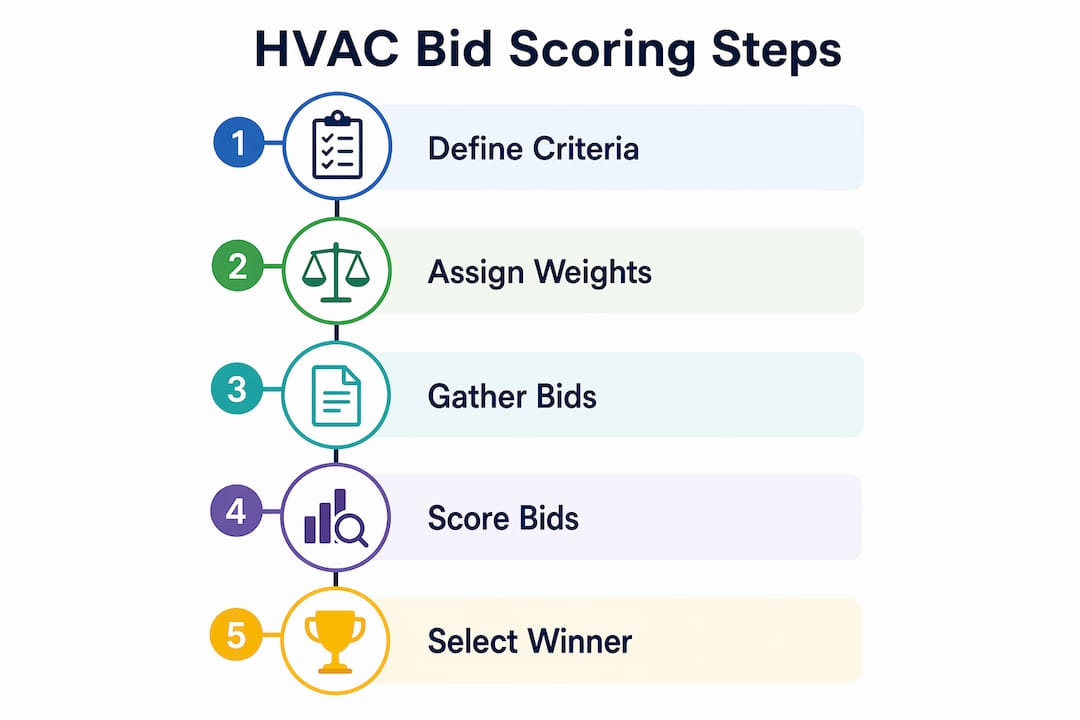
Assign weights to each dimension so price isn’t the only driver. A reasonable starting split for commercial projects: equipment quality and efficiency (35%), scope completeness (25%), warranty and SLA terms (15%), total price (15%), and timeline/contractor availability (10%). A bidder who scores highest on equipment and scope but comes in 8% higher on price may deliver lower total cost of ownership over a ten-year lifecycle.
When bids differ by 25% or more, the gap almost always traces back to missing scope items or different equipment assumptions, not honest pricing differences. Before you assume one contractor is cheaper, confirm they’re quoting the same unit and the same installation scope.
Supporting documents to request before award: proof of equipment purchase commitments for long-lead items, a commissioning report template showing what the startup documentation will look like, and references from at least two properties of similar size and system type.
What negotiation levers actually work for HVAC contracts?
Most contractors have more flexibility than they show in a first proposal. The key is knowing which levers move price without cutting into the quality or reliability of the installed system.
Levers that reduce price without sacrificing quality
- Shoulder-season scheduling. Spring and fall installs typically yield discounts of roughly 5–15% because contractors have more crew availability and less emergency demand.
- Portfolio or volume buys. If you manage multiple buildings, bundling replacements across properties gives a contractor predictable revenue and justifies lower per-unit pricing.
- Multi-year service commitments. Offering a two- or three-year maintenance agreement alongside an installation contract is one of the most reliable ways to get a lower installed price. Contractors price uncertainty into bids; a guaranteed service relationship removes some of that uncertainty.
- Prioritized scheduling. Offering to be a “fill-in” job during slow periods in exchange for a discount works well for non-emergency replacements.
- Payment-term flexibility. A larger upfront deposit (within reason) can reduce contractor financing costs and translate to a lower total price. Explore HVAC financing options if you need to preserve cash while still offering favorable payment terms.
Non-price concessions with real value
Not every concession shows up as a dollar reduction. These add-ons often cost the contractor little but protect you significantly:
- Extended labor warranty (two years instead of one)
- Free first-year annual maintenance visit
- Smart thermostat or controls upgrade included in scope
- Expedited commissioning with a written performance report
- Warranty start date aligned to commissioning completion, not equipment delivery
Tactics for the final negotiation round
Ask for a “best and final” offer in writing after you’ve leveled all bids. For major equipment, request a manufacturer invoice or dealer pricing confirmation so you understand the actual equipment cost versus the markup. Push for line-item discounts on specific scope elements rather than asking for a blunt percentage cut across the board. Contractors can often move on labor rates or disposal fees more easily than on equipment margins.
Pro Tip: Negotiate a parts markup cap and a fixed price per pound for refrigerant before you sign. Open-ended refrigerant pricing is one of the most common sources of surprise invoices during service calls, especially as R-410A phase-out drives up refrigerant costs.
| Concession type | Realistic ask | Contractor flexibility |
|---|---|---|
| Shoulder-season discount | 5–15% off installed price | High — crew utilization benefit |
| Extended labor warranty | +1 year beyond standard | Medium — low incremental cost |
| Free annual maintenance | First year included | Medium — builds service relationship |
| Parts markup cap | 10–25% ceiling | Medium — requires transparency |
| Fixed refrigerant $/lb | Locked rate for contract term | Low-medium — depends on market |
| Smart thermostat upgrade | Included in scope | High — low equipment cost |
Red flags that cost you more over the system’s life
A low bid feels like a win until the system underperforms, the warranty dispute starts, or the contractor disappears after installation. These are the warning signs worth slowing down for.
Contractor red flags
- Bids with no equipment model numbers or vague descriptions like “comparable unit”
- No Manual J load calculation or refusal to provide one
- Contractors who won’t break out labor, equipment, and permits as separate line items
- Missing or expired license and insurance documentation
- Unusually fast promised timelines for equipment that typically has long lead times
A contractor promising immediate delivery on a custom chiller or large air-handling unit is almost certainly planning a substitution. Confirm supplier commitments in writing before you award the work. For a detailed vetting checklist, the HVAC contractor selection guide for Florida covers the specific licensing and insurance requirements that apply locally.
Contract pitfalls to catch before signing
- Vague warranty language (“parts covered as applicable”) with no explicit list of what’s included
- Open-ended exclusions that let the contractor add scope at will
- No commissioning or startup report requirement
- Unlimited parts markup with no ceiling
- Auto-renewal service clauses with no renegotiation window or termination-for-cause right
When a bid is significantly lower than the others, treat it as a question, not a gift. Request a written clarification of every scope item the low bidder excluded, ask for a sample subcontract for any specialty work, and verify that the equipment model matches your specification. A bid that can’t survive that scrutiny is telling you something important about how the project will be managed.
What do the $5,000 rule and the 70/30 rule mean for your project?
Two heuristics come up repeatedly in HVAC procurement conversations. Neither is a hard rule, but both give you a quick gut-check before you go deeper on analysis.
The $5,000 rule
Industry guidance frames a rough threshold: when repair costs on a major component approach or exceed $5,000, replacement often becomes the more financially sound choice, particularly when the unit is past the midpoint of its expected service life. For commercial systems, the math gets more nuanced because downtime costs and energy penalties factor in, but the principle holds. If you’re spending $5,000 to fix a 12-year-old rooftop unit with a 15-year expected life, you’re investing heavily in a depreciating asset.
The 70/30 rule in negotiation
In negotiation contexts, the 70/30 framing refers to bargaining posture: open with a position that leaves roughly 30% room to move toward the other party without giving up your real target. Applied to HVAC procurement, this means your opening counter-offer or “target price” should be set low enough that you can make visible concessions (accepting a slightly longer lead time, agreeing to a larger deposit) while still landing near your actual goal. It’s not about lowballing. It’s about creating space for the contractor to feel they negotiated something too.
Typical cost splits to benchmark against
For packaged rooftop units and split systems in commercial applications, a rough breakdown of installed cost looks like this:
- Equipment: 40–60% of total installed cost
- Labor: 25–35%
- Permits, inspections, and fees: 5–10%
- Overhead and contractor margin: 10–20%
HVAC systems typically account for 15–20% of commercial construction budgets, which means the category is large enough to warrant serious procurement attention. Shoulder-season scheduling can reduce installed cost by roughly 5–15% compared to peak summer or winter demand periods.
These ranges are national averages. Costs in Southwest Florida reflect local labor markets, permitting timelines, and the specific demands of a high-humidity, high-cooling-load climate. Always benchmark against local comparables when evaluating bids.
What contract clauses protect building owners from surprise costs?
The contract is where negotiation outcomes become enforceable. A verbal agreement about warranty terms or response times is worth nothing when a system fails at 2 AM on a Friday in August.
Essential clauses to negotiate before signing
- Detailed line-item scope. Every included and excluded item in writing, with model numbers for major equipment.
- Parts markup cap. A ceiling of 10–25% above dealer net, with a requirement that the contractor provide invoice copies for major components.
- Explicit parts and labor coverage. Define what “covered” means: which components, which failure modes, and whether labor for covered repairs is included.
- Response time SLAs. Specify measurable times: for example, two hours for critical system failures, four hours for non-critical. Vague language like “prompt service” is unenforceable.
- Commissioning and acceptance criteria. Define what a passing startup looks like (airflow measurements, refrigerant charge verification, controls integration) and tie final payment to a signed commissioning report.
- Warranty start date. The warranty clock should start on the date of successful commissioning, not the date of equipment delivery or installation.
Commercial terms worth pushing for
Negotiate an annual escalation cap tied to CPI or a fixed percentage so your maintenance contract doesn’t balloon after year one. Include a refrigerant pricing cap or fixed $/lb clause for the contract term. Add an early termination for cause right so you’re not locked in if service quality drops. Define a change-order approval workflow with not-to-exceed pricing so scope additions require your written sign-off before work begins.
Documentation and data rights
Commissioning reports, diagnostic logs, and maintenance records belong to the building owner, not the service provider. Specify this in the contract. If you ever change contractors, you need that data to brief the next vendor and avoid paying for duplicate diagnostics.
Payment schedule and holdback
Structure payments to milestone events: a deposit at contract signing, a progress payment at equipment delivery, and a final payment only after successful commissioning and warranty registration confirmation. Withhold 10–15% until those conditions are met.
Pro Tip: Negotiate a specific, enforceable remedy for repeated SLA misses rather than relying on “prompt service” language. A credit against the next service invoice for each missed response window gives the contractor a real financial incentive to show up on time. Subjective language gives you nothing to enforce.
For a deeper look at what warranty terms should cover and how to read the fine print, the HVAC warranty guide breaks down manufacturer versus installer coverage and what to insist on before signing.
How do property managers consistently get better HVAC pricing?
The property managers who consistently pay less for better HVAC outcomes don’t do it by being aggressive in one-off negotiations. They build procurement systems that make contractors want to compete for their business.
Step 1: Standardize before you solicit
Write a baseline scope package and RFP template before you contact a single contractor. Define equipment minimums, required services, documentation deliverables, and contract terms you won’t waive. When every bidder works from the same document, bid variance drops and your comparison work becomes straightforward.
Step 2: Make your procurement predictable
Contractors price uncertainty. A property manager who can say “we have three rooftop units scheduled for replacement this fall and two more next spring” is a more attractive customer than one who calls with an emergency. Predictable scheduling lets contractors plan crew and equipment procurement, and they pass some of that savings back to you.

Step 3: Use competitive leverage deliberately
Collect three to four detailed bids, run a formal best-and-final round, and use a scoring matrix that weights lifecycle value, not just upfront price. Volume guarantees, off-peak installs, and multi-year commitments yield deeper and more sustainable pricing concessions than one-time price pressure.
Step 4: Reduce contractor risk with better asset data
Provide a complete asset list: unit ages, tonnage, serial numbers, runtime hours, and any known issues. Contractors price uncertainty into bids. When you remove the unknowns, the risk premium shrinks. This is one of the most underused levers in commercial HVAC procurement.
Step 5: Require performance guarantees and data ownership
Insist on commissioning and performance guarantees as contract conditions, not verbal assurances. Require that all diagnostic data, maintenance logs, and commissioning reports remain your property. If you’re considering building-envelope improvements alongside the HVAC project, new interior doors and insulation upgrades can reduce the required system tonnage and lower equipment cost, which is worth modeling before you finalize your equipment specification.
What should you actually say when negotiating HVAC pricing?
Knowing what to ask for is half the battle. Having the right language ready makes the conversation faster and keeps the relationship intact.
Email templates you can use today
A. Requesting a line-item quote
B. Asking for a best-and-final offer
C. Proposing a lead-time trade-off
D. Requesting a fixed parts markup
Phone and on-site negotiation phrases
- “We’re close on price, but we need the labor warranty extended to two years to move forward. Is that something you can include?”
- “The commissioning report is a requirement for us, not an option. Can you confirm that’s included in your scope?”
- “We have two other proposals in the same range. What can you do on the refrigerant pricing clause?”
- “We’re ready to sign this week if we can align on the response time SLA. What’s realistic for your team?”
Follow-up checklist after verbal agreement
- Confirm equipment model numbers match the agreed specification in writing
- Request written warranty registration confirmation before final payment
- Confirm commissioning date and report delivery timeline
- Get the change-order approval process in writing before work starts
Pro Tip: When asking for non-monetary concessions like an extended labor warranty or a free maintenance visit, frame it as a relationship investment rather than a cost reduction. “We want to build a long-term relationship with one contractor, and including the first-year maintenance visit would help us get there” lands differently than “Can you throw in free maintenance?” The first framing gives the contractor a reason to say yes.
Key Takeaways
Effective building HVAC upgrade negotiation combines bid-leveling discipline, targeted leverage, and enforceable contract protections to lower upfront cost without compromising system reliability.
| Point | Details |
|---|---|
| Level bids before negotiating price | Bids differing by 25% or more almost always reflect scope gaps, not honest pricing differences. |
| Timing and bundling move the number | Shoulder-season scheduling yields discounts compared to peak demand periods; multi-year commitments often produce deeper, more sustainable savings. |
| Contract clauses are the real protection | Parts markup caps, commissioning requirements, SLA response times, and warranty start dates should be clearly documented before you sign. |
| Asset data reduces your cost | A complete asset list (ages, tonnage, serial numbers) removes contractor uncertainty and lowers the risk premium baked into bids. |
| Ultraairswfl provides line-item bids | Ultra Air Heating & Cooling delivers itemized proposals, committed lead times, and commissioning documentation for Southwest Florida building owners. |
Your one-week action plan:
- Day 1: Assemble your asset list (unit ages, tonnage, serial numbers, runtime data) and write your baseline scope document.
- Days 2–3: Solicit three to four detailed bids using your RFP template; require line-item breakdowns and model numbers from every bidder.
- Day 4: Run bid-leveling. Map each proposal to your baseline, log exclusions, and request add-on pricing for any missing items.
- Days 5–7: Negotiate. Request best-and-final offers from your top two bidders, push for the contract clauses that matter most (markup cap, SLA, commissioning requirement), and confirm warranty terms before signing.
Top three contract clauses to get in writing before final payment:
- Commissioning acceptance criteria tied to final payment release
- Parts markup cap with invoice transparency for major components
- SLA response times with an enforceable remedy for repeated misses
A vendor-aware view on HVAC negotiation
Most negotiation advice treats contractors as adversaries. That framing is both inaccurate and counterproductive, especially for building owners who need a reliable service partner for the next decade.
Contractors price risk. When a building owner shows up with a vague scope, no asset data, and a tight timeline, the contractor has no choice but to pad the bid. They don’t know what they’ll find when they open the walls. They don’t know if the electrical panel can handle the new load. They don’t know if you’ll approve change orders quickly or fight every one. That uncertainty has a dollar value, and it shows up in the proposal.
The most effective negotiation posture isn’t aggressive. It’s prepared. A building owner who arrives with a complete asset list, a written scope, a realistic timeline, and a track record of paying on time is a customer contractors compete for. That competition is what produces real price movement, not a confrontational “beat your price or we walk” approach.
What’s reasonable to push for: markup caps, extended labor warranties, commissioning requirements, SLA response times, and data ownership. These cost the contractor relatively little and protect you significantly. What’s not reasonable: demanding rock-bottom pricing on a complex rooftop replacement with a two-week timeline during peak summer. That’s how you get a contractor who cuts corners on commissioning because they’re losing money on the job.
Ultra Air Heating & Cooling operates exactly the way a good long-term partner should: transparent bids, documented commissioning, and service terms that protect the building owner rather than the contractor. For Southwest Florida building owners, that kind of local accountability shortens timelines and reduces the change-order surprises that inflate project costs. You can upgrade your HVAC system with a contractor who treats the commissioning report as a deliverable, not an afterthought.
Ultra Air Heating & Cooling: line-item bids, committed timelines, and owner-first contracts
For building owners in Naples, Cape Coral, and Fort Myers, the gap between a good HVAC upgrade and an expensive one often comes down to who you hire and what their contract actually says. Ultra Air Heating & Cooling provides commercial HVAC installations, commissioning, maintenance contracts, and flexible financing built around the way property managers actually make decisions.
Every proposal from Ultraairswfl includes a line-item breakdown with equipment model numbers, explicit scope inclusions and exclusions, committed lead times, and commissioning documentation as a standard deliverable, not an upsell. Service agreements include measurable SLA response times and parts markup caps so your maintenance budget stays predictable. Local knowledge of Southwest Florida permitting timelines, utility rebate programs, and high-humidity equipment requirements means fewer change orders and faster project completion.
If you’re ready to request a bid or schedule a site visit, contact Ultra Air Heating & Cooling to get a line-item proposal for your building.
Useful sources and references
- Construction Bid Leveling (Procore Library) — Practical guidance on standardizing scope definitions to reduce bid variance.
- How FMs Can Compare HVAC Replacement Bids Before Award (IFMA Knowledge Library) — Facility manager’s framework for evaluating scope, exclusions, controls, startup, and warranty terms before award.
- HVAC Bid Comparison Guide (EstimateHawk) — Explains why bids vary and what to check beyond the bottom line.
- How to Negotiate HVAC Installation Prices (HVACDatabase) — Practical tactics including timing, rebates, and concession strategies.
- Commercial HVAC Contracts: What to Include and How to Negotiate (iFactory) — Ten contract terms to negotiate, including markup caps, escalation clauses, and documentation rights.
- Commercial HVAC Service Contract: What to Look For (White Scarver Engineering) — Engineering perspective on SLAs, exclusions, and response-time language.
- 5 Tips for Negotiating HVAC Vendor Costs (Switch Solutions) — Volume, consolidation, and multi-year commitment strategies.
- Commercial HVAC Installation Timeline Explained (Promote Project) — Shoulder-season scheduling and lead-time impacts on installed cost.
- Understanding the $5,000 AC Rule — Industry framing for the repair-versus-replace decision threshold.
- Ultra Air Heating & Cooling — Southwest Florida HVAC installation, maintenance, and commercial services.