

Southwest Florida’s summer is not just hot, it’s relentlessly hot and humid from May through October, with temperatures regularly hitting the low 90s and humidity that makes it feel closer to 100°F. Choosing the wrong AC unit for a Naples, Cape Coral, or Fort Myers home doesn’t just mean mild discomfort. It means skyrocketing electric bills, poor humidity control, and a system that fails early under the load. Many homeowners focus only on price or brand name, completely overlooking how different unit types handle humidity, efficiency, and long-term operating costs in this climate specifically.
Table of Contents
- How to choose the best air conditioning unit for Southwest Florida
- Central air conditioners: Whole-home cooling and best practices
- Window and portable AC units: Affordable cooling options
- Geothermal and specialty systems: Efficiency leaders with higher upfront costs
- What to avoid: Evaporative coolers and common missteps in Florida
- Head-to-head comparison: Which AC unit is right for you?
- Why smart AC choices matter more than ever in Southwest Florida
- Upgrade your comfort: Pro AC guidance and installation
- Frequently asked questions
Key Takeaways
| Point | Details |
|---|---|
| Match AC type to your space | Whole-home central AC is best for most Florida homes, while window or portable units suit single rooms. |
| Prioritize efficiency ratings | Choose units with higher SEER2 or EER for major energy savings in Southwest Florida. |
| Humidity control is crucial | Only vapor-compression (not evaporative) units handle Florida’s high humidity effectively. |
| Premium features pay off | Inverter and variable-speed ACs improve comfort and lower costs—especially in hot, humid climates. |
How to choose the best air conditioning unit for Southwest Florida
Before comparing individual AC types, it helps to know the criteria that actually matter here. Southwest Florida is not Phoenix, where dry heat dominates. Here, your AC must work constantly and pull moisture out of the air all day long.
Here are the key factors to weigh when selecting a unit:
- Climate demand: Cooling needs in Naples and Fort Myers run roughly 8 to 9 months per year, far above the national average.
- Humidity control: A unit that cools but doesn’t dehumidify properly creates mold risks and that “sticky” feeling even at 75°F.
- Efficiency rating (SEER2 and EER): SEER2 (Seasonal Energy Efficiency Ratio 2) measures seasonal efficiency; EER measures peak-load efficiency. The SEER2 minimums for southern regions like Florida are 14.3 to 15 for central AC, but higher SEER2 models in the 16 to 20+ range are strongly recommended for the heat and humidity here.
- Installation cost vs. long-term savings: A cheaper unit with a low SEER2 can cost hundreds more per year in electricity, which adds up fast.
- Space and property type: A single room, a 2,500-square-foot home, and a commercial office building each require a different approach.
Pro Tip: Look for ENERGY STAR certified models with SEER2 ratings of 16 or higher. In Southwest Florida’s climate, the extra upfront cost pays back faster than almost anywhere else in the country because your system runs so many more hours per year. You can also explore the system options for Florida to understand what fits your specific property layout before making any purchase.
Central air conditioners: Whole-home cooling and best practices
Central air conditioning remains the most popular and practical solution for whole-home cooling in Southwest Florida, and for good reason. These systems are designed to handle the continuous load that Florida weather demands.
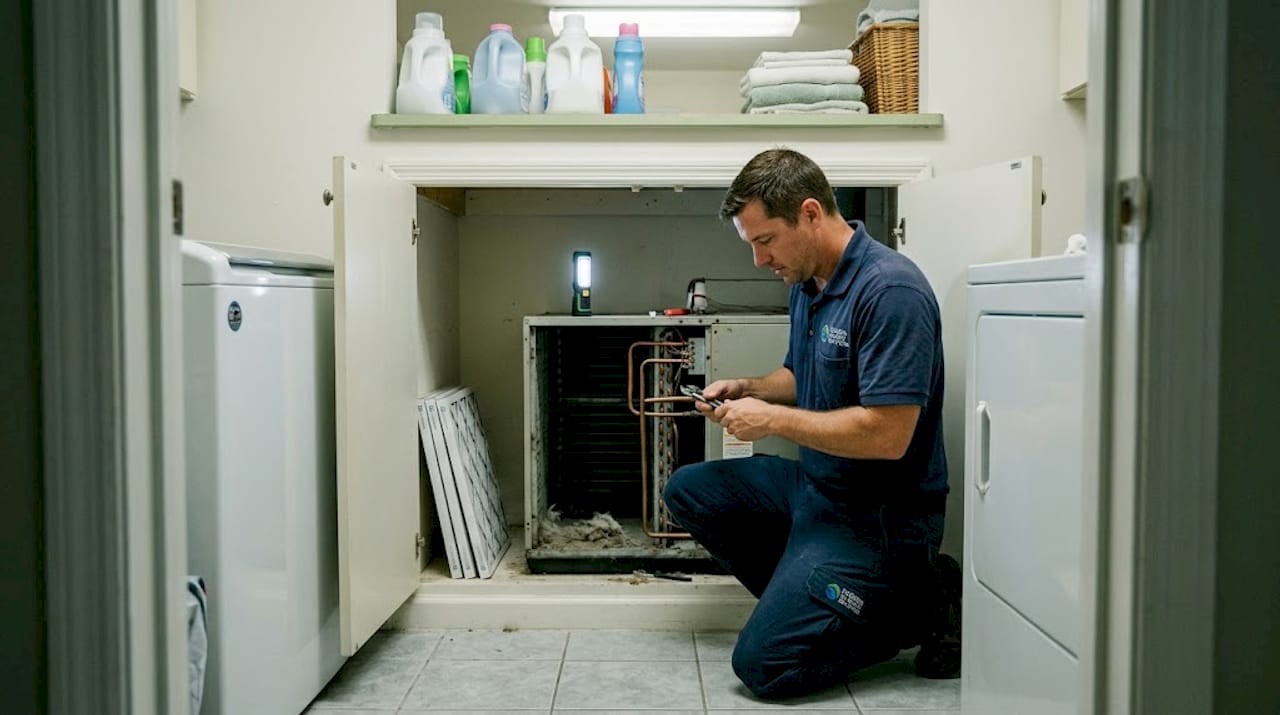
A central air conditioner is a split system with an outdoor compressor and condenser unit paired with an indoor evaporator coil, all connected through ductwork that distributes cooled air throughout your home. The system draws warm air from each room, passes it over the cold evaporator coil, strips out heat and humidity, and pushes conditioned air back through your vents.
Core features of central AC systems:
- Cools the entire home from a single system
- Removes large volumes of moisture with every cycle
- Offers zoning capabilities with multi-stage or variable-speed units
- Integrates with smart thermostats for precise scheduling
- Provides consistent airflow that reduces hot spots and stuffiness
Advantages:
- Best humidity control of any residential AC type
- Long service life of 15 to 20 years with proper maintenance
- High-efficiency models qualify for AC tax credits in 2026
Drawbacks:
- Requires existing ductwork or costly installation of new ducts
- Higher upfront installation cost than room units
- Efficiency losses if ductwork is old, leaky, or poorly insulated
The SEER2 minimum for central AC in southern Florida sits at 14.3 to 15, but the real sweet spot for Southwest Florida homeowners is 18 to 20+. At those ratings, you’re genuinely cutting your cooling costs while keeping indoor humidity in the ideal 40 to 50 percent range. Learn more about how these units affect AC comfort and energy use when sized and set up correctly.
Pro Tip: If you’re upgrading a central AC system, ask specifically about inverter or variable-speed compressor models. Traditional single-stage compressors slam on at full power and shut off quickly. Variable-speed units run at lower speeds for longer cycles, which removes far more moisture from the air. In a Florida home, that difference in humidity control is noticeable every single day.
Window and portable AC units: Affordable cooling options
If you need cost-effective cooling for a single room, garage apartment, sunroom, or a temporary fix while your central unit is being repaired, window and portable ACs step in as practical options.
Window air conditioners are self-contained units installed directly into a window opening, cooling a single room efficiently at a fraction of the cost of central AC installation. They’re relatively easy to install, widely available, and come in sizes from 5,000 to 25,000 BTUs to match different room sizes.
Portable ACs offer mobility: you roll them from room to room and vent the exhaust through a window kit. However, single-hose portable units consume 20 to 30 percent more energy than equivalent window units because they depressurize the room, drawing warm air in from outside. If you go the portable route, choose a dual-hose model that pulls intake air from outside and exhausts heat separately.
| AC type | Typical cost | Approx. EER | Best use |
|---|---|---|---|
| Window unit | $150 to $700 | 10 to 12 | Single rooms, add-on spaces |
| Single-hose portable | $200 to $600 | 7 to 9 | Temporary, very limited use |
| Dual-hose portable | $300 to $800 | 9 to 11 | Supplemental, room-to-room |
Practical limitations to keep in mind:
- Neither type is designed for whole-home or multi-room cooling
- Window units require a suitable window opening and may conflict with security
- Portable units take up floor space and need regular water drainage in humid climates
- Both are short-term or supplemental solutions, not permanent replacements for central AC
Pro Tip: A window unit is a smart backup to have during a central AC repair waiting period in July or August. The cost is minimal compared to the discomfort and health risks of a hot, humid home in Southwest Florida. For more ideas on keeping costs down, check out these AC tips for savings.
Geothermal and specialty systems: Efficiency leaders with higher upfront costs
For homeowners building new or undertaking a major renovation, geothermal heat pumps represent the pinnacle of cooling efficiency. They’re worth understanding even if they’re not right for every situation.
Geothermal heat pumps use underground loop systems to exchange heat with the earth rather than the outdoor air. Because ground temperatures in Florida stay relatively constant at around 70 to 75°F year-round, the system works with a much smaller temperature differential than air-source units, driving efficiencies that are simply unmatched by conventional cooling.
Key advantages of geothermal systems:
- Efficiency ratings can reach EER 20 to 40+, far above any air-cooled unit
- Significantly lower monthly electric bills once installed
- Excellent humidity control since the system runs at lower, steadier speeds
- Very long equipment life, with ground loops lasting 50 or more years
Where geothermal falls short for many property owners:
- Upfront installation costs range from $15,000 to $30,000 or more depending on lot size and loop type
- Requires sufficient land or a deep well for the ground loop installation
- Retrofit into an existing home with a small lot can be difficult or impossible
- Permit and soil assessment requirements add time to the process
“Geothermal heat pumps achieve the highest efficiency available in residential cooling, but the payback period depends heavily on current electric rates, system size, and how many hours per year the system runs.” Consumer Reports, Central Air Conditioning Buying Guide
For energy-efficient cooling solutions in Southwest Florida, geothermal makes the strongest financial case for new construction where the loop can be installed at the same time as other site work, reducing labor overlap costs significantly.
What to avoid: Evaporative coolers and common missteps in Florida
Some cooling technologies work brilliantly in dry climates but become completely useless or even counterproductive in Southwest Florida’s humidity. The most important one to know about is the evaporative cooler, also called a swamp cooler.
Evaporative coolers work by passing warm, dry air over water-saturated pads, causing the water to evaporate and cool the air. The problem is that this process adds moisture to the air. In a climate where your outdoor humidity already sits at 80 to 90 percent most of the summer, adding more moisture makes your space feel worse, not better.
“In humid climates like Southwest Florida, evaporative coolers are ineffective and counterproductive. Vapor-compression systems are the only type that both cool and dehumidify air effectively.” The Spruce, How Types of Air Conditioning Systems Work
Vapor-compression systems work by mechanically removing heat and wringing moisture out of the air as a core function. Every AC type covered in this guide except evaporative coolers operates on vapor-compression, which is why they all work here while swamp coolers don’t.
Warning signs that you’re making a costly mistake:
- Buying an undersized unit to save money upfront (it will run constantly and still fail to dehumidify)
- Choosing the lowest SEER2 unit available when Florida’s run hours make efficiency critical
- Installing a window or portable unit as a permanent whole-home solution
- Skipping a load calculation and guessing at the right unit size
Keeping up with Florida HVAC efficiency trends can also help you avoid making decisions based on outdated information about unit types and ratings.
Head-to-head comparison: Which AC unit is right for you?
Here’s a clear comparison of the main AC unit types available to Southwest Florida homeowners and property managers.
| AC type | Upfront cost | SEER2/EER range | Humidity control | Best suited for |
|---|---|---|---|---|
| Central AC (split system) | $4,000 to $12,000+ | SEER2 14.3 to 22+ | Excellent | Whole homes, consistent comfort |
| Window unit | $150 to $700 | EER 10 to 12 | Moderate | Single rooms, guest quarters |
| Portable AC (dual-hose) | $300 to $800 | EER 9 to 11 | Limited | Temporary/supplemental use |
| Ductless mini-split | $2,500 to $8,000 | SEER2 18 to 25+ | Very good | Additions, commercial spaces |
| Geothermal heat pump | $15,000 to $30,000+ | EER 20 to 40+ | Excellent | New construction, premium builds |
| Evaporative cooler | $100 to $500 | N/A | None | Not suitable for Florida |
Now match your situation to the right choice:
- Single room or garage apartment: Window unit or dual-hose portable. Size by BTU to the room square footage.
- Whole home under 2,500 sq ft: High-efficiency central AC with variable-speed, SEER2 18+.
- Large home or estate over 3,000 sq ft: Central AC with zoning, or central AC plus ductless mini-splits for wings or additions.
- Commercial office or retail space: Commercial-grade central system or multi-zone ductless, sized by a professional load calculation.
- New construction: Evaluate geothermal seriously, or install the highest-SEER2 central system your budget allows.
- Historic home without ductwork: Ductless mini-split is usually the cleanest, most efficient solution.
Check out the sizing guide for AC units to make sure whatever type you choose is properly matched to your home’s square footage and insulation level.
Why smart AC choices matter more than ever in Southwest Florida
We’ve seen firsthand what happens when homeowners treat an AC purchase as a commodity decision, picking the cheapest option or whatever is in stock. In Southwest Florida, the consequences show up fast. A low-efficiency, single-stage central AC running 3,000 or more hours per year costs dramatically more to operate than a high-efficiency inverter model. That cost difference can easily exceed $500 to $1,000 annually in this climate.
The piece most buyers miss is the humidity factor. A system that cools quickly but short-cycles, meaning it turns on and off rapidly without running long enough to pull moisture out, leaves your home at 72°F but 65 percent relative humidity. That’s the condition that breeds mold, warps wood floors, and makes your space feel uncomfortable despite a “comfortable” thermostat reading.
Inverter and variable-speed technology in premium AC units reduces cycling, dramatically improves humidity control, and typically pays back in 3 to 5 years in hot climates like ours. In Southwest Florida, 3 years is a realistic payback window for many households because of how many hours the system operates.
Our perspective is this: the total cost of ownership, meaning purchase price plus operating costs over 10 to 15 years, almost always favors the higher-efficiency unit in this region. A $1,500 difference at installation may save you $8,000 or more over the life of the system. That’s not a luxury decision. It’s the financially sound one. Staying current with future Florida HVAC trends also matters, since efficiency standards and available technology continue improving every year.
Upgrade your comfort: Pro AC guidance and installation
Selecting the right air conditioning unit is only half the equation. Proper sizing, installation, and setup determine whether that unit delivers on its efficiency and comfort promises or falls short from day one.
At Ultra Air Heating & Cooling, we work with homeowners and commercial property owners across Naples, Cape Coral, and Fort Myers to match the right system to their specific needs. Our team handles everything from professional load calculations and equipment selection to full AC installation and ongoing maintenance. We don’t recommend a unit based on what’s easiest to sell. We recommend what genuinely fits your home, budget, and comfort goals. Ready to find your best match? Start by exploring the best-fit HVAC systems available for Florida homes or contact us directly to schedule a free consultation.
Frequently asked questions
What is the most energy-efficient air conditioning unit for Florida homes?
Geothermal heat pumps offer the highest efficiency overall, but high-SEER2 central ACs with inverter technology are the most practical blend of efficiency and cost for most Florida homeowners.
Can evaporative (swamp) coolers work in Southwest Florida?
No. Evaporative coolers are ineffective in humid climates and actually add moisture to the air, making conditions worse in Southwest Florida.
How do SEER and EER ratings affect my AC costs?
Higher ratings directly reduce your operating costs. The SEER2 minimum for Florida is 14.3 to 15, but models rated 18 to 20+ cut costs significantly in a climate where the AC runs most of the year.
What AC unit type is best for a single room or add-on garage apartment?
Window air conditioners are the most efficient choice for single rooms; if you need mobility, choose a dual-hose portable and avoid single-hose models, which waste 20 to 30 percent more energy.
Does premium variable-speed AC make a big difference in Florida?
Yes, significantly. Variable-speed inverter technology reduces cycling, improves humidity control, and typically pays back its premium cost within 3 to 5 years in Florida’s demanding climate.
Recommended
- Types of HVAC Systems: Best Fit for Florida Homes
- Air Conditioner Installation Near Me: The 2026 SWFL Homeowner’s Guide – Ultra Air Heating and Cooling
- Ultra Air Heating and Cooling Strategies for Growth in Southwest Florida – Ultra Air Heating and Cooling
- Commercial AC Setup: Step-by-Step Guide for SWFL Owners