You survived the 100-mph winds and the torrential downpour, but as the clouds clear over Lee County, you’re facing a new emergency: a silent thermostat. We know that feeling of dread when your AC unit not turning on after storm Cape Coral conditions hit, especially when the indoor humidity starts climbing past 60% within the first hour. It’s natural to worry about expensive compressor failures or whether your homeowner’s insurance will actually cover the damage after a major SWFL weather event.
As a family owned and operated team, we believe you deserve peace of mind and a fast return to your Ultra comfort. This 2026 recovery checklist provides a step-by-step path to safely troubleshoot your system and identify when you truly need a professional technician. We will walk you through five critical safety checks, from breaker resets to identifying surge protector failures, so you can beat the heat and get your home back to normal without overpaying for unnecessary repairs.
Key Takeaways
- Learn how to safely verify your power status with LCEC and the “Golden Rule” for handling units near standing water to avoid electrical hazards.
- Follow a 5-point physical inspection guide to assess your system if you find your AC unit not turning on after storm Cape Coral.
- Identify the most common electrical components, like capacitors and contactors, that frequently fail during Southwest Florida lightning strikes and power surges.
- Understand how to document “Evidence Photos” correctly to help insurance adjusters distinguish between an “Act of God” and standard wear and tear.
- Recognize the critical “Red Flag” warning signs that signal it is time to contact Ultra Air for professional 24/7 emergency recovery and peace of mind.
Step 1: The Safety & Power Restoration Checklist
Storms in Southwest Florida move fast, but your recovery must be methodical. If you find your AC unit not turning on after storm Cape Coral conditions have passed, your first priority is physical safety. Before you touch any part of your HVAC system, check the ground. We follow a strict “Golden Rule” regarding standing water: never approach or touch a submerged outdoor condenser. Even if the power seems off, residual electricity or grounded wires can create a lethal environment. If your yard has flooded, wait for the water to recede completely before investigating further.
Once the area is dry, you can begin the process of verifying power. Many homeowners in the Cape experience “ghost” outages where some appliances work while others don’t. This often points to a tripped breaker or a localized grid issue. Restoring your Ultra comfort starts with a calm, step-by-step verification of your home’s electrical health.
Checking Your Thermostat and Main Panel
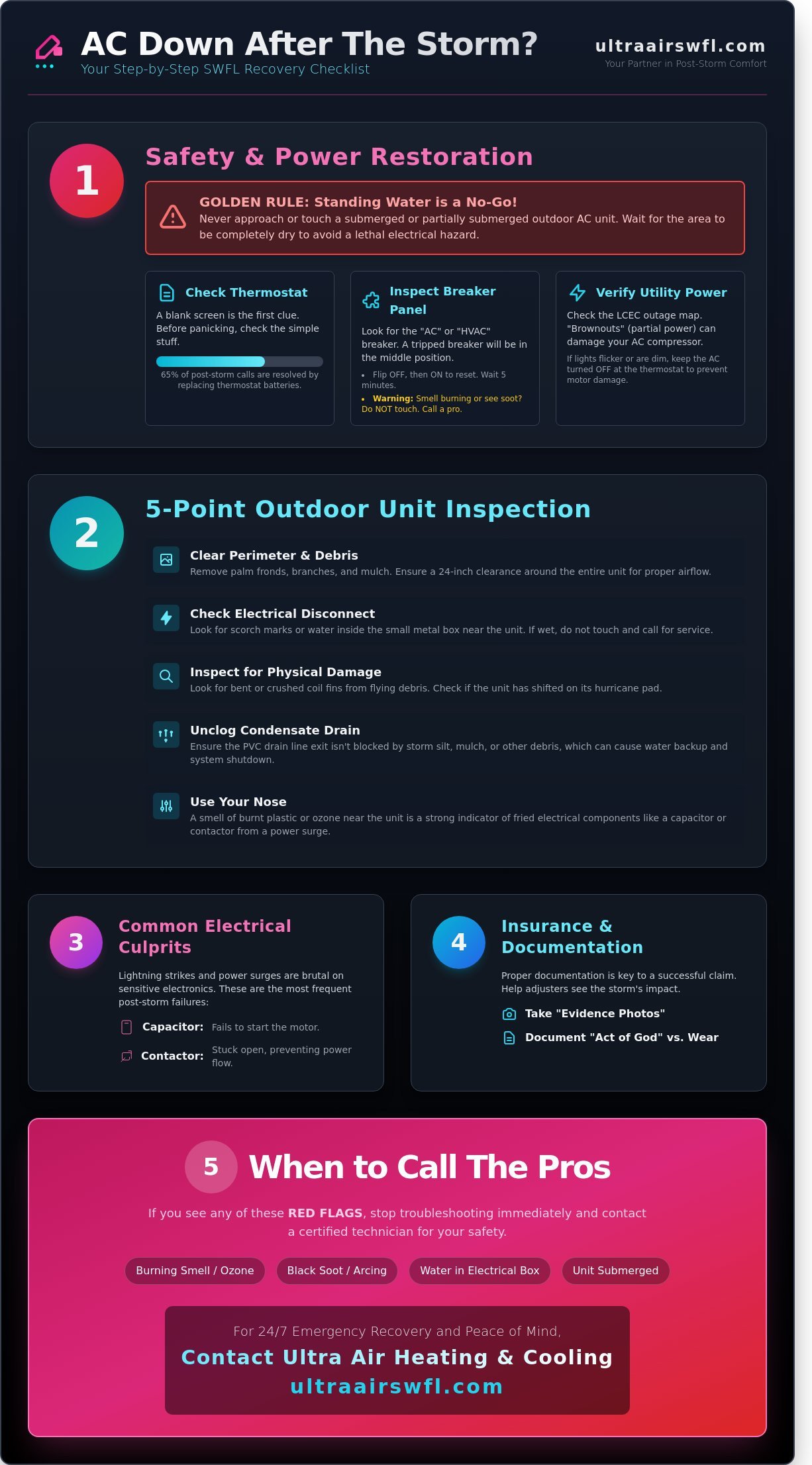
Start at your thermostat. If you see a blank screen, it might not be a system failure. Check the batteries first; 65% of post-storm service calls in Cape Coral are resolved by simply replacing two AA batteries that died during the power flicker. If the batteries are fresh and the screen remains dark, your system likely lost its connection to the main power grid during the peak of the storm.
Head to your indoor electrical panel. Look for the breaker labeled “AC” or “HVAC.” In many Cape Coral homes built before 1980, you might still have a fuse box. A tripped breaker will be stuck in the middle position, while a blown fuse will show a broken metal link or a dark smudge. If you smell a metallic “burning” scent or see black soot marks (arcing) near the switches, do not flip the breaker. This is a clear sign of how power surges damage electronics and requires an expert inspection. If everything looks clean, perform a hard reset by flipping the breaker to “Off” and then back to “On.” You must then follow the 5-minute wait rule. Don’t flip the switch repeatedly. Modern systems have delay timers to protect the compressor from short-cycling.
Verifying Local Utility Restoration
Before you call for a repair, verify your status with the Lee County Electric Cooperative (LCEC). Check the LCEC live outage map to ensure your specific neighborhood has reached 100% voltage restoration. It is common for homes to experience “brownouts” where they receive enough power for lightbulbs but not enough for a heavy-duty AC compressor. Partial power can ‘cook’ a motor if the unit is left on during a brownout. If your lights are dim or flickering, keep your AC turned off at the thermostat. This prevents your motor from trying to start with insufficient voltage, which can lead to permanent internal damage. We recommend waiting until your neighbors’ porch lights are consistently bright before attempting to restart your AC unit not turning on after storm Cape Coral events.
Step 2: The 5-Point Outdoor Unit Physical Inspection
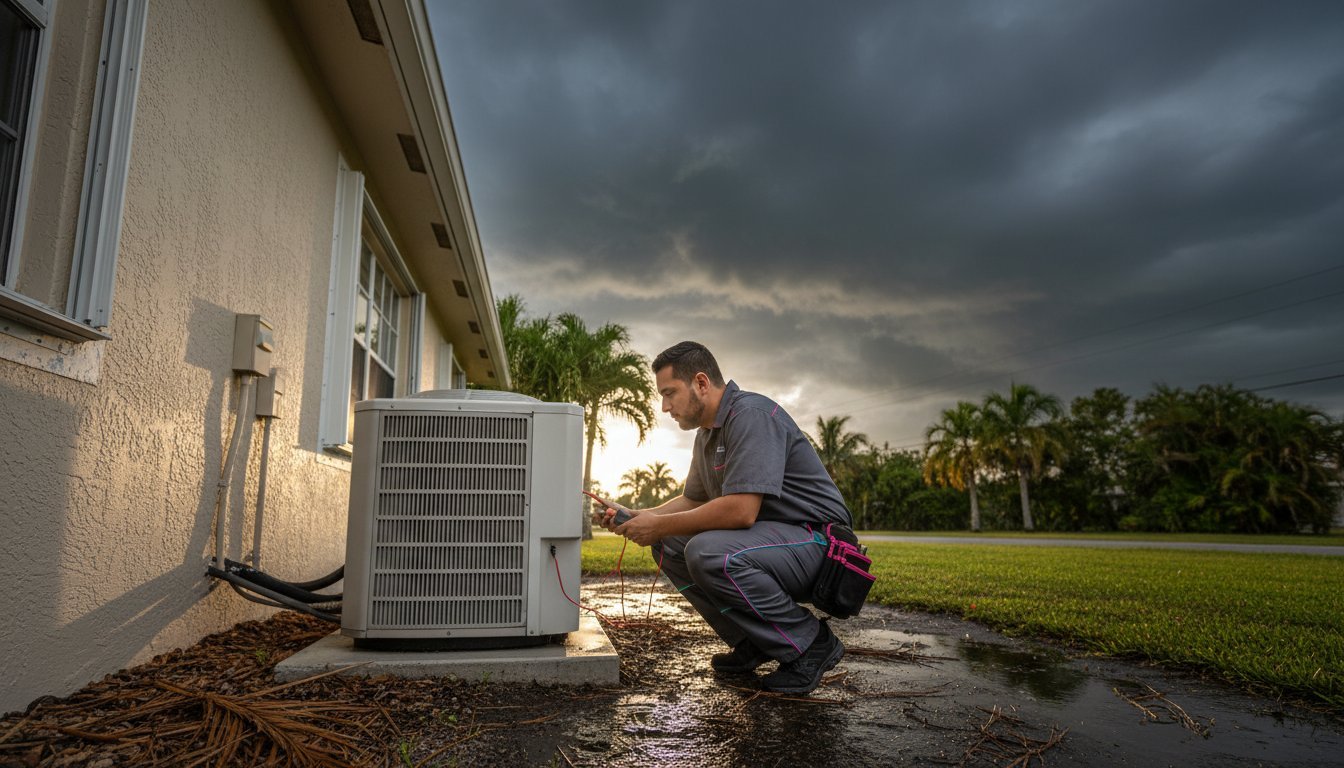
Once it’s safe to venture outside, your outdoor condenser is the first place to investigate if your AC unit not turning on after storm Cape Coral. High winds and flying debris frequently turn a standard backyard into a source of potential equipment failure. Start by clearing away palm fronds, mulch, and branches that have lodged against the condenser fins. These aluminum fins are delicate. Even a small layer of debris can choke the airflow, causing the system to overheat and shut down within minutes of an attempted restart.
Next, check your electrical disconnect box. This is the small metal box mounted on the wall near your unit. Look for scorch marks or evidence of water intrusion. If you see standing water or smell ozone, don’t touch the equipment. Follow the National Weather Service storm safety guidelines to avoid electrical hazards before proceeding with any manual checks. Our technicians often find that a simple blown fuse in this box is the culprit, but water inside the housing requires professional attention to prevent a fire.
- Clear the Perimeter: Maintain a 24-inch clearance around the unit to ensure proper heat exchange.
- Check the Drain: Ensure the condensate drain line exit isn’t buried under new mulch or storm silt.
- Smell for Burned Plastic: This often indicates a fried capacitor or contactor caused by a power surge.
Identifying Visible Exterior Damage
Check the coil fins for ‘shrapnel’ damage. Flying shingles or loose patio furniture can crush these slats. When fins are bent, they block the heat exchange process. You should also inspect the hurricane pad. During 2024 and 2025 storm seasons, we saw many units shift several inches, which can crack the concrete pad or stress the copper refrigerant lines. Listen closely for a hissing sound. This usually indicates a puncture in the line. If you hear it, turn off the power immediately. Losing refrigerant stops the cooling and can quickly burn out your compressor.
Water and Flood Assessment for Cape Coral Homes
Cape Coral’s canal-heavy landscape makes flood assessment vital for your recovery. Use the ‘high water mark’ rule. If you see a line of silt or salt residue halfway up the unit, the electronics were likely submerged. Silt and mud trapped in the base pan are silent killers in our salt-air climate. They trap moisture against the metal, leading to 40% faster corrosion compared to clean units. For a deep system flush and component testing, you can rely on Expert AC Repair in Cape Coral to ensure your system is safe to run. If you’re unsure about the internal state of your unit, it’s always safer to let an Ultra Air expert verify the electrical integrity before you flip the switch.
Step 3: Common Culprits When the AC Won’t Start
Your AC unit not turning on after storm Cape Coral events usually stems from electrical damage rather than mechanical failure. High-voltage spikes from Florida’s 2025 hurricane season showed that even a nearby strike can overwhelm your system’s sensitive electronics. When your home feels like a sauna, identifying these specific failures helps our Ultra Air technicians get your cooling back online fast. We look for these four primary issues during every post-storm inspection.
- The Capacitor: This is the most frequent casualty of SWFL lightning. It acts as a bridge for electrical loads, and a surge often causes it to “pop” or fail instantly.
- Contactor Failure: Surges can cause the silver pads on your contactor to “weld” together or become “pitted.” If they stick, your unit might run non-stop; if they burn out, it won’t start at all.
- Blown Transformers: If your thermostat is blank but your circuit breakers are on, a blown transformer is likely. This component converts high voltage to the low voltage your control board needs.
- Compressor Lock-out: Modern units have a safety “brain” that detects irregular power. It locks the system to prevent the motor from burning out during a brownout.
Lightning Strikes vs. Power Surges
A direct lightning strike is a catastrophic event that physically melts components. However, indirect power surges via the utility grid are more common in Cape Coral. You might notice scorched marks on the control board or “ghost” error codes that appear and disappear. We use specialized multimeters to test for winding resistance. This allows us to determine if your compressor is “grounded,” meaning the internal electrical insulation has failed and the unit is no longer safe to operate. If the resistance readings don’t meet manufacturer specs, the compressor is likely “fried.”
The Role of the Start/Run Capacitor
A capacitor is the battery that gives your AC the kickstart it needs to run. When these fail due to storm stress, they often look “bulging” at the top or leak a thick, oily fluid. You might hear a distinct humming sound coming from the outdoor unit while the house remains hot. This happens because the motor is trying to turn but lacks the electrical “push” to start the fan or compressor. Replacing these proactively during an Ultra Air inspection prevents 85 percent of emergency no-cool calls after a summer storm. It’s a quick fix that restores your Ultra comfort immediately.
Step 4: Insurance and Warranty Documentation Checklist
If you find your AC unit not turning on after storm Cape Coral conditions pass, don’t touch the equipment until you have your phone ready. Documentation is the difference between a covered claim and an out-of-pocket disaster. Start by taking “Evidence Photos” of the unit from every angle. Capture images of standing water, fallen branches, or scorched electrical components before any cleanup begins. This visual proof establishes the state of your property immediately following the event.
Insurance adjusters look for a clear distinction between “Wear and Tear” and an “Act of God.” Most SWFL policies cover storm-related surges, but they won’t pay for a system that failed due to years of neglected maintenance. You must prove the storm was the direct cause. We recommend keeping a digital log of power outages and surges reported by LCEC (Lee County Electric Cooperative). Matching their outage data with the exact time your AC unit not turning on after storm Cape Coral occurred provides the technical “smoking gun” adjusters need.
It’s vital to realize that manufacturer warranties have strict limitations. Brands like Trane or Carrier usually cover factory defects, not environmental damage. Power surges are almost always excluded from standard manufacturer warranties. This makes your homeowner’s insurance documentation even more critical for recovering the costs of expensive parts like compressors or control boards.
Filing a Claim for Storm Damage
Your insurance adjuster isn’t an HVAC expert. They require a professional diagnostic report from a licensed technician to process a claim. This report must explicitly state that the failure resulted from a surge or wind damage. Never throw away damaged parts. If we replace a fried circuit board, keep that part in a box for the adjuster to inspect. Additionally, be aware that Cape Coral building codes in 2026 require permits for system replacements. We handle the permitting process to ensure your new installation meets all local SWFL wind-load requirements.
Protecting Your System for the Next Storm
Ultra Air recommends proactive upgrades to stop the cycle of storm damage. Whole-home surge protectors are the gold standard in Southwest Florida. They mount directly to your electrical panel to block high-voltage spikes before they reach your expensive HVAC equipment. We also install hard start kits. These devices provide your compressor with the necessary torque to start during low-voltage “brownout” conditions that often follow major storms. For more on protecting your investment, see our expert advice on Air Conditioning Maintenance Near Me to schedule your protective upgrades.
Don’t let a storm surge leave you in the heat. Contact Ultra Air now for a professional diagnostic report and Ultra-reliable storm recovery service.
Step 5: When to Call Ultra Air for Emergency Recovery
Sometimes, a simple breaker flip isn’t enough. If you’ve followed the basic reset steps and your system remains silent, you’ve reached the limit of safe DIY troubleshooting. Cape Coral storms carry high winds and heavy surges that cause internal damage invisible to the naked eye. Pushing a compromised system to start can lead to a total compressor failure or an electrical fire. Safety must be your first priority.
Look for these “Red Flags” that require immediate professional intervention:
- Burning odors or ozone smells coming from the vents or the outdoor unit.
- Rapid clicking or loud humming sounds when the thermostat calls for cooling.
- Standing water or heavy debris packed deep inside the condenser fins.
- Visible scorch marks on the electrical disconnect box or wiring.
We understand the urgency of a humid Florida home. As a family-owned and operated business, Ultra Air treats your emergency like our own. Our 24/7 response teams prioritize Cape Coral and surrounding SWFL neighborhoods to ensure your family stays safe. We don’t just fix units; we restore comfort to our neighbors.
Our Post-Storm Restoration Process
An “Ultra Diagnostic” visit goes beyond a simple repair. Our technicians follow a rigorous protocol to ensure your system survives the next 10 years, not just the next 10 minutes. We verify electrical integrity from the thermostat to the condenser, checking for voltage drops that indicate wire degradation. We also conduct refrigerant pressure testing. High-velocity winds cause vibrations that lead to micro-fractures in copper lines. Every visit includes the Ultra Guarantee, giving you peace of mind that your equipment is 100% safe to operate. We’ve served the local community through every major weather event, providing technical mastery when you need it most.
Schedule Your Emergency Repair Now
Don’t wait in the heat. When an AC unit not turning on after storm Cape Coral becomes a reality, our priority scheduling system puts local residents at the front of the line. We pride ourselves on honest, no-pressure assessments. If a simple component failed, we fix it; we don’t use a storm as an excuse to sell you a new system you don’t need. You get direct answers and efficient service from neighbors who know the SWFL climate. Contact Ultra Air for Emergency AC Repair and beat the Florida heat today.
Restore Your SWFL Comfort Today
Dealing with a storm’s aftermath is stressful enough without the Florida heat moving into your living room. By following this 2026 recovery checklist, you’ve already taken the right steps to identify power issues and document damage for your insurance provider. Even a minor electrical surge can cause hidden failures that aren’t visible to the naked eye. If your initial checks didn’t solve the problem, don’t risk your system’s lifespan by forcing it to start. An AC unit not turning on after storm Cape Coral residents experience often needs a professional diagnostic to ensure the compressor and electrical components are safe for operation.
Ultra Air is ready to help you beat the heat with the local expertise you deserve. As a family-owned and operated business, we prioritize your safety and home comfort above all else. We provide 24/7 emergency service across Lee County and remain fully licensed and insured for complex storm recovery work. We’ll handle the technical repairs and provide the specific documentation you need for warranty or insurance claims. You don’t have to navigate the humidity alone.
Get Your AC Back Online – Schedule Emergency Repair with Ultra Air
Stay safe and trust that your local experts are ready to bring the cool air back to your home immediately.
Cape Coral Post-Storm HVAC FAQs
Is it safe to turn on my AC immediately after a storm?
No, you shouldn’t restore power until you’ve performed a visual inspection of the outdoor condenser. Check for standing water, downed power lines, or debris like palm fronds lodged inside the fan blades. Powering up a unit with a blocked fan can burn out the motor in less than 60 seconds. If the area around the unit flooded during the storm, wait for a professional to clear the electrical components to avoid a short circuit.
Why does my AC breaker keep tripping after the power came back on?
Your breaker trips because it’s protecting the system from an electrical overload or a grounded compressor. High voltage spikes often occur when LCEC or Florida Power & Light restores the grid after a blackout. If your AC unit not turning on after storm Cape Coral events involves a breaker that flips back instantly, don’t force it. This typically indicates a damaged capacitor or a lightning-induced short that requires an Ultra service technician to resolve safely.
Can a lightning strike miles away still damage my AC unit in Cape Coral?
Yes, a lightning strike within a 2 mile radius can send a massive surge through underground utility lines directly into your home. Sensitive control boards in modern high efficiency systems are particularly vulnerable to these indirect hits. Data from 2024 regional insurance claims shows that nearly 30 percent of HVAC electronic failures in SWFL are caused by surges from distant strikes rather than direct hits to the property.
Will my homeowners insurance cover an AC unit damaged by a storm surge?
Standard homeowners insurance policies generally cover wind or lightning damage but exclude losses caused by rising floodwaters. You usually need a separate flood insurance policy through the NFIP to cover an outdoor unit submerged by a storm surge. Review your 2026 policy declarations page to see if you have an “Equipment Breakdown” endorsement. This specific add-on often covers mechanical failures that occur after a power surge once your deductible is met.
What is the ‘burning smell’ coming from my vents after the storm?
A burning smell usually signals that the blower motor is seized or electrical wiring has shorted out due to moisture. Storm-driven rain can penetrate the internal housing and cause corrosion on the wire nuts or the circuit board. If you smell ozone or burning plastic, shut the system off at the thermostat and the breaker immediately. Running a damaged system can lead to an electrical fire within your ductwork.
How long can a typical AC unit stay submerged in water before it’s ruined?
Any amount of time submerged in salt or brackish water can cause permanent damage to your system’s copper coils and aluminum fins. While a unit might survive 24 hours of fresh water exposure if dried properly, Cape Coral’s coastal location means floodwater often contains salt that accelerates corrosion. Even 3 inches of water can reach the contactor and start a chemical reaction that destroys the unit’s integrity within days.
Should I cover my outdoor AC unit during a hurricane or tropical storm?
No, you should never wrap your unit in a plastic tarp or any cover that traps moisture inside the cabinet. These covers create a greenhouse effect that causes rapid rust on the compressor and electrical terminals. Instead, ensure the unit is bolted to a concrete pad that meets the 2023 Florida Building Code height requirements. For protection against flying debris, use a manufacturer-approved hurricane screen that allows for proper airflow.
How much does a typical post-storm AC diagnostic cost in Cape Coral?
Diagnostic fees in Southwest Florida vary depending on the complexity of the inspection and whether it’s an emergency call. According to 2024 industry reports for the Fort Myers-Cape Coral metro area, a professional HVAC diagnostic typically ranges from $75 to $200. This fee covers the technician’s time to test the voltage, check refrigerant levels, and inspect the ductwork for storm-related breaches. Getting a certified inspection provides the documentation you need for potential insurance claims.