

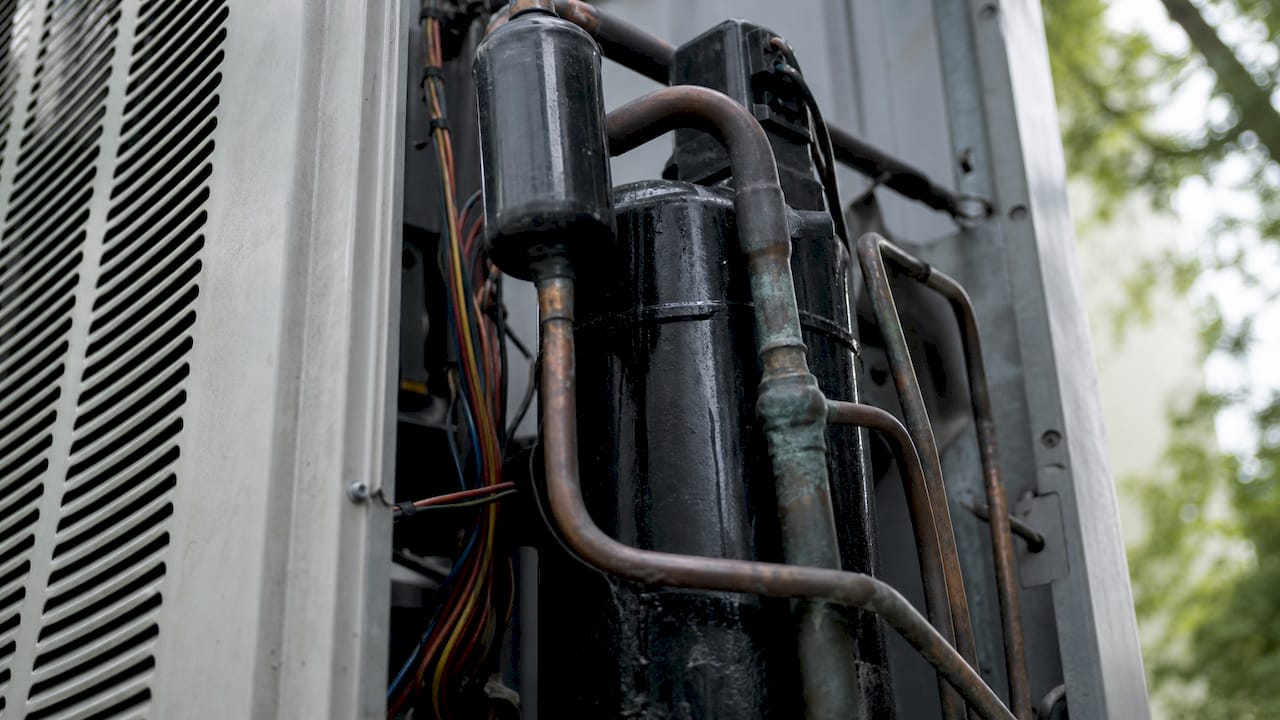
The AC compressor is defined as the mechanical heart of your home’s air conditioning system, responsible for pressurizing refrigerant and driving the entire cooling cycle. Without it, no heat transfer occurs and your home stays hot regardless of how new or expensive your system is. Brands like Trane and MRCOOL build their residential units around compressor performance as the central measure of system quality. Replacement costs range from $800 to $2,500 including labor, making it the single most expensive component in a standard residential AC system. Understanding how it works protects your investment and helps you catch problems before they become emergencies.
How does an AC compressor work?
The compressor’s job is to take low-pressure refrigerant gas from the evaporator coil and squeeze it into a high-pressure, high-temperature vapor. That compression is what makes the entire cooling cycle possible. Think of refrigerant as a heat taxi: it picks up heat inside your home, the compressor pressurizes it so it can drop that heat off outside, and then it loops back to do it again.
Here is the step-by-step sequence every homeowner should understand:
- Refrigerant enters the compressor as a cool, low-pressure gas after absorbing heat from indoor air at the evaporator coil.
- The compressor squeezes the gas, raising its pressure and temperature to 120–140°F, which forces the refrigerant into a state where it can release heat.
- Hot refrigerant flows to the condenser coil in the outdoor unit, where a fan blows air across the coil and the heat dissipates outside.
- Refrigerant cools and expands through the expansion valve, dropping back to a low-pressure state before returning indoors.
- The cycle repeats continuously, pulling heat out of your home on every loop.
The compressor is the only active mechanical component in this refrigeration cycle. Every other part, including the coils and expansion valve, is passive. That is why compressor failure shuts down the entire system.
Pro Tip: If your outdoor unit is running but your indoor air feels warm, the compressor may not be pressurizing refrigerant properly. Call a technician before running the system further, since operating a struggling compressor accelerates internal damage.
What are the common types of AC compressors?
Not all compressors work the same way. The type installed in your system affects energy use, noise level, repair complexity, and lifespan. Here is a comparison of the three types you are most likely to encounter in residential and light commercial systems.
| Compressor Type | How It Works | Best For |
|---|---|---|
| Reciprocating (Piston) | Uses pistons driven by a crankshaft to compress refrigerant | Older residential systems, budget replacements |
| Scroll | Two spiral-shaped scrolls orbit each other to compress gas smoothly | Modern residential systems, quieter operation |
| Inverter-Driven | Variable-speed motor adjusts compression rate to match cooling demand | High-efficiency homes, Florida climates with long run cycles |
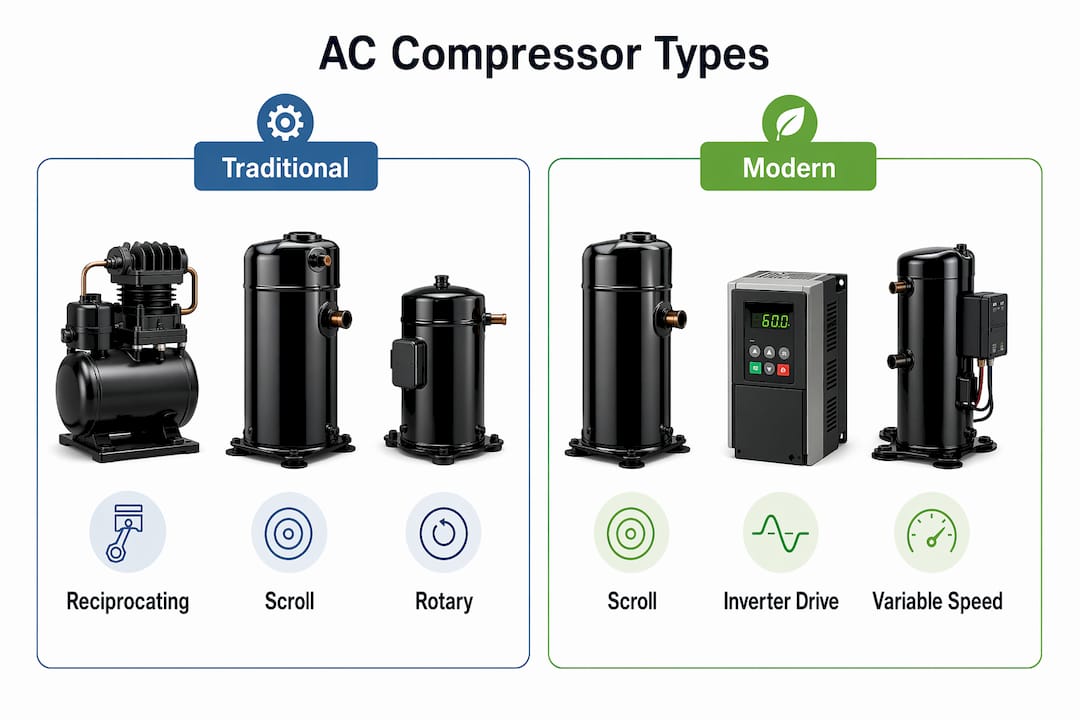
Reciprocating compressors are the oldest design. They work like a car engine, using pistons to compress gas in cylinders. They are reliable but loud and less efficient than newer designs.
Scroll compressors dominate modern residential installations. The orbiting scroll design has fewer moving parts, runs quieter, and handles refrigerant more gently. Most new Trane and Carrier residential units ship with scroll compressors as standard.
Inverter-driven compressors are the current performance standard. They vary speed to match cooling demand, which reduces energy consumption and mechanical wear simultaneously. A fixed-speed compressor runs at full power or not at all. An inverter compressor runs at 40% capacity on a mild day and ramps up only when needed. That difference adds years to the compressor’s lifespan.
Pro Tip: If you are replacing a system in Southwest Florida, where AC runs nearly year-round, an inverter-driven compressor pays back its higher upfront cost through lower monthly energy bills within a few seasons.
What are the signs of a bad AC compressor?
Catching compressor problems early is the difference between a $200 repair and a $2,000 replacement. The symptoms below are specific and actionable. If you recognize more than one, stop running the system and call a technician.
- Warm air from vents. The system runs but blows room-temperature or warm air. This is the most direct sign that refrigerant is not being pressurized correctly.
- Constant running without cooling. The system never reaches the set temperature and runs without cycling off. The compressor may be working but losing efficiency rapidly.
- Short cycling. The system turns on and off every few minutes. This often signals the compressor is overheating and tripping its internal protection switch.
- Grinding, rattling, or clicking noises from the outdoor unit. Mechanical noise from the compressor housing points to internal component wear or bearing failure.
- Tripped circuit breaker. A compressor drawing too much current will trip the breaker repeatedly. This is an electrical symptom of a mechanical problem.
Ignoring these symptoms increases repair costs because continued operation worsens internal damage. One specific risk is liquid slugging, where liquid refrigerant floods into the compressor and destroys valves and internal components instantly. There is no recovering from that kind of damage without full replacement.
One important note: faulty start capacitors mimic compressor failure in many cases. A capacitor replacement costs $150–$300. A compressor replacement costs up to $2,500. Always get a professional diagnosis before authorizing a compressor swap. Misdiagnosis is one of the most expensive mistakes homeowners make.
Pro Tip: Before assuming the compressor is dead, ask your technician to test the start capacitor first. It is a five-minute test that could save you thousands of dollars.
How much does AC compressor replacement cost?
AC compressor replacement costs $800–$2,500 including labor, according to current residential pricing data. That range is wide because several variables push the final number up or down significantly.
| Cost Factor | Lower End | Higher End |
|---|---|---|
| Compressor type | Reciprocating (basic) | Inverter-driven (variable speed) |
| System size | 1.5–2 ton residential | 4–5 ton larger home |
| Labor rates | Rural or lower-cost markets | Urban or high-demand markets |
| Refrigerant recharge | Not needed | Full recharge required |
| Associated parts | Compressor only | Capacitor, contactor, filter drier |
Refrigerant recharge is a common add-on cost. If the compressor failed due to a refrigerant leak, the leak must be repaired and the system recharged before the new compressor can run. That adds $150–$400 to the total depending on refrigerant type and quantity.
DIY compressor replacement is not a realistic option for homeowners. Professional diagnosis requires specialized tools to test refrigerant pressure and electrical continuity. Compressors involve high-voltage wiring and pressurized refrigerant lines, both of which carry serious injury risk without proper training and equipment. For local repair cost context, Southwest Florida homeowners should factor in the region’s high seasonal demand, which affects labor availability and pricing.
Pro Tip: Get at least two written estimates before authorizing a compressor replacement. Ask each technician to itemize parts, labor, refrigerant, and any secondary components separately so you can compare accurately.
How can you maintain your AC compressor?
The compressor is the most expensive part of your system and also one of the most preventable failures. Most compressor breakdowns trace back to neglected maintenance rather than random mechanical failure.
- Clean the condenser coils annually. Dirty coils force the compressor to work harder to reject heat. Clean condenser coils are the single most effective way to extend compressor life. In Florida, where pollen, dust, and humidity coat outdoor units fast, twice-yearly cleaning is worth the effort.
- Keep refrigerant levels correct. Low refrigerant causes the compressor to run hot and under-pressurized. High refrigerant causes liquid slugging. Both conditions destroy compressors. Only a licensed technician can check and adjust refrigerant levels legally.
- Clear debris from the outdoor unit. Leaves, grass clippings, and dirt block airflow around the condenser. Restricted airflow raises operating pressure and compressor temperature. Keep a two-foot clearance around the unit at all times.
- Schedule professional tune-ups twice a year. A technician checks refrigerant charge, electrical connections, capacitor health, and coil condition in one visit. This is the most cost-effective compressor protection available. The 2026 AC tune-up checklist from Ultraairswfl covers every step Florida homeowners need.
- Shade the outdoor unit where possible. Direct sun raises the ambient temperature around the condenser, making the compressor work harder. A shade structure or strategic landscaping reduces operating load without restricting airflow.
Preventive maintenance is the primary way to extend compressor life, according to Trane’s commercial HVAC guidance. For a practical step-by-step approach, the DIY maintenance checklist from Ultraairswfl walks Southwest Florida homeowners through what they can do themselves between professional visits.
Pro Tip: Schedule your professional AC tune-up in March or April, before Florida’s peak cooling season hits. Technicians are less busy, appointments are easier to get, and any compressor issues get caught before you need the system running at full capacity.
Key takeaways
The AC compressor is the sole mechanical driver of the refrigeration cycle, and protecting it through regular maintenance and early diagnosis is the most cost-effective decision a homeowner can make.
| Point | Details |
|---|---|
| Compressor function | It pressurizes refrigerant to enable heat transfer, making it the only active mechanical component in the cooling cycle. |
| Failure warning signs | Warm air, short cycling, grinding noises, and tripped breakers all signal compressor problems that worsen with delay. |
| Diagnosis before replacement | Faulty start capacitors often mimic compressor failure and cost far less to fix. Always get a professional diagnosis first. |
| Replacement cost range | Expect $800–$2,500 including labor, with refrigerant recharge and secondary parts potentially adding to the total. |
| Maintenance priority | Annual condenser coil cleaning and twice-yearly professional tune-ups are the most effective ways to prevent compressor failure. |
Why the compressor deserves more respect than it gets
Most homeowners think about their AC system only when it stops working. That is understandable. But the compressor is one of the few home components where neglect has a direct, measurable financial consequence. I have seen homeowners spend $2,200 on a compressor replacement that a $180 capacitor swap would have prevented, simply because they skipped the diagnostic step and trusted the first quote they received.
The other misconception I run into constantly is the belief that a newer system means a worry-free compressor. Inverter-driven compressors are more efficient and longer-lasting, but they require proprietary diagnostic tools that most general technicians do not carry. If you have a variable-speed system and something feels off, you need a technician who specializes in that technology, not a generalist with a standard manifold gauge set.
My honest recommendation: treat the compressor like the engine in your car. You would not skip oil changes and wait for the engine to seize. The same logic applies here. Two professional tune-ups a year, clean coils, and a quick call when something sounds or feels wrong will keep most compressors running well past the ten-year mark.
— albert
Protect your compressor with ultraairswfl’s expert service
Ultraairswfl serves homeowners and property managers across Naples, Cape Coral, and Fort Myers with residential and commercial HVAC installation, repair, and maintenance. If your system is showing any of the warning signs covered in this article, or if you simply want a professional to confirm your compressor is in good shape before summer peaks, Ultraairswfl’s certified technicians carry the diagnostic tools to test every compressor type accurately.
Property managers overseeing multiple units will find Ultraairswfl’s office HVAC installation guidance useful for planning system upgrades and protecting compressor investments across an entire portfolio. For homeowners focused on year-round comfort and lower energy bills, contact Ultraairswfl today to schedule a tune-up or free consultation before the next heat wave arrives.
FAQ
What does an AC compressor actually do?
The AC compressor pressurizes refrigerant gas, raising its temperature so it can release heat outside and return indoors to absorb more. It is the only active mechanical component in the refrigeration cycle, meaning the system cannot cool without it.
How long does an AC compressor last?
Most residential AC compressors last 10–15 years with regular maintenance. Neglected systems, particularly those with dirty coils or low refrigerant, often fail well before the ten-year mark.
Can i replace just the compressor or do i need a new system?
You can replace just the compressor, but if your system is over ten years old, a full replacement often makes more financial sense. A new compressor in an aging system still leaves you with old coils, an old motor, and no warranty coverage on surrounding components.
What is the most common cause of compressor failure?
Dirty condenser coils and low refrigerant are the two leading causes of premature compressor failure. Both force the compressor to run hotter and harder than it was designed to, accelerating wear on internal components.
Is a grinding noise from my outdoor unit always the compressor?
Not always. Grinding or rattling from the outdoor unit can come from the condenser fan motor, loose housing panels, or debris caught in the fan blades. A technician can isolate the source quickly, and ruling out cheaper causes before assuming compressor failure saves significant money.