

Two-stage cooling is defined as an air conditioning system where the compressor operates at two distinct capacity levels: a lower stage at roughly 60 to 70% output for mild conditions, and a full 100% stage for peak heat demand. Unlike a standard single-stage unit that runs at full blast or shuts off completely, a two-stage cooling system modulates its output to match what your home actually needs. Brands like Bryant, Carrier, and Goodman all manufacture two-stage AC units, making this technology widely available across price points. The result is steadier temperatures, better humidity control, and lower energy bills compared to conventional systems.
What is two-stage cooling and how does it work?
The compressor is the heart of any air conditioner, and in a two-stage system, it has two operating speeds rather than one. According to Bryant’s product documentation, stage one runs at 60 to 70% capacity and handles the majority of cooling days. Stage two kicks in at full 100% capacity only when outdoor temperatures spike or the home has been unoccupied and needs rapid cool-down.
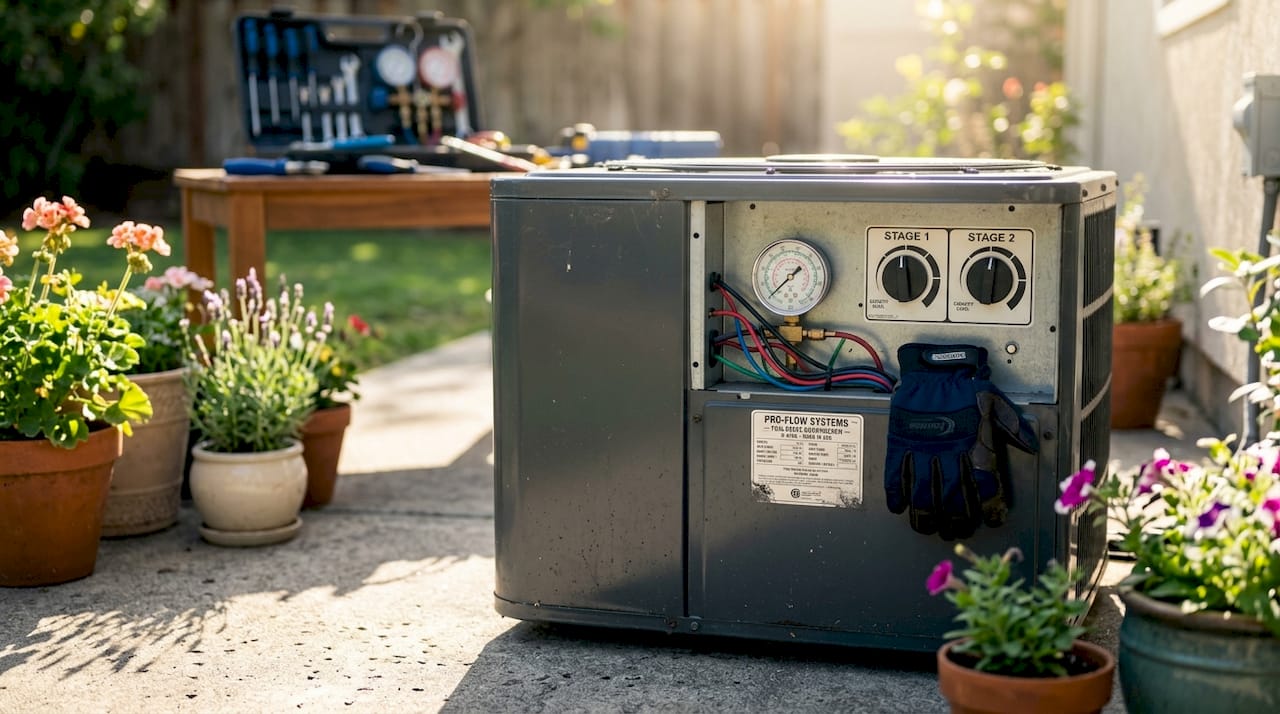
Think of it like the gears in a car. You don’t drive at full throttle every time you leave a stoplight. You ease into speed, then accelerate when the highway demands it. A two-stage air conditioner does the same thing: it starts gentle and only pushes hard when the situation calls for it. This approach keeps the system from hammering your home with cold air and then shutting off, which is exactly what a single-stage unit does on a loop.
The thermostat plays a critical role in staging behavior. A two-stage compatible thermostat reads indoor temperature and demand, then signals the compressor to run at low or high stage accordingly. Most modern smart thermostats from Ecobee, Honeywell Home, and Nest support two-stage communication, but the thermostat must be wired and configured correctly for staging to function as designed.
- Low stage (60 to 70% capacity): Handles everyday cooling loads, runs longer cycles, removes more humidity
- High stage (100% capacity): Activates during peak heat, rapid recovery after setback, or extreme outdoor temperatures
- Thermostat signal: Two-stage thermostats send separate Y1 and Y2 signals to trigger each stage independently
- Transition logic: Most systems attempt low stage first and escalate to high stage only if the setpoint isn’t reached within a set time window
Pro Tip: If your two-stage system seems to run in high stage most of the time, the problem is rarely the equipment itself. Check your thermostat settings, filter condition, and return air clearance before calling for service.
What are the benefits of a two-stage cooling system?
The most significant benefit of a two-stage cooling system is humidity control, and this matters more in Southwest Florida than almost anywhere else in the country. Longer low-stage run times pull more moisture out of the air because the evaporator coil stays cold longer, giving it more contact time with humid indoor air. A single-stage unit that cycles on and off rapidly never gets that extended contact time.
Noise reduction is another real-world advantage. Two-stage systems run quieter at low stage compared to single-stage compressors running at full capacity. If your outdoor unit sits near a bedroom window or a patio, the difference in sound level is noticeable. Lower-stage operation also means fewer hard starts and stops, which reduces wear on the compressor over time and extends equipment life.
Energy consumption drops meaningfully when a system spends most of its runtime at 60 to 70% capacity instead of 100%. For energy-efficient cooling at home, this translates directly into lower monthly utility bills, particularly during the long cooling seasons common in Florida.
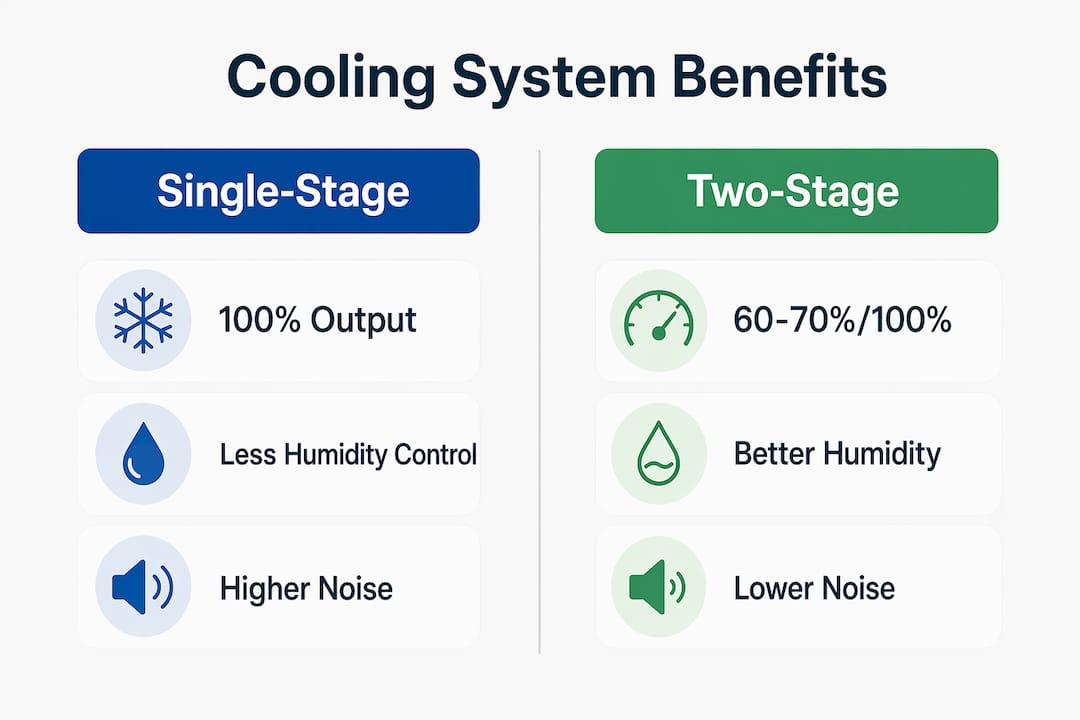
| Feature | Single-stage | Two-stage |
|---|---|---|
| Compressor output | 100% only | 60 to 70% or 100% |
| Humidity control | Limited | Strong, due to longer run times |
| Noise level | Louder at startup | Quieter during low-stage operation |
| Energy efficiency | Lower | Higher during mild conditions |
| Equipment wear | More on/off cycling | Fewer cycles, less mechanical stress |
| Upfront cost | Lower | Moderate to higher |
Two-stage cooling vs. single-stage vs. variable-speed: what’s the difference?
Three main technologies compete in the residential cooling market, and each serves a different need. Single-stage systems are the simplest: the compressor is either fully on or fully off. They cool effectively but lack any ability to modulate output, which means temperature swings, shorter run times, and less humidity removal. They cost less upfront and are straightforward to service.
Two-stage systems add one level of flexibility. The compressor runs at low capacity for most conditions and escalates to full output when needed. This middle-ground approach delivers most of the comfort and efficiency gains of advanced technology without the premium price of variable-speed equipment. For most Florida homeowners, a properly sized two-stage unit hits the best balance of performance and value.
Variable-speed systems adjust output continuously, modulating compressor speed dynamically rather than switching between two fixed levels. They offer the most precise temperature control and the highest efficiency ratings, but they also carry the highest purchase and installation cost. The benefits of a variable-speed air handler are real, but the payback period is longer and the technology requires more sophisticated diagnostics when something goes wrong.
| System type | Capacity levels | Best for | Relative cost |
|---|---|---|---|
| Single-stage | 1 (100% only) | Budget installs, smaller homes | Lowest |
| Two-stage | 2 (low and high) | Most residential applications | Moderate |
| Variable-speed | Continuous modulation | Large homes, extreme climates | Highest |
Pro Tip: In Florida’s climate, two-stage cooling outperforms single-stage for humidity control even when the efficiency ratings look similar on paper. The longer low-stage runtime is the deciding factor, not the SEER number alone.
Installation and sizing considerations for two-stage cooling
Proper sizing is the single most important factor in whether a two-stage system delivers on its promises. Oversizing a two-stage unit causes it to reach the setpoint temperature too quickly, forcing it to run mostly in high stage and short-cycle. When that happens, you lose the humidity control and energy savings that justify the investment in the first place. A Manual J load calculation, not a rule-of-thumb square footage estimate, is the correct method for sizing.
HVAC sizing directly affects both efficiency and comfort in ways that no amount of post-installation tuning can fully correct. Duct design matters just as much. Undersized or leaky ducts restrict airflow, which prevents the system from running in low stage as intended and pushes it into high stage prematurely.
Key installation factors that determine real-world performance:
- Manual J load calculation: Required for accurate sizing. Square footage alone is not sufficient.
- Duct sealing and sizing: Correct airflow and duct sealing are non-negotiable for humidity control and low-stage operation.
- Thermostat compatibility: Confirm the thermostat supports two-stage wiring (Y1 and Y2 terminals) before installation.
- Zoning systems: Multi-zone setups require careful balancing so low-stage airflow reaches all zones adequately.
- Return air clearance: Blocked or undersized returns are one of the most common causes of high-stage lock-in after installation.
If your system runs in high stage more than expected after installation, the diagnostic checklist starts with filter condition, return air clearance, and duct leakage before pointing to equipment failure.
Practical tips to get the most from your two-stage system
Maintaining a two-stage cooling system is not fundamentally different from maintaining any other central AC, but a few habits make a measurable difference in performance. Replace filters on schedule, typically every 30 to 90 days depending on household conditions, and never block return air grilles with furniture or curtains. Restricted airflow is the fastest way to push a two-stage system into permanent high-stage operation.
- Monitor thermostat runtime data. Thermostat runtime and mode data reveal whether your system is staging correctly. If it logs mostly high-stage runtime during mild weather, something is wrong.
- Schedule annual maintenance. A professional tune-up catches coil fouling, refrigerant issues, and blower problems before they affect staging behavior.
- Keep outdoor units clear. Debris around the condenser restricts heat rejection and forces the system into high stage earlier than necessary.
- Use setback temperatures carefully. Aggressive setbacks (raising the thermostat 10 or more degrees while away) force high-stage recovery. Moderate setbacks of 3 to 5 degrees let the system recover in low stage.
- Evaluate performance seasonally. Florida’s shoulder seasons (spring and fall) are when low-stage operation should dominate. If it doesn’t, that’s the time to call for a system evaluation.
Pro Tip: Smart thermostats like Ecobee or Honeywell Home T6 Pro display stage-by-stage runtime in their apps. Check this data monthly during peak season to confirm your system is staging as designed.
Key takeaways
Two-stage cooling systems deliver their full value only when properly sized, correctly installed, and supported by adequate airflow and thermostat configuration.
| Point | Details |
|---|---|
| Two-stage definition | Compressor runs at 60 to 70% for mild days and 100% for peak demand. |
| Humidity advantage | Longer low-stage run times remove more moisture than single-stage cycling. |
| Sizing is critical | Oversized systems short-cycle into high stage, eliminating efficiency benefits. |
| Monitor staging data | Thermostat runtime logs confirm whether the system operates as designed. |
| Variable-speed comparison | Variable-speed offers more precision but at higher cost; two-stage suits most homes. |
Why runtime data matters more than temperature readings
I’ve seen homeowners invest in two-stage equipment and then wonder why their bills didn’t drop. Nine times out of ten, the system was running in high stage almost constantly because of an oversized unit or a duct system that couldn’t support low-stage airflow. The thermostat showed the right temperature, so everyone assumed it was working. It wasn’t working correctly. It was just working.
The uncomfortable truth about two-stage cooling is that the label on the equipment means very little without the right installation behind it. I’ve watched properly sized two-stage Carrier and Goodman units transform the comfort of Florida homes, cutting humidity complaints and dropping runtime costs noticeably. I’ve also seen the same equipment installed in oversized configurations deliver no real benefit over a single-stage unit.
My advice: before you replace any system, pull the runtime data from your existing thermostat if it supports it. Look at how often your current unit cycles per hour and how long each cycle lasts. That data tells you more about what your home needs than any sales sheet. If you’re averaging short cycles and high indoor humidity, a properly sized two-stage system is likely the right call. If your current unit already runs long cycles and humidity is controlled, the upgrade math changes considerably.
The types of HVAC systems that perform best in Florida are the ones matched to the actual load of the building, not the ones with the highest efficiency rating on the box.
— albert
Get expert two-stage cooling guidance from Ultraairswfl
If you’re weighing a two-stage air conditioning upgrade for your home or managed property in Naples, Cape Coral, or Fort Myers, Ultraairswfl has the local experience to size, install, and service the right system for your building. Southwest Florida’s heat and humidity demand equipment that’s matched precisely to the load, and that’s exactly what the team at Ultra Air Heating & Cooling delivers.
From full heating and cooling installations to system evaluations and maintenance plans, Ultraairswfl covers every stage of HVAC ownership. Explore AC upgrade options for Southwest Florida homes or contact the team directly to schedule a load calculation and system consultation. Getting the sizing right from the start is the difference between a two-stage system that performs and one that just runs.
FAQ
What is two-stage cooling in simple terms?
Two-stage cooling means your air conditioner’s compressor runs at two output levels: roughly 60 to 70% capacity for normal days and 100% capacity for peak heat. This lets the system match its output to actual demand instead of cycling fully on and off.
How does two-stage cooling improve humidity control?
Low-stage operation runs longer, continuous cycles that give the evaporator coil more contact time with humid indoor air. This extended runtime removes significantly more moisture than the short, full-blast cycles of a single-stage system.
Is two-stage cooling worth the extra cost?
For most Florida homeowners, yes. The combination of lower energy use during mild conditions, better humidity control, and reduced equipment wear typically justifies the moderate price premium over single-stage systems, especially given the long cooling season.
What is two-stage heating and how does it relate?
Two-stage heating applies the same dual-capacity principle to furnaces and heat pumps. Two-stage furnaces run at lower capacity most of the time for quieter, steadier warmth and switch to full output only during cold snaps, mirroring the efficiency logic of two-stage cooling.
How do I know if my two-stage system is staging correctly?
Check the runtime data in your thermostat’s app or history log. If the system logs mostly high-stage operation during mild weather, the likely causes are an oversized unit, dirty filters, blocked returns, or duct leakage that needs professional attention.