
Ventilation is the intentional exchange of indoor and outdoor air, and it does more than just freshen a room. According to the NCBI, the core purpose of ventilation in any building is to supply healthy air for breathing by diluting and removing pollutants at their source. Three elements define how well a system performs: the ventilation rate (how much outdoor air enters), airflow direction (always from clean zones toward dirty ones), and air distribution (how evenly that fresh air reaches every occupied corner). The EPA, CDC, and WHO all recognize adequate ventilation as a foundational requirement for safe indoor environments, not a luxury upgrade.
- Fresh air supply: Replaces oxygen-depleted, pollutant-rich indoor air with cleaner outdoor air
- Pollutant removal: Dilutes volatile organic compounds (VOCs), particulate matter, carbon dioxide, and biological contaminants
- Moisture control: Reduces humidity that feeds mold and dust mites
- Odor management: Exhausts cooking fumes, chemical off-gassing, and stale air
- Thermal comfort: Works alongside heating and cooling to maintain livable temperatures
What types of ventilation systems actually work in buildings?
Buildings use three main approaches: natural, mechanical, and hybrid. Each has a distinct operating principle, and the right choice depends on climate, building design, and budget.
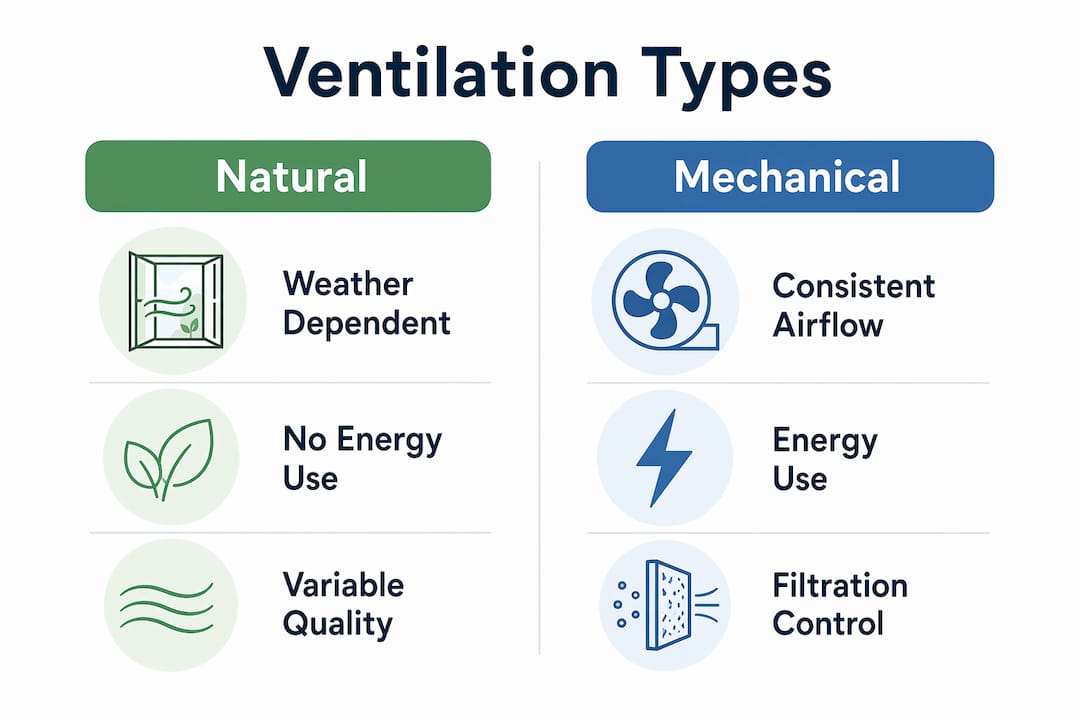
Natural ventilation relies on wind pressure and the stack effect, where warm air rises and escapes through high openings while cooler outdoor air enters below. Windows, doors, trickle vents, solar chimneys, and wind towers all serve as purpose-built openings. It costs almost nothing to run, but airflow varies with weather, and on a still, humid Florida afternoon, it may deliver almost nothing.
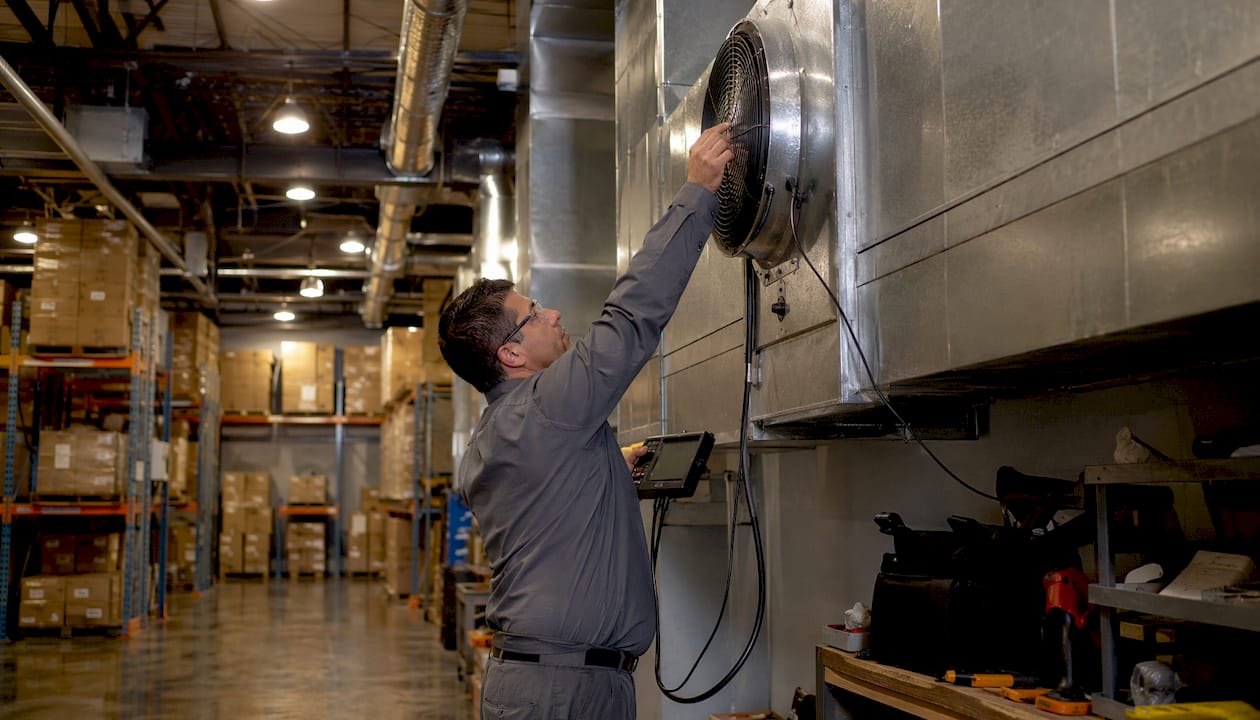
Mechanical ventilation uses fans and ductwork to move air regardless of outdoor conditions. The three main configurations are exhaust-only (bathroom and kitchen fans pull air out, drawing fresh air in through gaps), supply-only (a fan pushes outdoor air in), and balanced systems. Heat Recovery Ventilators (HRVs) and Energy Recovery Ventilators (ERVs) are the gold standard for balanced systems: they transfer heat and, in the case of ERVs, moisture between incoming and outgoing airstreams, so you get fresh air without throwing away conditioned energy.
Hybrid (mixed-mode) ventilation uses natural forces when they are sufficient and switches to mechanical assistance when they are not. High-tech versions are computer-controlled and can match the performance of full mechanical systems while cutting energy costs.

| Feature | Natural | Mechanical | Hybrid |
|---|---|---|---|
| Reliability | Weather-dependent | Consistent | Consistent with backup |
| Energy use | Very low | Moderate to high | Low to moderate |
| Upfront cost | Low | Moderate to high | High |
| Control | Limited | Full | Full |
| Best suited for | Mild climates, older buildings | Airtight modern homes | Mixed climates, large buildings |
How do you know if your ventilation is actually doing its job?
The most practical metric is air changes per hour (ACH), which measures how many times per hour the total air volume in a space is replaced. CDC guidance recommends a minimum of 5 ACH for general occupied spaces. CO2 concentration is a practical proxy; lower values indicate generally adequate ventilation, though precise thresholds depend on context.
| Indicator | Target / Threshold | Notes |
|---|---|---|
| Air changes per hour (ACH), CO2 concentration levels, and outdoor air per person are key indicators used to assess ventilation adequacy, adjusting thresholds based on settings and activities. |
Signs your ventilation is falling short:
- Persistent condensation on windows or walls
- Musty or stale odors that do not clear after airing out
- Visible mold growth in bathrooms or near HVAC vents
- Frequent headaches or fatigue among occupants
- CO2 monitor readings that climb steadily during occupied hours
Pro Tip: A $30–$50 plug-in CO2 monitor placed at breathing height in your most-used room gives you real-time feedback that no visual inspection can match. If the number climbs past 1,000 ppm within an hour of occupancy, your ventilation rate needs attention.
How ventilation protects your health and reduces infection risk
Good ventilation cuts your exposure to a wide range of indoor threats, from VOCs off-gassing from furniture to airborne respiratory viruses. The EPA confirms that ventilation reduces levels of particulate matter, VOCs, and biological pollutants, including respiratory viruses, by replacing contaminated indoor air with fresh outdoor air. For indoor air quality in homes, this is one of the most direct levers available.
The infection-control evidence is striking. Research published by the UK’s Scientific Advisory Group for Emergencies found that doubling the ventilation rate approximately halves viral aerosol exposure under steady-state conditions. That relationship holds for influenza, COVID-19, and other airborne pathogens that spread via fine aerosols in shared indoor spaces.
Core health benefits of proper ventilation:
- Reduced respiratory irritation and allergy symptoms from lower allergen concentrations
- Lower risk of mold-related illness through humidity control
- Decreased exposure to combustion byproducts from gas stoves and fireplaces
- Reduced far-field aerosol transmission of airborne viruses
- Better cognitive performance linked to lower CO2 levels in occupied rooms
Ventilation alone is not a complete defense. The EPA is explicit that increasing ventilation must be combined with source control, air filtration (MERV-13 filters or better), and occupancy management for maximum protection. Think of ventilation as one essential layer in a multi-layer strategy, not a standalone fix.
Mechanical vs. natural ventilation: which delivers better air quality?
The honest answer is that it depends on what you are trying to control and where you live. Natural ventilation can deliver very high air-change rates at low cost when outdoor conditions cooperate, but airflow fluctuates stochastically with wind and temperature. In Southwest Florida’s hot, humid summers, relying on open windows means pulling in heat and moisture that your air conditioner then has to fight.
Mechanical systems deliver designed airflow regardless of weather. They also allow humidity control, filtration, and pressure management, which prevents pollutants from migrating in from wall cavities or adjacent spaces. The trade-off is energy consumption and maintenance. Demand-controlled ventilation (DCV) addresses the energy side directly: modern DCV systems adjust fresh-air intake based on real-time CO2 readings, keeping levels below 1,000 ppm without over-ventilating an empty room.
| Criterion | Natural | Mechanical |
|---|---|---|
| Air quality consistency | Variable | Reliable |
| Humidity control | None | Full (with HRV/ERV) |
| Energy cost | Near zero | Moderate (lower with DCV) |
| Maintenance | Minimal | Regular filter and fan service |
| Outdoor pollutant risk | High (no filtration) | Low (filtered intake) |
| Suitable for airtight homes | No | Yes |
Hybrid systems split the difference. They use natural forces when outdoor conditions are favorable and engage mechanical assistance when they are not, which is why they are increasingly common in eco-friendly HVAC designs for new construction.
Common ventilation mistakes and how to avoid them
Poorly maintained or improperly installed ventilation creates pressure imbalances that pull pollutants from wall cavities, attics, and crawl spaces directly into living areas. That is the opposite of what ventilation is supposed to do. Sealing a home tightly without adding mechanical ventilation is another frequent error: modern airtight construction reduces natural infiltration to near zero, so without an HRV or ERV, indoor air quality deteriorates fast.
Common mistakes to avoid:
- Blocking or covering trickle vents and exhaust grilles to reduce drafts
- Running bathroom and kitchen fans only during use rather than continuously or on a timer
- Skipping annual filter changes, which chokes airflow and forces fans to work harder
- Ignoring duct leakage, which can deliver conditioned air to unconditioned spaces instead of living rooms
- Ventilating with outdoor air during wildfire events or high-pollution days without filtration
Best practices for lasting performance:
- Commission the system after installation to verify actual airflow matches design specs
- Clean or replace filters every 1–3 months depending on occupancy and local air quality
- Monitor CO2 levels seasonally to catch degradation before it affects health
- Integrate ventilation controls with your thermostat so the system responds to occupancy
- Schedule a professional inspection annually, especially before the high-use summer season in Florida
Pro Tip: True ventilation means exchanging indoor air with outdoor air, not just recirculating it. A ceiling fan moves air but does not ventilate. Confirm your ventilation system has a dedicated outdoor air intake before assuming your home is adequately ventilated.
For guidance on boiler room safety and how ventilation design affects combustion appliance performance, the principles of pressure balance and exhaust sizing apply equally to residential and commercial settings.
How smart technology is changing ventilation in 2026
The biggest shift in ventilation over the past decade is the move from fixed-rate systems to demand-responsive ones. Sensors now measure CO2, VOCs, humidity, and particulate matter in real time, feeding data to controllers that adjust fan speed and damper position minute by minute. The result is a system that ventilates more when a room is full and backs off when it is empty, cutting energy waste without compromising air quality.
Smart ventilation platforms integrate with building automation systems and can send alerts when CO2 exceeds thresholds or when a filter needs replacement. Some residential HRV and ERV units now connect to smartphone apps, letting homeowners check airflow rates and indoor air quality from anywhere. For commercial buildings, this data feeds into energy management dashboards that track ventilation efficiency alongside lighting and HVAC loads.
ASHRAE Standard 62.1, the national consensus standard for outdoor air ventilation, increasingly serves as the baseline that smart systems are programmed to meet or exceed. Pairing that standard with real-time sensor feedback closes the gap between designed performance and actual performance, which is where most ventilation failures occur.
Key Takeaways
Proper ventilation is the single most direct way to control indoor air quality, reduce airborne infection risk, and prevent moisture damage in any building.
| Point | Details |
|---|---|
| Ventilation rate matters most | CDC recommends a minimum of 5 ACH; CO2 below 1,000 ppm confirms adequate fresh air delivery. |
| Doubling ventilation halves viral exposure | Under steady-state conditions, doubling the ventilation rate approximately halves aerosol concentration indoors. |
| Mechanical beats natural in airtight homes | Modern sealed construction requires HRV or ERV systems to maintain air quality without energy loss. |
| Ventilation needs filtration to work fully | MERV-13 filters combined with increased ventilation remove more contaminants than ventilation alone. |
| Maintenance determines real-world performance | Blocked vents, dirty filters, and pressure imbalances turn a well-designed system into a liability. |
Ultraairswfl serves homeowners and building managers across Naples, Cape Coral, and Fort Myers with professional HVAC installation, ventilation assessment, and indoor air quality services. Whether you need an HRV retrofit, a CO2 monitoring setup, or a full office HVAC installation designed to meet ASHRAE 62.1 standards, the team at Ultraairswfl brings the expertise to get it right the first time.

If respiratory health is a concern, the asthma air quality checklist from Ultraairswfl walks you through every ventilation and filtration step specific to Southwest Florida’s climate. Contact Ultraairswfl today to schedule a ventilation assessment.