
Your HVAC system can quietly lose 20% or more of its efficiency before you notice anything wrong, and by the time comfort drops or your energy bill spikes, the damage is often well underway. Understanding the most effective ways to monitor HVAC health, what professionals call HVAC system health monitoring or continuous performance assessment, gives you the ability to catch problems early, extend equipment life, and avoid the kind of repair bills that ruin a budget. This guide covers everything from simple manual checks to advanced sensor networks, matched to what actually makes sense for homeowners and property managers in 2026.
Table of Contents
- Key takeaways
- Ways to monitor HVAC health: the core framework
- Practical methods for monitoring HVAC performance at home
- Advanced HVAC monitoring technologies for proactive property management
- Comparing monitoring approaches: what works and when
- Steps for building your HVAC health monitoring routine
- My honest take on what actually matters
- Ready to take your HVAC monitoring further?
- FAQ
Key takeaways
| Point | Details |
|---|---|
| Start with a system assessment | Identify which components and parameters your HVAC setup needs monitored before buying any tools. |
| Manual checks remain non-negotiable | Filter and coil maintenance are both critical since clean filters alone do not prevent coil dirt buildup. |
| Smart devices fill the gap | Smart thermostats and standalone sensors give homeowners real-time data without complex installation. |
| Advanced sensors catch hidden faults | Tracking valve position, pressure, and runtime reveals faults that a thermostat alone will never flag. |
| Combine methods for best results | Pairing manual inspections with automated alerts creates the most reliable HVAC health monitoring routine. |
Ways to monitor HVAC health: the core framework
Before picking tools or devices, you need to know what you are actually monitoring. HVAC health monitoring covers several distinct categories, and skipping any one of them creates blind spots.
The key system components that require attention include:
- Filters and coils: The most commonly neglected pairing. Evaporator coils accumulate dirt even when filters look clean, which steadily reduces heat exchange efficiency.
- Refrigerant lines: Low refrigerant pressure signals either a leak or an undercharge, both of which force the compressor to work harder.
- Airflow and ductwork: Restricted or unbalanced airflow creates hot and cold zones and accelerates wear on the air handler.
- Electrical controls and thermostat accuracy: Faulty controls cause short-cycling, which is one of the fastest ways to wear out a compressor.
- Indoor environmental quality (IEQ): Temperature and humidity are the obvious ones, but CO2 and particulate levels also reflect how well your system is performing.
The type of data you collect matters as much as the components you watch. Temperature differentials across the coil, runtime patterns, energy consumption trends, and humidity readings all tell different parts of the same story. Continuous monitoring catches slow-developing faults that a once-a-month manual check will miss entirely. That said, manual inspections still catch things sensors cannot, like physical damage, debris accumulation, or condensate drain blockages. The best approach combines both.
Pro Tip: Track your system’s runtime per day during a stable weather period and write it down. If runtime increases by 20% or more without a change in outdoor temperature, that is an early fault signal worth investigating.
Practical methods for monitoring HVAC performance at home
For most homeowners, the best strategy is layering a few simple methods rather than relying on any single approach.
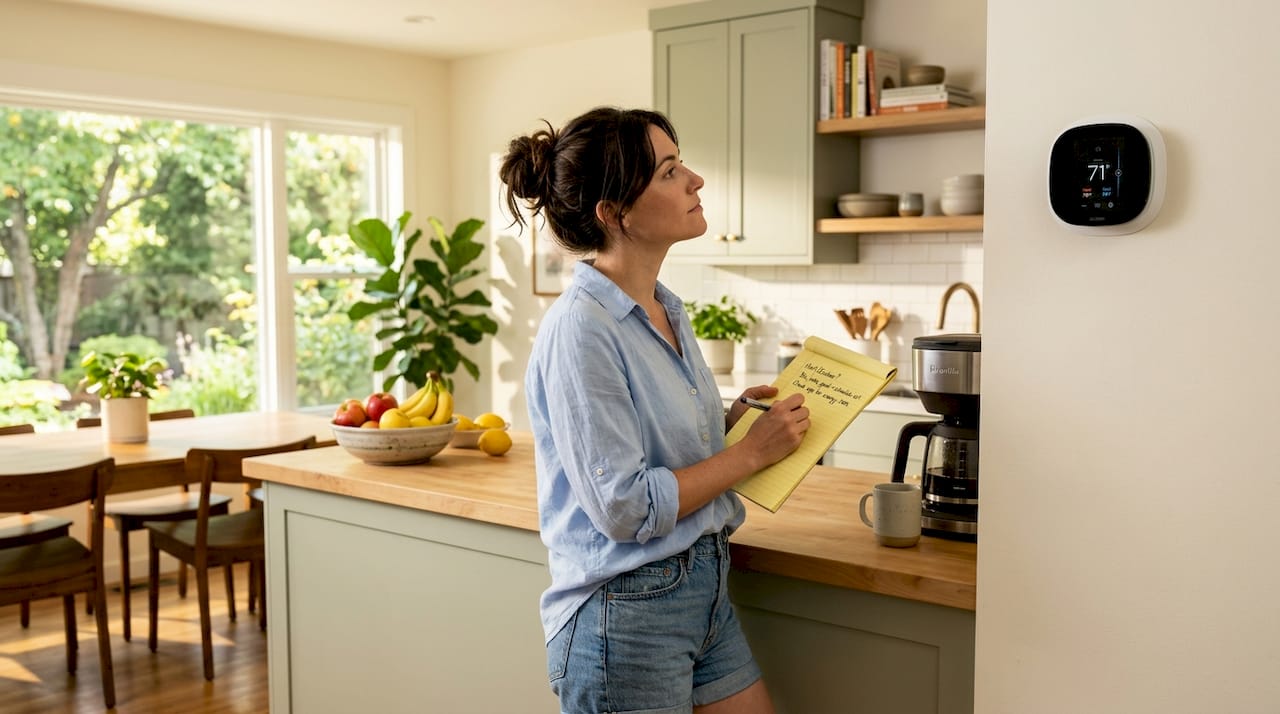
Regular manual inspections are the foundation. Cleaning or replacing filters every 1 to 2 months is one of the highest-return maintenance habits you can build. Check your HVAC maintenance checklist to make sure you are covering coil cleaning, drain line flushing, and outdoor unit clearance as well. A visual inspection of the unit takes five minutes and can reveal refrigerant line frost, unusual condensation, or debris buildup before they become expensive problems.
Smart thermostats are the most accessible monitoring upgrade for homeowners. Devices like ecobee or Honeywell Home T6 Pro log runtime history, alert you to unusually long or short cycles, and track indoor temperature and humidity continuously. Most also connect to a smartphone app, so you get alerts when something is off even when you are away from the property.
Standalone sensors add another layer. Examples of HVAC monitoring devices suitable for home use include:
- Humidity sensors: Whole-home humidity above 60% or below 30% suggests the system is not properly conditioning air.
- CO2 monitors: Elevated CO2 points to inadequate ventilation, which may mean the system is not moving enough fresh air.
- Differential temperature gauges: Measuring supply and return air temperature tells you whether your coil is transferring heat correctly. A healthy split is typically 14 to 22 degrees Fahrenheit.
- Energy monitors: Devices like the Emporia Vue clip onto your electrical panel and track HVAC energy draw in real time, flagging efficiency drops quickly.
Many homeowners never look beyond the thermostat display. That alone will not tell you whether a motor is straining, whether refrigerant pressure is low, or whether your ducts are leaking conditioned air. Layering two or three of these devices gives you a much more complete picture without requiring professional-grade equipment.
Advanced HVAC monitoring technologies for proactive property management
Property managers and tech-savvy homeowners who want to move beyond reactive maintenance have access to a more sophisticated set of tools. This is where monitoring shifts from awareness to true predictive management.
Component status monitoring
A data-driven HVAC monitoring system tracks not just environmental conditions but the operational behavior of individual components. That means logging valve position, pump activity, motor runtime, and pressure readings continuously. When a valve starts cycling more frequently than its baseline, or a pump’s runtime creeps upward, you get an early warning before the component fails outright. Thermostat readings alone will never surface these patterns.
Air quality and IEQ sensor networks
Advanced IAQ monitoring covers CO2 concentration, PM2.5 particulate matter, and total volatile organic compounds (TVOCs). LEED v5 guidelines call for 15-minute CO2 readings and hourly PM2.5 and TVOC measurements. For sensor placement, accuracy depends on positioning in the breathing zone, typically 3 to 6 feet above the floor, rather than near vents or walls where readings skew.
Building Automation System integration
A Building Automation System (BAS) or Building Management System (BMS) ties all these sensors into a single platform. Trending and alarm setup in BAS platforms lets you log supply air temperature every one to five minutes and set alerts based on deviation from a running baseline rather than a fixed number. This is important because fixed-threshold alarms create alert fatigue, too many false positives from normal seasonal variation.
The comparison below shows how these advanced approaches stack up against simpler options:
| Monitoring method | Cost | Data quality | Ideal for |
|---|---|---|---|
| Manual inspections | Low | Moderate | All homeowners |
| Smart thermostat | Low to medium | Good for environment | Homeowners, small rentals |
| Standalone sensors | Medium | Good for specific parameters | Homeowners, small multi-unit |
| BAS/BMS integration | High | Excellent, continuous | Property managers, commercial |
| Full sensor network | High | Highest, predictive | Large properties, facilities |
Pro Tip: Configure trending alarms based on dynamic baselines rather than fixed thresholds. A system running 10% longer than its seasonal average is far more meaningful than a raw runtime number.
Comparing monitoring approaches: what works and when
No single method covers every scenario. The right mix depends on your property type, budget, and how much hands-on involvement you want.
| Approach | Pros | Cons | Best scenario |
|---|---|---|---|
| Manual inspection only | No cost, high tactile feedback | Time-intensive, misses data trends | Small home, tight budget |
| Smart thermostat only | Easy setup, app alerts | Misses component-level faults | Single-family homeowner |
| Sensors plus smart thermostat | Affordable, multi-parameter | Requires some setup effort | Most homeowners |
| BAS with full sensor network | Predictive, automated alerts | High upfront cost | Multi-unit or commercial property |
For a single-family homeowner, a smart thermostat paired with a humidity sensor and a clamp-style energy monitor covers the most ground for the least investment. Property managers running multiple units benefit far more from commercial HVAC best practices that include BAS integration, where structured energy and IEQ assessments drive monitoring decisions and prioritize corrective actions before tenant complaints arise.
The key insight is that methods are additive. A good manual inspection routine does not become irrelevant once you install sensors. Sensors catch data trends; inspections catch physical conditions. Together they cover the failure modes that each misses on its own.
Steps for building your HVAC health monitoring routine
Getting started does not require buying everything at once. A phased approach works better for both budget and learning curve.
- Assess your current system. Walk through every component: filter condition, coil cleanliness, thermostat accuracy, and any warning signs of HVAC problems like unusual noise, odor, or uneven temperatures. Document what you find.
- Choose tools matched to your needs. A homeowner with a newer single system needs different tools than a property manager with a 20-unit building. Use the comparison table above to narrow your selection.
- Install and calibrate sensors. Place humidity and CO2 sensors in living areas, not next to supply vents. Set your smart thermostat to log runtime history.
- Establish a review schedule. Check sensor data and runtime logs weekly. Review filter condition monthly. Schedule a professional HVAC system health check at least once a year.
- Use your data to guide professional service. When you bring a technician in, share your runtime logs and any anomalies you noticed. That data shortens diagnostic time and leads to more targeted repairs.
- Adjust as you learn. After one full season of tracking, you will know which parameters matter most for your specific system and climate. Refine your monitoring setup accordingly.
My honest take on what actually matters
I have looked at a lot of HVAC monitoring setups over the years, and the most common mistake I see is people focusing on the thermostat display and calling that monitoring. It is not. The thermostat tells you what the air feels like. It does not tell you what the system is doing to get there.
The second most common mistake is buying sensors and then never reviewing the data. Monitoring is only as useful as the habit behind it. I have seen properties where a $30 humidity sensor caught a refrigerant issue three weeks before the system would have failed completely. I have also seen expensive BAS setups generate thousands of data points that nobody ever looks at.
My honest take is this: start simple, build the habit first, then add technology. A homeowner who checks filter condition monthly and reviews smart thermostat runtime weekly will outperform someone with a sophisticated sensor network they ignore. Once the habit is solid, adding practical energy-saving upgrades and more advanced monitoring becomes genuinely useful rather than just more noise.
The goal is not to become an HVAC technician. The goal is to catch problems early enough that a technician can fix them before they become emergencies. That shift alone saves most homeowners several hundred dollars a year and extends system life by years.
— albert
Ready to take your HVAC monitoring further?
If your monitoring routine has revealed concerns or you want a professional baseline before adding sensors, Ultraairswfl is ready to help. The team at Ultra Air Heating & Cooling serves Naples, Cape Coral, and Fort Myers with detailed HVAC inspections, indoor air quality testing, and full system assessments. Whether you manage one home or a portfolio of properties, their office HVAC installation guide is a practical starting point for facility-level monitoring planning. Homeowners focused on air quality can also explore professional home air quality testing in Naples, FL. Contact Ultraairswfl to schedule a system health check and get expert eyes on the parameters your sensors cannot see.
FAQ
How often should I check my HVAC system’s health?
Filter condition should be checked monthly, with replacement every one to two months depending on usage. A full professional inspection once a year covers the components homeowners cannot assess themselves.
What are the best HVAC monitoring devices for homeowners?
Smart thermostats, standalone humidity sensors, CO2 monitors, and clamp-style energy monitors are the most accessible and practical options. Together they cover environmental conditions and system efficiency without requiring professional installation.
Can a smart thermostat alone monitor HVAC health?
No. Smart thermostats track temperature and runtime but miss component-level faults like low refrigerant pressure, failing motors, or restricted airflow. Adding even one or two standalone sensors significantly improves fault detection.
What indoor air quality parameters should I monitor?
CO2, PM2.5 particulate matter, humidity, and TVOCs are the core parameters. Elevated CO2 signals ventilation problems; high PM2.5 points to filtration failure or duct contamination; humidity outside the 40 to 60 percent range indicates conditioning issues.
When should I call a professional instead of relying on sensors?
Call a professional when you see unusual runtime increases, hear new sounds, notice refrigerant line frost, or when sensor data shows a trend you cannot explain. Monitoring data helps your technician diagnose faster, but it does not replace hands-on expertise.