
Most homeowners and property managers assume their HVAC system will run when they need it. That assumption is exactly what makes a mid-summer breakdown so costly. What is HVAC redundancy? At its core, it is the practice of building backup capacity into your heating and cooling system so that one failing component does not shut everything down. In Southwest Florida, where temperatures push 95°F and humidity never takes a day off, that distinction between “probably fine” and “definitely protected” is the difference between a minor inconvenience and a serious problem.
Table of Contents
- Key Takeaways
- What is HVAC redundancy: core concepts explained
- Benefits of HVAC redundancy worth knowing
- Redundant HVAC system designs and where they fit
- Challenges to plan for before adding redundancy
- Practical steps to upgrade your HVAC protection
- My take on why this is more critical than most people realize
- Protect your property with Ultraairswfl
- FAQ
Key Takeaways
| Point | Details |
|---|---|
| Redundancy prevents total failure | A system with backup capacity keeps running when one component fails, protecting comfort and safety. |
| N+1 is the most common starting point | Installing one extra unit beyond the minimum required load covers most homes and small businesses. |
| Controls need redundancy too | Duplicating control pathways prevents a single sensor or software glitch from shutting everything down. |
| Redundancy can improve efficiency | Multiple smaller components running at part load often use less energy than one oversized unit running hard. |
| Professional design matters | Every property has unique vulnerabilities; a tailored redundancy plan from a licensed technician delivers the best protection. |
What is HVAC redundancy: core concepts explained
The industry term for what most people call “backup HVAC” is engineered redundancy. It refers to the intentional design of backup capacity into an HVAC system so that a single failure does not interrupt heating, cooling, or ventilation. Think of it the way you think about a spare tire. You do not drive on the spare every day, but you are genuinely relieved it exists when you need it.
The concept of a “single point of failure” is what makes HVAC system redundancy worth understanding. A single point of failure is any one component whose failure stops the entire system. In a standard residential setup, that might be the compressor on your only air handler. When it quits, your entire home loses cooling with no fallback.
Redundancy configurations are typically described using three models:
- N (baseline): The exact number of units or components needed to meet the full load. No backup exists. Any failure affects the whole system.
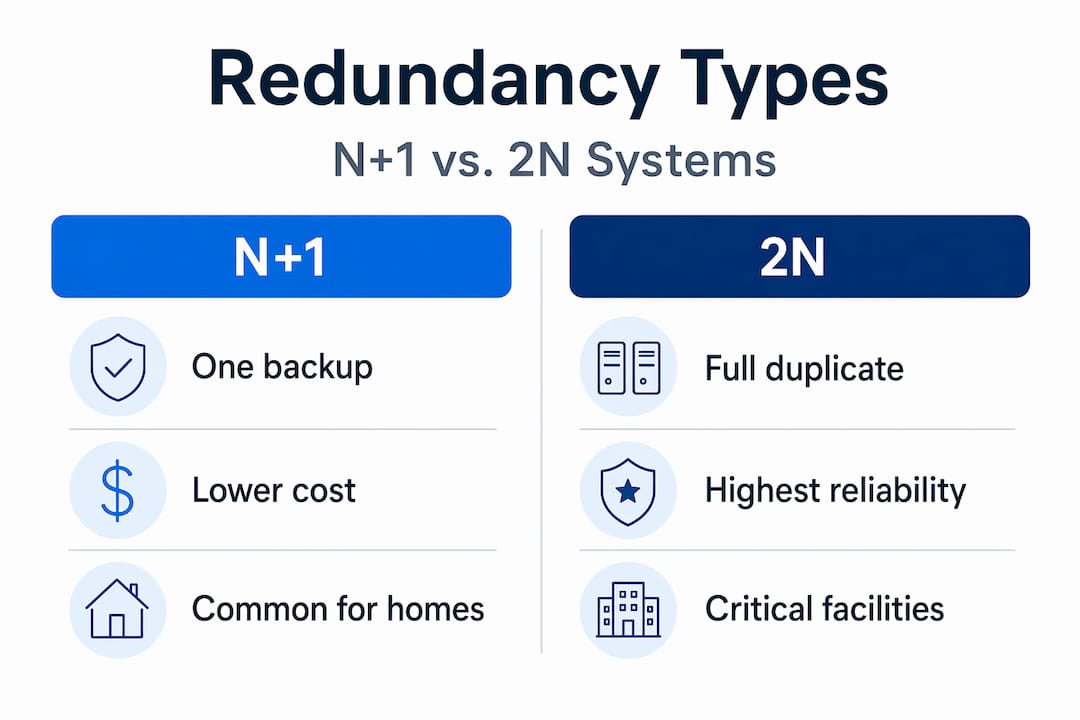
- N+1: One additional unit beyond the minimum requirement. If your property needs two cooling units to handle peak load, an N+1 design installs three. N+1 means one extra unit acts as a standby, so maintenance or failure of one unit leaves the other two covering the full load.
- 2N (full duplication): Two entirely independent systems, each capable of handling the full capacity alone. This is the gold standard in hospitals and data centers, where any downtime is unacceptable.
For most homeowners, N+1 is the practical sweet spot. For commercial property managers running server rooms, medical offices, or retail spaces with large footprints, a 2N design starts to make financial sense. The right choice depends on what you stand to lose when the system goes down.
Pro Tip: Before you decide on a redundancy level, calculate the real cost of downtime for your specific property. For a restaurant in Fort Myers, even four hours without cooling during July service can mean spoiled inventory and lost revenue that exceeds the cost of an N+1 upgrade.
Benefits of HVAC redundancy worth knowing
The obvious benefit is continuous operation. But the practical advantages of HVAC backup systems go several layers deeper than that.

Reliability and comfort protection. Mission-critical environments prioritize uptime over theoretical efficiency gains because they understand that equipment will eventually fail. That same logic applies to your home if you have elderly family members, young children, or anyone with a health condition sensitive to heat. Florida heat is not just uncomfortable. It is a legitimate health risk.
Maintenance without shutdowns. One underappreciated benefit of redundant HVAC design is that you can take a component offline for service without losing system function. This means your maintenance contractor can do thorough work instead of rushing through inspections to minimize downtime. You get better service and a longer system lifespan as a result.
Improved indoor air quality. A redundant system keeps air circulating and filtering even when primary components are being serviced. This matters more than most people realize, especially in humid Southwest Florida climates where mold can begin developing within 24 to 48 hours of airflow interruption.
Energy efficiency through part-load operation. Here is the counterintuitive part: multiple smaller components at part load often use less energy than one large unit running at full capacity. Instead of a single oversized system cycling on and off inefficiently, distributed units share the load proportionally. You get better dehumidification, more stable temperatures, and lower utility bills. For more ways to get efficiency gains alongside reliability, check out these HVAC tips for maximizing comfort without driving up your energy costs.
Pro Tip: When shopping for redundancy solutions, look for systems with staged compressor technology or variable-speed blowers. These designs naturally support part-load operation and make your redundancy investment work harder on efficiency, not just backup protection.
Redundant HVAC system designs and where they fit
How does HVAC redundancy work at the equipment level? The answer depends on which layer of the system you are protecting.
-
Fan array redundancy. Instead of one large fan moving air through an air handler, a fan array installs multiple smaller fans in a shared housing. If one fan fails, others maintain airflow without any manual intervention. This design is particularly valuable in retrofits because it replaces a single point of failure with distributed capacity that fits within existing ductwork.
-
Redundant VFD (variable frequency drive) systems. VFDs control motor speed and energy consumption across fans, pumps, and compressors. Redundant VFDs run independent internal control loops so that if one drive fails or loses its sensor signal, the backup takes over automatically without requiring the building management system (BMS) to intervene. This is a level of protection most property managers overlook entirely.
-
Fully duplicated N+1 or 2N systems. These involve parallel mechanical systems. Each unit is capable of handling the load independently. One runs as primary, the other stays ready. Commercial properties that house refrigerated goods, medical equipment, or sensitive electronics should take this approach seriously.
-
Redundant control pathways. True redundancy requires duplicated control pathways, not just duplicate equipment. A backup chiller unit means nothing if both units share a single controller that can fail. Smart redundant design separates control systems so each layer operates autonomously.
Here is a quick comparison of the three main system tiers:
| Design type | Best for | Redundancy level | Relative cost |
|---|---|---|---|
| N (baseline) | Budget-constrained properties | None | Lowest |
| N+1 (one extra unit) | Most homes and small businesses | Moderate | Moderate |
| 2N (full duplication) | Medical, data, commercial-critical | Full | High |
For homeowners considering an air conditioning upgrade, understanding these tiers helps you have a much more productive conversation with your HVAC contractor about what protection level actually fits your budget and risk profile.
Challenges to plan for before adding redundancy
Redundancy is not a plug-and-play upgrade. The benefits are real, but so are the practical considerations that catch people off guard.
- Upfront cost. More equipment means more initial investment. N+1 systems require additional units, additional installation labor, and in some cases, expanded electrical capacity. The payoff comes over time through avoided repair costs, prevented downtime, and longer equipment life.
- Space requirements. Adding a backup unit or fan array requires physical space. In tight mechanical rooms or homes with limited utility areas, this can complicate the design. A qualified contractor will assess your layout before recommending a configuration.
- Control system complexity. Redundancy requires proactive maintenance and intelligent controls to function as intended. A backup system that has never been tested or serviced might fail exactly when you need it. Build regular testing of failover systems into your maintenance schedule.
- Hidden single points of failure. The most common mistake in redundant design is overlooking the controls layer. You can have two compressors and still have a single-point failure if both are managed by one thermostat or one BMS communication line. Redundancy in controls and communication pathways is as critical as the mechanical equipment itself.
- Energy balance. Running parallel systems without proper load management can actually increase energy consumption. Work with a contractor who understands how to configure staged operation so your redundant system runs efficiently, not wastefully.
For commercial property managers, overall facility resilience connects multiple systems. A commercial property planning resource can help you think through how building envelope decisions interact with HVAC demands.
Practical steps to upgrade your HVAC protection
Knowing that redundancy matters is one thing. Taking concrete steps to get there is another. Here is a straightforward process:
-
Audit your current system for single points of failure. Walk through your property with your HVAC contractor and identify every component whose failure would shut down your whole system. Pay particular attention to controls, compressors, and air handlers.
-
Match redundancy level to your actual risk. A home in Naples where two adults work during the day has a different risk profile than a Naples restaurant with $40,000 in refrigerated inventory. Match your investment to what you genuinely stand to lose.
-
Prioritize controls redundancy first. If your budget is limited, start by ensuring your control pathways are not a single point of failure. Redundant thermostats and independent control loops are relatively affordable and often overlooked.
-
Choose scalable and energy-efficient equipment. Systems with variable-speed technology and modular components give you efficiency during normal operation and backup capacity when something fails. Review the types of HVAC systems available for Florida homes to understand what configurations align with your goals.
-
Schedule annual failover testing. Test your backup systems at least once a year, before peak cooling season. A backup unit that has sat idle for 18 months without a test is not a reliable backup. It is a false sense of security.
My take on why this is more critical than most people realize
I have worked with homeowners and property managers across Southwest Florida for years, and the pattern I see repeatedly is the same. People do not think about redundancy until the first catastrophic failure. Then they become true believers immediately.
What surprises me most is how rarely people think about the controls layer. I have visited properties where two perfectly functional backup units sat idle while the entire system stayed offline because one BMS communication line failed. The equipment was fine. The design was not. That is the lesson I want every property manager to internalize.
The other thing I push back on is the idea that redundancy is only for data centers or hospitals. In Florida, your home is a life-safety environment during July and August. That is not an exaggeration. Heat-related illness does not discriminate, and a home that stays at 90°F for 18 hours because the only compressor failed is a genuine health risk for anyone vulnerable.
The good news is that you do not need a 2N hospital-grade system to protect your home. You need a well-designed N+1 plan with tested failover, intelligent controls, and a contractor who understands both the mechanical and the controls layers. The peace of mind that comes from knowing your system has a backup is worth every dollar of the investment.
— albert
Protect your property with Ultraairswfl
If this article made you think twice about your current setup, that is exactly the right reaction. Ultraairswfl designs and installs HVAC systems for homeowners and commercial property managers throughout Naples, Cape Coral, and Fort Myers, with a focus on reliability, energy efficiency, and long-term protection. Whether you are building a new home, upgrading an aging system, or managing a commercial space that cannot afford downtime, the team at Ultraairswfl can design a solution that fits your property and your budget. Start with their Fort Myers HVAC installation guide to understand your options, or explore heating solutions that incorporate the same reliability principles discussed here. Call or schedule online to get a customized assessment today.
FAQ
What is HVAC redundancy in simple terms?
HVAC redundancy means your heating and cooling system has backup capacity built in so that one failed component does not take the entire system offline. It is engineered protection against single points of failure.
What is the difference between N+1 and 2N redundancy?
N+1 adds one extra unit beyond the minimum needed to meet your load, giving you one backup. 2N fully duplicates every system so two independent setups each handle the full load on their own.
Does HVAC redundancy save energy?
Yes, in many cases. Running multiple smaller components at part load is often more efficient than one large unit cycling at full capacity, because distributed capacity supports part-load operation and reduces energy waste.
Do homeowners really need HVAC redundancy?
In Southwest Florida, where summer heat poses real health risks and system failures can cause rapid humidity spikes and mold growth, having at least a basic N+1 setup or HVAC safety equipment is a practical investment rather than an luxury.
What is the most overlooked part of HVAC redundancy?
Control system redundancy. Duplicate mechanical equipment means nothing if both units share a single controller or communication pathway that can fail. Independent control loops for each unit are a critical part of any complete redundancy design.