
Living in Southwest Florida means your air conditioner isn’t a luxury. It’s a lifeline. When your system quits in August, you’re not just uncomfortable. You’re dealing with humidity that climbs past 90%, interior temperatures that can spike dangerously fast, and a repair bill that arrives at the worst possible moment. The good news is that most HVAC breakdowns are preventable. A consistent, structured maintenance checklist is the difference between a system that runs reliably for 15 years and one that fails at the peak of the cooling season. This guide gives you exactly that, organized by season, task type, and skill level.
Table of Contents
- Why HVAC maintenance matters in Southwest Florida
- What you need: Tools, materials, and documentation essentials
- The seasonal HVAC maintenance checklist
- How often should you check your HVAC? Frequency and recordkeeping
- Signs your HVAC needs attention and how to troubleshoot
- The hidden value of documentation: Why most HVAC checklists fail
- Ready to protect your comfort? Local HVAC experts can help
- Frequently asked questions
Key Takeaways
| Point | Details |
|---|---|
| Routine checks save money | Monthly and seasonal maintenance prevents high energy costs and sudden breakdowns. |
| Track every service | Documenting each action keeps your system reliable and simplifies repairs or warranty claims. |
| Split tasks by skill | Handle filter changes and cleaning yourself, but leave complex tune-ups to a licensed pro. |
| Season-specific steps | Adapt your checklist for Florida’s cooling and heating demands to maximize comfort. |
Why HVAC maintenance matters in Southwest Florida
Southwest Florida’s climate is genuinely punishing on HVAC equipment. Unlike systems in the northern states that rest for months during mild weather, your unit in Naples, Cape Coral, or Fort Myers runs hard for at least 10 months a year. That continuous use, combined with high humidity and salt air near the coast, accelerates wear on every component from the condenser coils to the blower motor.
The stakes go beyond comfort. HVAC warning signs that homeowners often dismiss, like slightly longer cooling cycles or a faint musty odor, frequently signal early-stage failures that compound quickly without intervention. Neglect a minor refrigerant issue in April, and you could face a full compressor replacement by July.
The energy cost of a dirty system is equally significant. Dirty coils can use up to 37% more energy, according to a U.S. Department of Energy ventilation assessment guide. In a region where cooling bills regularly exceed $200 per month during peak season, that translates to real money wasted every billing cycle.
Here is what consistent preventive maintenance protects against:
- Compressor burnout from overworked, restricted airflow
- Mold and mildew growth inside the air handler
- Frozen evaporator coils caused by low refrigerant or dirty filters
- Clogged condensate drain lines that trigger water damage
- Short cycling that spikes your electricity bill
Following energy-saving AC tips consistently, combined with routine upkeep, can cut your annual operating costs noticeably and push your equipment toward the higher end of its expected lifespan.

What you need: Tools, materials, and documentation essentials
Before you execute any maintenance task, gather the right materials. Attempting coil cleaning without the correct cleaner, or replacing a filter with the wrong MERV (Minimum Efficiency Reporting Value) rating, can create new problems while solving old ones.
Here is a practical toolkit for Southwest Florida homeowners and property managers:
| Item | Purpose | Who needs it |
|---|---|---|
| Flathead and Phillips screwdrivers | Access panels and covers | Everyone |
| Shop vacuum or soft brush | Clean around coils and drain pans | Everyone |
| Non-acid coil cleaner | Remove buildup from evaporator coils | Homeowners and managers |
| Replacement air filters (MERV 8-11) | Airflow and indoor air quality | Everyone |
| Condensate drain tablets | Prevent algae in drain lines | Everyone |
| Flashlight or inspection light | Inspect dark interior spaces | Everyone |
| Maintenance logbook or digital app | Record all actions and findings | Everyone, especially managers |
| Fin comb | Straighten bent condenser fins | Advanced DIYers |
The logbook deserves special attention. Most homeowners skip it entirely, but preventive maintenance only works when measurements and corrective actions are recorded. This principle, emphasized in commercial and facility management standards, applies just as directly to a single-family home in Fort Myers. When a technician arrives for a repair, a written history of filter changes, coil cleanings, and thermostat readings dramatically speeds up diagnosis.
Pro Tip: Use a free app like Maintenance Care or even a simple Google Sheet to log every task with a date and note. Include the filter brand and MERV rating so you can track whether a higher-rated filter caused airflow restrictions.
For a more detailed breakdown of what each task involves, the DIY maintenance checklist on our site walks through each step with regional considerations built in. And if you run across unfamiliar terminology during your inspection, the HVAC terminology guide is a useful reference point.
The seasonal HVAC maintenance checklist
Seasonal maintenance pairs cooling-season tasks with heating-season tasks and frames the entire process as part of an annual schedule, not a one-time fix. In Southwest Florida, the seasons shift a bit differently than the national standard, but the two-phase structure still applies.
Spring and cooling season prep (March through May)
- Replace the air filter with a clean MERV 8 to 11 rated filter.
- Inspect and clean the evaporator coil inside the air handler using a non-acid foaming cleaner.
- Flush the condensate drain line with a diluted bleach solution or commercial drain tablets.
- Clear debris and vegetation from around the outdoor condenser unit, leaving at least 18 inches of clearance.
- Straighten any bent condenser fins with a fin comb if needed.
- Test thermostat calibration by comparing the reading to a standalone thermometer.
- Run the system and listen for unusual sounds like rattling, grinding, or squealing.
- Check all supply and return vents to confirm they are open and unobstructed.
Learn more about Southwest Florida HVAC tips specific to the regional climate before starting your spring prep.
Fall and heating season tasks (October through November)
- Test the heating mode on your heat pump or backup heating strips.
- Replace the air filter again before the cooler months add dust from open windows.
- Inspect electrical connections and tighten any that show signs of loosening.
- Verify the thermostat transitions correctly between heat and cool modes.
- Check the combustion efficiency on any supplemental gas heating if applicable.
Year-round and monthly tasks
- Check the air filter every 30 days and replace it when visibly gray, even if it has not reached its rated lifespan.
- Inspect the area around the air handler for moisture, which signals a clogged drain line.
- Wipe down supply vents to prevent dust buildup from entering the airstream.
- Monitor your energy bill for unexplained spikes, which often precede visible system problems.
| Task | Homeowner | Licensed professional |
|---|---|---|
| Filter replacement | Yes | Not needed |
| Drain line flush | Yes | Not needed |
| Evaporator coil cleaning | Light cleaning only | Deep cleaning with specialized tools |
| Refrigerant check and recharge | No | Required by law |
| Electrical connection inspection | Visual check only | Full testing and tightening |
| Condenser coil cleaning | Exterior rinse only | Chemical cleaning of full coil |
| Thermostat calibration | Basic test | Full calibration and wiring check |
Pro Tip: For property managers handling multiple units, assign each property a color-coded folder in your maintenance app. Log the filter size, brand, and replacement date separately for each unit. It prevents the common mistake of buying the wrong filter size in bulk and saves hours during inspections.
If you want expert maintenance guidance before tackling these tasks yourself, a pre-season inspection by a qualified technician is a smart investment.
How often should you check your HVAC? Frequency and recordkeeping
Timing is everything with HVAC maintenance. Doing the right tasks at the wrong intervals is nearly as ineffective as skipping them entirely.
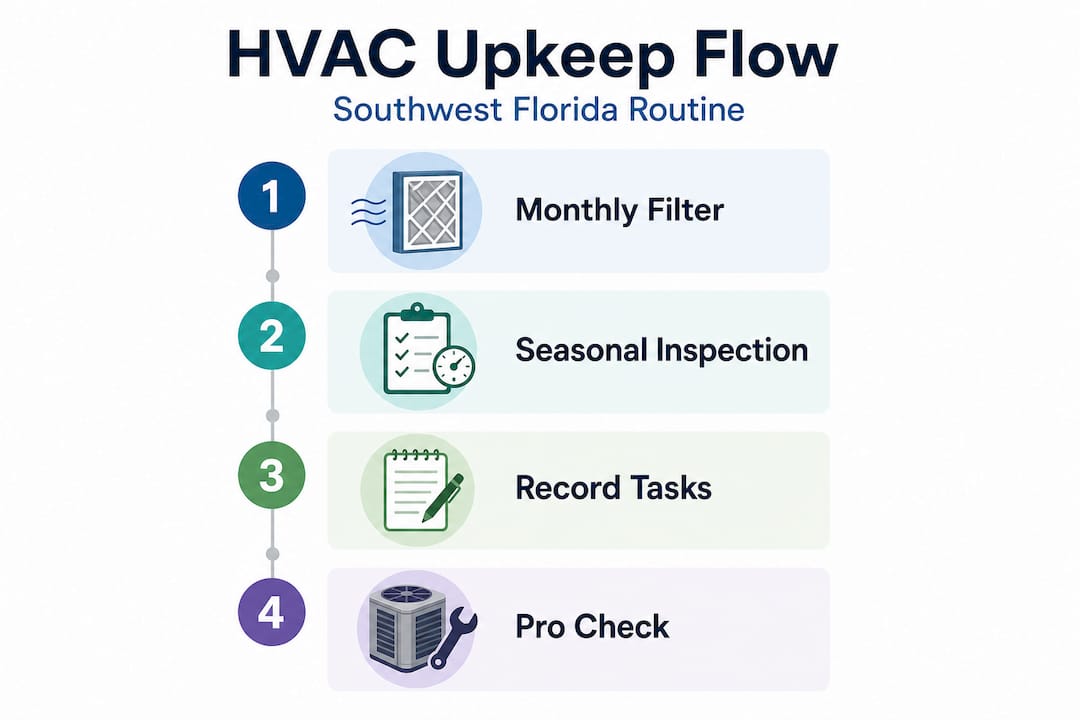
Commercial facilities align HVAC preventive maintenance with a structured inspection cadence including weekly, monthly, quarterly, and annual intervals that cover drain pan checks, filter and damper operation, and airflow verification. Residential systems benefit from a simplified version of that same structure.
Here is a practical schedule for Southwest Florida homeowners:
- Weekly: Glance at vents and the area around the air handler for visible moisture or unusual buildup.
- Monthly: Replace or inspect the air filter. Check and clear the condensate drain line outlet outside your home.
- Quarterly: Clean accessible coil surfaces, inspect wiring for visible wear, and test the thermostat.
- Annually: Schedule a professional tune-up before the peak cooling season, ideally in March or April. This should include refrigerant level checks, full coil cleaning, electrical testing, and blower wheel inspection.
Property managers overseeing rental homes or commercial spaces should keep logs that go deeper than a simple date and task entry.
“A maintenance log should capture not just what was done, but what was found. A note that reads ‘filter replaced’ is useful. A note that reads ‘filter was heavily soiled after only 3 weeks, possible duct leak suspected’ is actionable.”
That distinction makes the difference when a repair technician needs to identify the source of a recurring issue. It also protects you if a tenant files a complaint or if a warranty claim requires documented service history.
If a repair becomes necessary despite preventive efforts, the HVAC repair steps guide walks through the process. And if you face an urgent issue, having a plan in place using an emergency service checklist can save critical time.
Signs your HVAC needs attention and how to troubleshoot
Even with a solid maintenance schedule, your system will occasionally send warning signals. Catching them early is the difference between a quick fix and a full replacement.
Watch for these signs:
- Warm air from supply vents when the system is set to cool
- Visible ice or frost on the refrigerant lines or indoor unit
- Musty or sour smell from vents, indicating mold inside the air handler or ductwork
- Unusual sounds including banging, squealing, or persistent clicking at startup
- Water pooling around the base of the indoor unit
- Noticeably reduced airflow from one or more vents
- A sudden spike in your electric bill without a change in usage habits
Some of these symptoms have simple fixes you can try before calling a technician. If the system is blowing warm air, check the filter first. A severely clogged filter restricts airflow enough to cause the evaporator coil to ice over, which shuts down cooling. Replace the filter, switch the unit to “fan only” for 30 minutes to thaw the coil, then restart in cooling mode.
If the system is not turning on at all, check the circuit breaker before anything else. A tripped breaker from a voltage surge is a common and easy fix. Reset it once. If it trips again immediately, stop and call a professional because repeated tripping signals an electrical fault.
Condenser coil fouling can increase energy consumption by up to 37%, so dirty outdoor coils are worth addressing promptly. Rinse the condenser unit gently with a garden hose from the inside out to remove surface debris. Avoid using a pressure washer, which bends the delicate aluminum fins.
Pro Tip: Download your system’s model-specific error code list from the manufacturer’s website. Most modern thermostats and air handlers display fault codes that pinpoint the problem before a technician even arrives, saving diagnostic time and service fees.
When the issue involves refrigerant, electrical components, or anything inside the sealed refrigerant circuit, stop. These tasks require a licensed HVAC technician and in many cases a federal EPA 608 certification. Attempting them without proper equipment causes more damage and can void your warranty. Review DIY maintenance tips to understand exactly where the DIY boundary sits.
The hidden value of documentation: Why most HVAC checklists fail
Here is what most maintenance guides won’t tell you. The checklist itself is not what keeps your system running well. It’s the record you keep of following it.
We see this constantly in our work across Southwest Florida. A homeowner follows a reasonable maintenance routine for years but keeps no written record. When a compressor fails at year eight, the warranty claim requires documented evidence of annual professional maintenance. Without it, the manufacturer denies the claim. A $200 per year maintenance agreement with records just became a $2,500 out-of-pocket replacement.
Commercial guidance emphasizes logging as a core part of inspection and maintenance programs, not as an administrative afterthought. There is a reason that principle holds in every serious building management context. It is because logs reveal patterns that a single inspection never can. A filter that used to last 45 days now needs replacement every 18 days. That change tells you something: a new pet in the home, increased dust from a renovation, or a possible duct leak pulling in attic debris.
For homeowners, documentation also adds tangible value when selling a property. A buyer who sees a binder of dated maintenance records for the HVAC system, including professional tune-up invoices, filter logs, and repair notes, perceives lower risk and is more likely to accept the home as-is. That paper trail can directly affect your sale price.
Reviewing commercial HVAC best practices is worthwhile even for residential owners. The habits that keep large commercial systems running reliably in Florida’s climate translate directly to home systems. The scale is different. The principles are the same.
Ready to protect your comfort? Local HVAC experts can help
You now have a complete framework for keeping your system reliable through every season. Putting it into practice consistently is what separates the homeowners who face emergency repairs from those who don’t.
At Ultra Air Heating and Cooling, we work with homeowners and property managers across Naples, Cape Coral, and Fort Myers to perform the advanced maintenance tasks that go beyond DIY reach, including deep coil cleaning, refrigerant checks, electrical system testing, and full system tune-ups. Whether you need HVAC installation in Fort Myers for a new build or are focused on improving indoor air quality in an existing home, our team is ready to help. Don’t wait until the peak of summer to discover a problem. Book your pre-season inspection today.
Frequently asked questions
How often should homeowners in Southwest Florida check their HVAC systems?
Check your filters monthly and schedule a professional inspection at least once a year, ideally before peak cooling season. Structured maintenance cadences used in commercial settings recommend weekly visual checks alongside monthly, quarterly, and annual service intervals.
What are the most important HVAC maintenance tasks homeowners can do themselves?
Change air filters regularly, keep vents clear of furniture and obstructions, and rinse the outdoor condenser unit to remove debris. Dirty coils use up to 37% more energy, so even basic cleaning steps have a direct impact on your utility bills.
How do property managers track and document system upkeep across multiple units?
Use digital maintenance apps or shared logs to record inspections, filter changes, and service actions for each property individually. Preventive maintenance only works when corrective actions are recorded alongside dates and findings, not just task completion checks.
Why is scheduling seasonal HVAC maintenance important for Florida homes?
Seasonal maintenance prepares your system for shifting demand and catches developing issues before they become failures during peak weather. Pairing cooling-season tasks with fall heating checks as part of an annual schedule keeps both heating and cooling components in reliable condition throughout the year.