
Many Southwest Florida homeowners believe cranking the AC colder automatically means more comfort. It doesn’t. True comfort in our region depends on a precise balance of temperature, humidity, air quality, and airflow, and getting that balance wrong costs you money while still leaving you feeling miserable. Naples, Cape Coral, and Fort Myers summers push heat and humidity to extremes that most AC systems weren’t optimized to handle without the right setup. This guide breaks down exactly how air conditioning works in humid climates, what efficiency ratings and system sizes actually mean for your bills, and the practical steps you can take to feel genuinely comfortable year-round.
Table of Contents
- What does comfort really mean indoors?
- How AC systems control your home environment
- The impact of AC on energy costs and efficiency
- Why managing humidity is critical in Southwest Florida homes
- Bringing it all together: Steps to optimize comfort in your home
- Hard truths about air conditioning and comfort most experts miss
- Optimize your Southwest Florida comfort with Ultra Air
- Frequently asked questions
Key Takeaways
| Point | Details |
|---|---|
| Comfort is more than cooling | True comfort in your home blends temperature, humidity, air movement, and air quality. |
| AC efficiency drives savings | Higher SEER and correct AC sizing cut utility bills while keeping you comfortable. |
| Humidity control is vital | Managing indoor moisture prevents mold, stickiness, and boosts health and comfort. |
| Thermostat settings matter | A well-set thermostat and access for household members improve comfort and lower costs. |
| Optimize with the right solutions | Integrating dehumidifiers, zoning, and regular maintenance maximizes comfort year-round. |
What does comfort really mean indoors?
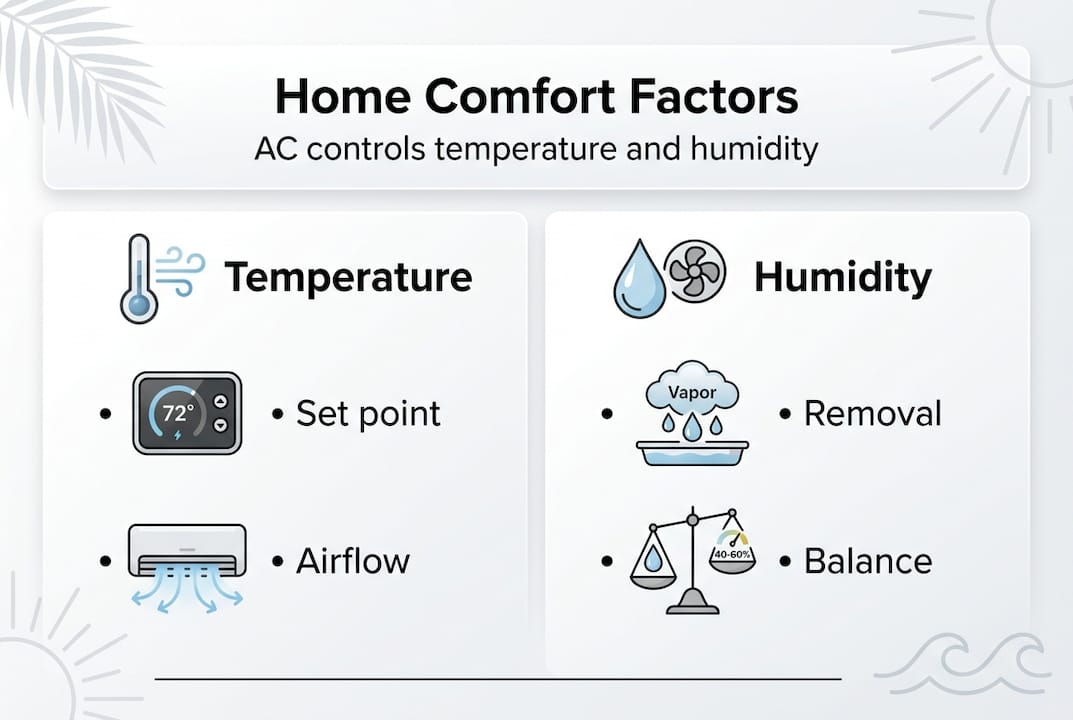
Most people define indoor comfort as “not too hot.” But thermal comfort, the technical term for feeling comfortable in a space, is actually controlled by five interacting factors: air temperature, humidity, airflow, radiant temperature (heat radiating from walls and floors), and air quality. Miss any one of these and you feel it, even if the thermostat reads 72°F.
Humidity is the sneakiest culprit here. The ideal indoor relative humidity (RH) sits between 30% and 60%. Above 60%, the air feels muggy and heavy, your skin stays damp, and mold risk climbs fast. Below 30%, air becomes dry and irritating, especially for your respiratory system. In Southwest Florida, the outdoor RH routinely pushes past 80% in summer, which means your AC is working overtime just to pull moisture out of the air before it can cool anything down effectively.
Here’s how those five comfort factors map to what your air conditioning system actually does:
| Comfort factor | Ideal range | What your AC does |
|---|---|---|
| Air temperature | 68–76°F | Cools supply air |
| Relative humidity | 30–60% RH | Removes moisture from air |
| Airflow | 15–60 fpm | Circulates conditioned air |
| Radiant temperature | Near air temp | Indirect: cools surfaces over time |
| Air quality | Low pollutants | Filters and ventilates |
The international benchmark for what qualifies as “comfortable” comes from ASHRAE 55, the standard most HVAC engineers use. Thermal comfort regulation covers temperature, humidity, air quality, and ventilation together, not temperature alone. That’s a critical distinction.
When AC systems fail to manage humidity properly, homeowners notice sticky air, condensation on windows, musty smells, and visible mold in corners or behind furniture. These aren’t just annoyances. They’re health hazards and signs your system is struggling. Learning about managing humidity levels in our climate gives you a real edge in solving these problems before they worsen.
Good indoor air quality tips also matter here. Dust, allergens, and volatile organic compounds (VOCs) all circulate through your home’s air and affect how comfortable you feel, regardless of the temperature.
“Comfort is not a single dial you turn. It’s a system you balance.”
With a sense of how complex comfort actually is, let’s see how air conditioning systems specifically make this balance possible in Southwest Florida.
How AC systems control your home environment
Your air conditioner operates on a vapor-compression refrigeration cycle. That sounds technical, but the process is straightforward: a refrigerant fluid absorbs heat from your indoor air at the evaporator coil, gets compressed to release that heat outside at the condenser, and then cycles back to absorb more heat. The refrigerant cycle also pulls moisture out of the air as warm humid air passes over the cold evaporator coil, which is why your AC produces condensation.
Four key components drive this process:
- Evaporator coil absorbs indoor heat and humidity
- Compressor pressurizes the refrigerant to move heat outdoors
- Condenser coil releases heat outside your home
- Air handler and blower circulate conditioned air through your ducts
The airflow component is often underestimated. Weak or unbalanced airflow means some rooms stay warm while others overcool, and humidity removal suffers throughout the house.
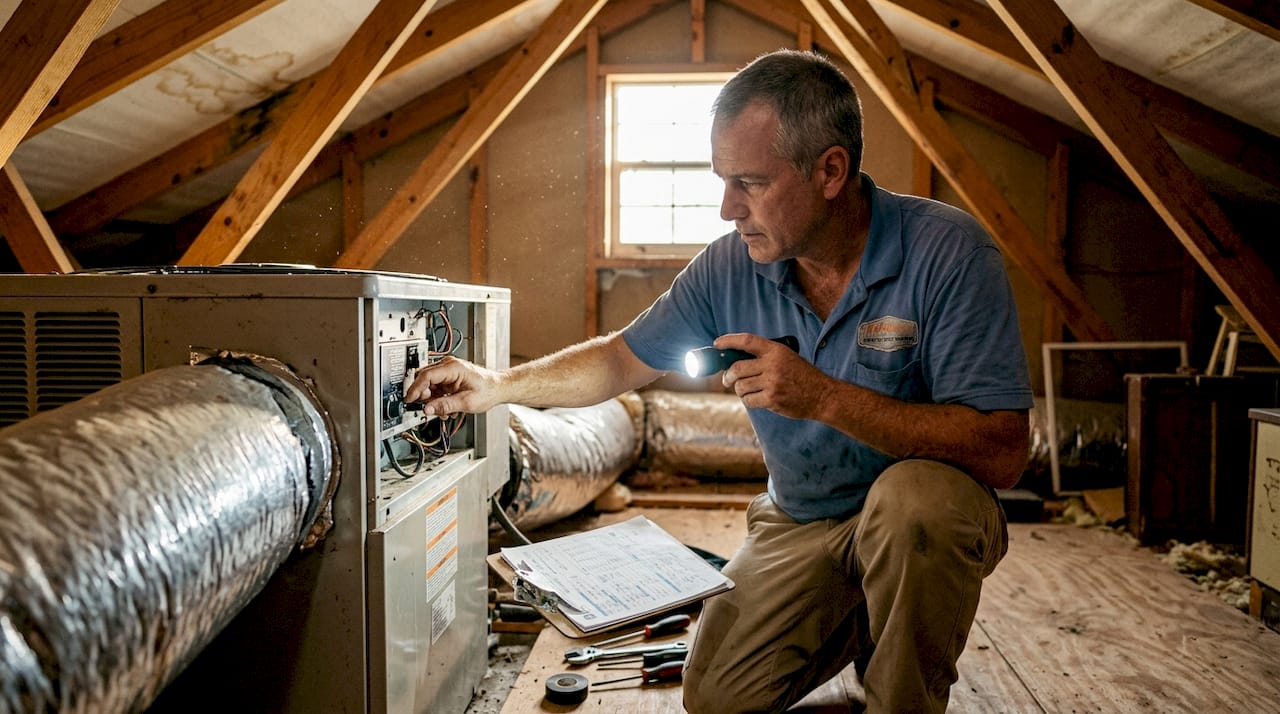
Here’s where sizing becomes critical. Southwest Florida homes carry what engineers call high latent loads, meaning the air contains so much moisture that your AC must work harder on humidity removal than on pure temperature reduction. Proper AC sizing using Manual J calculations accounts for both sensible heat (temperature) and latent heat (moisture) for humid climates like ours.
| System sizing | Temperature control | Humidity removal | Energy use |
|---|---|---|---|
| Properly sized | Consistent | Effective | Optimized |
| Oversized | Fluctuates | Poor (short cycles) | Wasteful |
| Undersized | Struggles | Overwhelmed | High |
An oversized AC cools air so quickly that it shuts off before completing a full cycle, a problem called short-cycling. Short-cycling means the system never runs long enough to pull significant moisture from the air. Your home hits the target temperature fast but feels humid and clammy within minutes. An undersized system runs nonstop, wears out faster, and still can’t keep up on the hottest days.
Pro Tip: Always ask for a Manual J load calculation before any new installation. Skipping this step is the single most common reason homeowners end up uncomfortable and overpaying on their utility bill.
Different HVAC system types handle these loads differently, and understanding your options is the first step to a smarter purchase. Everyday AC system tips can also help you get more out of your current setup while you plan for upgrades.
Now that we understand the mechanics, let’s break down what makes AC efficiency and energy savings possible and why it matters for your comfort and bills.
The impact of AC on energy costs and efficiency
SEER stands for Seasonal Energy Efficiency Ratio. It measures how much cooling output you get per unit of electricity consumed. Higher SEER means lower electricity use for the same cooling. Florida’s minimum SEER requirement is 15, and upgrading from an older unit below 10 SEER can cut your cooling costs by up to 40%.
For Southwest Florida homeowners, AC accounts for roughly 40 to 50% of the average monthly electric bill. Here’s what SEER upgrades look like in real terms:
| SEER rating | Estimated monthly savings vs. 10 SEER | Comfort benefit |
|---|---|---|
| 15 SEER | Baseline (minimum standard) | Adequate |
| 18 SEER | ~15–20% lower bill | Better humidity control |
| 20+ SEER | ~25–40% lower bill | Variable-speed precision |
Variable-speed compressors, found in higher-SEER units, are a game changer for comfort. Instead of running at full blast and shutting off, they modulate speed to match exactly how much cooling your home needs at any given moment. This means longer, gentler cycles that remove far more humidity and maintain steadier temperatures.
Programmable and smart thermostats add another layer of savings. Saving energy with AC is much easier when your system automatically adjusts temperatures during hours when you’re away or asleep.
Key upgrades worth considering:
- Variable-speed compressor for precise humidity control
- Smart thermostat for automated scheduling and energy tracking
- Zoned system to avoid cooling unoccupied rooms
- Regular maintenance to keep efficiency from degrading year over year
Pro Tip: Set your thermostat to 78°F when you’re home and raise it 7 to 10 degrees when you’re away. Each degree lower than 78°F adds roughly 8% to your cooling costs, so precision matters more than comfort guessing.
Beyond temperature and savings, let’s examine why handling humidity is the next frontier for true comfort in Southwest Florida homes.
Why managing humidity is critical in Southwest Florida homes
Southwest Florida’s humidity doesn’t take a break. Even in January, outdoor RH can hover around 70%, and from May through October, it’s relentlessly above 80%. Your AC handles some of this, but many standard systems aren’t designed to carry the full moisture load our climate demands.
Signs your home has a humidity problem:
- Air feels sticky even when the temperature reads comfortable
- Mold or mildew spots appear in bathrooms, closets, or near vents
- Condensation forms on interior windows
- Allergy or asthma symptoms worsen at home
- Wood floors or cabinets warp or swell
The consequences go beyond comfort. Excess indoor humidity causes mold growth, damages building materials, and creates respiratory health risks if left unmanaged.
Solutions that go beyond just cranking the AC colder:
- Install a whole-home dehumidifier to handle moisture independently of cooling cycles
- Upgrade to a variable-speed compressor that runs longer cycles for better moisture removal
- Add AC zoning for comfort to manage humidity room by room
- Improve ventilation with energy recovery ventilators (ERVs) to swap stale humid air for fresh filtered air
- Seal duct leaks that let humid attic air infiltrate your conditioned spaces
“Targeting 60% RH maximum saves energy without health risks as long as condensation is prevented on surfaces.”
Pro Tip: Don’t try to solve humidity by lowering your thermostat. Overcooling wastes energy, creates cold spots, and still doesn’t address the root moisture problem. Learn more about reducing home humidity and consider a whole-home dehumidifier for a direct fix.
Finally, let’s bring the science and solutions together so you can optimize comfort in your own home.
Bringing it all together: Steps to optimize comfort in your home
Real comfort in Southwest Florida isn’t accidental. It comes from deliberate choices about your system, your settings, and your habits. Here’s a practical checklist to work through:
- Get proper sizing done. If your AC was installed without a Manual J calculation, schedule an evaluation. Correct sizing fixes most sticky-air complaints immediately.
- Schedule annual maintenance. Clean coils, charged refrigerant, and clear drains all impact both comfort and efficiency throughout the season.
- Set your thermostat strategically. Use 78°F as your home baseline and program setbacks when you’re away. A smart thermostat makes this automatic.
- Address humidity separately if needed. If your home still feels muggy after addressing sizing and maintenance, add a dedicated dehumidifier or upgrade to variable-speed equipment.
- Upgrade when the math works. If your unit is over 10 to 12 years old and below 15 SEER, the energy savings from a new system often justify the investment within a few years.
- Give household members some control. Research shows that thermostat access increases comfort satisfaction and actually reduces energy use because people stop fighting over extreme settings.
Pro Tip: A simple programmable thermostat that everyone in the house can adjust reduces complaints and arguments about temperature while keeping average settings in the efficient range. Comfort is partly psychological, and control matters.
Browse everyday AC tips for more actionable guidance you can start using today.
Hard truths about air conditioning and comfort most experts miss
Here’s what we’ve learned after working with hundreds of Southwest Florida homeowners: the biggest comfort problems almost never come from the equipment itself. They come from how the equipment was sized, installed, or operated.
We regularly meet homeowners who spent thousands on a premium AC brand but are still miserable because nobody did a proper load calculation. We also meet homeowners with mid-range systems who are perfectly comfortable because sizing, maintenance, and humidity management were handled correctly from day one.
The other thing most experts don’t talk about? Psychological comfort is real. Homeowners who feel in control of their environment, even just having access to zoning for comfort or a programmable thermostat, report higher satisfaction. This isn’t soft science. It shows up in reduced energy use and fewer service calls.
The biggest return on investment in Southwest Florida HVAC almost always comes from proper sizing, humidity management, and thermostat strategy. Not from chasing the highest SEER rating available.
Optimize your Southwest Florida comfort with Ultra Air
If you’re ready to move from guessing about comfort to actually achieving it, Ultra Air Heating & Cooling is your local partner in Naples, Cape Coral, and Fort Myers.
We handle everything from correctly sized HVAC installation to humidity solutions, smart thermostat setups, and whole-home air quality improvements. Our team performs thorough load calculations so your new system fits your home, not just your floor plan. Need help financing an upgrade? We offer HVAC financing options designed to make better comfort accessible without a big upfront cost. Explore our improving indoor air quality services or schedule a consultation today to get a system that genuinely works for Southwest Florida’s unique demands.
Frequently asked questions
What temperature should I set my AC for maximum comfort and efficiency?
Set your thermostat to 78°F when you’re home. Each degree lower adds roughly 8% to your cooling costs, so staying at 78°F delivers real savings without sacrificing comfort.
Why does my home feel sticky even when the AC is running?
Your unit may be oversized and short-cycling, which means it cools the air quickly but doesn’t run long enough to remove humidity. Oversized units short-cycle and deliver poor dehumidification, and a proper Manual J sizing calculation solves this problem at the root.
Is it better to invest in a higher SEER AC for Southwest Florida?
Higher SEER units do save on energy costs, but SEER alone isn’t enough without proper sizing and humidity management. Balance all three factors for the best results in our climate.
Can air conditioners remove enough humidity in Florida’s climate?
Standard central ACs remove some humidity but often can’t keep up with Southwest Florida’s intense latent loads. Whole-home dehumidifiers or variable-speed systems are often needed to maintain true comfort here.
Does giving everyone a thermostat remote really help comfort?
Yes. Research confirms that perceived thermostat control improves comfort satisfaction and actually reduces overall energy use, making it a practical and low-cost improvement for any household.
Recommended
- AC Tips for Homeowners: Maximize Comfort & Save Energy
- Ultra Air Heating and Cooling Strategies for Growth in Southwest Florida – Ultra Air Heating and Cooling
- Best Practices for Ultra Air Heating and Cooling in Southwest Florida – Ultra Air Heating and Cooling
- Ultra Air Heating and Cooling Success: Expert Tips for SWFL Comfort – Ultra Air Heating and Cooling