
Commercial air conditioning in Southwest Florida isn’t a one-size-fits-all proposition. Between relentless humidity, salt air corrosion, hurricane season, and Florida’s strict building codes, property owners and managers face a unique set of challenges that national installation guides simply don’t address. Get the setup wrong and you’re looking at skyrocketing energy bills, moisture damage, code violations, and equipment that fails years before it should. This guide walks you through every critical phase of commercial AC installation in SWFL, from permitting and system selection to commissioning and post-install best practices, so you can protect your property and your budget.
Table of Contents
- Essential requirements for commercial AC setup in SWFL
- How to choose the right AC system for your building
- Step-by-step commercial AC installation process
- Energy efficiency, humidity, and post-installation best practices
- Why the conventional approach to commercial AC setup falls short in Southwest Florida
- Get professional air conditioning installation for your SWFL property
- Frequently asked questions
Key Takeaways
| Point | Details |
|---|---|
| Proper preparation is essential | Gather permits and review SWFL-specific codes to avoid delays and extra costs. |
| Choose the right system for humidity | Systems that control both temperature and humidity optimize comfort and reduce energy use in Southwest Florida. |
| Avoid common installation mistakes | Oversizing equipment and skipping commissioning lead to high bills and poor indoor air quality. |
| Ongoing maintenance saves money | Regular checks for duct sealing, humidity, and salt damage keep your AC efficient and compliant over time. |
Essential requirements for commercial AC setup in SWFL
Now that you understand the importance of getting your commercial AC installation right, let’s look at everything you must have in place before the first screw is turned.
Florida commercial HVAC is governed by a layered set of regulations. The Florida Building Code adopts ASHRAE 90.1 for energy efficiency, setting minimum IEER and EER2 ratings for equipment. The International Mechanical Code (IMC) covers mechanical systems. Permits are required for any system exceeding 65,000 BTU/h. In Southwest Florida, you also face additional requirements for hurricane anchoring, flood elevation compliance, and salt corrosion protection on exposed components. Skipping any of these layers creates serious liability.
Before installation begins, property managers should check:
- Valid permits pulled for the specific equipment and location
- Structural engineer sign-off for rooftop unit anchoring
- Compliance with hurricane HVAC protection standards
- Corrosion-resistant coatings specified for all outdoor components
- Flood elevation certificates if equipment is near ground level
- Contractor license verification with Florida DBPR
Here’s a quick reference for the key prerequisites:
| Requirement | Standard/Code | SWFL-Specific Add-On |
|---|---|---|
| Energy efficiency | ASHRAE 90.1 (IEER/EER2) | Latent load calculations required |
| Mechanical compliance | IMC | Hurricane anchoring per FBC |
| Permitting | Required above 65k BTU/h | HVAC permitting in Cape Coral |
| Corrosion protection | SMACNA/ASHRAE ductwork | Salt-spray-rated coils and fasteners |
| Flood mitigation | FBC Chapter 12 | Elevation certificates |
For ductwork layout and material specs, follow SMACNA/ASHRAE ductwork guidance to avoid pressure loss and moisture infiltration from the start.
Pro Tip: Submit permit applications and full equipment specs at least three to four weeks before your planned start date. Early permitting prevents the costly delays that push projects past peak season.
How to choose the right AC system for your building
Once prerequisites are met, selecting the right system design is the next critical decision.
Florida’s climate sits in ASHRAE Zones 1A and 2A, where latent heat removal, meaning moisture extraction, matters as much as raw cooling power. The wrong system type doesn’t just underperform; it can actively damage your building through elevated humidity and mold risk. Florida’s high latent loads demand systems with enhanced dehumidification, not just high efficiency ratings.
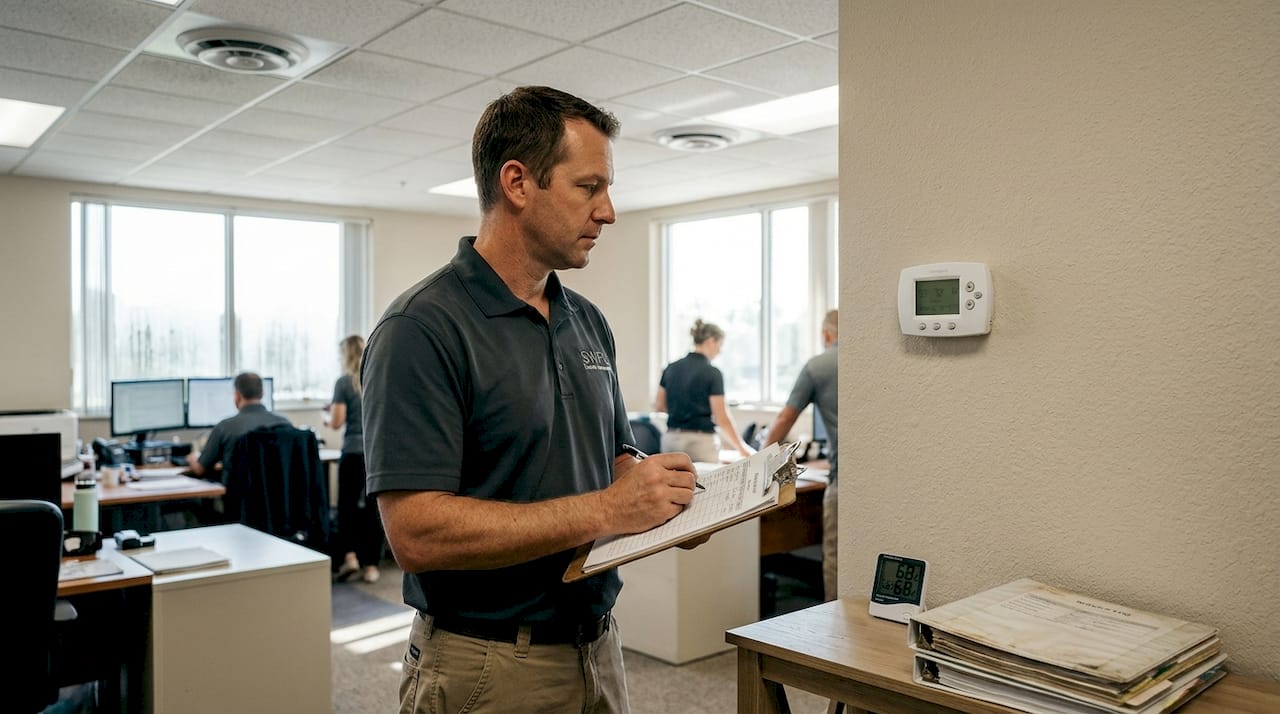
Here’s how the main system types stack up for SWFL commercial buildings:
| System Type | Best Fit | SWFL Consideration |
|---|---|---|
| Rooftop Unit (RTU) | Retail, small office under 50k sq ft | Needs enhanced dehumidification controls |
| Variable Refrigerant Flow (VRF) | 5,000 to 80,000 sq ft, multi-zone | Superior latent removal, high efficiency |
| Chiller System | Large buildings over 80,000 sq ft | High upfront cost, excellent scalability |
| Split System | Small commercial, server rooms | Cost-effective for targeted zones |
Follow these steps when selecting your system:
- Calculate your building’s load using ACCA Manual N or ASHRAE methodology.
- Account for 35 to 50% latent load in your total tonnage calculation.
- Estimate one ton per 450 to 650 square feet, adjusted for occupancy and exposure.
- Prioritize units with variable-speed compressors for humidity control.
- Confirm equipment is rated for Zone 1A/2A performance conditions.
- Verify salt-spray resistance for all outdoor components.
Common mistakes include oversizing the system (which causes short cycling and high relative humidity), underestimating dehumidification needs, and specifying equipment without corrosion ratings. Reviewing Florida HVAC system types helps you match technology to your building’s actual profile. Also, staying current with HVAC trends in Florida gives you a competitive edge in efficiency and tenant comfort.
Pro Tip: For any SWFL commercial building, prioritize units with advanced humidity controls and sensible heat ratios (SHR) between 0.70 and 0.78. Standard national specs often miss this critical zone.
Step-by-step commercial AC installation process
Choosing the right system means little without precise execution. Here’s how to ensure your installation meets every code and climate demand.
Commercial HVAC installation is a multi-phase process that spans weeks, not days. Rushing any phase creates problems that often don’t surface until the first hot, humid summer day.
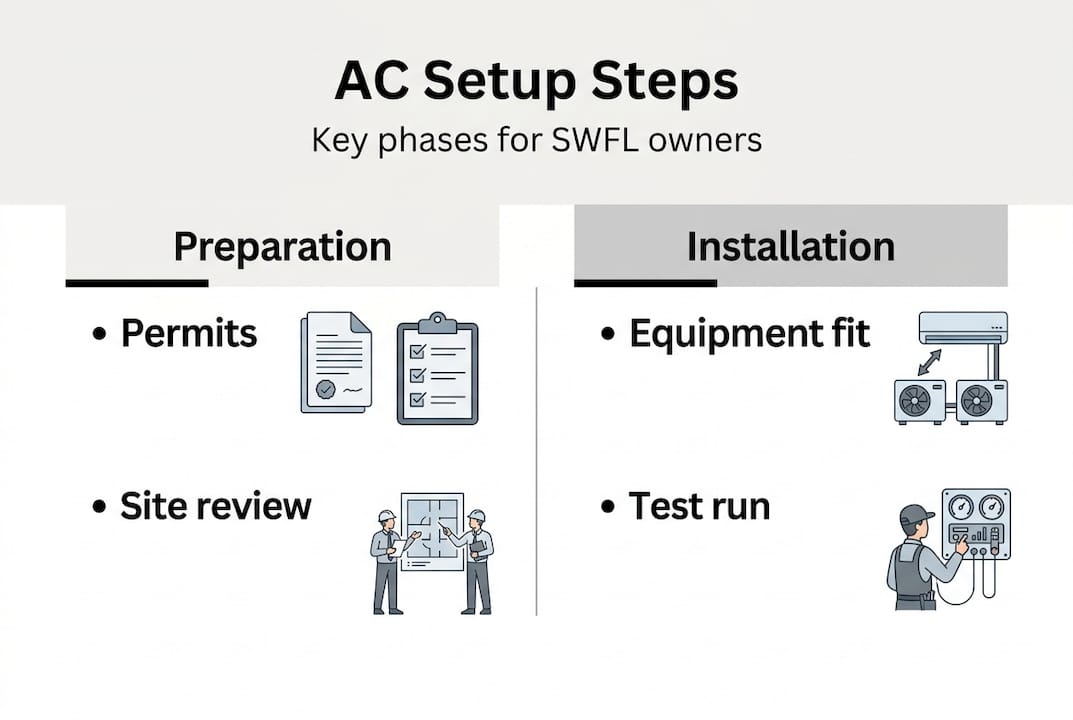
- Planning: Conduct load calculations using ACCA Manual N or ASHRAE methods. Define performance goals and budget.
- Design: Develop blueprints with energy modeling. Specify ductwork layouts and equipment schedules.
- Site prep and permitting: Pull permits, prepare structural supports, verify flood elevation compliance, and coordinate with the general contractor.
- Ductwork installation: Follow SMACNA standards for sealing and insulation. Pressure-test all runs before equipment connection.
- Equipment positioning: Install units with hurricane straps, corrosion-resistant hardware, and proper clearances per manufacturer and FBC requirements.
- Commissioning: Program the Building Management System (BMS), test airflow balance, verify humidity setpoints, and confirm code compliance.
- Ongoing maintenance: Schedule biannual coil inspections, filter changes, and duct sealing checks.
Critical checkpoints that installers sometimes skip:
- Ductwork pressure testing before walls close up
- Hurricane anchor torque verification
- BMS integration testing under full load
- Humidity sensor calibration
- Documentation package for the local building inspector
Warning: Missing even one compliance step, such as skipping the BMS commissioning or omitting hurricane anchoring documentation, can trigger fines, require costly rework, and void manufacturer warranties. In Southwest Florida, this is not a shortcut worth taking.
For a detailed breakdown of installation phases, the full installation guide covers equipment-specific steps for Fort Myers properties. Understanding HVAC business efficiency benefits also helps you frame the ROI conversation with stakeholders before the project kicks off.
Energy efficiency, humidity, and post-installation best practices
Once the system is in and running, ongoing steps ensure it delivers on comfort, efficiency, and long-term safety.
HVAC accounts for 35 to 45% of commercial energy use in commercial buildings, according to EIA CBECS data. That means even small improvements in system performance translate directly into significant savings on your monthly utility bills. In Southwest Florida, the variables that affect performance go beyond temperature.
High humidity demands units with low SHR values between 0.70 and 0.78, variable-speed or two-stage compressors, and in many cases, supplemental whole-building dehumidifiers. An oversized system that short-cycles will consistently push relative humidity above 60%, creating conditions for mold growth and tenant complaints.
Post-installation actions every property manager should schedule:
- Monthly filter inspections and replacements as needed
- Biannual duct sealing and pressure testing
- Quarterly coil cleaning, with salt residue checks in coastal locations
- BMS setpoint reviews each season
- Humidity sensor recalibration every six months
- Annual energy benchmarking against ASHRAE 90.1 minimums
Variable-speed equipment pays for itself faster in Southwest Florida than almost anywhere else in the country. It modulates capacity to match actual load, which means better dehumidification at partial loads and lower energy draw during mild weather. Proper commissioning at startup ensures the equipment actually operates within those parameters rather than defaulting to full-capacity mode.
Post-install pitfalls to watch for include short cycling (usually a sign of oversizing), persistently high humidity above 55%, and unusual noise from ductwork indicating pressure imbalance. Maintaining indoor air quality benchmarks protects both occupant health and your building’s reputation. Scheduling professional duct cleaning removes accumulated debris that reduces airflow and system efficiency over time.
Pro Tip: Schedule duct sealing checks and full humidity tests every six months, once before summer and once entering winter. This two-a-year rhythm catches problems before they become expensive failures.
Why the conventional approach to commercial AC setup falls short in Southwest Florida
National installation standards are written for average conditions. Southwest Florida is anything but average. We see buildings where code-compliant systems installed by qualified contractors still underperform because the specs stopped at the minimum required rather than what the environment actually demands.
The tension between energy efficiency codes and latent removal is real. Chasing the highest EER rating without checking the SHR often results in a system that cools the air but leaves it wet. Duct sealing and commissioning are not optional finishing touches; they are the difference between a system that lasts 18 years and one that needs major repairs at year seven.
Most post-install failures we observe in SWFL trace back to three shortcuts: inadequate duct sealing, insufficient dehumidification capacity, and missing corrosion controls on outdoor components. Salt air doesn’t give equipment a grace period. A VRF system is ideal for buildings between 5,000 and 80,000 square feet, RTUs work under 50,000, and chillers fit buildings above 80,000 square feet, but none of them perform as designed without customization for SWFL conditions.
Our experience working with Southwest Florida HVAC expertise tells us that the properties with the lowest operating costs are the ones whose owners insisted on going beyond default code minimums. That investment in detail almost always pays back within two to three cooling seasons.
Get professional air conditioning installation for your SWFL property
Ready to move from theory to a commercial-grade solution tailored for Southwest Florida?
Ultra Air Heating and Cooling brings hands-on experience with Florida Building Code permitting, hurricane anchoring requirements, and humidity-focused system design to every commercial project we handle. We don’t apply cookie-cutter specs to SWFL buildings.
From system selection and permitting to commissioning and ongoing support, our team manages the entire process so you can focus on running your business. Our HVAC installation services are built around the real demands of Naples, Cape Coral, and Fort Myers properties. We also offer air quality solutions to keep your tenants comfortable year-round. Contact Ultra Air today to schedule a commercial consultation.
Frequently asked questions
What is the most energy-efficient commercial AC system for Southwest Florida?
Variable refrigerant flow (VRF) systems rank among the most efficient for SWFL buildings because they offer precise load matching and superior latent heat removal suited to Florida’s high-humidity climate zones.
How do I prevent humidity problems with my new commercial AC?
Specify systems with low SHR and variable-speed compressors, size equipment accurately using Manual N, and schedule humidity sensor checks every six months to catch drift before it becomes a problem.
Do I need a permit for a commercial AC install in Florida?
Yes. Florida law requires permits above 65k BTU/h, and Southwest Florida adds hurricane anchoring and flood elevation documentation as mandatory parts of the approval package.
How often should ductwork and coils be checked on a commercial AC system?
Inspect ducts and coils at least twice per year. In coastal SWFL locations, salt corrosion on coils can accelerate damage quickly, making biannual checks the minimum rather than the ideal.
What’s the number one mistake in Florida commercial AC setups?
Oversizing the system. An oversized unit short-cycles and raises RH above 60%, driving up both operating costs and the risk of mold growth in the building.
Recommended
- DIY AC Maintenance Checklist for SWFL Homeowners: 2026 Edition – Ultra Air Heating and Cooling
- Step-by-step HVAC repair guide for SW Florida homes
- AC Troubleshooting Guide: Solve Common Problems Fast
- Professional AC Cleaning Services: A Homeowner’s Guide to SWFL Comfort – Ultra Air Heating and Cooling
- HVAC Installation Step by Step for Homeowners