
Cooling your home in summer shouldn’t mean choosing between comfort and a manageable electric bill. Yet millions of homeowners face exactly that trade-off every season, running inefficient systems that cost far more than they should. This guide to energy efficient cooling walks you through everything that actually moves the needle: preparing your home, choosing the right system, running it smarter, and confirming it’s working as promised. Follow these steps and you’ll spend less to stay cooler, not more.
Table of Contents
- Key takeaways
- Your guide to energy efficient cooling starts with home prep
- Choosing the right efficient cooling system
- Implementing energy-saving practices day to day
- Quality installation and system verification
- Troubleshooting and extending system lifespan
- What I’ve learned after years of watching cooling systems succeed and fail
- How Ultraairswfl can help you cool smarter
- FAQ
Key takeaways
| Point | Details |
|---|---|
| Prep your home first | Insulation, air sealing, and shading cut your cooling load before you ever touch the thermostat. |
| Size your system correctly | An oversized AC wastes energy and creates humidity problems that make rooms feel uncomfortable. |
| Use fans strategically | Ceiling and portable fans let you raise the thermostat several degrees without losing comfort. |
| Demand quality installation | Proper refrigerant charge and airflow verification matter more than a high SEER rating on the box. |
| Track performance over time | Monitoring energy use after installation confirms your system is delivering what you paid for. |
Your guide to energy efficient cooling starts with home prep
Most homeowners go straight to buying a new AC unit when their cooling costs spike. That’s usually the wrong first move. Before any equipment upgrade pays off, you need to reduce how much heat your home absorbs in the first place.
Think of your house as a container. If that container leaks, no cooling system will ever run efficiently. Combining insulation, air sealing, and shading reduces your cooling load significantly, letting your AC work far less to maintain the same temperature. Attic insulation alone makes one of the biggest differences in hot climates, because most heat enters through the roof.
Here’s a practical checklist to work through before you upgrade or replace any cooling equipment:
- Check attic insulation depth (aim for R-38 to R-60 in hot climates)
- Seal gaps around electrical outlets, plumbing penetrations, and attic hatches with caulk or foam
- Weatherstrip doors and windows to stop conditioned air from escaping
- Install blackout or reflective window coverings on west and south-facing windows
- Add attic ventilation or a radiant barrier if your attic temperatures regularly exceed 130°F
- Weatherize your home by addressing any uncontrolled air leaks before running the AC harder
Pro Tip: Seal air leaks before adding insulation. Insulation slows heat transfer, but it won’t stop air movement. Do both and you’ll feel the difference immediately.
| Preparation step | What you need | Why it matters |
|---|---|---|
| Attic insulation upgrade | Blown-in or batt insulation, vapor barrier | Reduces radiant heat gain through the ceiling |
| Air sealing | Caulk, spray foam, weatherstripping | Stops conditioned air from leaking out |
| Window shading | Reflective film, exterior shades, blinds | Blocks solar heat before it enters the glass |
| Duct inspection | Duct mastic, foil tape, flashlight | Leaky ducts waste 20 to 30 percent of cooled air |
Getting these fundamentals right is what separates homeowners who see real savings from those who buy a new unit and wonder why the bill barely changed.
Choosing the right efficient cooling system
Once your home is prepared, the next step is matching the right system to your actual cooling needs. This is where most people make expensive mistakes.
Sizing is not optional
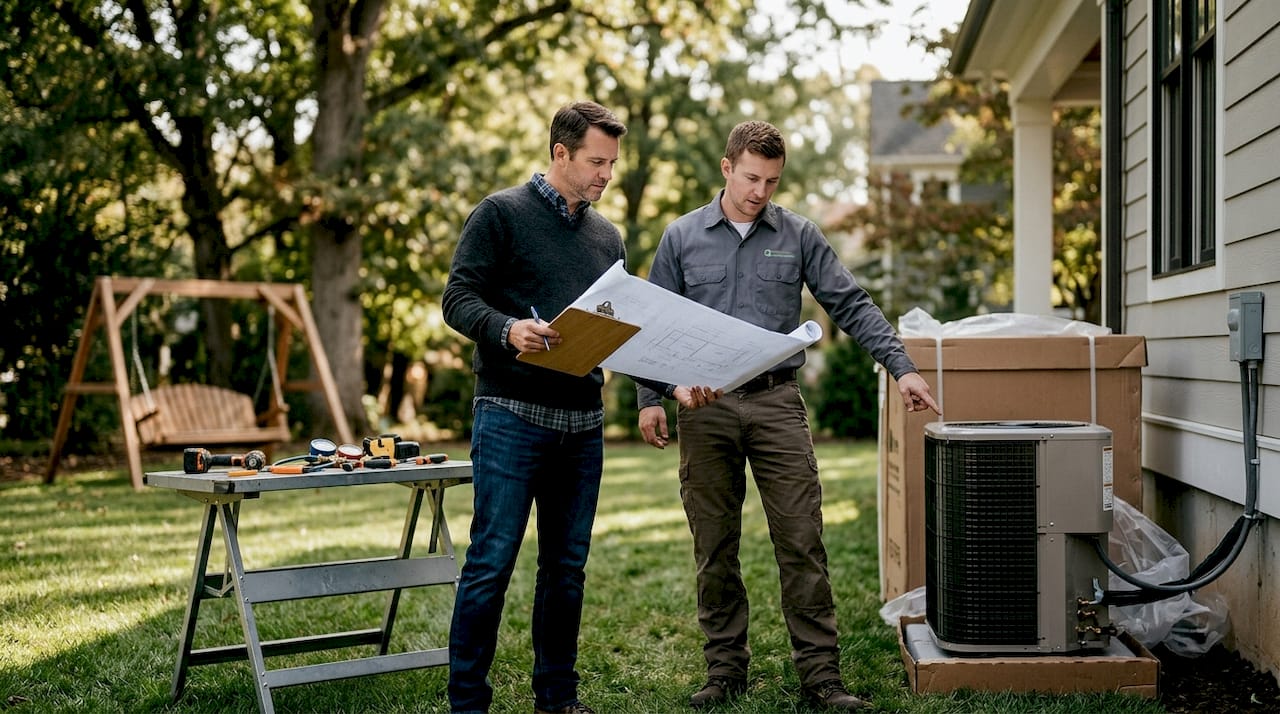
Oversized air conditioners waste energy and fail to remove humidity properly, leaving rooms feeling damp and clammy even when the thermostat hits the target. A correctly sized unit runs longer cycles, pulls moisture out of the air, and uses less electricity doing it. For help calculating the right size for your space, this Florida AC sizing guide breaks down the process clearly.
System types and their trade-offs
| System type | Best for | Efficiency | Upfront cost |
|---|---|---|---|
| Central AC | Whole-home cooling with existing ducts | High (SEER2 16+) | Moderate to high |
| Mini-split (ductless) | Room additions, older homes, zoned control | Very high | Moderate to high |
| Heat pump | Homes needing both heating and cooling | Very high | Higher upfront |
| Window/room AC | Single rooms, renters, supplemental cooling | Moderate | Low |
Mini-splits and heat pumps consistently outperform traditional central AC in efficiency ratings, and they give you zoned control that central systems can’t match without an upgrade. That said, central AC makes sense if you already have well-sealed ductwork and want to cool the whole house uniformly.
What to look for in equipment
Variable speed compressors adapt their output to actual demand rather than cycling fully on and off. The result is quieter operation, better humidity control, and real energy savings over a full season. Look for ENERGY STAR certified equipment, which also uses low-GWP refrigerants that are better for the environment.
Pro Tip: Don’t buy the highest SEER unit on the shelf and assume you’re done. A SEER 20 unit installed poorly will underperform a SEER 16 unit installed correctly every single time.
Implementing energy-saving practices day to day
Buying a good system is step one. Running it intelligently is where you actually cut the bill.
- Set your thermostat to 75 to 78°F during occupied hours. The DOE recommends this range as the sweet spot between comfort and efficiency in most climates.
- Raise the setpoint when you leave. Setting the thermostat 7°F higher when the house is empty saves measurable cooling energy without making your system work hard to recover when you return.
- Use ceiling fans in occupied rooms. Fans combined with AC allow you to raise the thermostat setpoint by several degrees and reduce energy use by around 30% without feeling warmer. Turn fans off when you leave the room.
- Install a programmable or smart thermostat. Schedules that align with your actual occupancy pattern prevent the system from cooling an empty house. Smart thermostats learn your routine and adjust automatically.
- Run kitchen and bathroom exhaust fans during and after cooking or showering. These pull heat and humidity out before they spread through the house.
- Close blinds and curtains on sun-facing windows during peak afternoon hours. This alone can reduce solar heat gain by up to 77 percent on south and west windows.
- Clean or replace your air filter monthly during heavy cooling season. A clogged filter makes the system work harder and can cause coil freeze-up.
A few additional habits that compound over a full season:
- Run heat-generating appliances (dishwashers, ovens, dryers) in the early morning or evening
- Use a dehumidifier in particularly humid rooms to reduce the AC’s moisture load
- Keep supply vents open and unblocked in all rooms, even those you use less often
- Check your outdoor unit monthly for debris buildup around the condenser coils
Pro Tip: Avoid setting the thermostat dramatically lower when you get home after a hot day. Extreme thermostat setbacks cause longer recovery runs and higher energy spikes. A 7°F adjustment is the effective ceiling for savings without penalty.
Quality installation and system verification
You can do everything else right and still end up with a system running at 60 percent of its rated efficiency. The culprit is almost always a poor installation.
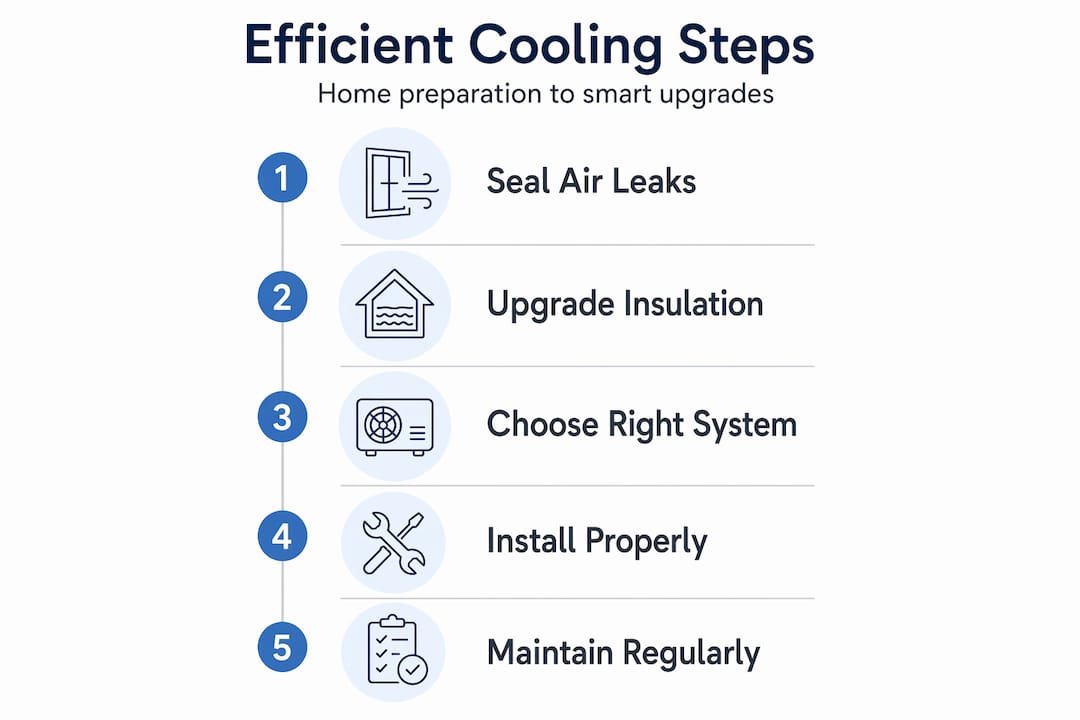
Proper refrigerant charging and airflow verification are critical for maintaining rated efficiency and extending equipment life. Many installers skip these steps to save time, and homeowners have no idea until their system underperforms for years. Review these essential installation steps to know what to expect from any contractor you hire.
Here’s what to verify after any new installation:
| Verification check | What to confirm | Red flag if missed |
|---|---|---|
| Refrigerant charge | Matches manufacturer spec (not just “added some”) | System runs longer, higher bills |
| Airflow measurement | 350 to 400 CFM per ton across the coil | Coil freeze-up, poor humidity control |
| Duct leakage test | Less than 5% leakage to outside | 20 to 30% of cooling lost before it reaches rooms |
| Thermostat calibration | Reads actual room temperature accurately | System short-cycles or runs too long |
| Drain line check | Clear, properly sloped, with secondary drain | Water damage and mold in humid climates |
Pro Tip: Ask your contractor for a startup report that documents refrigerant charge and airflow readings. A contractor who refuses to provide this is a contractor to avoid.
Working with a qualified technician isn’t a luxury. It’s the only way to confirm that the efficiency rating you paid for is actually what you’re getting.
Troubleshooting and extending system lifespan
Even a well-installed system will develop problems without regular attention. Knowing the signs early saves you from a full replacement years ahead of schedule.
Watch for these warning signs:
- Rooms that feel humid even when the AC is running (likely an oversized or failing system)
- Unusually long run times that never seem to reach the set temperature (refrigerant leak or airflow blockage)
- Ice forming on refrigerant lines or the indoor coil (dirty filter, low charge, or blocked airflow)
- A sudden spike in your electric bill with no change in usage habits (system efficiency has dropped)
- Uneven cooling between rooms (duct issues or zoning imbalance)
If your system is more than 12 years old and showing any of these signs, an HVAC retrofit may cost less over five years than continuing to repair an aging unit. For homes with multiple zones or significant temperature variation between floors, HVAC zoning is worth serious consideration.
One technology worth watching: ESEAC systems that integrate energy storage directly into the AC unit can reduce cooling electricity use by 38% and cut peak demand by 93%, according to NREL research. This technology is becoming more accessible for residential use and will reshape what efficient cooling systems look like within the next few years.
Schedule a professional tune-up once a year, ideally in the spring before cooling season starts. That single appointment catches refrigerant issues, cleans coils, checks electrical connections, and verifies that your system is ready to perform when you need it most.
Pro Tip: Set a calendar reminder every March to schedule your annual AC tune-up. Most HVAC companies are booked out for weeks once summer heat arrives. Scheduling early costs nothing extra and guarantees you’re not caught with a failing unit in July.
What I’ve learned after years of watching cooling systems succeed and fail
I’ve watched homeowners spend three thousand dollars on a new high-efficiency unit and see their electric bill barely budge. I’ve also watched a family cut their cooling costs by 40% without replacing their AC at all. The difference? The second family sealed their attic, added insulation, and replaced their ancient single-pane windows before touching the equipment.
The loudest myth in this industry is that efficiency lives in the equipment label. In my experience, the biggest gains almost always come from reducing what the system has to fight against. A well-sealed, well-insulated home with a correctly sized 16 SEER unit will outperform a drafty house running a 20 SEER unit every month of the year.
I’m also direct about sizing with anyone who asks. Oversizing is rampant because contractors sometimes feel pressure to give clients “more cooling power.” What it actually delivers is poor humidity control, short-cycling, and a system that wears out faster. The impact of oversizing is real and consistently underestimated.
The homeowners who get the best long-term results share one trait. They treat their cooling system as a system, not an appliance. They prep the envelope, size correctly, install properly, and maintain consistently. That’s not complicated. It just requires following the steps in order.
— albert
How Ultraairswfl can help you cool smarter
If you’re in Naples, Cape Coral, or Fort Myers and ready to stop overpaying to cool your home, Ultraairswfl is the team to call. We specialize in energy-efficient cooling solutions tailored to the specific demands of Southwest Florida’s climate, from sizing consultations and ENERGY STAR installations to full system retrofits and indoor air quality upgrades. Our technicians verify refrigerant charge and airflow on every installation, and we document it so you know you’re getting what you paid for. We also help clients take advantage of available rebates and financing for qualifying ENERGY STAR upgrades. Whether you need a new installation, a repair, or a full heating and cooling system review, contact Ultraairswfl to schedule your consultation and start saving this season.
FAQ
What is the most energy efficient way to cool a home?
The most effective approach combines building envelope improvements (insulation, air sealing, window shading) with a correctly sized ENERGY STAR certified cooling system and smart thermostat scheduling. No single fix outperforms doing all three together.
What temperature should I set my AC for energy savings?
The DOE recommends 75 to 78°F when you’re home and raising the setpoint by 7°F when the house is empty. Avoid large setbacks, as extreme temperature swings cause longer recovery runs that cancel out your savings.
Does an oversized AC unit really cause problems?
Yes. Oversized units short-cycle, meaning they cool the air temperature quickly but don’t run long enough to pull humidity out. The result is a room that reads 74°F but still feels sticky and uncomfortable.
How often should I service my air conditioner?
Once a year is the standard recommendation, ideally in spring before peak cooling season. Annual maintenance catches refrigerant issues, cleans coils, and confirms the system is operating at rated efficiency.
Are ceiling fans worth using with AC?
Absolutely. Fans create a wind-chill effect that lets you raise your thermostat several degrees without feeling warmer, cutting energy use noticeably. Just turn them off when leaving a room since they cool people, not spaces.