
Indoor air testing is the process of measuring invisible pollutants inside your home to identify hazards before they damage your health. The U.S. EPA reports that indoor air is 2–5 times more polluted than outdoor air. That gap is alarming when you consider that most people spend about 90% of their time indoors. Contaminants like volatile organic compounds (VOCs), radon, carbon monoxide, and mold spores are odorless and invisible. Testing is the only reliable way to know what you are actually breathing every day.
Why indoor air testing is the first step every homeowner should take
Poor indoor air quality ranks among the top five environmental health risks, linked to respiratory disease, cardiovascular problems, cognitive impairment, and cancer. That is not a distant risk. It builds up quietly over months and years of daily exposure in your own living room, bedroom, and kitchen. Testing gives you a factual baseline instead of guesswork.
The core value of indoor air quality monitoring is that it replaces assumptions with data. You cannot smell most VOCs at dangerous concentrations. You cannot feel radon accumulating in your basement. A test tells you exactly what is present, at what level, and whether it exceeds established health thresholds. That data is what makes targeted action possible.
Homeowners who skip testing often spend money on air purifiers and filters without knowing whether those products address their actual problem. Source control, which means removing or reducing the pollutant at its origin, is far more effective than filtering air after the fact. Testing tells you what the source is.

What pollutants does indoor air testing detect?
Indoor air quality testing identifies a wide range of contaminants. Each one has a distinct source and a distinct health effect. Understanding what testing covers helps you decide which tests your home actually needs.
Common indoor pollutants and their effects:
- VOCs (volatile organic compounds): Released by paints, furniture, cleaning products, and adhesives. Cause eye and throat irritation, headaches, and long-term organ damage with chronic exposure.
- Radon: A radioactive gas that seeps from soil and rock into basements and lower floors. Radon is the second leading cause of lung cancer, responsible for around 21,000 deaths annually in the United States. It has no smell, no color, and no taste.
- Carbon monoxide (CO): Produced by gas appliances, furnaces, and attached garages. Carbon monoxide is completely undetectable by your senses and causes headaches, nausea, brain damage, and death depending on concentration and duration.
- Mold spores: Indicate hidden moisture problems behind walls, under floors, or in HVAC systems. Trigger allergies, asthma attacks, and chronic respiratory symptoms.
- Particulate matter (PM2.5): Fine particles from cooking, candles, and outdoor infiltration. Penetrate deep into lung tissue and contribute to cardiovascular disease.
- Allergens: Dust mites, pet dander, and pollen accumulate in carpets and upholstery, worsening asthma and allergic reactions.
| Pollutant | Common sources | Primary health effect |
|---|---|---|
| VOCs | Paints, cleaners, furniture | Irritation, organ damage |
| Radon | Soil, foundation cracks | Lung cancer |
| Carbon monoxide | Gas appliances, furnaces | Brain damage, death |
| Mold spores | Moisture, leaks, HVAC | Respiratory disease |
| PM2.5 | Cooking, candles, outdoor air | Cardiovascular and lung damage |
| Allergens | Carpets, pets, bedding | Asthma, allergic reactions |
Pro Tip: If you have recently renovated, installed new flooring, or repainted, test for VOCs within 30 days. New materials off-gas most heavily in the first weeks after installation.
Routine home inspections and pest control checks can also uncover moisture damage and structural entry points that worsen indoor air quality over time.
How does indoor air testing work?
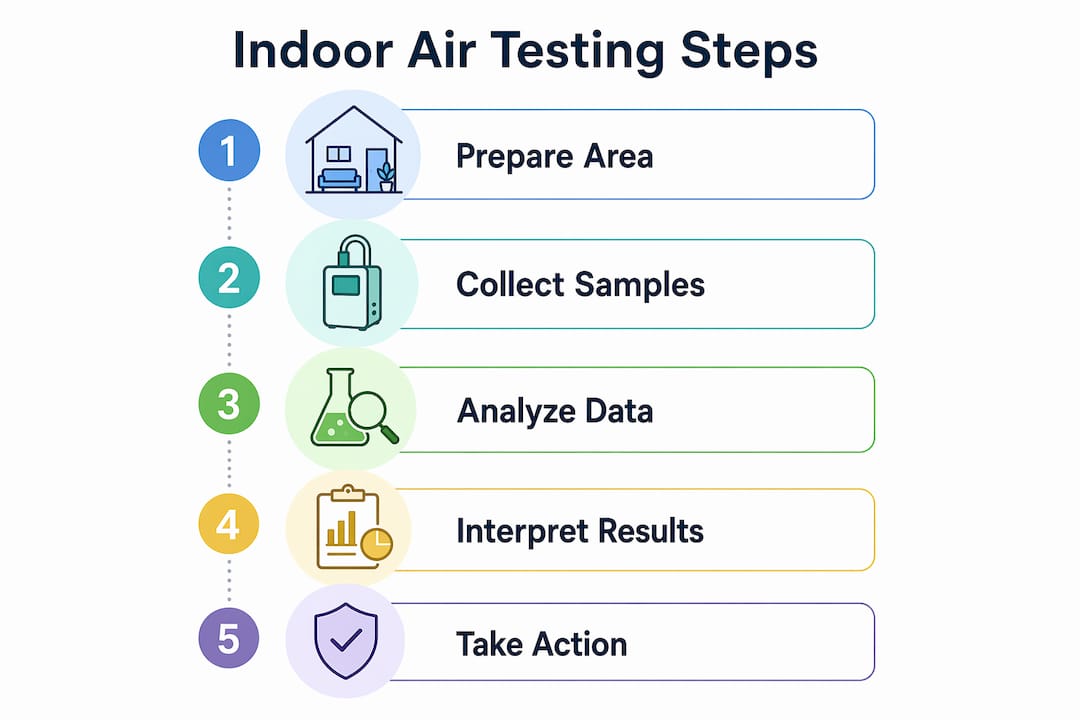
Indoor air quality monitoring uses two broad approaches: snapshot testing and continuous monitoring. Each has a specific role depending on your goals.
Snapshot testing captures conditions at a single point in time. A technician or a DIY kit collects an air or surface sample, which is then analyzed in a lab. This method works well for identifying whether a specific pollutant is present and at what level. Radon test kits, mold spore cassettes, and VOC canisters all fall into this category.
Continuous monitoring tracks pollutant levels over hours or days. VOC and CO2 levels fluctuate significantly throughout the day based on cooking, cleaning, and occupancy patterns. A one-time snapshot can miss peak exposure windows entirely. Continuous monitors capture that variation and give you a more accurate picture of real exposure risk.
Testing parameters typically include PM2.5, CO2 as a ventilation proxy, VOCs, mold spores, radon, and carbon monoxide. A healthy indoor environment depends on all of these being within safe ranges, not just one or two.
Professional testing vs. DIY kits:
- DIY kits work for radon and basic mold screening. They are affordable and accessible.
- Professional assessments cover a broader range of parameters, use calibrated equipment, and include expert interpretation of results.
- Initial residential assessments typically cost between $300 and $600, depending on scope and home size.
- For households with children, elderly residents, or anyone with asthma, professional testing provides the accuracy and scope that DIY kits cannot match.
Pro Tip: Ask any testing service which specific parameters their assessment covers before booking. A test that only checks mold will miss radon, CO, and VOCs entirely.
How do you interpret indoor air test results?
Test results list pollutant concentrations measured in units like parts per million (ppm) or micrograms per cubic meter. The key is comparing those numbers to established health thresholds.
CO2 levels above 1,000 ppm during normal occupancy signal poor ventilation. That means your home is not exchanging enough fresh air, which causes pollutants of all types to accumulate. Improving air exchange is the first fix when CO2 readings are elevated.
The U.S. EPA recommends source control as the primary strategy for improving indoor air quality. Filtering air is a secondary measure. If your test reveals high VOC levels, the right response is to identify and remove the source, whether that is a specific product, material, or appliance, not simply to run an air purifier.
Common results and recommended actions:
| Pollutant level | Interpretation | Recommended action |
|---|---|---|
| CO2 above 1,000 ppm | Poor ventilation | Increase fresh air exchange, check HVAC |
| Radon above 4 pCi/L | EPA action level | Install radon mitigation system |
| VOCs elevated | Off-gassing or chemical source | Identify and remove source, ventilate |
| Mold spores elevated | Hidden moisture problem | Locate and fix moisture source, remediate mold |
| PM2.5 elevated | Combustion or outdoor infiltration | Improve filtration, identify combustion sources |
Follow-up testing after remediation is not optional. It confirms that your intervention actually worked. Without a second test, you are assuming the problem is solved rather than knowing it is. The home air quality improvement process typically involves testing, source control, ventilation adjustment, and then verification testing.
For households with asthma sufferers, the indoor air quality checklist for asthma from Ultraairswfl provides a structured approach to acting on test results.
When should homeowners consider air quality testing?
Certain situations call for testing more urgently than others. Knowing when to test prevents both unnecessary spending and missed hazards.
- Unexplained health symptoms. Persistent headaches, fatigue, eye irritation, or worsening allergies that improve when you leave home are classic signs of poor indoor air. These symptoms point to a home-specific exposure rather than a general illness.
- After water damage or flooding. Moisture events create ideal conditions for mold growth within 24–48 hours. Testing after a flood, roof leak, or plumbing failure identifies mold before it spreads inside walls.
- After renovations. Sanding, painting, installing new flooring, or replacing cabinetry releases VOCs and particulates. Testing within weeks of a renovation confirms whether levels have returned to safe ranges.
- Before moving into a new home. Radon levels, mold history, and VOC off-gassing from new construction materials are invisible to a standard home inspection. Air quality testing fills that gap.
- Routine testing for vulnerable households. Children, elderly residents, and people with asthma or chronic lung disease face greater health risks from the same pollutant levels that a healthy adult might tolerate. Annual or biannual testing is appropriate for these households.
Testing should be targeted and purposeful. Testing without a clear objective produces data that is difficult to interpret and act on. Identify your concern first, then choose the test that addresses it directly.
Pro Tip: Keep a simple log of when symptoms occur and where in the home they are worst. That pattern often points directly to the pollutant source before you even test.
Key Takeaways
Indoor air testing is the only reliable method to identify the invisible pollutants that cause chronic health damage in residential spaces.
| Point | Details |
|---|---|
| Indoor air is more polluted than outdoor air | EPA data shows indoor air is 2–5 times more polluted, making testing a health priority. |
| Testing identifies specific hazards | VOCs, radon, CO, mold, and PM2.5 each require targeted detection methods. |
| CO2 above 1,000 ppm signals poor ventilation | Elevated CO2 means pollutants accumulate faster and air exchange needs improvement. |
| Source control beats filtration | Removing the pollutant source is more effective than filtering air after the fact. |
| Test with a clear objective | Purposeless testing produces misleading data; symptom-driven or event-driven testing delivers useful results. |
What I have learned from years of watching homeowners test their air
Most homeowners I have spoken with assume their home’s air is fine because it smells fine. That assumption is the most dangerous one in residential health. Radon, carbon monoxide, and many VOCs have no detectable odor at concentrations that cause real harm.
The single biggest mistake I see is treating a one-time test as a permanent answer. A single test is a snapshot, not a long-term picture. Conditions change with seasons, renovations, new appliances, and occupancy patterns. A home that tested clean in January may have elevated radon by march if foundation cracks have shifted.
The second mistake is testing without a plan for what to do with the results. I have seen homeowners receive a report showing elevated VOCs and then do nothing because they did not know what the numbers meant or where to start. Testing is only valuable when it leads to action. Pair every test with a clear remediation plan and a follow-up test date.
The tools available in 2026 make this easier than ever. Continuous monitors have dropped in price significantly. Professional assessments cover more parameters with faster turnaround. There is no good reason to stay in the dark about what you are breathing at home.
— albert
Ultraairswfl can help you test and improve your home’s air
Ultraairswfl serves homeowners across Naples, Cape Coral, and Fort Myers with professional indoor air quality assessments and targeted HVAC-based solutions. If your test results reveal ventilation problems, elevated pollutants, or moisture-related issues, the next step is a system that actually addresses the source.
Ultraairswfl combines air quality testing with HVAC improvements, including ventilation upgrades, filtration enhancements, and humidity control, to address what testing uncovers. The team helps you understand your results and prioritize fixes based on actual risk, not guesswork. For households with asthma or other sensitivities, the indoor air quality health savings guide outlines the long-term financial and health case for acting on test findings. Contact Ultraairswfl to schedule a professional assessment and get a clear picture of your home’s air.
FAQ
What does indoor air testing check for?
Indoor air testing measures pollutants including VOCs, radon, carbon monoxide, mold spores, PM2.5, and CO2. Each parameter requires a specific detection method, which is why professional assessments cover more ground than single-pollutant DIY kits.
How much does a home air quality test cost?
A professional residential indoor air quality assessment typically costs between $300 and $600, depending on the size of the home and the number of parameters tested. DIY radon and mold kits are available for significantly less but cover fewer pollutants.
How often should I test my home’s indoor air?
Households with children, elderly residents, or people with asthma benefit from annual or biannual testing. All homeowners should test after water damage, major renovations, or the appearance of unexplained health symptoms.
Can I rely on a CO detector instead of full air testing?
A CO detector alerts you to dangerous carbon monoxide levels but does not measure radon, VOCs, mold, or particulates. Full air quality testing covers the complete range of pollutants that affect long-term health.
What is the most dangerous indoor air pollutant?
Radon is among the most dangerous because it is radioactive, completely undetectable without testing, and causes around 21,000 lung cancer deaths annually in the United States. Carbon monoxide is the most immediately life-threatening at high concentrations.
Recommended
- Professional Air Quality Testing in Cape Coral: Ensure Your Home’s Health – Ultra Air Heating and Cooling
- Professional Home Air Quality Testing in Naples, FL: Your 2026 Guide to Healthy Indoor Living
- Why Invest in Indoor Air Quality for Health Savings
- How to Improve Indoor Air Quality for Asthma: A 2026 SWFL Homeowner’s Checklist