
Commercial AC in Southwest Florida is not a luxury. It’s a lifeline. When temperatures regularly push past 95°F and humidity makes the air feel like a wet towel, a failed AC system can shut down your operations faster than any staffing issue or supply chain problem. Yet many business owners and property managers still treat commercial AC repair as an afterthought, assuming it works just like their home system. That assumption is costly. This guide breaks down exactly what commercial AC repair involves, what warning signs to watch for, and how to make smart decisions that protect your business, your tenants, and your bottom line.
Table of Contents
- What is commercial AC repair?
- Key signs your commercial AC needs repair
- The commercial AC repair process: What to expect
- Choosing the right commercial AC repair service in Southwest Florida
- The impact of commercial AC repair on efficiency and indoor air quality
- The truth about commercial AC repair: What most guides overlook
- Connect with trusted commercial AC experts in Southwest Florida
- Frequently asked questions
Key Takeaways
| Point | Details |
|---|---|
| Early action matters | Spotting and addressing problems quickly saves money and prevents business disruption. |
| Choose local expertise | Local, licensed providers understand Florida’s climate and business reliability needs best. |
| Repairs boost efficiency | Regular repairs and maintenance directly lead to lower energy bills and improved air quality. |
| Understand the process | Knowing what to expect during a commercial AC repair minimizes surprises and downtime. |
What is commercial AC repair?
Commercial AC repair is the diagnosis, service, and restoration of air conditioning systems designed to cool large commercial spaces such as offices, retail stores, restaurants, warehouses, medical facilities, and multi-unit properties. This is fundamentally different from residential repair, and that distinction matters enormously when you’re managing a business.
Commercial systems handle significantly larger cooling loads. They’re often rooftop units, chiller systems, or complex multi-zone setups. The controls, compressors, and ductwork are engineered to a different standard than anything found in a typical home. Repairing these systems requires technicians who understand commercial-grade equipment, variable refrigerant flow systems, building automation controls, and regulatory compliance.
Here’s what commercial AC repair typically covers:
- Diagnosing system faults using specialized commercial diagnostic tools
- Replacing failed compressors, fan motors, capacitors, and refrigerant components
- Repairing or reprogramming building automation and thermostat controls
- Identifying and fixing refrigerant leaks in compliance with EPA regulations
- Restoring airflow balance across multiple zones or floors
- Addressing electrical faults, wiring issues, and control board failures
“Commercial AC repair is not just about comfort. It’s about legal compliance, tenant safety, and operational continuity. A prolonged outage can lead to code violations, lease disputes, and lost revenue.” Emergency commercial AC repair is often necessary precisely because the stakes are so high for businesses.
One common misconception we hear from business owners is that commercial repairs are simply more expensive residential jobs. They’re not the same category of work. Commercial systems have different pressure ratings, different refrigerant volumes, and often require permits or compliance documentation that residential jobs do not. Treating them as equivalent is one of the fastest ways to end up with an underqualified technician and a deeper problem than the one you started with.
Key signs your commercial AC needs repair
Catching a problem early is always less expensive than dealing with a full system failure. Southwest Florida’s heat puts commercial systems under enormous continuous stress. A unit that’s struggling will almost always show warning signs before it fails completely. Here’s what to watch for:
- Temperature inconsistencies across zones. If one area of your building is noticeably warmer or cooler than another, it could signal a refrigerant imbalance, blocked ductwork, or a failing damper.
- Unusual sounds from equipment. Banging, grinding, rattling, or high-pitched squealing are not normal operating sounds. These typically indicate mechanical wear, loose components, or failing bearings.
- Strange odors. Musty smells often point to mold growth inside ductwork or air handlers. A burning or chemical odor can signal electrical problems or refrigerant leaks.
- Unexplained spikes in energy bills. When your system works harder to deliver the same result, energy consumption climbs. If your utility costs jump without a change in usage patterns, the AC system is likely the culprit.
- Short cycling or constant running. A system that turns on and off frequently, or one that never shuts off, is not operating efficiently. Both patterns accelerate wear and signal underlying faults.
- Poor humidity control. In Florida, controlling humidity is as important as controlling temperature. If your space feels muggy despite the AC running, the system may be undersized for the load or losing efficiency.
Pro Tip: Schedule a visual inspection after any particularly heavy weather event. Florida storms can cause debris buildup on rooftop units and condenser coils that silently reduces efficiency for weeks.
Consistent preventative diagnostics can help you catch minor issues before they cascade into system failures. Industry data consistently shows that unaddressed minor faults, such as dirty coils, low refrigerant, or worn contactors, can lead to compressor failures that cost businesses thousands of dollars in replacement parts and lost productivity. For many Southwest Florida businesses, a single day of heat-related closure can mean losing thousands in revenue, particularly in hospitality, retail, and healthcare settings. Use an AC troubleshooting guide to document symptoms before calling a technician.
The commercial AC repair process: What to expect
Knowing what happens when you call for a commercial AC repair helps you prepare, set expectations with tenants or employees, and avoid being blindsided by unexpected costs or timelines.
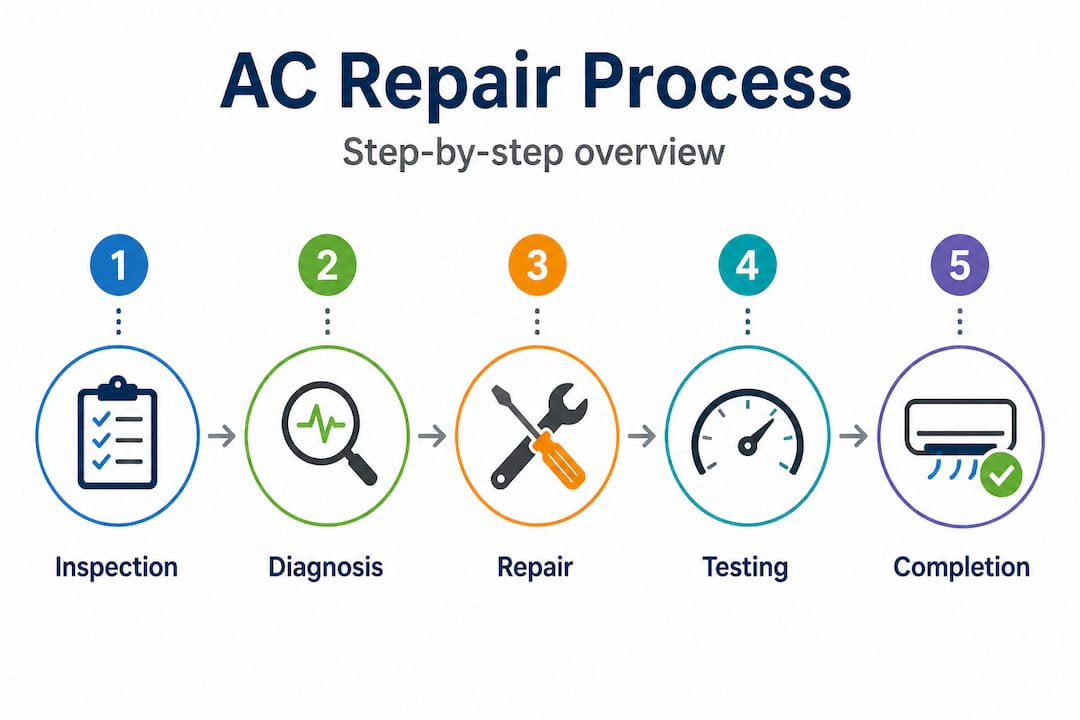
Here’s how a typical commercial repair service unfolds:
- Initial contact and triage. You report the issue. The service provider assesses urgency and dispatches accordingly. Emergency calls are prioritized differently than scheduled service.
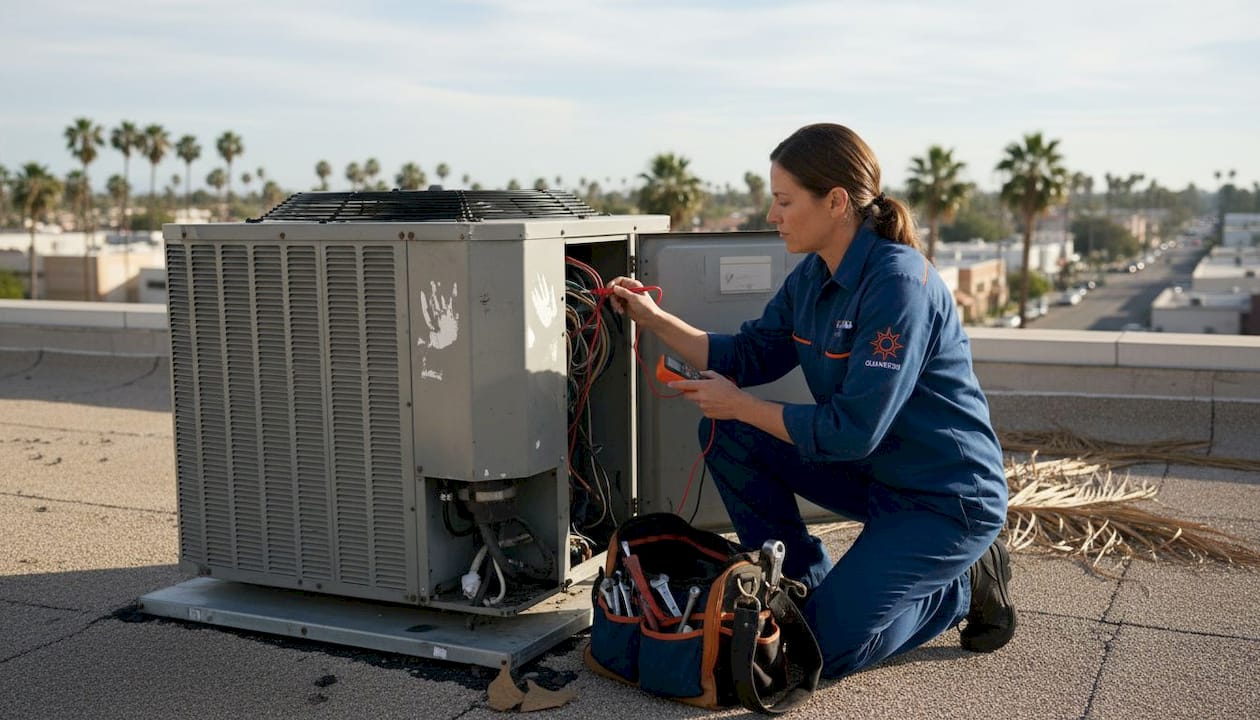
- On-site diagnostic inspection. The technician performs a full system assessment, including electrical readings, refrigerant pressure checks, airflow measurements, and control system diagnostics.
- Fault identification and quote. Once the issue is identified, you receive a repair recommendation and cost estimate. A good provider explains findings clearly without unnecessary technical jargon.
- Parts procurement. Commercial parts are not always in stock. Depending on the component, lead times can add hours or days to the repair timeline.
- Repair execution. The technician completes the repair, which may involve replacing components, recharging refrigerant, or reconfiguring controls.
- Post-repair testing. The system is tested under load conditions to confirm the issue is resolved and performance meets expectations.
- Documentation. A professional service provider gives you written documentation of what was repaired, what parts were used, and any follow-up recommendations.
| Repair type | Typical action | Average duration |
|---|---|---|
| Refrigerant leak repair | Locate leak, repair, recharge | 2 to 4 hours |
| Compressor replacement | Full unit swap, wiring, testing | 4 to 8 hours |
| Electrical fault repair | Diagnosis, rewiring, component swap | 1 to 3 hours |
| Coil cleaning and service | Flush, clean, system check | 1 to 2 hours |
| Control board replacement | Swap board, reprogram, test | 2 to 5 hours |
For urgent AC breakdowns in commercial settings, emergency interventions skip the scheduling queue entirely and aim to restore functionality as fast as possible, sometimes within hours of your call.
Pro Tip: Keep a system folder with your equipment model numbers, service history, warranty documents, and site access codes. Providing this to your technician before they arrive can cut diagnostic time significantly and reduce your labor costs.
Understanding the commercial AC setup process also helps you understand repair expectations, since technicians often trace failures back to the original installation quality.
Choosing the right commercial AC repair service in Southwest Florida
Not all HVAC companies are equipped to handle commercial systems. In Florida, this distinction carries real consequences. Here’s what to look for when selecting a repair provider:
Licensing and credentials to verify:
- State of Florida HVAC contractor’s license (Class A or B)
- EPA 608 certification for handling refrigerants
- Commercial liability insurance and workers’ compensation coverage
- Experience with your specific equipment brand and system type
| Factor | Local provider | National provider |
|---|---|---|
| Emergency response time | Typically under 2 hours | Often 4+ hours or subcontracted |
| Local code knowledge | Strong, Florida-specific | Variable and inconsistent |
| Relationship continuity | Same technicians over time | High technician turnover |
| Maintenance agreements | Flexible and customizable | Rigid, standardized packages |
| Accountability | Direct and accessible | Multiple layers of management |
For property managers and business owners, after-hours availability is non-negotiable. Florida businesses operate across evenings and weekends, and a Friday night failure cannot wait until Monday morning. Look for providers offering genuine 24/7 emergency coverage, not just an answering service that schedules a morning call. Choosing local reliable AC repair in the Fort Myers and Naples area means faster response and technicians who genuinely know the regional climate demands.
Red flags to avoid:
- No physical local address or office
- Unwillingness to provide written estimates
- Pressure to replace entire systems without thorough diagnostics
- No verifiable license number or insurance documentation
- Extremely low bids with vague scope of work
For rental property operators, commercial AC management for Cape Coral properties requires a provider who understands landlord-tenant compliance and can respond fast when tenant comfort is affected. A qualified service provider builds a documented service history that protects you legally and operationally.
The impact of commercial AC repair on efficiency and indoor air quality
Prompt, professional commercial AC repair does more than restore cooling. It creates measurable improvements in how your building consumes energy and how healthy the air feels for everyone inside.
Consider these business outcomes connected to well-maintained AC systems:
- Energy cost reduction. Dirty coils, low refrigerant, and failing motors all force systems to work harder, consuming more electricity for the same output.
- Reduced code violations. Florida building codes and OSHA standards address workplace temperature and air quality. A failing system can trigger compliance issues, especially in commercial kitchens, medical offices, and childcare facilities.
- Mold and contamination prevention. Refrigerant leaks and drainage problems create moisture buildup inside air handlers and ductwork. That moisture feeds mold growth, which then circulates through your ventilation system.
- Tenant and employee retention. Consistently comfortable spaces reduce complaints, reduce sick days, and create better working environments that contribute to productivity.
- Longer equipment lifespan. Small repairs done promptly prevent cascading failures that shorten your system’s overall life expectancy.
Studies consistently show that neglected HVAC systems can waste up to 30% more energy than properly maintained equipment, directly impacting operating costs for commercial properties.
Understanding what an HVAC repair technician does at a technical level helps you ask better questions and set clearer expectations for every service call. Pairing repair services with HVAC maintenance agreements is the most effective way to capture these efficiency gains consistently throughout the year.
The efficiency gains from routine repairs often cover their own cost within a single billing cycle when you factor in reduced energy consumption. For larger commercial properties, this impact compounds significantly over a 12-month period.
The truth about commercial AC repair: What most guides overlook
Most national HVAC guides treat commercial AC repair as a cost center. We see it differently after years of working with businesses across Southwest Florida.
The reality is that most generic guides are written for national audiences in temperate climates. Southwest Florida is a completely different operating environment. Here, even a four-hour AC outage during peak summer heat can make a building uninhabitable. Restaurants lose food. Medical offices halt procedures. Retail stores empty. The financial stakes are not theoretical.
We also notice that many business owners focus almost entirely on repair costs during a negotiation, while completely ignoring uptime guarantees and response time commitments. A $200 cheaper quote from a provider who arrives six hours later can easily cost you $2,000 in lost business. The economics of reliability always outperform the economics of lowest price in this climate.
The other thing most guides miss: the majority of expensive commercial AC failures are completely preventable. Compressors don’t simply fail. They fail because low refrigerant went unaddressed for months. Motors don’t burn out overnight. They burn out because dirty filters restricted airflow and caused overheating through gradual wear. These failures are not bad luck. They’re the predictable outcome of deferred maintenance.
Businesses that partner with local providers and invest in best HVAC practices through ongoing service relationships consistently spend less on emergency repairs over a three to five year period than businesses that call only when something breaks. The math is not complicated. Prevention beats emergency response every time.
Pro Tip: Invest in minor repairs immediately when identified. The emergency call at 11 PM during a record heat wave is almost always a minor issue that was ignored for too long.
Connect with trusted commercial AC experts in Southwest Florida
The information in this guide gives you a real foundation for managing your commercial AC system more strategically. But knowing is only the first step. Applying it to your specific building, your equipment type, and your operational requirements requires a local expert who knows Southwest Florida’s demands firsthand.
At Ultra Air Heating & Cooling, we specialize in commercial AC repair, maintenance agreements, and emergency response for businesses across Naples, Fort Myers, and Cape Coral. Our licensed technicians understand Florida’s building codes, climate demands, and the operational realities of businesses that cannot afford downtime. Whether you need a repair assessment, a scheduled maintenance plan, or guidance on Southwest Florida HVAC best practices for your property, we’re ready to help. Reach out today to schedule a consultation and keep your business running at full capacity, regardless of what Florida’s summer throws at you.
Frequently asked questions
How often should commercial AC systems be serviced in Southwest Florida?
Twice-yearly professional service is the recommended minimum in this region, given the climate and near-continuous system usage. Consistent preventative care is the single most effective way to extend equipment life and avoid emergency breakdowns.
Are emergency commercial AC repair services available after hours?
Yes, many Southwest Florida providers offer 24/7 emergency AC repair specifically for commercial clients where daytime-only service is simply not sufficient given business operating schedules.
What are the benefits of signing a commercial HVAC maintenance agreement?
Maintenance agreements provide scheduled inspections, priority emergency response, and documented service history that typically results in lower energy costs and fewer unexpected repair bills over time. A commercial HVAC maintenance agreement is one of the most cost-effective tools available to Southwest Florida property managers.
Do commercial AC repairs improve indoor air quality?
Yes. Timely repairs address drainage problems, refrigerant leaks, and filtration failures that directly affect air quality. Proper repairs reduce mold risk and ensure clean airflow, which benefits both employee health and regulatory HVAC compliance standards.