

A heat exchanger is defined as a device that transfers thermal energy between two or more fluids through a conductive barrier, preventing direct contact while allowing heat to move from the hotter fluid to the cooler one. This principle drives energy efficiency across HVAC systems, power plants, chemical processing facilities, and food manufacturing lines. Understanding how these devices work, which types exist, and how to select the right one gives professionals a real edge in system design, troubleshooting, and cost control. Whether you manage a commercial building in Southwest Florida or specify industrial equipment, this guide covers what you need to know.
What is a heat exchanger and how does it work?
A heat exchanger transfers heat between fluids through a solid conductive wall, keeping those fluids physically separated at all times. The hotter fluid gives up thermal energy through the wall, and the cooler fluid absorbs it. No mixing occurs. That separation is what makes heat exchangers safe and practical across industries where contamination between process streams would be catastrophic.
Three physical mechanisms drive this transfer. Conduction, convection, and radiation all play a role, though radiation contributes minimally in most industrial applications. Conduction moves heat through the solid wall itself. Convection carries heat between each fluid and the wall surface. Engineers designing for performance must account for three distinct thermal resistances: convection on the hot side, conduction through the wall, and convection on the cold side. Estimating convective resistance is the most challenging part because fluid dynamics vary with temperature, velocity, and fluid properties.
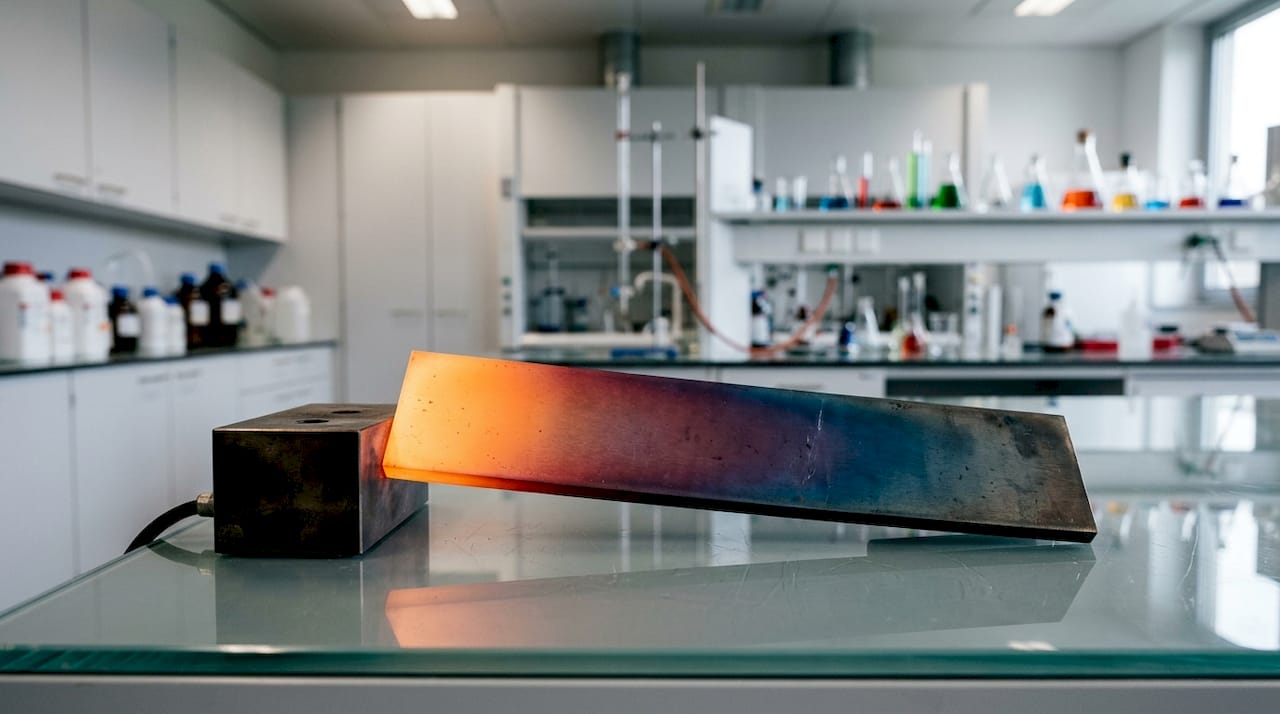
Flow arrangement is the factor most professionals underestimate. Counter-current flow maintains a higher temperature difference across the full length of the exchanger compared to co-current (parallel) flow. That sustained gradient means better thermal performance without requiring a physically larger unit. Co-current flow, where both fluids travel in the same direction, causes the temperature difference to shrink rapidly along the flow path, limiting how much heat can transfer.
Pro Tip: When specifying a new heat exchanger, always confirm the flow arrangement before finalizing the design. Switching from co-current to counter-current flow on an existing system can meaningfully improve output without replacing any hardware.
What are the main types of heat exchangers and their industrial uses?
Common heat exchanger types include shell-and-tube, plate-and-frame, air-cooled, and double-pipe, each suited to different operating conditions. Selecting the wrong type for an application leads to fouling problems, maintenance headaches, and poor energy performance. The right choice depends on fluid cleanliness, available space, required thermal output, and operating pressure.
Shell-and-tube heat exchangers
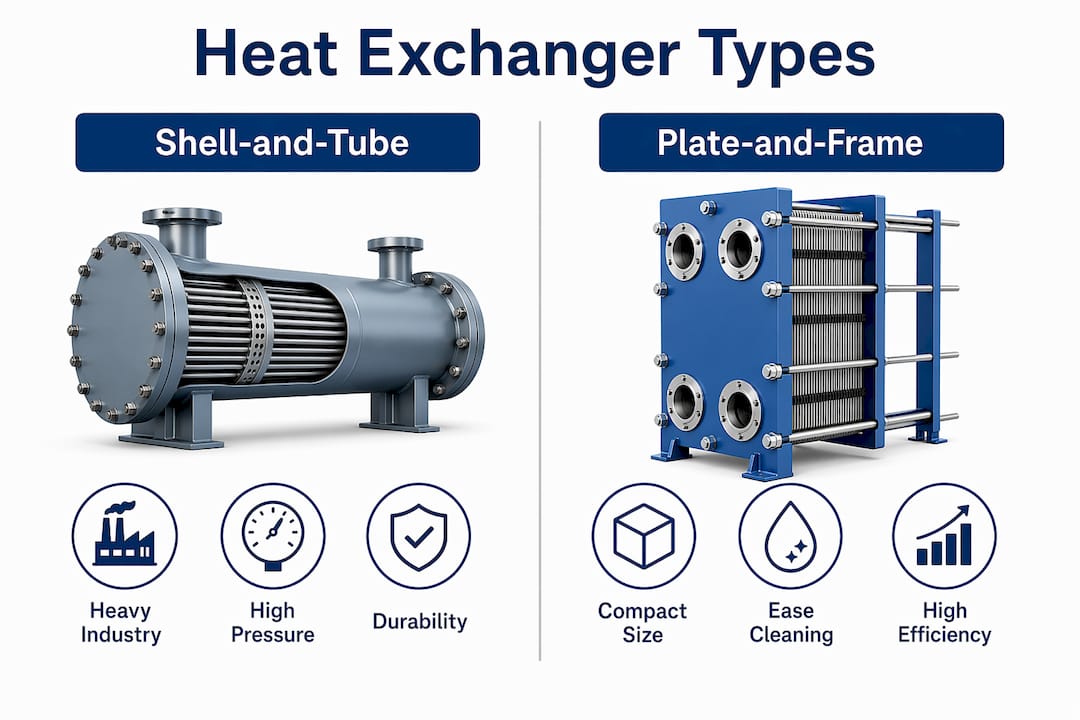
Shell-and-tube units are the workhorses of heavy industry. One fluid flows through a bundle of tubes while the other flows around those tubes inside a large outer shell. Internal baffles inside the shell increase turbulence and prevent stagnant zones, which keeps heat transfer rates high. These baffles also provide structural support for the tube bundle. Shell-and-tube exchangers handle dirty or fouling fluids better than most alternatives because the tube side is relatively easy to clean mechanically. Power plants, oil refineries, and chemical plants rely on them for this reason.
Plate-and-frame heat exchangers
Plate-and-frame units stack corrugated metal plates with alternating flow channels between them. Plate exchangers have high surface area-to-volume ratios, making them highly efficient in a compact footprint. The trade-off is sensitivity to particulates. Fluids with suspended solids clog the narrow channels between plates quickly. These units work best with clean fluids in food processing, HVAC, and pharmaceutical applications. Gasket-sealed plate exchangers can be disassembled and cleaned, while brazed-plate versions are permanent and suited to refrigeration circuits.
Air-cooled and double-pipe heat exchangers
Air-cooled exchangers use ambient air as the cooling medium, eliminating the need for cooling water. They appear in power generation and petrochemical plants where water scarcity or water treatment costs make liquid cooling impractical. Double-pipe exchangers are the simplest design: one pipe inside another, with each fluid flowing through one pipe. They suit low-flow, high-pressure applications and are easy to fabricate and maintain, though their surface area is limited.
The table below summarizes key selection criteria across the four main types.
| Type | Best for | Weakness | Typical application |
|---|---|---|---|
| Shell-and-tube | Dirty or fouling fluids | Large footprint | Power plants, refineries |
| Plate-and-frame | Clean fluids, compact spaces | Clogs with particulates | HVAC, food processing |
| Air-cooled | Water-scarce environments | Weather-dependent performance | Petrochemical plants |
| Double-pipe | Low-flow, high-pressure | Limited surface area | Pilot plants, small systems |
What design considerations optimize heat exchanger efficiency?
Effective performance depends more on fluid distribution and turbulence than on total surface area. This surprises many engineers who assume that bigger always means better. Oversizing a heat exchanger creates dead zones where fluid stagnates, fouling accumulates faster, and energy efficiency drops. The goal is to match the unit precisely to the duty, not to add a large safety margin as a substitute for accurate thermal analysis.
Four design factors consistently separate high-performing units from underperforming ones:
-
Fluid distribution uniformity. Uneven flow across the heat transfer surface creates hot spots and cold zones. Proper inlet header design and flow distributors prevent this. In plate exchangers, corrugation patterns on the plates promote turbulence and even distribution simultaneously.
-
Baffle design and spacing. In shell-and-tube units, baffle pitch controls shell-side velocity. Spacing baffles too far apart reduces turbulence and heat transfer. Spacing them too close increases pressure drop and pumping costs. The right baffle spacing is a calculated trade-off, not a default setting.
-
Flow velocity management. Too low a velocity allows fouling to accumulate on surfaces. Too high a velocity causes erosion, especially in tube inlets. Optimizing flow velocity is one of the most direct levers for controlling both performance and maintenance frequency.
-
Surface condition and fouling allowance. Fouling adds thermal resistance over time, reducing heat transfer. Engineers include a fouling factor in the initial design to account for this degradation. However, an excessive fouling factor leads back to oversizing, which creates the very fouling problems it was meant to address.
Pro Tip: Request a fouling factor justification from your vendor before accepting a design. If the fouling factor is set conservatively without process data to support it, the unit will likely be oversized and underperform from day one.
Maintenance trade-offs between types are real and worth planning for before purchase. Plate exchangers are easy to clean when gasketed but impossible to clean when brazed. Shell-and-tube units tolerate fouling longer but require mechanical cleaning of the tube bundle. Choosing a type without considering the maintenance workflow leads to deferred cleaning and accelerating performance loss.
What are heat exchanger applications in HVAC and industrial processes?
Heat exchangers enable energy-efficient heating and cooling in HVAC systems and precise thermal management in industrial processes. In HVAC, they appear in several critical roles that most building occupants never see but depend on every day.
- Refrigerant-to-air heat exchange. The evaporator coil in a central air conditioning system is a heat exchanger. It absorbs heat from indoor air into the refrigerant circuit, cooling the space. The condenser coil outside rejects that heat to the outdoor air.
- Hot water heating coils. In forced-air heating systems, a heat exchanger transfers heat from combustion gases or hot water to the supply air stream. The types of HVAC systems used in Florida homes rely on this process for both heating and dehumidification.
- Energy recovery ventilators (ERVs). ERVs use a heat exchanger to pre-condition incoming fresh air using the energy from exhaust air. This cuts the load on the primary HVAC system without sacrificing ventilation rates.
- Chiller systems. Large commercial buildings use water-cooled chillers where a refrigerant-to-water heat exchanger (the evaporator) cools a chilled water loop that then serves air handling units throughout the building.
Industrial applications extend the same principles to far more demanding conditions. Power plants use shell-and-tube condensers to convert steam back to water after it passes through turbines. Chemical plants use heat exchangers to control reaction temperatures, recovering heat from exothermic reactions to preheat incoming feed streams. Food processing plants use plate exchangers for pasteurization, heating product to a precise temperature and then cooling it rapidly.
AI and machine learning are now transforming how facilities manage heat exchanger maintenance. Real-time fouling detection using sensor data and predictive algorithms replaces fixed-schedule cleaning programs. That shift reduces unplanned downtime and extends equipment life. Facilities that have adopted condition-based maintenance report fewer emergency shutdowns and lower annual maintenance costs. Monitoring HVAC system health using similar data-driven approaches is becoming standard practice in commercial buildings across Southwest Florida.
Key Takeaways
A heat exchanger is the most critical thermal management component in any HVAC or industrial system, and its performance depends on type selection, flow arrangement, and maintenance discipline.
| Point | Details |
|---|---|
| Core function | A heat exchanger transfers heat between fluids through a conductive wall without mixing them. |
| Counter-current flow wins | Counter-current arrangements maintain higher temperature gradients, improving efficiency without increasing equipment size. |
| Oversizing causes problems | Dead zones and accelerated fouling result from oversized units; match the design precisely to the thermal duty. |
| Type selection matters | Shell-and-tube suits dirty fluids; plate-and-frame suits clean fluids in compact spaces. |
| Maintenance drives performance | Fouling accumulates over time; condition-based maintenance using real-time data outperforms fixed-schedule cleaning. |
What most guides get wrong about heat exchanger selection
The standard advice is to pick the most efficient type and size it conservatively. I’ve seen that approach fail more often than it succeeds. The real problem is that efficiency ratings are measured under ideal lab conditions with clean fluids and uniform flow. Real operating environments are messier. Fluids carry particulates. Flow rates vary. Inlet temperatures drift with seasons.
The detail that actually determines long-term performance is how well the unit handles the worst-case operating condition, not the design-point condition. A plate exchanger rated for high efficiency with clean water will underperform badly if the actual fluid carries any suspended solids. A shell-and-tube unit specified with an excessive fouling factor will create the fouling problem it was designed to tolerate.
The other thing I’d push back on is the assumption that AI-driven maintenance is only for large industrial facilities. The same sensor-based fouling detection logic applies to commercial HVAC systems. A chiller that runs slightly degraded for six months before anyone notices costs far more in energy than a monitoring system that catches the problem in week two. The technology is accessible now, and the payback period is short.
My practical recommendation: always specify the flow arrangement explicitly in your purchase order, confirm the fouling factor with process data, and build a maintenance access plan before the unit is installed. Those three steps prevent the majority of heat exchanger problems I’ve seen in the field.
— albert
Ultraairswfl’s approach to heating and cooling efficiency
Heat exchanger performance is only as good as the system it sits inside. Ultraairswfl specializes in HVAC installation, repair, and maintenance across Naples, Cape Coral, and Fort Myers, with a focus on energy-efficient solutions for both residential and commercial clients.
Whether you need a new heating system installation or a professional assessment of your existing equipment, Ultraairswfl’s team brings the technical depth to get it right the first time. Facility managers can also reference the HVAC installation guide for detailed guidance on specifying and installing systems that include heat exchanger components. Contact Ultraairswfl to schedule a professional evaluation and get your system performing at its full potential.
FAQ
What is a heat exchanger in simple terms?
A heat exchanger is a device that moves heat from one fluid to another through a solid wall, without letting the two fluids touch or mix.
How does a heat exchanger differ from a boiler?
A boiler generates heat by burning fuel and transfers it to water to produce steam or hot water. A heat exchanger only moves existing heat between two fluid streams without generating any heat itself.
Which type of heat exchanger is most efficient?
Plate-and-frame exchangers are the most thermally efficient per unit of volume due to their high surface area-to-volume ratio, but they require clean fluids to avoid clogging.
How often should a heat exchanger be cleaned?
Cleaning frequency depends on fluid cleanliness and fouling rate. Condition-based monitoring using real-time sensor data is the most reliable method, replacing fixed-interval schedules that often clean too early or too late.
What causes a heat exchanger to fail?
Fouling, corrosion, and mechanical stress from thermal cycling are the leading causes of heat exchanger failure. Routine HVAC maintenance that includes heat exchanger inspection catches these issues before they cause system failure.