

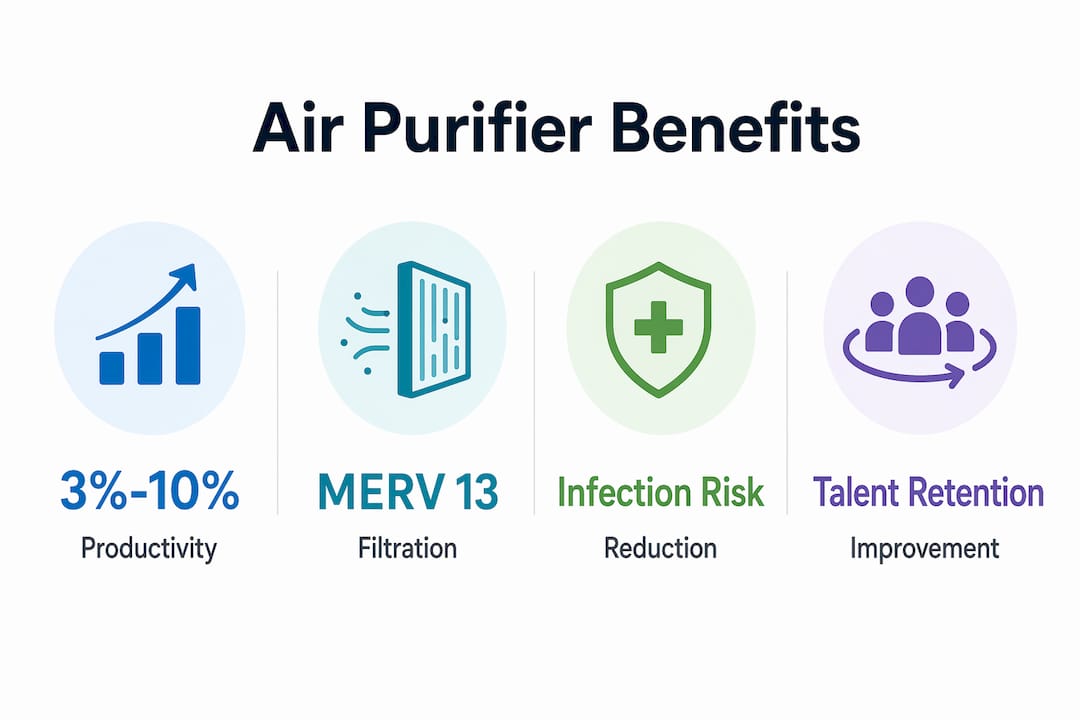
Air purifiers in business settings are defined as active indoor air quality (IAQ) management devices that remove airborne contaminants, including particulate matter, volatile organic compounds, and biological pathogens, from occupied commercial spaces. The role of air purifiers in business extends well beyond basic comfort. Improving indoor air quality can increase workplace productivity by 3%–10% and reduce sick-building-related symptoms by 20%–50%. For business owners and facility managers, those numbers translate directly into fewer sick days, sharper decision-making, and a measurable return on a relatively modest capital investment. Clean air is not a perk. It is an operational input.
What measurable benefits do air purifiers bring to businesses?
Air purifiers deliver three categories of benefit that matter to business owners: health protection, cognitive performance, and financial return. Each is backed by recent research, and each compounds the others.
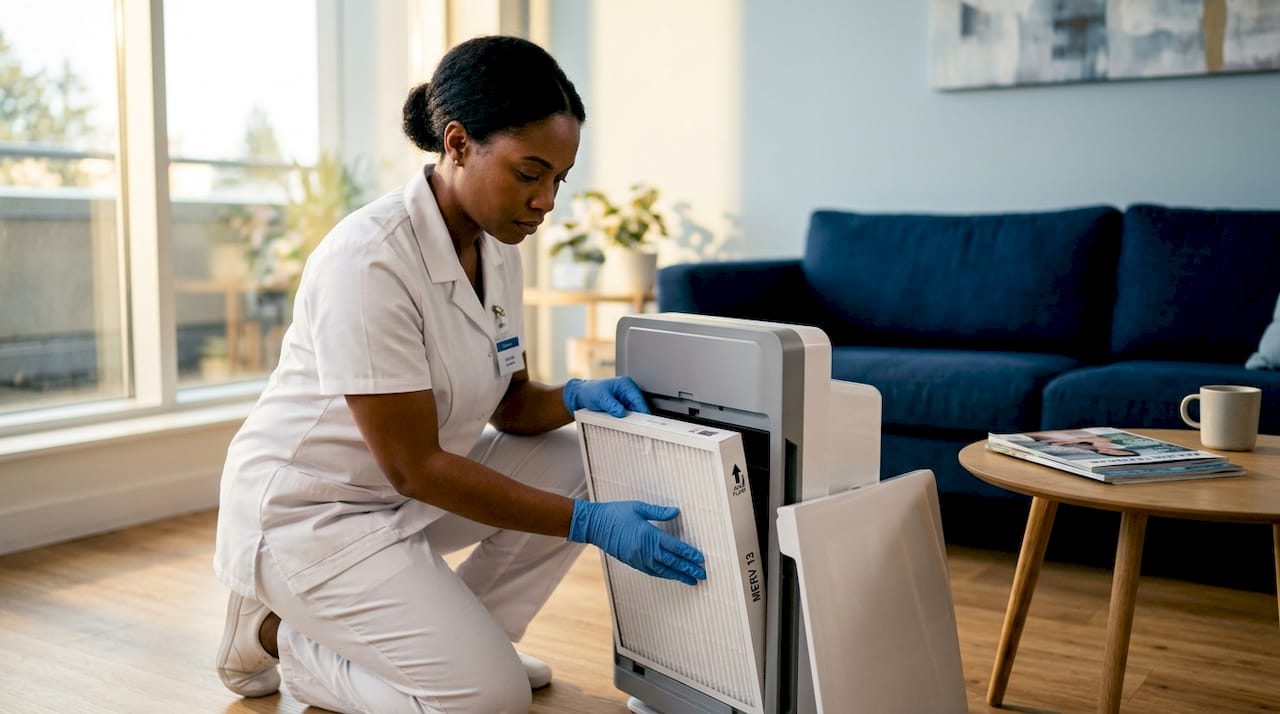
Health protection is the most immediate gain. Upgrading filtration to MERV 13 reduces airborne infection transmission risk by 42%, and adding HEPA air purifiers pushes that protection to 50%. That reduction in transmission means fewer employees calling in sick and lower pressure on your health benefits budget.
Cognitive performance is the benefit most facility managers underestimate. Higher CO2 and fine particle levels associate with slower response times and more errors. Reducing those pollutants through active filtration can improve cognitive task performance by 61%–101%. A customer service team making faster, more accurate decisions is a direct business outcome of cleaner air.
Financial return follows from the first two. Reduced absenteeism cuts direct labor costs. Fewer sick-building complaints reduce HR friction and potential liability. IAQ is increasingly viewed as a competitive advantage in talent attraction and retention, not just a compliance checkbox. Businesses that make air quality visible to employees and job candidates signal that they take worker health seriously.
- Productivity gains of 3%–10% from improved IAQ
- Airborne infection risk cut by up to 50% with MERV 13 plus HEPA filtration
- Cognitive performance improvements of 61%–101% with reduced pollutant exposure
- Lower absenteeism and reduced sick-building complaints
- Stronger employer brand for talent recruitment and retention
How do air purifiers technically support HVAC systems?
Air purifiers function as a secondary filtration layer, not a replacement for your HVAC system. Purifiers work best when integrated with properly maintained HVAC equipment, including clean ducts, functioning coils, and calibrated airflow. Treating a purifier as a standalone fix while neglecting duct cleanliness is one of the most common and costly mistakes facility managers make.
Understanding filter ratings
MERV ratings measure how effectively a filter captures particles of different sizes. MERV 8 filters, common in older commercial systems, miss a significant portion of fine particles and biological aerosols. MERV 13 filters are now the minimum standard in many commercial settings as of 2026. HEPA filters, used in standalone purifiers, capture 99.97% of particles at 0.3 microns, making them the strongest option for high-risk or high-occupancy spaces.
Airflow, noise, and sizing
Matching a purifier to its space requires more than checking square footage. Ceiling height, occupancy density, and the number of air changes per hour all affect which unit performs adequately. Noise levels matter in open-plan offices and conference rooms. Units rated above 50 decibels at working speed disrupt concentration, which defeats the purpose of improving cognitive performance. Lifecycle costs also vary widely. Cheaper units can incur higher long-term expenses through frequent filter changes and higher energy draw, sometimes doubling operating costs over three years.
| Consideration | What to evaluate |
|---|---|
| Filter rating | MERV 13 minimum for HVAC; HEPA for standalone purifiers |
| CADR rating | Must match room volume and air change requirements |
| Noise level | Below 50 decibels for occupied workspaces |
| Energy draw | Factor into 3-year total cost of ownership |
| Maintenance cycle | Filter replacement schedule and cost per unit |
Pro Tip: Have your HVAC technician inspect duct cleanliness and coil condition before adding air purifiers. A purifier pulling air through a contaminated duct system recirculates the problem, not the solution.
What practical strategies maximize air purifier impact?
Placement is the single most underestimated variable in commercial air purification. Incorrect positioning creates dead zones where pollutants accumulate despite the purifier running at full capacity. Airflow mapping, which traces how air actually moves through a space rather than how you assume it moves, is the correct starting point for any deployment.
-
Map airflow before placing units. Identify natural air currents from HVAC vents, windows, and doors. Place purifiers where they intercept contaminated air before it reaches workstations, not in corners where air stagnates.
-
Match CADR to room conditions. Clean Air Delivery Rate (CADR) measures how much filtered air a unit delivers per minute. A unit with a CADR of 200 cubic feet per minute is adequate for a small conference room but inadequate for a 2,000-square-foot open office. Size up, not down.
-
Prioritize high-occupancy zones first. Reception areas, break rooms, and shared conference rooms generate the highest pollutant loads. Deploy your strongest units there before addressing private offices.
-
Schedule filter replacement on a calendar, not a complaint. Waiting until air quality degrades visibly means the filter has been underperforming for weeks. Most commercial HEPA filters require replacement every 6–12 months depending on occupancy and local air conditions.
-
Install IAQ monitors to track real results. CO2 sensors and particulate monitors give you objective data on whether your purifiers are performing. That data also builds the internal business case for continued investment.
Pro Tip: In Southwest Florida, outdoor humidity and pollen levels spike seasonally. Schedule filter inspections in march and september to catch degraded performance before it affects your team.
How can businesses evaluate ROI and justify air purifier investments?
The financial case for air purification rests on three pillars: productivity recovery, health cost reduction, and talent economics. Each is quantifiable with data you likely already track.
Productivity recovery is the largest lever. If a 50-person office gains even 3% in output from improved IAQ, and average fully loaded labor cost per employee is $60,000 per year, that gain represents $90,000 in recovered value annually. The math scales with headcount and average compensation.
Health cost reduction compounds that figure. Fewer sick days mean lower direct absence costs and reduced pressure on group health premiums over time. Investing in IAQ consistently shows returns that exceed the cost of equipment and maintenance when absenteeism data is tracked over a 12-month period.
Talent economics are harder to quantify but real. Leadership that treats IAQ as an asset achieves measurably better outcomes in talent attraction and retention. In a tight labor market, a health-conscious workplace is a recruiting argument that costs less than a salary increase.
- Calculate productivity value: headcount × average labor cost × estimated productivity gain percentage
- Track absenteeism before and after deployment to measure direct health impact
- Factor in lifecycle costs including filters, energy, and maintenance over a 3-year horizon
- Confirm vendor compliance with 2026 MERV 13 and HEPA standards before purchasing
- Document IAQ improvements with monitor data to support future budget requests
Key Takeaways
Air purifiers deliver measurable business value through productivity gains, infection risk reduction, and talent retention when deployed correctly within an integrated IAQ management plan.
| Point | Details |
|---|---|
| Productivity and health gains | Improved IAQ raises productivity by 3%–10% and cuts sick-building symptoms by 20%–50%. |
| Filtration standards | MERV 13 is the 2026 commercial minimum; HEPA purifiers add a critical second layer of protection. |
| HVAC integration | Purifiers work only as well as the HVAC system they support; clean ducts and coils are non-negotiable. |
| Placement and CADR | Airflow mapping and correct CADR matching prevent dead zones and wasted investment. |
| ROI calculation | Quantify productivity recovery, absenteeism reduction, and talent retention to build a defensible business case. |
Why I think most businesses are still getting IAQ wrong
After years of working with commercial facilities across Southwest Florida, the pattern I see most often is this: a business owner buys two or three air purifiers, places them in the most visible spots in the office, and considers the problem solved. The units run. The air smells fresher. And the underlying IAQ problems, dirty ducts, an undersized HVAC system, and no filtration upgrade, continue unchecked.
Indoor air quality has historically received far less attention than outdoor air pollution, even though workers spend the majority of their time indoors. That gap in attention is exactly where the real risk lives. A purifier placed in a corner of a large open office, without airflow mapping, without a CADR calculation, and without a MERV 13 filter in the HVAC system feeding that space, is theater. It looks like action. It is not action.
The businesses that get this right treat IAQ as a system, not a product purchase. They start with an HVAC audit, upgrade their filtration to current standards, then add purifiers as a targeted second layer in high-occupancy zones. They install monitors. They track results. They use that data to make the next decision. That is the approach that produces the 3%–10% productivity gains the research documents. The shortcut version produces none of them.
My honest recommendation: before you buy a single purifier, get your HVAC system assessed. The air quality improvement process starts with understanding what your existing system is and is not doing. Everything else follows from that baseline.
— albert
How Ultraairswfl helps businesses build a complete IAQ plan
Ultraairswfl works with business owners and facility managers across Naples, Cape Coral, and Fort Myers to assess, design, and implement commercial air quality solutions that go beyond a single product purchase.
The Ultraairswfl team evaluates your existing HVAC system, identifies filtration gaps, and recommends the right combination of MERV-rated filters, HEPA purifiers, and duct maintenance to meet 2026 commercial standards. Every recommendation accounts for your space’s airflow patterns, occupancy levels, and total lifecycle costs. For businesses ready to move from guesswork to a documented IAQ plan, Ultraairswfl’s commercial installation guidance covers the full process from assessment to deployment. You can also review the commercial air purifier guide for Estero for a detailed look at how local businesses are approaching this in 2026.
FAQ
What is the role of air purifiers in business settings?
Air purifiers in business settings actively remove airborne contaminants including particulate matter, pathogens, and volatile organic compounds from occupied spaces. Their primary role is to support employee health and improve cognitive performance by maintaining cleaner indoor air.
How much can air purifiers improve employee productivity?
Research shows that improving indoor air quality can raise workplace productivity by 3%–10% and reduce sick-building symptoms by 20%–50%. Cognitive task performance can improve by 61%–101% when fine particle and CO2 levels are reduced.
Do air purifiers replace HVAC maintenance in commercial buildings?
Air purifiers do not replace HVAC maintenance. They function as a secondary filtration layer and perform best when the underlying HVAC system has clean ducts, functioning coils, and MERV 13 or higher filters already in place.
What is CADR and why does it matter for office air purifiers?
Clean Air Delivery Rate (CADR) measures how much filtered air a purifier delivers per minute. Matching CADR to your room’s volume and occupancy level is the most reliable way to select a unit that will actually perform in your specific space.
Should businesses invest in air purifiers in 2026?
Yes. MERV 13 filtration and HEPA purification are now the expected minimums in commercial settings, and the productivity and health data supporting investment is well established. The financial case strengthens further when lifecycle costs are compared against measurable gains in output and reduced absenteeism.