
Most homeowners pay between $200 and $500 for a professional smart thermostat installation, with a national average near $350 according to HomeAdvisor’s compiled cost data. DIY installs on compatible systems can run as little as the device price alone, while complex multi-zone or line-voltage setups can push past $1,000.
- Unit vs. labor split: The thermostat itself typically costs $100–$300; labor and parts make up the rest of the installed total.
- Simplest case: A direct swap on a system with existing C-wire wiring takes under 30 minutes and may cost nothing beyond the device if you do it yourself.
- Most expensive case: Multi-zone retrofits, line-voltage baseboard systems, or installs requiring new wiring and a licensed electrician can reach $600–$1,000 or more.
Key Takeaways
Most homeowners pay a few hundred dollars for a professional smart thermostat installation, with the device price and C-wire situation being the two biggest variables in the final quote.
| Point | Details |
|---|---|
| Typical installed cost range | Professional installs average near $350, with most jobs falling between $200 and $500. |
| Top cost drivers | Missing C-wire, heat pump staging, and multi-zone systems push quotes toward $500–$1,000+. |
| DIY vs. pro rule of thumb | Single-zone systems with existing C-wire are DIY-friendly; complex wiring and heat pumps need a licensed tech. |
| ENERGY STAR savings and rebates | Smart thermostats save roughly 8%–15% on HVAC costs annually; check the ENERGY STAR product finder for utility rebates before buying. |
| Ultraairswfl local option | Ultra Air Heating & Cooling serves Southwest Florida with professional installs that include compatibility checks, wiring, programming, and cycle testing. |
Table of Contents
- What makes up your smart thermostat installation cost?
- What raises or lowers your quote
- When should you DIY, and when should you hire a pro?
- How to get accurate, comparable contractor quotes
- Rebates, incentives, and simple ROI math
- How long does a smart thermostat installation take?
- Worked example quotes for common setups
- What installers actually charge and why
- Smart thermostat installation in Southwest Florida
- Useful resources for rebates, compatibility, and cost benchmarks
- Sources
What makes up your smart thermostat installation cost?
Every quote you receive breaks down into the same four buckets: the device, labor, parts, and optional add-ons. Understanding each one tells you exactly where a contractor has room to negotiate and where they genuinely don’t.
Device price
Budget models like the Google Nest Thermostat (the entry-level version, not the Learning) typically retail near a low triple-digit price. Mid-range units such as the Honeywell Home T9 or ecobee SmartThermostat with Voice Control cost in the mid-hundreds range. Premium options, including the Google Nest Learning Thermostat, are priced higher. Trane’s homeowner guidance confirms that thermostat type is one of the primary drivers of installed price, since the device cost flows directly into the total.
Labor
HVAC technicians and electricians don’t charge the same rates. According to Bureau of Labor Statistics occupational wage data, HVAC technicians earn a median hourly wage around $25–$30, while licensed electricians typically earn more. Most contractors apply a minimum service-call fee of $75–$150 regardless of how fast the job goes, then bill hourly beyond that. A 30-minute swap at a $100 service-call minimum costs you $100 in labor even if the tech is done in 20 minutes.
Parts and add-ons
The most common add-on is a C-wire adapter or a new C-wire run. Mysa’s installation cost guide notes that a C-wire adapter or running a new C-wire can materially change the final cost, often adding $20–$50 for an adapter or $100–$200 for a new wire run through walls. Remote room sensors (sold separately for ecobee and Honeywell Home T9) add $40–$80 each. Smart hub integration or voice-assistant setup is usually software-only and adds no parts cost, just a few minutes of labor.
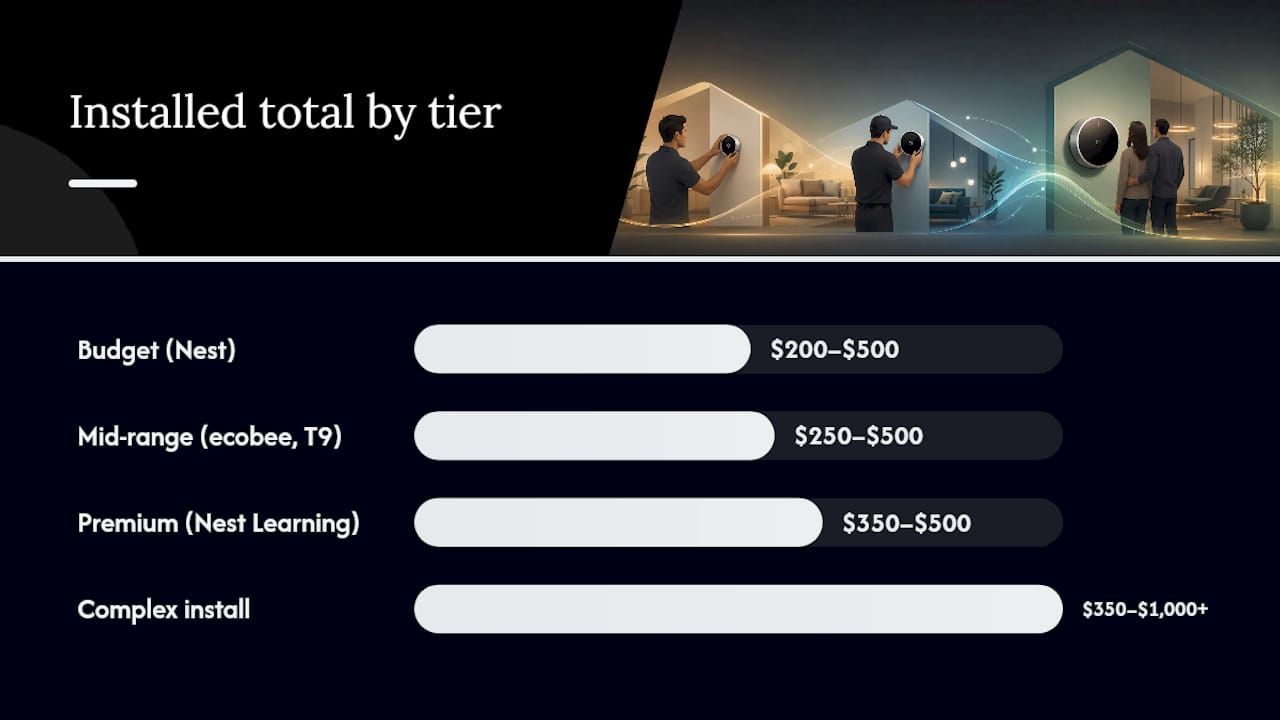
Typical installed cost by tier
| Tier | Device Price | Typical Labor + Parts | Installed Total |
|---|---|---|---|
| Budget (e.g., Nest Thermostat) | $100–$300 | $100–$150 | $200–$500 |
| Mid-range (e.g., ecobee, Honeywell T9) | $150–$500 | $100–$200 | $250–$500 |
| Premium (e.g., Nest Learning) | $250–$500 | $100–$200 | $350–$500 |
| Complex install (C-wire run, multi-zone) | $150–$300 | $200–$1,000 | $350–$1,000+ |
What raises or lowers your quote
A handful of conditions move a quote significantly, and most of them are things you can check before calling a contractor.
- No C-wire: The single most common cost-adder. Many older homes wired for a simple two-wire thermostat lack the common wire smart thermostats need for continuous power. An adapter (like the Nest Power Connector) solves it cheaply; running a new wire through finished walls does not.
- Heat pump systems: Heat pumps use different wiring configurations (O/B reversing valve wires, auxiliary heat stages) that require a thermostat with heat-pump compatibility and a tech who understands staging. Expect to pay toward the higher end of labor ranges.
- Multi-zone systems: Each zone has its own thermostat and zone control board. Retrofitting smart thermostats across multiple zones multiplies both device and labor costs, and coordinating zone dampers requires specialized experience.
- Millivolt and line-voltage systems: Older gas fireplaces, electric baseboard heaters, and radiant systems often run on millivolt or 120V/240V line-voltage circuits. Most standard smart thermostats are incompatible, and the few that work (like Mysa for electric baseboard) require an electrician, not just an HVAC tech.
- Thermostat relocation: Moving the thermostat to a better wall location means running new wire, patching drywall, and possibly pulling a permit. Budget an extra $150–$300.
- Additional room sensors: ecobee and Honeywell Home T9 both support remote sensors for room-by-room temperature balancing. Each sensor adds device cost and a few minutes of setup.
- Urban vs. rural labor rates: A contractor in Naples or Fort Myers charges differently than one in a rural Midwest market. Regional labor variation can shift the installed total by $50–$150 on an otherwise identical job.
Pro Tip: Check your existing thermostat’s wiring before requesting quotes. Pull the cover, photograph the wire terminals, and run the model number through the Google Nest or ecobee compatibility checker online. If you see a wire labeled “C” already connected, you’ll likely avoid the most common add-on charge.
One cost driver most homeowners miss: an aging HVAC control board. If your system is 15-plus years old and the control board is marginal, a new thermostat’s demand signals can expose short-cycling or staging faults that were previously masked. A good tech will flag this during installation; a rushed one won’t, and you’ll pay for a service call later.
When should you DIY, and when should you hire a pro?
For a standard central HVAC system with existing low-voltage wiring and a C-wire already in place, DIY installation is genuinely reasonable for most homeowners. Multi-zone systems, line-voltage setups, and heat pumps with complex staging should go to a licensed HVAC technician or electrician.
The practical rule: If your current thermostat has four or fewer wires and your system is a single-stage furnace or air conditioner, you can almost certainly swap it yourself in under 30 minutes. If you count five or more wires, see an “O,” “B,” or “E” terminal, or have electric baseboard heat, stop and call a pro.
Mysa’s DIY guidance confirms that many DIY installs finish in under 15–20 minutes when wiring is already present. The risk isn’t the swap itself; it’s misidentifying a wire, connecting it to the wrong terminal, and damaging a $500–$1,500 control board. That repair bill dwarfs any labor savings.
For building managers, the calculus is different regardless of system complexity. Documented professional installation protects warranty coverage on both the thermostat and the HVAC equipment, creates a paper trail for insurance purposes, and satisfies most commercial lease requirements. Require the contractor to provide a written scope of work, the installed device’s serial number, and a post-install test report before signing off.
Pro Tip: Google Nest, ecobee, and Honeywell Home all offer free online compatibility checkers. Run your wiring photo through one before purchasing the device. Buying an incompatible unit and returning it wastes a trip and sometimes a restocking fee.
How to get accurate, comparable contractor quotes
Getting three quotes that actually compare the same job requires asking the same specific questions of every contractor. Generic “how much to install a smart thermostat” calls produce wildly different numbers because contractors make different assumptions about what’s included.
- Ask for a line-item quote. Request separate figures for: device cost (or confirm you’re supplying it), labor (service call + hourly), C-wire assessment and any adapter or wire-run cost, sensors or accessories, programming and testing, and any permit fees.
- Specify the device model. Tell every contractor the exact model you want installed. Quotes built around different devices aren’t comparable.
- Ask about the warranty. What does the contractor warrant on their labor? Thirty days is minimal; 90 days to one year is reasonable for a thermostat install.
- Confirm post-install testing. A professional install should include a full system cycle test: heating, cooling, and fan modes. Ask if that’s included or billed separately.
- Ask about permits. Most simple thermostat swaps don’t require a permit, but thermostat relocation or new wiring sometimes does. Confirm who pulls it and who pays.
- Verify license and insurance. In Florida, HVAC contractors must hold a state license. Ask for the license number and verify it at the Florida Department of Business and Professional Regulation (DBPR) website. Request proof of general liability insurance. You can also check contractor reputation through the Better Business Bureau before committing.
Sample quote request script: “I’d like a written quote to install a [device model] at my home. Please break out the device cost separately from labor, note any C-wire or wiring work needed, include post-install testing, and confirm your labor warranty. Can you also confirm your state license number and that you carry liability insurance?”
Watch for these red flags: a quote with no line items, a contractor who won’t confirm their license number, or a price that seems to include the device but doesn’t specify the model. Vague quotes almost always produce surprise add-ons at invoice time.
Rebates, incentives, and simple ROI math
The upfront cost of smart thermostat installation looks different once you account for rebates and ongoing savings. ENERGY STAR reports that smart thermostats reduce heating and cooling costs by roughly 8%–15% on average, translating to approximately $100–$312 in annual savings for many households, with payback periods commonly ranging from 8 to 24 months.
That math changes further when rebates enter the picture. Many utility companies offer $25–$100 back on ENERGY STAR-certified smart thermostats, and some manufacturers run their own promotions. The practical step: before you buy, search your zip code on the ENERGY STAR product finder to see which models qualify and which local utilities offer rebates tied to specific products.
Quick ROI example:
- Mid-range ecobee SmartThermostat: $220 retail
- Professional install: $150 labor
- Utility rebate: $75
- Net upfront cost: $295
- Annual savings at 10% HVAC reduction: ~$150 (on a $1,500/year HVAC bill)
- Payback period: roughly 24 months
The U.S. Department of Energy’s programmable thermostat guidance reinforces that scheduling and temperature setbacks are what actually generate the savings, not the hardware alone. A smart thermostat left on “hold” at one temperature all day saves almost nothing. Configure geofencing, set weekday/weekend schedules, and use the ecobee or Nest app’s energy reports to confirm the system is actually cycling down when the home is empty.
One more angle worth considering: improving your home’s building envelope compounds thermostat savings. New interior doors and better insulation reduce the load your HVAC system carries, which means the smart thermostat’s setbacks produce larger percentage savings on a smaller baseline bill.
How long does a smart thermostat installation take?
Timeline matters because most contractors charge a one-hour minimum, and knowing the expected duration helps you understand whether a quote is reasonable.
- Simple DIY swap (existing C-wire, single-zone): 15–30 minutes. Mysa confirms many DIY installs finish under 20 minutes when wiring is already in place.
- Standard professional install with testing: 30–90 minutes. HomeAdvisor’s data puts typical professional installs around 30–45 minutes for straightforward jobs, though testing and app setup add time.
- C-wire adapter installation: Add 15–30 minutes to the above.
- New C-wire run through walls: 1–2 hours depending on wall construction and wire routing distance.
- Multi-zone retrofit (per zone): 1–2 hours per zone, plus time to test zone control board integration.
- Line-voltage system (electric baseboard): 1–2 hours minimum, requires a licensed electrician.
The one-hour minimum service call is standard across most HVAC and electrical contractors. On a 20-minute job, you’re paying for an hour of labor regardless. That’s not a rip-off; it’s how service businesses cover truck time and overhead. Factor it into your DIY-vs-pro math: if the device is compatible and the wiring is clean, the labor minimum alone may justify doing it yourself.
Worked example quotes for common setups
These examples use national cost ranges from HomeAdvisor and JC Energy Solutions’ regional data, which puts typical installs at $150–$600. Regional labor differences, particularly in high-cost metros and Southwest Florida markets, can shift these figures by $50–$150.
For older homes requiring new wiring or zone control board coordination, HUD’s HVAC retrofit research notes that retrofit complexity in older housing stock frequently adds labor time beyond initial estimates.
Readers in Cape Coral can find more localized pricing detail in the Cape Coral thermostat replacement guide, which covers Southwest Florida labor rates and common add-on scenarios specific to the region.
What installers actually charge and why
The line items on a professional invoice reflect real work, not padding. A thorough HVAC technician runs a compatibility check before touching a wire, confirms the system’s staging configuration (critical for heat pumps), and performs a full cycle test after installation to verify the thermostat is communicating correctly with every stage of the equipment. That last step, the cycle test, is where short-cycling problems get caught. A thermostat wired to the wrong terminal can cause a compressor to cycle on and off rapidly, a fault that stresses the equipment and can shorten its life significantly.
What separates a transparent contractor from one who pads invoices: every add-on should be explained before work starts, not discovered on the final bill. A C-wire assessment takes two minutes; a good tech does it during the initial visit and quotes the adapter or wire run before picking up a tool. If a contractor mentions a “system optimization fee” or “programming surcharge” that wasn’t in the original quote, ask exactly what it covers. Programming a Google Nest or ecobee takes 10 minutes and should be included in the base labor charge.
Ultra Air Heating & Cooling warranties its thermostat installations and includes post-install cycle testing as standard, not as a billable add-on. The smart thermostat energy savings guide on the Ultra Air site explains how proper installation and configuration work together to produce the savings ENERGY STAR certifies.
Smart thermostat installation in Southwest Florida
Getting a precise quote for a smart thermostat install in Southwest Florida means working with a contractor who knows the region’s HVAC systems, not just the national averages. Ultra Air Heating & Cooling serves Naples, Cape Coral, and Fort Myers with professional smart-thermostat installation that includes a compatibility check, all wiring work, device programming, and a full system cycle test before the technician leaves.
Southwest Florida homes often run heat pump systems year-round, which means staging compatibility matters more here than in markets with simple furnace-and-AC setups. Ultra Air’s technicians verify heat pump compatibility, confirm reversing valve wiring, and configure auxiliary heat staging correctly at every install. For building managers overseeing commercial properties, the office HVAC installation guide covers documentation, warranty requirements, and what a professional scope of work should include.
Ultra Air also helps homeowners identify and capture available utility rebates before purchase, so you’re not leaving $25–$100 on the table by buying the wrong model. Financing options are available for larger projects. To request an on-site estimate, have your current thermostat’s wire photo ready and the HVAC system model number handy. Call or book online at Ultraairswfl to schedule your installation.
Useful resources for rebates, compatibility, and cost benchmarks
These are the primary tools worth bookmarking before you buy a device or request a quote.
Start here before you purchase: The ENERGY STAR product finder at energystar.gov lets you search by zip code for qualified smart thermostat models and see which local utilities offer rebates tied to specific products. Running this search before checkout is the single fastest way to reduce your net upfront cost.
- ENERGY STAR Smart Thermostats: Search certified models, check rebate availability by zip code, and confirm which devices qualify for utility incentives in your area.
- ENERGY STAR Smart Thermostat FAQ: Explains the 8%–15% average savings range, how payback periods work, and what the certification requires.
- HomeAdvisor: Smart Thermostat Installation Cost: National cost benchmarks, install-time estimates, and a cost calculator for comparing your quote against typical ranges.
- Bureau of Labor Statistics: Occupational Wages: Look up median hourly wages for HVAC technicians and electricians in your metro area to gauge whether a labor quote is reasonable for your region.
- Ultraairswfl: HVAC efficiency in older homes: Local guidance for Southwest Florida homeowners whose installs may require additional wiring or system upgrades before a smart thermostat will perform as expected.
Sources
- HomeAdvisor: How Much Does Smart Thermostat Installation Cost?
- Mysa: Smart Thermostat Installation Cost