

The three upgrades that deliver the most allergy relief per dollar are upgrading to a MERV 11–13 deep-media filter, controlling indoor humidity between 30–50% with a whole-home dehumidifier or humidistat, and adding targeted whole-home purification such as UV-C at the coil. Combined, multiple interventions can reduce indoor allergen levels by 70–95% — but only when they work together as a system, not as isolated gadgets.
Start here, in this order:
- Low cost, DIY today: Check your current filter’s MERV rating and switch your thermostat fan to “Circulate” mode. Buy a $15 hygrometer and measure your indoor humidity.
- Mid cost, weekend or one-day install: Replace a 1" slot filter with a 4–5" deep-media cabinet rated MERV 13. Add a portable HEPA purifier in the bedroom.
- Professional install: Schedule an IAQ audit, whole-home dehumidifier, UV-C coil treatment, and duct sealing with a NATE-certified technician.
If your symptoms spike every time the AC kicks on, start with step one today. You may be surprised how much a filter swap and a fan-mode change accomplish before spending a dollar on equipment.
Table of Contents
- 1. How the right HVAC filter actually removes allergens
- 2. Whole-home air cleaners: which types actually help
- 3. Why indoor humidity control matters more than most people realize
- 4. Duct sealing and component maintenance stop allergens from recycling
- 5. Smart ventilation: when to open up and when to seal tight
- 6. Portable HEPA purifiers: targeted relief where you sleep
- 7. What allergy-focused HVAC upgrades actually cost
- 8. How to prioritize upgrades and what to ask a contractor
- 9. What the evidence and industry standards actually say
- Key Takeaways
- The upgrade that most homeowners skip — and why it matters most
- Ultraairswfl handles the upgrades that actually move the needle
- Useful sources and further reading
1. How the right HVAC filter actually removes allergens
Filters work by forcing air through a dense medium that traps particles. The MERV scale (Minimum Efficiency Reporting Value) measures how well a filter captures particles across different size ranges. MERV 8 catches large dust and pollen but lets pet dander and fine mold spores through. MERV 11–13 captures pollen, pet dander, and most mold spores — the sweet spot for residential allergy control without strangling airflow.
True HEPA filtration captures 99.97% of particles at 0.3 microns, which covers virtually every common allergen. The catch: standard residential HVAC systems are not designed for HEPA-level static pressure. Forcing a HEPA filter into a 1" slot can strain the blower, reduce airflow across the coil, and actually worsen air quality by letting the system run less.
Compatibility checklist before you upgrade:
- 1" slot: MERV 8–11 is the safe ceiling; anything higher needs a professional static-pressure check first.
- 2" slot: MERV 11 is generally safe; MERV 13 may work depending on blower capacity.
- 4–5" deep-media cabinet: MERV 13 performance with lower pressure drop than a thin high-MERV filter — the recommended upgrade path for most homes.
- Bypass HEPA or whole-home HEPA unit: Best for severe allergies when the main system cannot handle MERV 13 without airflow loss.
Stat to know: A 4–5" MERV 13 media cabinet increases filter surface area dramatically compared to a 1" filter, which means lower static pressure and longer filter life — often 6–12 months between changes versus 1–3 months for a 1" filter.
Filter replacement cadence:
- 1" filters: every 1–3 months (monthly if you have pets or live near construction)
- 2" filters: every 3–4 months
- 4–5" media cabinets: every 6–12 months
Pro Tip: Set a recurring calendar reminder tied to the season, not a fixed date. In Southwest Florida, pollen and mold loads peak in spring and after summer storms — check your filter at those transitions even if it is not due.
2. Whole-home air cleaners: which types actually help
Not all whole-home purifiers work the same way, and some carry real trade-offs worth knowing before you buy.
| Type | What it targets | Key trade-off | Maintenance |
|---|---|---|---|
| In-duct electronic / polarized media | Particles, some biologicals | Can produce trace ozone; needs regular cleaning | Media replacement every 3–6 months |
| Bypass HEPA unit | Fine particles, allergens | Requires dedicated bypass duct; higher install cost | HEPA filter every 6–12 months |
| UV-C at the coil | Mold, bacteria on wet surfaces | Limited effect on fast-moving airborne particles alone | Bulb replacement every 12 months |
| Photocatalytic / chemisorption | VOCs, odors | Effectiveness varies; some generate byproducts | Catalyst replacement per manufacturer |
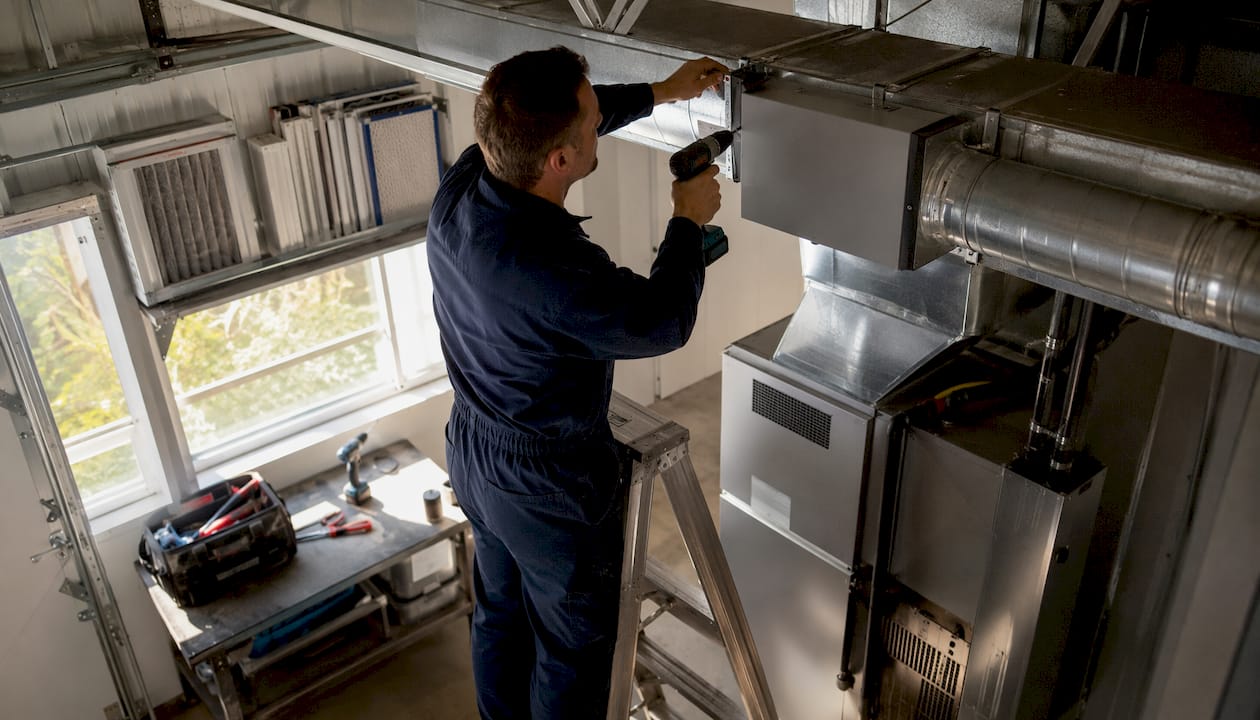
UV-C coil treatment is worth doing in humid climates like Southwest Florida because wet coil surfaces are prime real estate for mold and bacteria. It will not catch a pollen particle flying through the duct at 500 feet per minute, but it keeps the coil itself clean, which protects both air quality and system efficiency. For UV-C installation details specific to residential systems, the technology and placement options vary by unit.
What to watch for with in-duct electronic purifiers:
- Ask for third-party test data, not just manufacturer claims.
- Confirm the unit is certified to produce ozone below 0.05 ppm (the EPA’s recommended limit for indoor spaces).
- Factor in media or cell cleaning into your annual maintenance schedule — a neglected unit can become a contamination source.
The most effective whole-home approach pairs a deep-media MERV 13 cabinet (particle capture) with UV-C at the coil (biological control on wet surfaces). Adding a bypass HEPA makes sense for households with severe asthma or multiple allergy sufferers.
3. Why indoor humidity control matters more than most people realize
Dust mites cannot survive when indoor relative humidity stays below 50%. Mold growth on most surfaces requires RH above 60%. Keeping your home between 30–50% RH effectively starves both. In Southwest Florida, where outdoor humidity regularly exceeds 80%, your AC alone often cannot hold that range — especially in shoulder seasons when the system cycles less.
The target: 30–50% RH year-round. A $15 hygrometer tells you where you stand right now.
Options for hitting that target:
- Whole-home dehumidifier (ducted): The most reliable solution for humid climates. Sized in pints per day, installed in the return plenum or as a standalone unit. Runs independently of the AC, so it works even when the system is not cooling.
- Integrated humidistat: Pairs with your thermostat to trigger dehumidification when RH climbs. Works best when combined with a dedicated dehumidifier, not just the AC.
- AC performance tweaks: A properly charged system with clean coils dehumidifies better. Dirty coils reduce latent heat removal — which means more moisture stays in the air even when the temperature feels fine.
- Portable dehumidifiers: Useful for a single room or a problem area like a laundry room, but they do not address whole-home RH.
For SWFL homeowners, reducing indoor humidity is not optional — it is the foundation that makes every other allergy upgrade work better. A MERV 13 filter in a 75% RH home will still let mold spores regenerate on every wet surface the air touches.
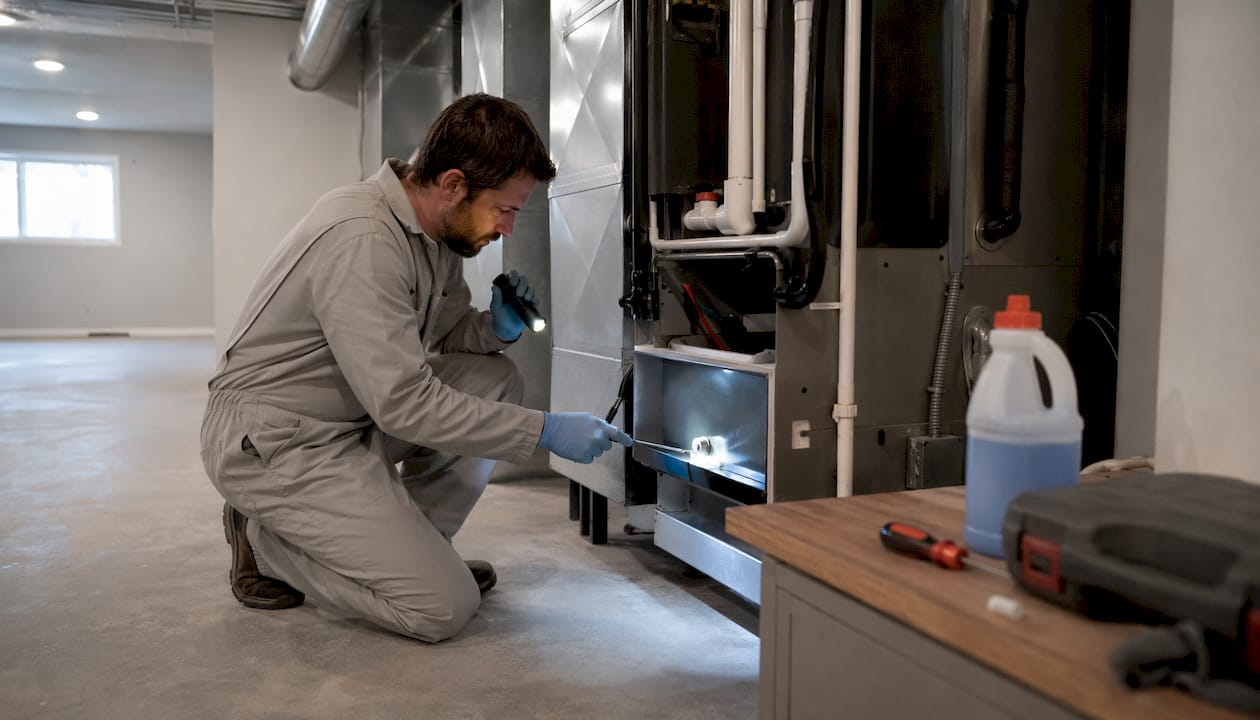
Condensate and drainage checks: Inspect the drain pan and condensate line at every tune-up. A clogged drain pan grows mold directly inside the air handler — the worst possible location.
4. Duct sealing and component maintenance stop allergens from recycling
Duct cleaning gets a lot of attention, but sealing is the more important step. Leaky ducts pull air from attics and crawlspaces — spaces loaded with insulation fibers, rodent dander, and mold spores — and deliver it straight to your living areas. Cleaning ducts without sealing them first is a temporary fix at best.
When professional duct cleaning is actually warranted:
- Visible mold growth inside ducts or on the air handler
- Evidence of rodent or insect infestation in the ductwork
- Heavy construction dust from a recent renovation
- Musty odors that persist after coil and drain pan cleaning
Routine cleaning without any of those conditions offers limited benefit, according to condition-based guidance from HVAC industry sources.
Component maintenance checklist:
- Evaporator coil: Clean annually; a dirty coil reduces dehumidification and becomes a mold surface.
- Blower wheel: Accumulates dust and biofilm; cleaning restores airflow and reduces particle redistribution.
- Drain pan: Treat with condensate tablets or pan strips to prevent algae and mold.
- Filter cabinet: Inspect the cabinet seal — a gap around the filter frame bypasses all filtration.
- Return air grilles: Vacuum regularly; they collect pet hair and dust that feeds back into the system.
Pro Tip: Before any duct cleaning appointment, ask the contractor to show you photos of the contamination they found. A reputable company documents the condition before and after. If they cannot show you evidence of contamination, question whether cleaning is necessary at all.
Red flags that warrant professional remediation: a musty smell that appears only when the system runs, allergy symptoms that are consistently worse at home than elsewhere, or visible dark staining around supply registers.
5. Smart ventilation: when to open up and when to seal tight
The instinct to “let fresh air in” works against you during pollen season and wildfire smoke events. During those periods, keeping windows closed and running your filtered HVAC system is the right call. The air inside a well-filtered home is cleaner than the air outside during a high-pollen day.
Decision rules for ventilation:
- High pollen or smoke outdoors: Close windows, run HVAC fan on “Circulate,” and rely on filtration.
- Good outdoor air quality: Introduce filtered fresh air through an ERV or HRV, or open windows briefly in the early morning when pollen counts are lowest.
- After cleaning or cooking: Run the fan to cycle air through the filter and clear particulates.
ERV vs. HRV for allergy-sensitive homes:
An Energy Recovery Ventilator (ERV) transfers both heat and moisture between incoming and outgoing air — better for humid climates like SWFL because it limits how much outdoor humidity enters. A Heat Recovery Ventilator (HRV) transfers heat only, which suits drier, colder climates. For Southwest Florida, an ERV is the right choice when balanced ventilation is a goal.
Both systems bring in filtered outdoor air without opening windows, which matters for tight, energy-efficient homes where natural infiltration is low. The trade-off is installation cost and the need for regular filter maintenance on the ERV/HRV unit itself.
Operational tips:
- Use a smart thermostat’s “Circulate” mode to run the fan 10–20 minutes per hour. Smart thermostat fan modes increase air changes and filter throughput without running the compressor continuously.
- If you have an IAQ sensor, tie ventilation schedules to CO₂ or particulate readings rather than a fixed timer.
- Keep fresh-air intakes away from driveways, pool equipment, and landscaping beds where allergens concentrate.
6. Portable HEPA purifiers: targeted relief where you sleep
Portable air purifiers are highly effective for room-level relief but do not replace whole-home solutions when allergens disperse throughout the house. Think of them as a precision tool, not a whole-house fix.
When a portable HEPA unit makes sense:
- Bedrooms and nurseries where you spend 7–9 hours with your face near the air
- A home office or single room where you spend most of your day
- Temporary relief during wildfire smoke events or peak pollen weeks
- Rental situations where duct modifications are not possible
How to size by CADR:
CADR (Clean Air Delivery Rate) measures how quickly a purifier cleans a room of a specific pollutant. The general rule: choose a unit with a CADR rating at least two-thirds of the room’s square footage. A 300 sq. ft. bedroom needs a CADR of at least 200 for smoke, dust, and pollen.
Placement and maintenance:
- Place the unit near the bed, not in a corner — you want clean air where you breathe, not where the walls are.
- Avoid placing it directly against furniture that blocks intake or exhaust.
- Replace HEPA filters on schedule (typically every 6–12 months); a clogged filter reduces CADR and can push particles back into the room.
Pro Tip: Run the portable purifier on high for 30 minutes before bed, then drop it to low. You get a fast clean-air cycle without the noise disrupting sleep.
Portable units become insufficient when allergens are entering from multiple rooms or when the HVAC system itself is distributing particles. At that point, whole-home upgrades are the only lasting fix.
7. What allergy-focused HVAC upgrades actually cost
Costs vary by region, home size, and existing equipment, but these ranges give you a realistic budget framework for Southwest Florida.
| Upgrade | Ballpark cost | Typical install time |
|---|---|---|
| 1" to 4–5" deep-media cabinet (MERV 13) | $200 installed | 1–2 hours |
| Bypass HEPA unit | $800 installed | Half day |
| UV-C coil treatment system | $300 installed | 1–3 hours |
| Whole-home ducted dehumidifier | $1,500 installed | Half to full day |
| ERV or HRV system | $1,500 installed | 1–2 days |
| In-duct electronic air cleaner | $500 installed | 2–4 hours |
| Professional duct sealing (mastic) | $500 depending on duct length | Half to full day |
| IAQ audit and static-pressure test | $150–$400 | 1–2 hours |
Timing considerations:
- Schedule filter cabinet upgrades and UV-C installs before peak pollen season (late winter/early spring in SWFL).
- Dehumidifier installs are best done before summer humidity peaks — contractors book up fast in May and June.
- Duct sealing can be done year-round but is easier when the attic is cooler (fall or winter in Florida).
Most homeowners start with the media cabinet and UV-C, which together run $500–$1,400 and cover the two biggest allergy drivers: particle capture and biological control on the coil. The dehumidifier is the next logical step for SWFL homes where humidity is a persistent issue.
8. How to prioritize upgrades and what to ask a contractor
Match your upgrade path to your symptom severity and budget. Overspecifying on day one is a common mistake — a $3,000 bypass HEPA in a home with leaky ducts and a dirty coil will underperform a $400 media cabinet in a well-maintained system.
Severity × budget framework:
- Mild seasonal symptoms, limited budget: Switch to MERV 11–13 in your existing slot (if compatible), set thermostat fan to “Circulate,” and add a portable HEPA in the bedroom. Total: under $200.
- Moderate symptoms, mid-range budget: Install a 4–5" deep-media cabinet (MERV 13), add a whole-home humidistat or portable dehumidifier, and schedule an annual tune-up with coil cleaning. Total: $400–$1,200.
- Severe symptoms or asthma, full budget: Bypass HEPA or whole-home purifier, whole-home ducted dehumidifier, UV-C at the coil, ERV/HRV, and professional duct sealing. Start with an IAQ audit and checklist before committing to equipment. Total: $3,000–$8,000+.
Questions to ask any contractor before signing:
- Will you perform a static-pressure test before recommending a filter upgrade?
- Are your technicians NATE-certified?
- For duct cleaning, can you show me documentation of the contamination found?
- What independent performance certifications do the products you’re recommending carry?
- Does your IAQ audit include airflow measurement, humidity readings, and a written report?
Red flags in contractor bids:
- “Hypoallergenic” claims on equipment with no independent certification to back them
- Filter upgrades recommended without any mention of static pressure or blower compatibility
- Duct cleaning pitched as a routine annual service rather than a condition-based one
- No written scope of work or performance benchmarks in the proposal
9. What the evidence and industry standards actually say
The numbers that matter for allergy-focused HVAC decisions are well-established. True HEPA filtration captures 99.97% of particles at 0.3 microns — the most penetrating particle size, which includes fine mold spores, pet dander fragments, and tobacco smoke particles. MERV 11–13 captures the bulk of common residential allergens at a fraction of the static-pressure cost.
The EPA recommends keeping indoor RH between 30–50% to suppress dust mite populations and prevent mold growth on most surfaces. Dust mites die off when RH drops below 50%; mold requires above 60% to colonize most materials.
Combined strategies deliver the most relief. Industry guidance consistently shows that filtration alone, humidity control alone, or purification alone each address only part of the allergen picture. Layering all three is what produces 70–95% reductions in targeted allergen levels.
Marketing terms to ignore:
- “Hypoallergenic” on HVAC equipment or filters has no regulatory definition. The AAFA endorsement program is one of the few independent certifications worth trusting for allergy-specific products.
- “Medical-grade” filtration is not a defined standard for residential HVAC.
- “Kills 99.9% of germs” claims on UV systems often reflect lab conditions, not installed performance in a real duct.
Trust signals to ask for:
- Written IAQ audit with airflow and humidity measurements
- Static-pressure test results before and after filter upgrades
- NATE or NADCA credentials for the technician performing duct work
- Independent performance certificates (AAFA or equivalent) for any purifier or filter product recommended
Key Takeaways
The most effective HVAC strategy for allergy relief combines MERV 13 deep-media filtration, whole-home humidity control at 30–50% RH, and UV-C coil treatment as a layered system rather than isolated upgrades.
| Point | Details |
|---|---|
| Filter upgrade first | A 4–5" MERV 13 media cabinet is the highest-impact, lowest-risk starting point for most homes. |
| Humidity is non-negotiable | Keep indoor RH at 30–50%; below 50% suppresses dust mites, below 60% prevents most mold growth. |
| Combined strategies win | Filtration plus humidity control plus purification can reduce allergen levels by 70–95%. |
| Duct sealing before cleaning | Seal leaks with mastic first; cleaning without sealing allows attic and crawlspace contaminants back in. |
| Ultraairswfl for SWFL homes | Ultraairswfl provides IAQ audits, media cabinet installs, UV-C, dehumidifiers, and duct sealing across Naples, Cape Coral, and Fort Myers. |
The upgrade that most homeowners skip — and why it matters most
The conversation about allergy-focused HVAC upgrades almost always starts with filters and ends with air purifiers. Both matter. But the upgrade that consistently gets skipped is the static-pressure check before any of it.
Here is what actually happens in a lot of homes: a homeowner reads that MERV 13 is the gold standard, buys the thickest filter they can find, and installs it in a 1" slot that was designed for a MERV 8. The blower strains, airflow drops, the coil runs colder and wetter, and mold starts growing on the evaporator. Allergy symptoms get worse, not better. The filter gets blamed. The real problem was never the filter rating — it was the mismatch between the filter and the system.
The same logic applies to whole-home purifiers. A bypass HEPA in a home with 30% duct leakage is pulling allergen-laden attic air through those leaks faster than the HEPA can clean it. Seal the ducts first. Then upgrade the filtration.
The practical takeaway: treat your HVAC as a system, not a collection of components you can upgrade independently. A $150 IAQ audit that includes a static-pressure test and a duct leakage assessment will tell you more about where to spend your money than any product review. In Southwest Florida’s humidity, that system-level thinking is especially important — the coil, the drain pan, the ductwork, and the filter all interact with moisture in ways that amplify allergy problems when any one piece is neglected.
Ultraairswfl handles the upgrades that actually move the needle
If you have worked through this guide and you are ready to stop guessing and start fixing, Ultraairswfl is the team to call in Southwest Florida. The difference between a generic HVAC tune-up and a real allergy-relief visit is the scope: Ultraairswfl technicians perform IAQ audits with airflow and humidity measurements, not just a filter swap and a handshake.
Services that map directly to the upgrades in this article: deep-media cabinet installation, UV-C coil treatment, whole-home dehumidifiers, duct sealing with mastic, ERV/HRV installation, and static-pressure testing before any filter upgrade. Financing options are available for larger installs, and the service area covers Naples, Cape Coral, and Fort Myers. For regular maintenance plans that keep your allergy upgrades performing year after year, or to schedule a full IAQ assessment, contact Ultraairswfl and request a quote. A technician will measure, document, and give you a written scope before any work begins.
Useful sources and further reading
The recommendations in this article draw on the following primary sources. Share these with your contractor when discussing IAQ audits, filter specifications, or certification requirements.
- U.S. Environmental Protection Agency (EPA) — Covers indoor humidity targets (30–50% RH), HEPA performance standards (99.97% at 0.3 microns), duct cleaning guidance, and portable air cleaner recommendations. The most authoritative starting point for any IAQ conversation.
- HVAC Base allergen control guide — Detailed breakdown of combined filtration, humidity, and purification strategies and the evidence behind 70–95% allergen reduction claims.
- HVACDatabase filter and allergen guide — Practical MERV band guidance for common residential allergens and filter replacement cadence.
- Asthma and Allergy Foundation of America (AAFA) — Independent product certification program and guidance on marketing terms like “hypoallergenic.” Share with contractors who recommend purifiers or filters with vague performance claims.
- NATE (North American Technician Excellence) — The credential to ask for when vetting HVAC technicians for IAQ work, static-pressure testing, and duct sealing.
For homeowners: bring the EPA humidity guidance and the AAFA certification page to any contractor meeting where purifiers or high-MERV filters are being proposed. A contractor who cannot reference these standards or provide independent certification for their recommended products is worth questioning.