
A proper HVAC tune-up is a short, checklist-driven service that restores factory-level performance by checking airflow, refrigerant charge, electrical safety, drainage, and controls. The single most important action you can take right now: schedule two professional visits annually (one before summer cooling season, one before winter heating season) and regularly replace your filter. ENERGY STAR recommends scheduling the cooling check in spring and the heating check in fall, before contractors get busy and rates climb.
Here is what a complete tune-up covers and why each step matters:
- Airflow and filtration: Dirty filters force the blower to work harder and can reduce system efficiency by up to 15%.
- Refrigerant charge: Low refrigerant almost always means a leak, not normal consumption.
- Electrical safety: Loose connections and failing capacitors are “silent” failures you will not catch without a meter.
- Drainage: A clogged condensate line can dump gallons of water into your home before the safety switch trips.
- Combustion safety (gas furnaces): A cracked heat exchanger can leak carbon monoxide with no visible warning.
Credentials matter here. Look for technicians holding NATE certification and EPA 608 certification for refrigerant handling. Ultra Air Heating & Cooling serves Naples, Cape Coral, and Fort Myers with certified technicians who document every reading and provide a written report after each visit.
Table of Contents
- Your 10-Point HVAC Tune-Up Checklist
- What Each Tune-Up Task Actually Involves
- What You Can Do Yourself vs. What Needs a Pro
- What Does a Professional Tune-Up Cost?
- When Should You Call a Pro Immediately?
- How Ultra Air Heating & Cooling Performs a Tune-Up
- Key Takeaways
- Why Biannual Maintenance Matters More in Southwest Florida
- Book Your Ultra Air Tune-Up in Southwest Florida
- Useful Sources and Further Reading
Your 10-Point HVAC Tune-Up Checklist
Print this and hand it to your technician. Each item maps to a real safety, efficiency, or warranty concern.
- ☐ Air filter inspection and replacement — A clogged filter is the leading cause of reduced airflow and frozen evaporator coils. Flag if: filter is visibly gray or airflow feels weak at registers.
- ☐ Evaporator and condenser coil cleaning — Dust and biological growth on coils cut heat transfer and spike energy use. Flag if: coils show visible debris, mold, or bent fins.
- ☐ Condensate drain and pan clearing — The drain removes 5–20 gallons of moisture per day during peak cooling; algae clogs cause water damage. Flag if: standing water in the pan or drain is slow to clear.
- ☐ Refrigerant level and charge verification — Technician measures superheat and subcooling; low charge indicates a leak. Flag if: readings are outside manufacturer spec.
- ☐ Electrical connection inspection and tightening — Loose terminals cause arcing, overheating, and premature component failure. Flag if: any connection shows discoloration or corrosion.
- ☐ Motor and moving-part lubrication — Dry bearings draw excess amperage and fail early. Flag if: motor amp draw is above nameplate rating.
- ☐ Belt and pulley inspection — Worn belts slip, reduce airflow, and can snap mid-season. Flag if: belt shows cracking, fraying, or glazing.
- ☐ Thermostat calibration and controls test — A miscalibrated thermostat pushes the system harder than needed. Flag if: measured room temp differs from thermostat reading by more than 2°F.
- ☐ Airflow, ductwork, and vent inspection — Disconnected or leaky ducts waste conditioned air before it reaches the room. Flag if: visible gaps, disconnected sections, or uneven room temperatures.
- ☐ Heat exchanger and combustion safety check (gas furnaces) — A cracked heat exchanger is a carbon monoxide hazard. Flag if: any visible crack, rust, or CO reading above zero.
Pro Tip: Before the technician leaves, ask for three specific readings: refrigerant superheat/subcooling values, motor amperage, and the temperature split (delta-T) across the evaporator coil. Photograph the capacitor with its spec sticker visible and the before/after coil condition. These numbers are your baseline for the next visit.
For a localized version of this checklist built for Florida’s climate, see Ultra Air’s Florida homeowner tune-up guide.

What Each Tune-Up Task Actually Involves
Airflow and filters
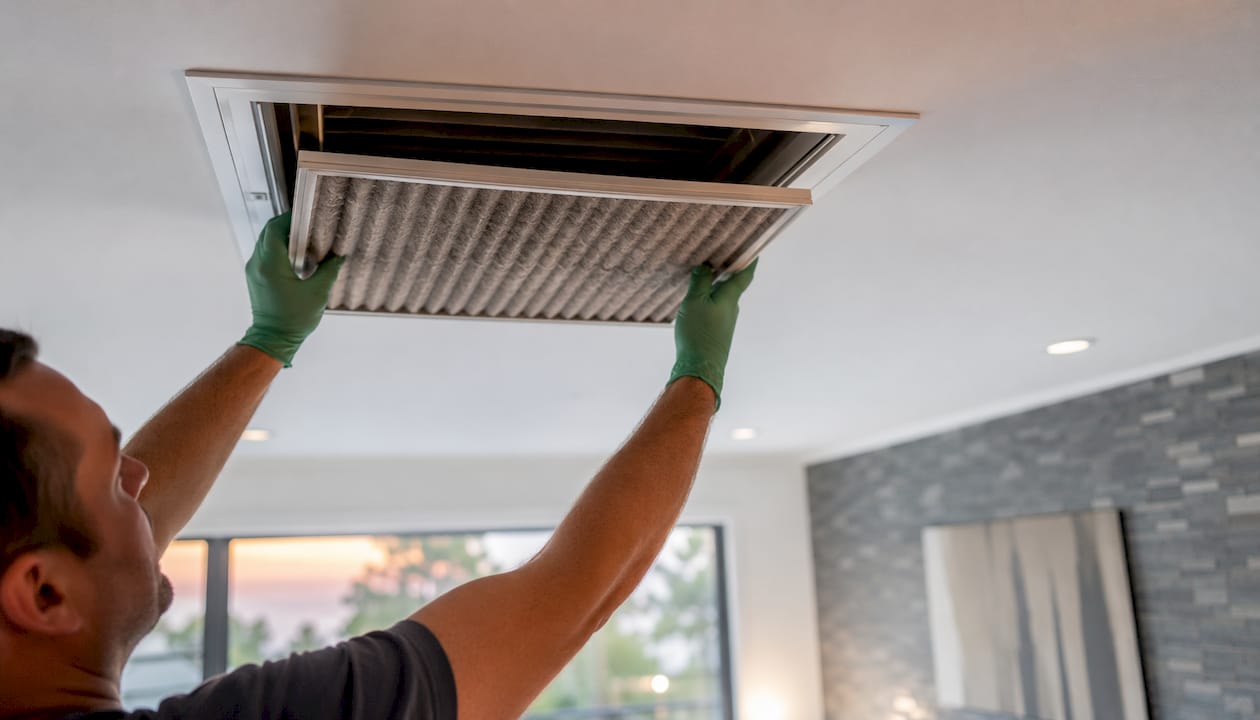
Filter fit matters as much as filter type. A filter that is slightly undersized lets unfiltered air bypass the media entirely. MERV ratings between 8 and 13 are the sweet spot for most residential systems: high enough to catch fine particles, low enough not to choke airflow. A technician should measure static pressure across the air handler and check the temperature split across the evaporator coil (delta-T). A healthy temperature difference across the evaporator coil indicates proper operation; deviations suggest airflow restriction, refrigerant issues, or a dirty coil.
Airflow problems can reduce system efficiency by up to 15%, and the fix is often as simple as a filter swap. That said, a filter alone will not fix a blower wheel caked in dust or a duct with a disconnected joint.
Coils and condensate drainage
Evaporator coil cleaning usually involves a no-rinse foaming coil cleaner applied to the indoor coil, followed by a flush into the condensate pan. Condenser coil cleaning means rinsing the outdoor coil from the inside out with a garden hose (never a pressure washer, which bends fins). Biological growth on either coil is a red flag for indoor air quality and a direct cause of efficiency loss.
The condensate drain should be flushed regularly with a diluted bleach or vinegar solution. A technician inspects the condensate pan for standing water, staining, or cracks to prevent potential water damage.
Refrigerant charge and leak detection
A thorough tune-up measures refrigerant pressures using manifold gauges, then calculates superheat (on fixed-orifice systems) and subcooling (on TXV systems) to confirm the charge is within manufacturer spec. Low refrigerant is not a normal consumable. It means there is a leak somewhere in the system. Simply adding refrigerant without finding and repairing the leak is a temporary and wasteful fix that leaves the underlying problem in place.
Leak detection involves checking service valves, flare connections, and the evaporator coil for oil staining, which is a reliable indicator of refrigerant escaping.
Electrical components and controls
ENERGY STAR’s maintenance checklist specifically calls for tightening electrical connections and testing controls. A technician should measure voltage at the disconnect and amperage at the compressor and condenser fan motor. Capacitors are tested with a capacitor meter against the microfarad rating printed on the label; a reading more than 10% below spec means the capacitor is failing. Contactors are inspected for pitting and carbon scoring.
These are the “silent” failures that homeowners never detect until the system stops running on the hottest day of the year.
Combustion and safety checks for gas furnaces
Heat exchanger inspection is the most safety-critical task on a gas furnace tune-up. A cracked heat exchanger allows combustion gases, including carbon monoxide, to mix with supply air. Visual inspection, combustion analysis with a flue-gas analyzer, and CO testing at the supply registers are all part of a complete furnace service checklist. The technician should also test the flame sensor, igniter, and gas valve operation.
Statistic callout: A professional tune-up that includes combustion analysis and CO testing is the only reliable way to detect a cracked heat exchanger before it becomes a health emergency.
Blower and mechanical components
A dirty blower wheel is one of the most consistently overlooked efficiency losses in residential HVAC. Dust buildup on the blower blades reduces airflow and forces the motor to draw more amperage. Motor amp draw should be measured and compared against the nameplate rating. Belt-driven systems (common in older equipment and some commercial units) need belt tension and condition checks; a glazed or cracked belt will slip under load.
Statistic callout: A quality tune-up takes 45–90 minutes per system. A visit that wraps up in 20 minutes almost certainly skipped the diagnostic measurements that make the service worth paying for.
Lubrication points include blower motor bearings and any other manufacturer-specified moving parts. Always use the oil type specified in the equipment manual.
What You Can Do Yourself vs. What Needs a Pro
Safe DIY tasks keep your system healthy between professional visits. Unsafe DIY tasks can injure you, void your warranty, or create a hazard that is invisible until it is serious.
Safe DIY maintenance tasks
- Replace or inspect the air filter every 30–90 days (check monthly; replace when visibly dirty or per manufacturer schedule).
- Clear debris, leaves, and vegetation from around the outdoor condenser unit, maintaining at least 18–24 inches of clearance on all sides.
- Flush the condensate drain line with a diluted bleach or vinegar solution quarterly.
- Test the thermostat by setting it 5°F below room temperature and confirming the system responds within 1–2 minutes.
- Clean supply and return registers with warm soapy water.
- Check your CO detector batteries and test the unit every fall before heating season.
Tasks that belong to a certified technician
Never attempt refrigerant handling, electrical tightening under load, heat exchanger inspection, combustion analysis, or refrigerant leak repair yourself. ENERGY STAR guidance is direct on this: these are safety issues, and a qualified technician is the right call. EPA 608 certification is legally required to purchase and handle refrigerants.
For Southwest Florida homeowners, Ultra Air’s HVAC maintenance checklist covers region-specific prep tasks worth doing before a technician arrives.
Maintenance frequency table
| Task | Who | Frequency |
|---|---|---|
| Air filter check/replacement | DIY | Monthly check; replace every 30–90 days |
| Condensate drain flush | DIY | Quarterly |
| Outdoor unit debris clearance | DIY | Monthly during growing season |
| Thermostat test | DIY | Each seasonal changeover |
| CO detector test | DIY | Every fall |
| Full cooling tune-up (AC) | Pro | Annually, pre-summer (spring) |
| Full heating tune-up (furnace/heat pump) | Pro | Annually, pre-winter (fall) |
| Refrigerant charge verification | Pro | Annually or when symptoms appear |
| Electrical inspection and tightening | Pro | Annually |
| Heat exchanger / combustion analysis | Pro | Annually (gas furnaces) |
Stop and call a pro immediately if you notice: an electrical burning smell, visible smoke from any component, CO alarm activation, a refrigerant-scented oily odor near the indoor unit, or a system that produces no heating or cooling at all. These are not tune-up situations. They are service calls. See Ultra Air’s guide on HVAC warning signs for a full breakdown.
Statistic callout: Scheduling your spring AC tune-up in March or April typically costs 10–20% less than peak summer pricing, when contractors are fully booked.
What Does a Professional Tune-Up Cost?
A professional tune-up usually costs a modest amount depending on system type and region, with annual maintenance plans bundling spring and fall visits often including repair discounts.
Common add-on repair costs
These are parts a technician may find during a tune-up that need replacement. Prices reflect typical installed ranges:
| Component | Typical Installed Cost Range |
|---|---|
| Capacitor | $200–$400 |
| Contactor | $150–$320 |
| Igniter (gas furnace) | $200–$400 |
| Surge protector | $250–$450 |
| Float switch | Varies by system |
| IAQ upgrades (filtration, UV) | $400–$1,800 |
What drives the price up
- System age: Older equipment takes longer to inspect and is more likely to need parts.
- Accessibility: Attic-mounted air handlers or rooftop units require more time.
- Refrigerant type and quantity: R-22 (found in pre-2010 systems) costs significantly more than R-410A or R-454B.
- Diagnostic time: A technician who measures and documents readings takes longer than one who just cleans and leaves.
- Parts discovered during inspection: A tune-up that uncovers a failing capacitor or a leaking condensate pan will add parts and labor.
When repair costs start stacking up on an aging system, the informal “$5,000 rule” is worth knowing: if the repair cost multiplied by the system’s age exceeds $5,000, replacement is usually the better financial decision. Your technician can walk you through the math.
Pro Tip: A technician who provides documented readings and photos before recommending repairs is worth the slightly longer visit time. That paper trail protects you from surprise emergency costs and gives you a real baseline for tracking system health year over year.
Attic ductwork and roof penetrations can also affect system performance. If your technician flags duct issues, it is worth checking whether roof ventilation problems are contributing to attic heat gain that overloads the system.
When Should You Call a Pro Immediately?
Some symptoms are not tune-up candidates. They are emergencies. Here is what to watch for and what to do before the technician arrives.
- Electrical burning smell or visible smoke. Turn the system off at the thermostat and the breaker. Do not restart it. Call a technician.
- CO alarm activation. Evacuate the building immediately. Call 911 and your gas utility before calling an HVAC technician.
- Refrigerant-scented oily odor near the indoor unit. This is a refrigerant leak. Turn the system off and call a certified technician. Do not attempt to locate or repair the leak yourself.
- No heating or cooling despite the system running. Could be a failed compressor, a refrigerant leak, or a tripped safety switch. A technician needs to diagnose it.
- Frequent short cycling. The system turning on and off every few minutes points to an oversized unit, a refrigerant issue, a dirty filter, or a failing control board.
- Sudden large spike in your energy bill. An unexplained 20–30% increase with no change in usage habits is often the first measurable sign of a failing component or a refrigerant leak.
Before the technician arrives: turn the system off at the thermostat and the breaker, photograph any visible symptoms (water staining, burnt components, ice on the refrigerant lines), and secure pets and children away from the equipment area.
One rule that covers all of it: never attempt live electrical work or refrigerant repair yourself. Call a certified HVAC technician for anything beyond the safe DIY tasks listed above.
Statistic callout: Capacitor failure is a common cause of cooling system issues in warmer months. Testing the capacitor every spring is a valuable tune-up task.
How Ultra Air Heating & Cooling Performs a Tune-Up
Here is the step-by-step process Ultra Air technicians follow on a standard visit in Naples, Cape Coral, and Fort Myers.
- Lockout and safety check. The technician confirms the system is safely de-energized before opening any panels.
- Visual inspection. Check for physical damage, corrosion, biological growth, and any obvious safety concerns before touching components.
- Filter inspection and replacement. Confirm filter size, MERV rating, and condition; replace if needed.
- Coil cleaning. Apply coil cleaner to the evaporator coil; rinse the condenser coil from inside out. Photograph before and after.
- Refrigerant charge verification. Connect manifold gauges, measure superheat and subcooling, and compare against manufacturer spec. Document pressures.
- Electrical inspection. Tighten all connections, measure voltage and amperage at the compressor and fan motors, test capacitor microfarad values against the spec sticker.
- Blower and duct assessment. Inspect blower wheel for dust buildup, measure motor amp draw, check belt and pulley condition on belt-drive systems, and assess accessible ductwork for leaks.
- Condensate system test. Flush the drain line, inspect the pan, and confirm the float safety switch operates correctly.
- Combustion checks (gas furnaces). Inspect the heat exchanger, run combustion analysis, test CO levels at supply registers, and verify flame sensor and igniter function.
- Written report delivery. The technician provides a pass/flag/fail report with recorded readings, photos of key inspection points, and prioritized repair recommendations with cost estimates.
Ultra Air technicians hold NATE certification and EPA 608 certification. Diagnostic tools on every visit include refrigerant manifold gauges, a capacitor meter, a combustion analyzer, an airflow meter, and a digital camera for documentation.
This approach aligns with ENERGY STAR’s maintenance checklist, which calls for tightening electrical connections, lubricating moving parts, checking condensate drains, cleaning coils, and verifying refrigerant levels on every professional visit. For more on why regular tune-ups prevent failures and preserve warranties, see Ultra Air’s full breakdown.
Key Takeaways
Biannual professional tune-ups combined with monthly filter checks are the single most effective strategy for extending HVAC equipment life, maintaining efficiency, and catching safety hazards before they become emergencies.
| Point | Details |
|---|---|
| Schedule twice per year | Book a cooling tune-up in spring and a heating tune-up in fall, before contractor demand peaks. |
| Airflow is the first domino | Dirty filters can reduce system efficiency by up to 15%; check monthly and replace every 30–90 days. |
| Demand documented readings | A complete tune-up records refrigerant superheat/subcooling, motor amps, delta-T, and capacitor values. |
| Know when to stop DIY | Refrigerant handling, combustion analysis, and electrical work under load require a certified technician. |
| Ultra Air Heating & Cooling | Serves Naples, Cape Coral, and Fort Myers with NATE/EPA-certified technicians and written post-visit reports. |
Why Biannual Maintenance Matters More in Southwest Florida
Southwest Florida is genuinely harder on HVAC equipment than most of the country. The combination of near-year-round cooling demand, high humidity, and salt air accelerates corrosion on condenser coils and electrical components in ways that homeowners in drier climates simply do not deal with. A system in Naples or Fort Myers that runs 10–11 months per year accumulates wear that a system in a northern climate running 4–5 months never sees.
What Ultra Air consistently finds on first-visit tune-ups in this region: condenser coils with salt-accelerated fin corrosion, capacitors testing below spec after a single heavy summer, and condensate drains clogged with algae that grows year-round in the humidity. None of these failures announce themselves. They just quietly reduce efficiency and shorten equipment life until something stops working.
The practical case for biannual service is straightforward: two tune-ups per year cost less than one emergency call, and far less than a compressor replacement that a flagged capacitor reading would have predicted six months earlier. For commercial properties and building managers, the math is even clearer because a failed system affects tenants, not just comfort.
Ultra Air’s technicians are local, which means they understand what the salt air does to a condenser coil and what the August humidity does to a condensate drain. That regional knowledge is reflected in the annual HVAC inspection approach Ultra Air recommends for Southwest Florida homes.
Book Your Ultra Air Tune-Up in Southwest Florida
Skipping a tune-up in Southwest Florida’s climate is a different risk than skipping one in a mild northern state. Ultra Air Heating & Cooling gives Naples, Cape Coral, and Fort Myers homeowners and building managers a documented, measurement-based tune-up that covers every item on the checklist above, including filter replacement, coil washing, electrical tightening, condensate flush, refrigerant charge verification, and basic indoor air quality checks.
Every visit ends with a written report: recorded readings, photos of key inspection points, and a prioritized repair list with cost estimates. No guesswork, no verbal-only summaries.
To book, call Ultra Air directly or schedule online. Have your equipment make and model, the date of your last service, and any symptoms you have noticed ready when you call. Flexible financing and service plans are available for homeowners who want to lock in both annual visits at a predictable cost. For heating-specific service, including furnace tune-ups and heat pump checks, see Ultra Air’s heating solutions page. If a tune-up uncovers indoor air quality concerns, Ultra Air’s IAQ improvement checklist is a practical next step.
Useful Sources and Further Reading
The recommendations in this article draw on the following authoritative sources. Save or bookmark these for reference when reviewing your technician’s report or building your own maintenance log.
- ENERGY STAR: How to Keep Your HVAC System Working Efficiently — Primary guidance on scheduling, filter maintenance, and airflow efficiency.
- ENERGY STAR Maintenance Checklist — The official task list covering electrical, refrigerant, coil, and drainage checks.
- U.S. Department of Energy: Maintaining Your Air Conditioner — Federal guidance on AC maintenance priorities and efficiency.
- HVAC Base: Seasonal DIY Maintenance Guide — Detailed seasonal checklist with DIY vs. pro task breakdown and cost guidance.
- FilterBuy: AC Maintenance Checklist — Downloadable PDF/Excel checklist organized by season and system type.
- NATE (North American Technician Excellence) — The national certification body for HVAC technicians; use this to verify technician credentials.
- Ultra Air: Why Regular Tune-Ups Matter — Ultra Air’s explanation of how consistent maintenance prevents failures and preserves warranties.
- Ultra Air: Southwest Florida HVAC Maintenance Checklist — Region-specific checklist for homeowners in Naples, Cape Coral, and Fort Myers.
One practical step before your next service visit: print the 10-point checklist from this article, fill in any tasks you have already completed (filter changes, drain flushes, anything you noticed), and hand it to your technician when they arrive. A filled-in checklist cuts diagnostic time and keeps the visit focused on what actually needs attention. Ask for the written report with photos before the technician leaves.