Last August, a homeowner named Dave discovered that a simple AC replacement without the proper paperwork led to a voided manufacturer warranty and a stop-work order from a city inspector. It’s a frustrating, expensive setback that no neighbor should have to face in the Southwest Florida heat. Learning how to get a building permit for HVAC work in Cape Coral is the most important step to ensure your new system is legal, safe, and ready for the next hurricane season.
We understand that the EnerGov CSS portal feels like a maze and that 2026 hurricane tie-down requirements can be overwhelming. You want a service experience that doesn’t end with a fine or a headache during a future home resale. As Ultra Air Heating and Cooling, a family owned and operated business, we believe in doing things the right way the first time to protect your peace of mind. We’re here to help you navigate the City of Cape Coral’s requirements with the calm authority of a seasoned expert.
This guide breaks down the digital application process, mandatory SWFL wind-load documentation, and the specific steps to secure a final approval from the building department so you can beat the heat without any legal worries.
Key Takeaways
- Understand which specific projects require a mechanical permit under the Florida Building Code to keep your home legal and insurance-compliant.
- Identify the essential documents, including mandatory Florida Product Approvals, needed to satisfy Cape Coral’s strict equipment safety standards.
- Follow our professional guide on how to get a building permit for HVAC work in Cape Coral using the City’s EnerGov CSS portal for a smooth digital application.
- Learn how to meet critical hurricane resiliency requirements for condenser pads and flood zone elevations to protect your system from SWFL storms.
- Discover how our “Ultra Service” removes the stress of paperwork by managing the entire permitting and inspection lifecycle for you.
Do You Need a Permit for HVAC Work in Cape Coral?
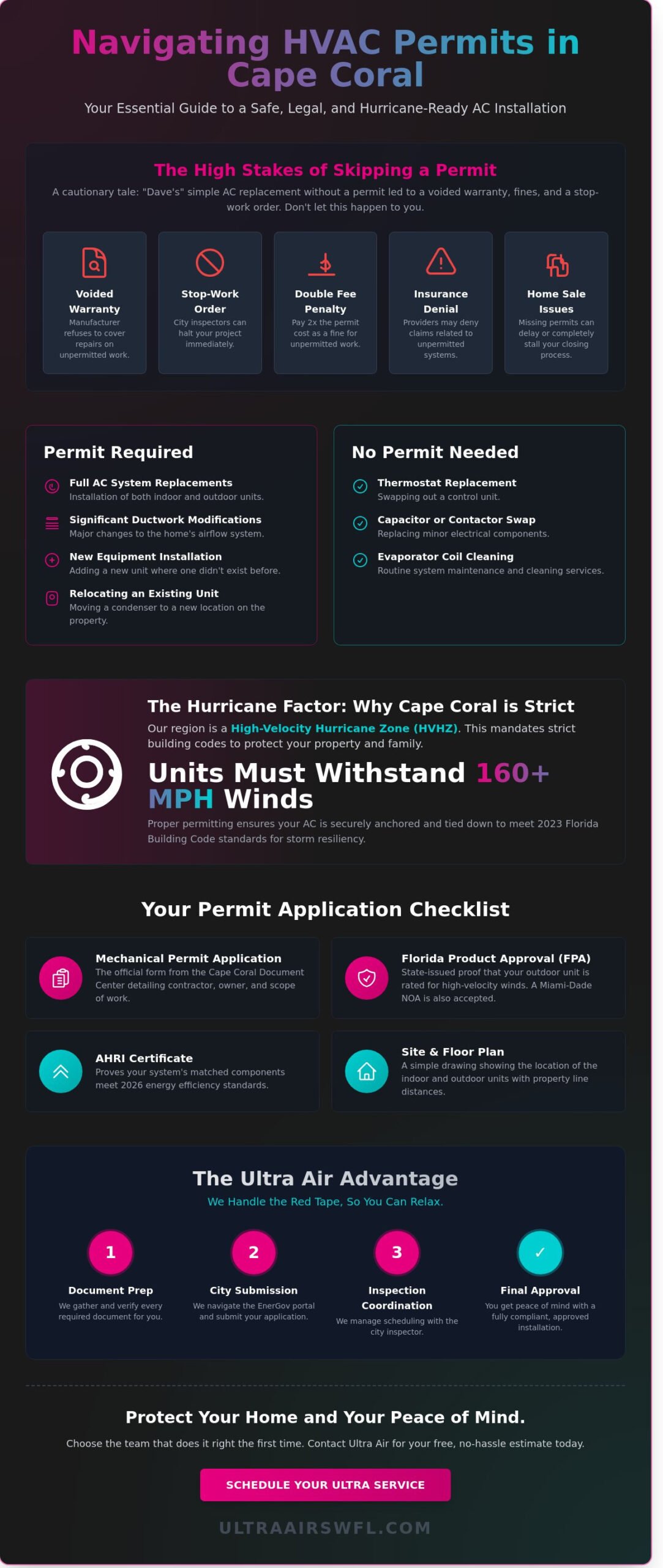
In Southwest Florida, your air conditioner isn’t a luxury; it’s a lifeline. When you’re looking at a major repair or a full system upgrade, you might wonder about the paperwork. The Florida Building Code 8th Edition (2023) is very clear about mechanical work. The City of Cape Coral enforces these rules strictly because our region is classified as a High-Velocity Hurricane Zone (HVHZ). This means every outdoor unit must be properly anchored to withstand winds exceeding 160 mph. Understanding how to get a building permit for HVAC work in Cape Coral is essential for every homeowner who values their property and safety.
To better understand how the permitting process works for a homeowner, watch this helpful video:
We see homeowners try to skip this step to save a few dollars, but the risks far outweigh the rewards. A permit ensures that a city inspector verifies the electrical connections, refrigerant lines, and structural tie-downs. In Cape Coral, you must obtain a permit for these projects:
- Full AC system replacements (indoor and outdoor units)
- Significant modifications to existing ductwork
- Installation of new heating or cooling equipment
- Relocating an existing unit to a different part of the property
Permit vs. No Permit: Drawing the Line
You don’t need the city’s permission for every minor fix. If our technicians are performing an Ultra service call to swap a thermostat, replace a blown capacitor, or clean your evaporator coils, a permit isn’t required. These are considered maintenance or minor repairs. However, any work that opens the refrigerant circuit or changes the home’s electrical load requires official approval. A mechanical permit is a legal requirement for all Cape Coral AC replacements to ensure the installation meets 2023 Florida Building Code standards.
The Legal Consequences of Skipping the City Inspector
Cutting corners leads to “Work Without a Permit” violations. Under Cape Coral Code of Ordinances Section 6-21, the Building Division applies a “Double Fee” penalty for work started before a permit is issued. This means you’ll pay twice the original cost of the permit as a fine. Beyond the city, your homeowners insurance provider may deny claims if a fire or flood is linked to an unpermitted HVAC system. Most SWFL insurers, including Citizens, require proof of a closed permit before they’ll cover a new installation. If you try to sell your home, an open or missing permit will likely stall the closing process. We focus on providing Ultra comfort by handling these details correctly the first time, protecting your investment and your peace of mind.
Essential Documents for Your Cape Coral HVAC Permit
Gathering the right paperwork is the first step toward a cooler home. Cape Coral’s Building Division requires a specific technical package to ensure your new system is safe, efficient, and storm-ready. Knowing how to get a building permit for HVAC work in Cape Coral means preparing these four items before you head to the Document Center.
- Mechanical Permit Application: You must download the current version from the Cape Coral Document Center. It requires detailed information about the contractor, the property owner, and the specific scope of work.
- Florida Product Approval (FPA): This is a state-issued document proving your outdoor unit can withstand high winds. You may also use a Miami-Dade Notice of Acceptance (NOA).
- AHRI Certificate: You need an Air-Conditioning, Heating, and Refrigeration Institute certificate. This proves your matched system meets the 2026 energy efficiency standards.
- Site and Floor Plan: You must provide a simple drawing. It should show the location of the indoor air handler and the outdoor condenser, including distances from property lines.
Accuracy matters here. If your AHRI certificate doesn’t match the model numbers on your application, the city will reject the permit. This causes delays that keep you sweating in the SWFL heat. Our team at Ultra Air stays updated on these clerical requirements to keep your project on track.
Understanding Florida Product Approvals (FPA)
Florida law is strict about exterior equipment because of our hurricane risk. Every outdoor condenser must have an FPA number. This number confirms the unit was tested against “wind load” ratings of at least 160 mph. You can usually find this number on the manufacturer’s specification sheet or on the Florida Building Code website.
It isn’t just about the machine. You must also document the hurricane tie-down method. Inspectors want to see exactly how the unit is bolted to the condenser pad. If you’re using a specific brand of clip or bolt, the permit must list those parts. This ensures your unit stays put during a tropical storm instead of becoming a projectile.
Mechanical Venting and Ductwork Specs
Ductwork is your home’s circulatory system. In Southwest Florida, we face extreme humidity, so the city requires high-quality insulation. All new ductwork in unconditioned spaces, like your attic, must meet R-8 insulation standards. This prevents “sweating” and mold growth while keeping your air cold. If your project involves new vent penetrations through the roof or walls, you must provide a diagram showing the flashing and sealing methods.
Energy efficiency is also a major focus for local inspectors. For 2026 residential installs, Florida maintains a minimum requirement of 14.3 SEER2 for split systems. This rating ensures you get the most cooling for every dollar spent on your electric bill. If the paperwork feels overwhelming, our family owned & operated team can help you secure Ultra comfort by handling these technical details for you. We make sure every spec meets the latest 2026 codes so your inspection passes the first time.
Step-by-Step: Applying via the EnerGov CSS Portal
Getting your HVAC project started in Cape Coral requires a trip to the digital front desk. The city uses the EnerGov Citizen Self-Service (CSS) portal for all mechanical permits. You’ll first need to create a personal account using a valid email address. This account acts as your command center for the entire project. Understanding how to get a building permit for HVAC work in Cape Coral starts with mastering this online system. It eliminates the need for paper applications and physical trips to City Hall, which is vital when you need to restore your Ultra comfort quickly.
Once logged in, you must select the correct permit category. For most homeowners, this is the “Residential Mechanical” permit. If you are managing a business property, select “Commercial Mechanical” instead. Accuracy at this stage prevents the city from rejecting your application later. You will also need to upload your digital documents. Cape Coral is strict about its PDF naming conventions. Every file must be clearly labeled, such as “Contract_123MainSt.pdf” or “AHRI_Certificate.pdf.” After the files are uploaded, you must pay the initial permitting fees online. The city will not begin the plan review process until the transaction is processed. This step is the “green light” for the city’s building officials to start their work.
Navigating the CSS Dashboard
The CSS dashboard can feel overwhelming at first glance. Click the “Apply” tab and use the search bar to find the Mechanical sub-permit. When entering the property address, ensure the Parcel ID matches the official Lee County Property Appraiser records exactly. Even a small typo can stall the process. You must also add your contractor as a professional contact. At Ultra Air, we are a Family Owned & Operated business that understands these local requirements. Adding us to the application allows our team to view the permit status and coordinate inspections directly, saving you time and reducing stress.
Tracking Your Permit Status
You don’t have to guess where your application stands. The portal uses specific status terms to keep you informed. “In Review” means city staff are currently checking your documents. “Incomplete” indicates that the city needs more information. If you see “Plan Review Comments,” read them carefully and provide the requested data to keep the project moving. Once the status changes to “Issued,” your permit is active. You must then download and print your “Permit Placard.” This document must be displayed in a visible window or on the front door of your job site. This ensures our technicians can “Beat the Heat” and begin the installation with full legal compliance.
Hurricane Resiliency: Cape Coral Specific Standards
Living in Southwest Florida means planning for the worst while hoping for the best. When you learn how to get a building permit for HVAC work in Cape Coral, you aren’t just checking a box for the city. You’re ensuring your home stays cool and safe after a major storm. Cape Coral enforces strict structural standards because an unsecured AC unit becomes a dangerous projectile during high-wind events. Our Ultra service focuses on these local codes to protect your investment and your family.
Condenser Tie-Downs and Wind Loads
Cape Coral requires equipment to withstand 160+ MPH winds. This standard ensures that your condenser stays put during a major hurricane. For ground-mounted systems, we follow specific bolt patterns that anchor the unit into a reinforced concrete pad. Ground-mounted units must be elevated at least 4 inches above the surrounding grade. Roof-mounted units require even more rigorous engineering, often involving heavy-gauge steel hurricane straps and specialized curb mountings. These Ultra-reliable mounting methods prevent the vibrating unit from loosening over time, which is critical for long-term resiliency.
HVAC Elevation in Flood Zones
Flood zones dictate the height of your equipment. The City of Cape Coral uses the Base Flood Elevation (BFE) to determine exactly how high your AC unit must sit. If you live in a canal-front home or a low-lying area, your permit will require the unit to be elevated on an aluminum stand or a masonry platform. This prevents storm surges from frying the expensive electronics in your condenser. If your current system is sitting at ground level in a flood-prone zone, you may need a platform upgrade to pass inspection. For homeowners managing older systems in these zones, we offer Expert AC Repair in Cape Coral to help bridge the gap between your current setup and modern safety codes.
Electrical Safety and Surge Protection
Part of knowing how to get a building permit for HVAC work in Cape Coral involves meeting strict electrical codes. Every installation must include a weather-rated disconnect switch within sight of the unit. This allows technicians to safely cut power during repairs. We also emphasize surge protection as a standard practice. Florida leads the nation in lightning strikes, and a single surge can destroy a new high-efficiency system. We install dedicated surge protectors at the disconnect to provide that extra layer of peace of mind.
To truly “Beat the Heat” in SWFL, you have to build for the next big storm. Our family-owned and operated team understands these local nuances because we live here too. We ensure every installation meets or exceeds the Florida Building Code, keeping your home a sanctuary of comfort regardless of the weather outside.
The Ultra Air Advantage: We Handle the Red Tape
Understanding how to get a building permit for HVAC work in Cape Coral shouldn’t be your job. It’s ours. As a family-owned and operated business, we believe our neighbors deserve a stress-free experience. We manage the entire permitting lifecycle from the moment you sign a proposal until the city inspector signs off on the final document. Our “Ultra Service” removes the administrative burden from your shoulders, allowing you to focus on your family while we handle the city’s technical requirements.
Speed is critical when your comfort is on the line. We utilize Private Providers to facilitate 24-hour inspection turnarounds. While standard municipal schedules often lag during peak summer months, our partnership with certified private inspectors keeps your project moving. This ensures your 2026 installation is fully code-compliant without the typical government delays. We guarantee that every “Ultra” installation meets the rigorous standards of the Florida Building Code, providing you with a system that is as safe as it is cool.
Professional Permitting vs. Owner-Builder Risks
Pulling a permit as an “Owner-Builder” is a common trap that creates significant legal liability. When you pull your own permit, you effectively become the general contractor. If a technician is injured on your property, you may be held legally responsible for medical bills and lost wages. Your homeowner’s insurance policy often contains exclusions for these specific scenarios.
- Liability Protection: Ultra Air is fully licensed, bonded, and insured. We carry the risk so you don’t have to.
- Technical Mastery: We stay updated on 2026 SWFL energy codes and SEER2 requirements.
- Long-term Value: A professionally pulled permit ensures your manufacturer warranty remains valid.
Hiring a licensed Cape Coral HVAC expert protects your investment and your peace of mind. Once your permitted system is installed, staying on top of upkeep is the best way to protect that investment. Read our expert tips in our guide to Air Conditioning Maintenance Near Me to maximize your system’s lifespan.
Scheduling Your Final Inspection
The final inspection is the last step in how to get a building permit for HVAC work in Cape Coral. During this walk-through, the city inspector verifies the electrical disconnect, the emergency drain pan, and the hurricane-rated condenser pad. We don’t just hope for a pass; we prepare for it. Our technicians perform a 25-point internal audit before the inspector ever arrives.
We coordinate the entire inspection window to fit your schedule. We’ve maintained a 98% first-attempt pass rate over the last decade because our technical mastery is second to none. If the inspector requires any adjustments, we handle them immediately at no extra cost to you. We’re your partners in this process from start to finish. Ready for a worry-free upgrade? Contact Ultra Air today! and let’s beat the heat together.
Streamline Your Cape Coral HVAC Upgrade Today
Navigating the EnerGov CSS portal and meeting the city’s 2026 hurricane resiliency standards requires technical precision. You’ve learned that gathering the right engineering documents and understanding local codes is the first step toward a safe installation. Knowing how to get a building permit for HVAC work in Cape Coral ensures your home remains compliant and protected during the next major storm season.
Don’t let the red tape stall your comfort. Ultra Air has been family owned and operated since 2018, providing the expert knowledge needed to navigate complex Cape Coral building codes with ease. We offer 24/7 emergency AC support to keep your family cool when the SWFL heat hits its peak. Our team manages the entire filing process so you can focus on your daily life. We bring technical mastery to every job, ensuring your system meets every local requirement for maximum peace of mind.
Let Ultra Air Handle Your Cape Coral HVAC Permitting Today!
Stay cool and confident knowing your Ultra comfort is in professional hands.
Frequently Asked Questions
Do I need a permit to replace an AC unit in Cape Coral?
Yes, you must obtain a permit for any AC replacement in Cape Coral. Florida Building Code Section 105.1 mandates a permit for any system installation or replacement to ensure safety and energy efficiency. At Ultra Air, we handle the paperwork for you to ensure your new system meets all SWFL wind-load and electrical requirements. This process protects your warranty and guarantees the installation passes city inspections for your peace of mind.
How much does an HVAC permit cost in Cape Coral?
Cape Coral permit fees are based on the City’s current fee schedule. For a standard residential mechanical permit, homeowners typically pay a base fee of $75 plus a 3% state surcharge. These costs can vary if additional electrical work or structural modifications are required for the installation. We recommend checking the City of Cape Coral’s official website for the most current 2024 pricing updates before starting your project.
Can a homeowner pull their own HVAC permit in Florida?
Yes, Florida Statute 489.103(7) allows homeowners to act as their own contractor if the property is for their own use. You must sign an Owner-Builder Disclosure Statement and assume all legal and financial responsibility for the work. Most residents prefer our Ultra service because we manage the technical filings and ensure the installation meets 160 MPH wind-load ratings required in SWFL. Doing it yourself means you’re liable for any code violations found during inspection.
How long does it take to get an HVAC permit in Cape Coral?
Most HVAC permits in Cape Coral are issued within 2 to 5 business days when submitted through the online portal. Learning how to get a building permit for HVAC work in Cape Coral efficiently involves having your AHRI certificate and floor plan ready for upload. Our team uses the city’s digital system to expedite approvals so you can beat the heat and restore comfort to your home without unnecessary delays.
What happens if I install an AC without a permit in Lee County?
Installing an AC without a permit can result in fines up to $500 per day or double permit fees under Lee County ordinances. Unpermitted work also creates major hurdles when you try to sell your home, as title companies often flag open code violations. Beyond the legal risks, many manufacturers will void your equipment warranty if they don’t have proof of a permitted, professional installation from a certified contractor.
Does an AC permit require an electrical permit too?
Yes, most AC replacements require a companion electrical permit to ensure the wiring and circuit breakers match the new unit’s specifications. Cape Coral building officials inspect both the mechanical installation and the electrical connections to prevent fire hazards. Our expert technicians coordinate both aspects of the job, providing a seamless experience that keeps your family safe and your system running at peak efficiency.
Is a duct leakage test required for my Cape Coral permit?
A duct leakage test is required if you replace more than 30 linear feet of ductwork according to the Florida Energy Conservation Code. For standard unit change-outs where ducts remain untouched, a test is generally not mandatory. However, we often recommend a pressure test to ensure your system delivers maximum comfort and lower energy bills. This data helps confirm your home isn’t losing cooled air into the attic.
What is the EnerGov CSS portal and how do I use it?
The EnerGov Citizen Self Service (CSS) portal is the City of Cape Coral’s official digital platform for permit applications and inspections. To use it, you must create a registered account, upload your digital plans, and pay fees via a secure credit card link. It’s the fastest way to understand how to get a building permit for HVAC work in Cape Coral without visiting City Hall. Our office staff manages this portal daily to track every project’s progress for our customers.