
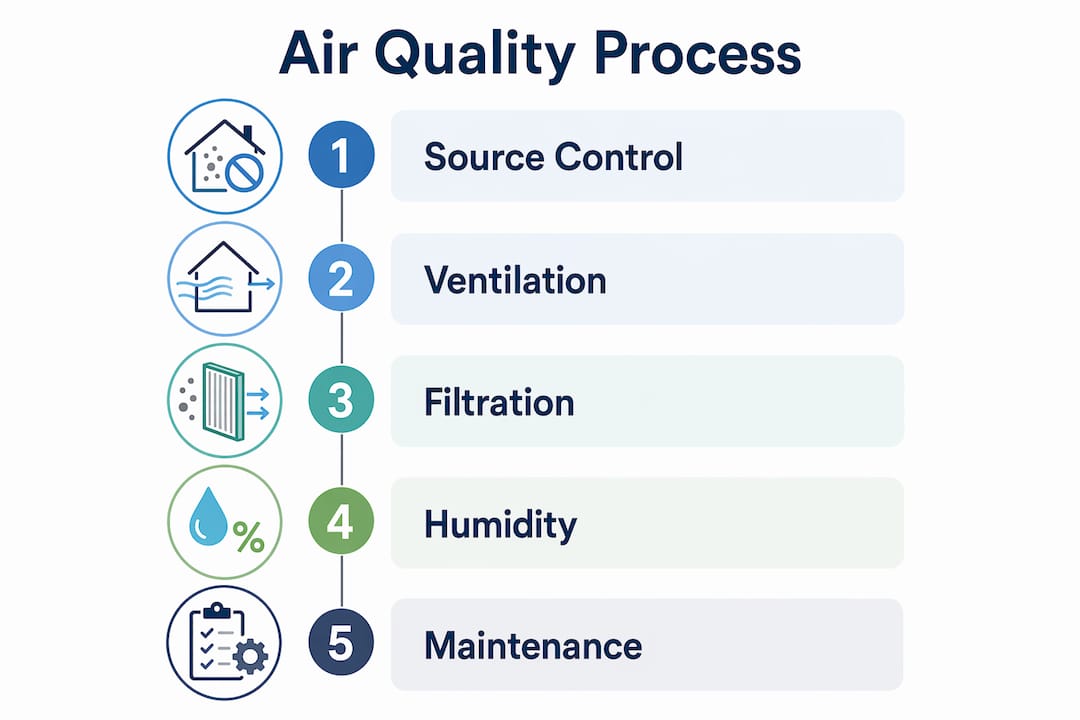
The home air quality improvement process is the systematic approach to reducing indoor air pollutants through source control, optimized ventilation, and targeted air filtration. Indoor air quality (IAQ) is the recognized industry term for this discipline, and professionals treat it as a three-level hierarchy rather than a single fix. The three-level IAQ hierarchy places source control first, ventilation second, and filtration third. Skipping any level reduces the effectiveness of the others. Tools like digital hygrometers, MERV 13 HVAC filters, and portable HEPA purifiers each serve a specific role in this process.
What is the home air quality improvement process?
Source control is the first and most impactful level of the IAQ hierarchy. Source control significantly outperforms ventilation and filtration in long-term effectiveness and cost-efficiency. That means the cheapest and most lasting gains come from removing or reducing pollutants at their origin, not from filtering them out after the fact.
Common indoor pollutants fall into five categories: volatile organic compounds (VOCs) from paints, adhesives, and cleaning products; combustion gases from gas stoves and fireplaces; dust and particulate matter; mold spores from moisture; and pet dander. Each category requires a different response. Knowing which pollutants are present in your home is the starting point for every decision that follows.
Practical source control steps include choosing low-VOC paints and cleaning products, sealing radon entry points in basements and crawl spaces, and storing chemicals in sealed containers outside the living area. Regular vacuuming with a HEPA-equipped vacuum removes settled dust and pet dander before they re-enter the air. Fuel-burning appliances require annual professional inspection and proper venting to prevent dangerous carbon monoxide buildup.
- Switch to low-VOC or zero-VOC paints, primers, and adhesives
- Store gasoline, solvents, and pesticides in a detached garage or shed
- Seal visible cracks in basement floors and walls to block radon entry
- Vacuum carpets and upholstery weekly using a HEPA-filtered vacuum
- Schedule annual inspections for gas furnaces, water heaters, and fireplaces
Pro Tip: Replace conventional air fresheners and scented candles with unscented alternatives or beeswax candles. Most synthetic fragrances release VOCs that directly undermine your source control efforts.
How to improve home ventilation effectively
Ventilation dilutes indoor pollutants by replacing stale air with outdoor air. It works best after source control has reduced the pollutant load. Without source control, ventilation alone cannot keep pace with continuous pollutant generation.
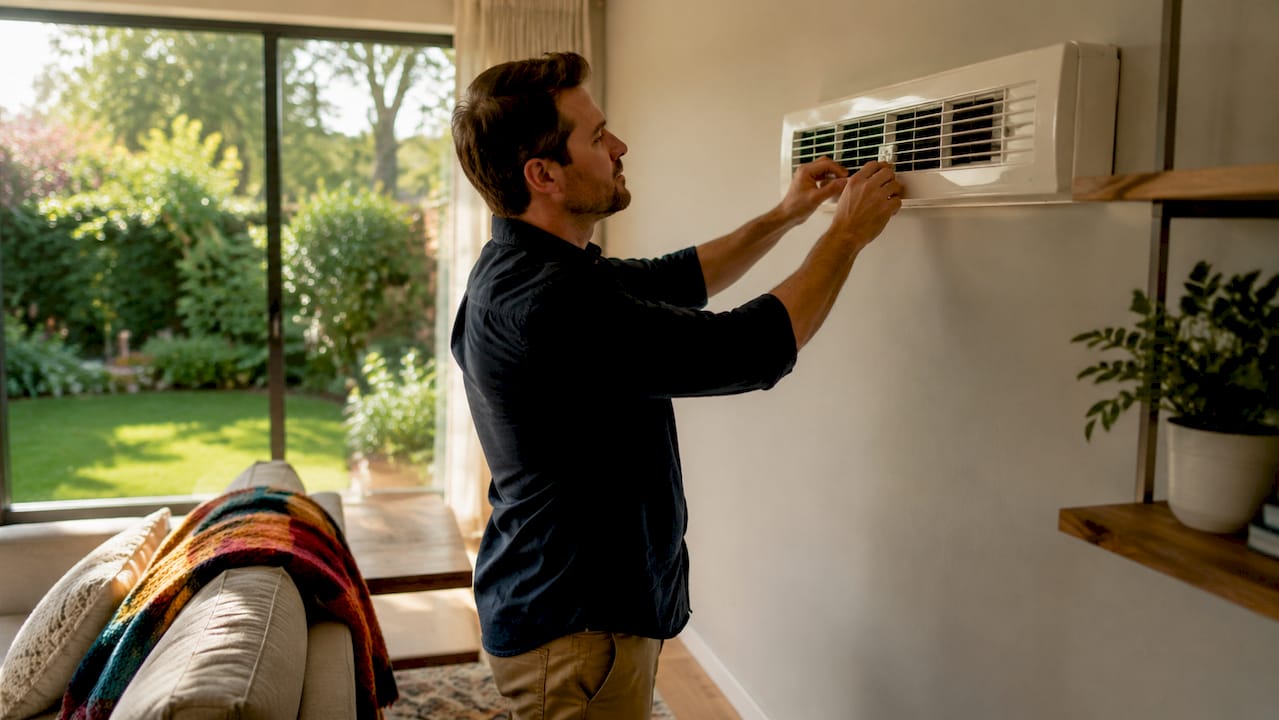
Natural ventilation works through cross-ventilation, which means opening windows on opposite sides of a room or home for 10–15 minutes. Opening a single window recirculates stale air rather than replacing it. This is one of the most common ventilation mistakes homeowners make, and it costs nothing to correct.
Mechanical ventilation options include bathroom and kitchen exhaust fans, whole-house energy recovery ventilators (ERVs), and HVAC fresh air intake dampers. ERVs are particularly effective in hot, humid climates like Southwest Florida because they exchange stale indoor air for fresh outdoor air while recovering most of the energy used to condition the indoor air. Smart ventilation strategies timed with outdoor air quality maximize benefits, especially on days when outdoor pollen or pollution levels are elevated.
- Check local air quality index (AQI) before opening windows, especially during high pollen or wildfire smoke events
- Run kitchen exhaust fans during and for 15 minutes after cooking to remove combustion gases and moisture
- Use bathroom exhaust fans for at least 20 minutes after showering to control humidity
- Install an ERV or heat recovery ventilator (HRV) if your home is tightly sealed
- Open windows on opposite sides of the home for cross-ventilation during mild weather
Pro Tip: Run your HVAC system fan on “on” rather than “auto” during high-activity periods. This circulates air through the filter continuously, even when the system is not heating or cooling.
Choosing and maintaining air filtration systems
Air filtration is the third layer of the IAQ process, not the first. No single device can ensure good IAQ. Filtration captures what source control and ventilation leave behind. Treating a purifier as a substitute for the first two steps leads to overwhelmed equipment and disappointing results.
MERV 13 HVAC filters capture fine particles including smoke, bacteria, and most allergens without restricting airflow in properly sized systems. Portable HEPA purifiers handle particles down to 0.3 microns and work best in single rooms where occupants spend the most time, such as bedrooms and living rooms. Activated carbon filters target VOCs and odors that HEPA filters cannot capture. Air purifiers do not remove radon or carbon monoxide unless specifically equipped with activated carbon or specialized media.
For allergy and asthma households, the EPA recommends targeting 5 air changes per hour in key rooms. To hit that target, match the purifier’s clean air delivery rate (CADR) to the room’s square footage. A unit rated for 150 square feet will underperform in a 300-square-foot bedroom. Exact room airflow and unit capacity calculations ensure clinically relevant reductions in allergens and particles.
| Filter type | Best for | Limitation |
|---|---|---|
| MERV 13 HVAC filter | Whole-home particle filtration | Does not capture gases or odors |
| Portable HEPA purifier | Single-room allergen and particle removal | Limited to one room; requires correct sizing |
| Activated carbon filter | VOCs, odors, and chemical gases | Does not capture particles or biological pollutants |
Placement matters as much as the filter type. Purifiers placed in corners create airflow dead zones that drastically reduce their effectiveness. Place units away from walls, curtains, and furniture to allow unobstructed airflow on all sides. Check filters monthly and replace HVAC filters every 60–90 days. For Florida homes with pets or heavy pollen exposure, monthly replacement is often the right call. The best air filter for Florida allergies depends on your specific pollutant mix, not just the MERV rating.
Managing indoor humidity for healthier air
Relative humidity between 30% and 50% is the target range for healthy indoor air. Humidity above 55–60% spikes mold and dust mite populations. Humidity below 35% dries mucous membranes and makes occupants more vulnerable to airborne viruses. Both extremes create real health risks.
Digital hygrometers cost $10–$25 and give you a real-time humidity reading in any room. Whole-house humidistats integrate with your HVAC system to maintain consistent levels throughout the home. Consistent monitoring paired with whole-home humidistats prevents mold and respiratory discomfort far more effectively than reacting after problems appear.
| Humidity level | Health effect | Recommended action |
|---|---|---|
| Below 30% | Dry skin, irritated airways, increased virus survival | Add a humidifier or adjust HVAC humidistat |
| 30%–50% | Optimal comfort and mold prevention | Maintain with monitoring and ventilation |
| Above 55% | Mold growth, dust mite increase, musty odors | Run dehumidifier or increase exhaust ventilation |
The EPA recommends controlling indoor moisture by fixing leaks promptly and using ventilation or dehumidifiers as needed. Whole-house dehumidifiers start at $1,200 and are a sound investment in humid climates like Southwest Florida. Portable dehumidifiers work for single rooms but require manual emptying and consistent monitoring.
Integrating the process: common pitfalls and how to fix them
The most common mistake homeowners make is buying an air purifier before addressing sources or ventilation. Skipping measurement and source control leads to overwhelmed devices and poor air quality results. A purifier placed in a room with an active mold problem or a poorly vented gas stove will run constantly and still fail to deliver clean air.
Test your indoor air quality before and after making changes. Basic IAQ test kits cover VOCs, mold, radon, and carbon monoxide. Professional assessments from HVAC specialists provide room-by-room data that consumer kits cannot match. The IAQ improvement checklist for your home should include baseline measurements, not just equipment purchases.
Seasonal adjustments are necessary. In summer, humidity control and ventilation timing around outdoor AQI matter most. In winter, dry indoor air from heating systems requires humidification. Activity-based adjustments, such as running exhaust fans during cooking or increasing filtration during renovation work, prevent short-term spikes from becoming chronic problems.
- Test for radon, carbon monoxide, and VOCs before purchasing filtration equipment
- Size purifiers to the room, not the whole house, for accurate performance
- Adjust ventilation schedules seasonally based on outdoor air quality data
- Replace HVAC filters on a fixed schedule, not just when they look dirty
- Keep an air quality maintenance checklist and review it quarterly
Pro Tip: After any renovation, painting, or new furniture delivery, run your HVAC fan continuously and open windows for cross-ventilation for at least 48 hours. New materials off-gas VOCs heavily in the first few days.
Key takeaways
The most effective home air quality improvement process follows a fixed sequence: eliminate sources first, improve ventilation second, and add filtration third.
| Point | Details |
|---|---|
| Source control comes first | Removing pollutant sources delivers better long-term results than any filter or purifier. |
| Ventilation requires cross-flow | Open windows on opposite sides of the home for 10–15 minutes to actually replace stale air. |
| Match filters to the pollutant | Use MERV 13 for particles, activated carbon for VOCs, and HEPA purifiers for single-room allergen control. |
| Keep humidity at 30%–50% | A $10–$25 digital hygrometer gives you the data you need to prevent mold and respiratory irritation. |
| Measure before you buy | Test for radon, VOCs, and carbon monoxide before spending money on purification equipment. |
What I’ve learned from watching homeowners get this backwards
Most people start with the purifier. They spend $300 on a HEPA unit, place it in the corner of the bedroom, and wonder why their allergies are still flaring. The device is not the problem. The sequence is.
After years of working with homeowners on IAQ, the pattern is consistent. The homes with the best air quality are not the ones with the most equipment. They are the ones where someone took the time to identify what was actually wrong before buying anything. A $15 digital hygrometer and a $30 radon test kit will tell you more about your home’s air than most consumer purifiers can fix.
The other thing I have seen consistently is deferred maintenance. Filters that have not been changed in six months. Gas furnaces that have not been inspected in three years. Bathroom fans that vent into the attic instead of outside. These are not expensive problems to fix. They are just easy to ignore until they are not.
The technology side of IAQ is genuinely improving. Whole-home air quality monitors, smart HVAC controls, and ERVs are more accessible than they were five years ago. But technology only works on top of a solid foundation. Get the sequence right first. Measure, control sources, ventilate, then filter. In that order, every time.
— albert
How Ultraairswfl supports your indoor air quality goals
Ultraairswfl serves homeowners across Naples, Cape Coral, and Fort Myers with professional IAQ assessments, MERV-rated filter upgrades, whole-home dehumidifier installation, and ventilation system improvements. The team maps your home’s specific pollutant sources and ventilation capacity before recommending equipment, which means you get solutions sized to your actual needs rather than generic product suggestions. Whether you need a humidity control system, an ERV installation, or a full indoor air quality evaluation, Ultraairswfl provides the technical expertise to get the process right from the start. Contact Ultraairswfl to schedule a professional IAQ consultation and get your home’s air quality improvement process on the right track.
FAQ
What is the correct order for improving indoor air quality?
The correct order is source control first, ventilation second, and air filtration third. This sequence is the most cost-effective and produces lasting results.
What humidity level prevents mold in a home?
Maintain indoor relative humidity between 30% and 50%. Levels above 55–60% promote mold growth and dust mite populations.
Do air purifiers remove all indoor pollutants?
No. Standard HEPA purifiers do not remove radon, carbon monoxide, or most VOCs unless paired with activated carbon filtration. The EPA classifies air cleaning as supplementary, not comprehensive.
How often should I replace HVAC filters?
Check HVAC filters monthly and replace them every 60–90 days. Homes with pets, allergies, or high dust levels benefit from monthly replacement.
What is the best way to ventilate a home naturally?
Open windows on opposite sides of the home to create cross-ventilation for 10–15 minutes. Opening a single window recirculates stale air and delivers little benefit.