
The most consequential examples of HVAC industry innovations right now include next-generation refrigerants like R-454B, inverter-driven compressors, AI-powered predictive maintenance and metal-organic framework dehumidification systems that cut energy use by 40% in commercial field trials. These aren’t concepts on a whiteboard. They’re installed in buildings, shipping facilities, and homes across the United States today, reshaping what efficiency and comfort actually look like.
The HVAC industry is moving fast, driven by three forces: tightening EPA regulations under the AIM Act, rising energy costs, and a post-pandemic demand for healthier indoor air. Whether you manage a commercial building or own a home in Southwest Florida, these shifts affect every system you buy, maintain, or upgrade.
Here’s a quick scan of what’s changing:
- Refrigerants: R-410A is being phased out; R-454B and similar low-GWP alternatives are taking over
- Inverter technology: Variable-speed compressors now match output to actual load instead of cycling on and off
- Smart systems: IoT sensors and AI analytics detect faults before they become failures
- Zoning: Multizone systems deliver different temperatures to different rooms without wasted energy
- IAQ: HEPA filtration, UV-C light, and bipolar ionization are now standard options, not upgrades
- Predictive maintenance: Cloud-connected diagnostics replace reactive repair calls
- Renewable integration: Solar-assisted and geothermal systems are entering the mainstream
- New materials: Electrocaloric solid-state heat pumps and MOF-based dehumidifiers are arriving from the lab
1. Emerging refrigerants are reshaping the industry under the AIM Act
The EPA’s American Innovation and Manufacturing (AIM) Act set a clear timeline for phasing down high-global-warming-potential refrigerants, and the industry responded with a new generation of alternatives. R-454B, marketed under the trade name Puron Advance, has a GWP of 466 compared to R-410A’s GWP of 2,088. That’s a dramatic reduction in climate impact for a refrigerant that performs comparably in residential and light commercial systems.
| Refrigerant | GWP | Primary Application | Status |
|---|---|---|---|
| R-410A | 2,088 | Residential/commercial AC | Being phased out |
| R-454B | 466 | Residential/light commercial | Current replacement |
| — | — | Mini-splits, heat pumps | Growing adoption |
| R-290 (propane) | 3 | Residential heat pumps | Emerging (2026) |
R-454B is mildly flammable (A2L classification), which required updated installation practices and equipment redesigns. Manufacturers retooled refrigerant circuits, leak detection, and service procedures to accommodate it. The transition also pushed the industry toward tighter system designs that reduce refrigerant charge overall, which is a secondary efficiency gain.
Pro Tip: If you’re replacing an R-410A system in 2026, ask your technician specifically about R-454B-compatible equipment. Mixing old and new refrigerant types in a system is not allowed, and the service tools differ.
2. Inverter technology delivers real efficiency gains over fixed-speed systems
Traditional HVAC compressors run at one speed: full blast. When the space reaches the set temperature, the compressor shuts off entirely, then cycles back on when the temperature drifts. That constant start-stop cycle wastes energy and stresses components. Inverter-driven compressors solve this by modulating speed continuously, running at 30% capacity when conditions are mild and ramping up only when needed.
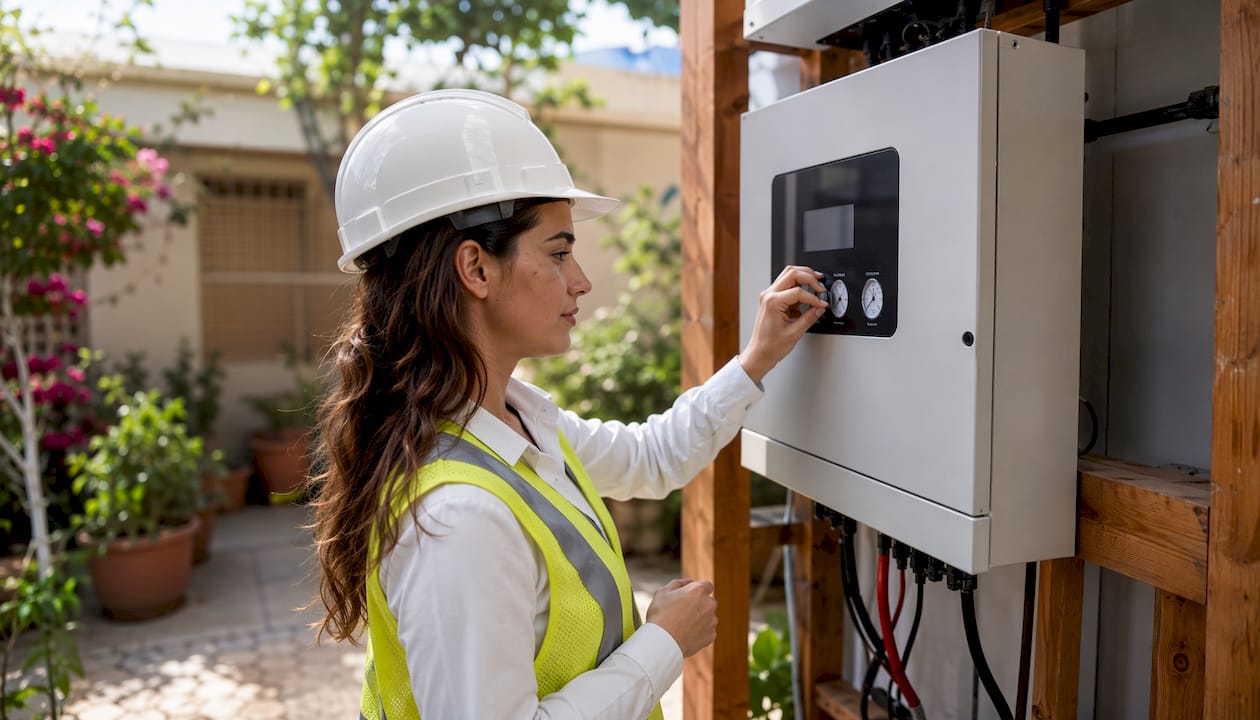
Modern unified heat pump architectures take this further by combining air-to-air cooling, hydronic heating, and domestic hot water production in a single inverter-managed system. The inverter allocates thermal load across all three functions simultaneously, which reduces waste that would otherwise occur when each function operates independently.
Key efficiency advantages inverter systems deliver:
- Precise temperature control: Maintains setpoint within a fraction of a degree rather than swinging several degrees between cycles
- Lower peak power draw: Avoids the large current surge that occurs every time a fixed-speed compressor starts
- Reduced mechanical wear: Fewer start-stop cycles extend compressor life
- Better dehumidification: Slower, sustained operation removes more moisture from air than short bursts
Retrofitting a residential heat pump to DC power builds on inverter gains by cutting conversion losses between solar panels and the compressor, yielding an additional 12.5–16.7% reduction in annual electricity costs in Purdue University field trials.
3. Smart HVAC systems use IoT and AI to optimize performance automatically
A smart thermostat connected to Wi-Fi is table stakes now. The real advancement is what happens behind the scenes: sensor networks that track occupancy, humidity, CO₂ concentration, and outdoor conditions, feeding data into machine learning models that adjust system behavior in real time. MIT research on smart thermostat efficiency demonstrated that predictive control algorithms outperform reactive setpoint-based control by anticipating thermal loads rather than responding to them.
Practical examples of smart HVAC in action:
- Occupancy-based control: Sensors detect when a room is empty and reduce conditioning automatically, then pre-condition before occupants return
- Fault detection: AI models flag abnormal power draw, refrigerant pressure anomalies, or unusual temperature differentials before they cause a breakdown
- Demand response: Systems automatically reduce load during peak grid hours, cutting utility costs without manual intervention
- Multi-unit coordination: In buildings with multiple zones or units, AI balances load across the system to avoid simultaneous peak draws
Pro Tip: When evaluating smart HVAC platforms, look for systems that offer open API integration with building management software. Proprietary-only ecosystems lock you into one vendor for every future upgrade.
For residential users, the Merino Mono single-unit heat pump (covered in section 8) takes smart integration a step further, with room-presence sensing and coordination between units in the same home. The HVAC automation landscape for both homes and businesses is expanding rapidly in 2026.
Steps to get the most from a smart HVAC system:
- Install CO₂ and occupancy sensors in high-traffic zones first
- Connect the system to your utility’s demand-response program
- Review the AI fault alerts monthly and track patterns over time
- Update firmware regularly, since manufacturers push efficiency improvements through software
4. Zoned and multizone systems give you room-by-room control
A single thermostat controlling an entire house or office floor is a blunt instrument. Zoned HVAC splits a building into independently controlled areas, each with its own thermostat or sensor, served by dampers or separate air handlers. The result: the bedroom stays cool at night while the living room isn’t being conditioned at all, and the conference room gets cooled only when it’s actually occupied.
Variable refrigerant flow (VRF) systems represent the most advanced form of multizone control. The energy savings potential of VRF versus variable air volume systems has been evaluated by Oak Ridge National Laboratory, which found meaningful efficiency advantages in buildings with diverse simultaneous heating and cooling loads.
Key advantages of zoned systems:
- Eliminates over-conditioning of unoccupied spaces
- Allows different comfort preferences across a household or office
- Reduces total system runtime, extending equipment life
- Pairs naturally with smart thermostats and occupancy sensors
For homeowners considering HVAC zoning, the entry point is a damper-based system added to existing ductwork. For new construction or major renovations, a ductless multizone mini-split system is often the cleaner solution.
5. Indoor air quality improvements are now a core HVAC function
Post-pandemic, IAQ stopped being a niche concern and became a baseline expectation. The technologies driving this shift are now integrated directly into HVAC equipment rather than bolted on as afterthoughts.
HEPA filtration captures particles down to 0.3 microns with 99.97% efficiency, including fine dust, pollen, mold spores, and some bacteria. Air handlers with HEPA-rated filtration sections are now available for both residential and commercial applications.
UV-C germicidal irradiation installed in air handlers and ductwork inactivates airborne pathogens by disrupting their DNA. Systems using UV-C lamps positioned at coil surfaces also prevent mold and biofilm growth on the coil itself, which maintains heat transfer efficiency over time.
Bipolar ionization generates positive and negative ions that attach to airborne particles, causing them to cluster and fall out of the air or get captured by filters. The technology has faced scrutiny over ozone byproduct concerns, so look for systems certified to produce ozone below ASHRAE and EPA thresholds.
IAQ technologies now integrated into modern HVAC systems:
- HEPA and MERV-13+ filtration sections
- UV-C coil and air-stream treatment
- Bipolar ionization with low-ozone certification
- Dedicated outdoor air systems (DOAS) for controlled fresh air delivery
- CO₂ monitoring tied to ventilation rate control
If you’re managing indoor air quality at home or in a commercial space, pairing filtration with proper ventilation rates matters as much as the filter rating itself. A high-MERV filter on an undersized air handler just restricts airflow.
6. Predictive maintenance replaces the reactive repair model
The old model: something breaks, you call a technician. The new model: IoT-connected diagnostics analyze real-time sensor data continuously, flag anomalies weeks before they become failures, and schedule service proactively. This shift from reactive to proactive maintenance is one of the most practical HVAC advancements examples you can point to right now.
Benefits of predictive maintenance systems:
- Failure prevention: Detects refrigerant leaks, bearing wear, and electrical faults early
- Cost reduction: Planned service visits cost less than emergency repairs and avoid equipment replacement
- Extended equipment life: Catching problems early prevents the cascade failures that destroy compressors
- Reduced downtime: Commercial facilities avoid the revenue loss that comes with unexpected system outages
- Better service scheduling: Technicians arrive with the right parts because the diagnostic data tells them what’s wrong before they get there
Pro Tip: Ask your HVAC contractor whether their service agreement includes cloud-connected monitoring. A maintenance contract without remote diagnostics is essentially the old reactive model with a monthly fee attached.
How a predictive maintenance platform works in practice:
- Sensors on the compressor, refrigerant lines, air handler, and electrical components stream data to a cloud platform
- Machine learning models compare current readings against baseline performance curves
- Anomalies trigger alerts ranked by severity and urgency
- The service team reviews alerts and schedules targeted inspections or part replacements
- After service, the system recalibrates its baseline for the repaired component
7. The most advanced HVAC technologies emerging from 2026 research
Four technologies from 2026 market research stand out for their potential to change the industry’s trajectory.
| Technology | Key Metric | Application | Readiness |
|---|---|---|---|
| MOF-based dehumidification | 40% energy savings | Commercial rooftop | Field-proven |
| Propane air-to-water heat pump | COP | Residential heating/DHW | Available 2026 |
| DC-retrofitted heat pump | 12.5–16.7% cost reduction | Residential solar integration | Research-stage |
| Electrocaloric solid-state | Over 70% theoretical efficiency | Sub-10 kW cooling | Early prototype |
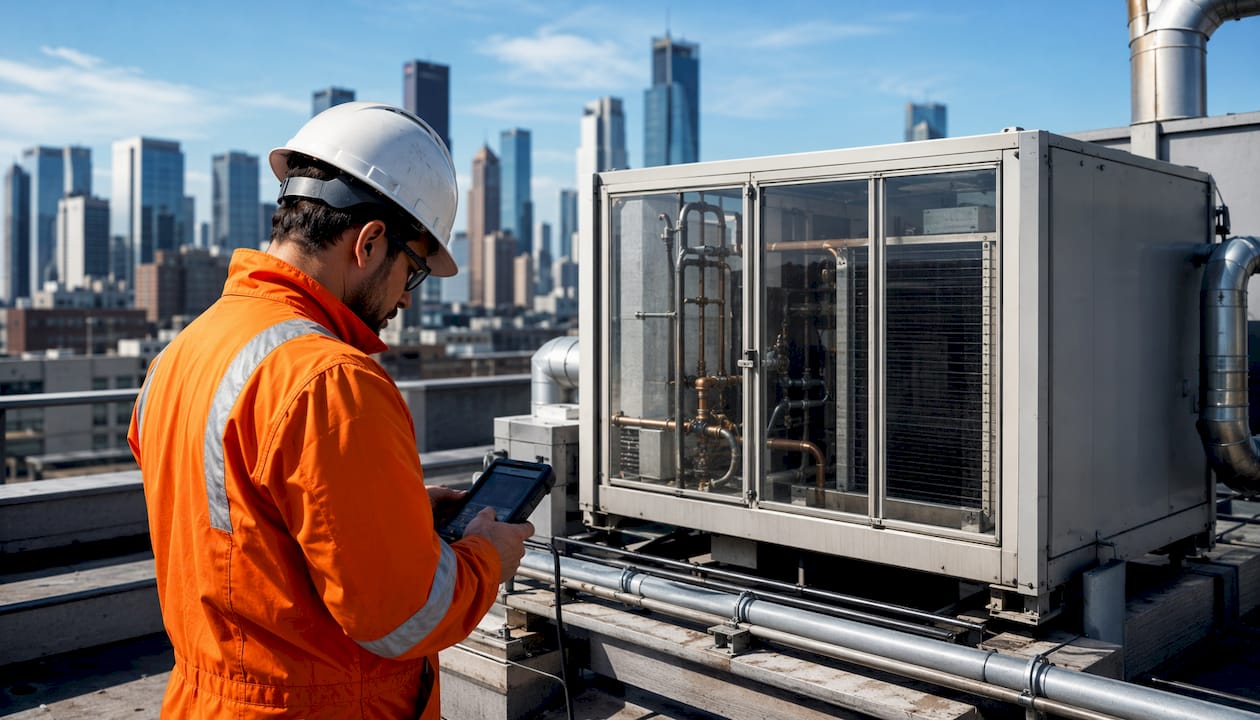
Metal-organic framework dehumidification: Transaera’s rooftop system uses MOF materials to strip humidity from incoming air before the cooling coil ever touches it. By treating latent load separately from sensible cooling, the system achieves 40% energy savings in hot, humid conditions, confirmed at an Amazon logistics facility. In climates like Southwest Florida, where latent load often exceeds sensible load, this approach addresses the actual problem rather than brute-forcing it with more cooling capacity.
Propane air-to-water heat pumps: NIBE’s 2026 residential units reach a seasonal COP of 5.53, meaning they deliver 5.53 units of heat energy for every unit of electricity consumed. They handle both space heating and domestic hot water from a single outdoor unit, using R-290 (propane) as the refrigerant, which has a GWP of just 3.
DC-retrofitted heat pumps: Purdue University researchers demonstrated that standard residential split-system heat pumps can run on 350V DC with minor hardware modifications and no meaningful performance loss. The efficiency gain of 12.5–16.7% comes from eliminating AC-to-DC conversion stages when pairing with solar PV and battery storage.
Electrocaloric heat pumps: Qurie GmbH, a spin-off from the Fraunhofer Institute, is developing a compressor-free heat pump using solid-state electrocaloric materials. The system operates without refrigerants, using an electric field to drive thermal cycles in ceramic or polymer materials. Scalability remains a challenge, and the technology targets sub-10 kW applications for now, but it represents a genuinely different architecture for residential cooling.
Pro Tip: The Merino Mono, a compact single-unit heat pump designed to plug into a standard 120-volt outlet, eliminates the panel upgrade that blocks heat pump adoption in many apartments. Its SEER2 rating of 15.2 trades some efficiency for dramatically simpler installation.
8. What these innovations mean for residential and commercial HVAC
The combined effect of these HVAC industry trends is a system landscape that’s more efficient, more connected, and more responsive to actual conditions than anything available five years ago. For homeowners, that means lower utility bills, better air quality, and equipment that tells you when it needs service instead of failing on the hottest day of the year. For commercial facility managers, it means moving from a cost center to a managed asset with measurable performance data.
Key takeaways from the innovation wave:
- New refrigerants are mandatory, not optional, as AIM Act timelines advance
- Inverter technology is now the baseline, not a premium feature
- Smart diagnostics pay for themselves by preventing emergency repairs
- IAQ is a health and liability issue, not just a comfort preference
- Renewable integration (solar, geothermal) is becoming economically viable for more building types
If you’re planning an upgrade or new installation, the eco-friendly HVAC options available in 2026 cover everything from refrigerant selection to full solar-integrated heat pump systems. The technology is there. The question is matching the right innovation to your building’s actual load profile and budget.
9. Energy recovery ventilation systems capture what you’d otherwise waste
Energy recovery ventilation (ERV) systems transfer heat and moisture between outgoing stale air and incoming fresh air, so you’re not conditioning outdoor air from scratch. In a hot, humid climate, an ERV pre-cools and dehumidifies incoming air using the cool, dry exhaust air leaving the building. In winter, it captures heat from exhaust air before it escapes.
The efficiency gain is straightforward: you’re recovering energy that would otherwise be lost every time you ventilate. Modern ERV cores use enthalpy wheels or flat-plate exchangers with transfer efficiencies typically above 70%. For commercial buildings with high ventilation requirements, ERV systems can meaningfully reduce the load on primary HVAC equipment.
For residential applications, ERV units are now compact enough to integrate with existing forced-air systems or operate as standalone whole-house ventilation. Pairing an ERV with energy-efficient windows and proper insulation creates a building envelope that works with the HVAC system rather than against it.
10. Solar-assisted and geothermal systems bring renewable energy into HVAC
Solar-assisted heat pumps use photovoltaic panels to power the compressor directly, or use solar thermal collectors to pre-heat the refrigerant, reducing the electrical input needed for the same heating output. The DC retrofit research from Purdue (noted in section 7) is the technical bridge between solar PV and heat pump operation, cutting conversion losses that currently reduce the benefit of pairing the two.
Geothermal heat pumps tap the stable temperature of the earth below the frost line, typically 50–60°F year-round in most U.S. regions. Because the ground loop operates at a consistent temperature, geothermal systems achieve higher efficiency than air-source units, which must work harder as outdoor temperatures become more extreme. The IEA’s future of cooling report identifies ground-source heat pumps as one of the highest-efficiency pathways for building cooling globally.
The barrier to geothermal adoption is upfront cost, specifically the ground loop installation. Horizontal loops require significant yard space; vertical loops require drilling. For commercial buildings with large footprints, the economics often work. For residential applications, the payback period depends heavily on local electricity rates and available incentives.
11. Ductless mini-split systems have become far more capable
Mini-splits have been around for decades, but the 2026 generation is a different product. The U.S. Department of Energy’s ductless mini-split overview covers the core technology, but recent advances go well beyond the basics.
Modern mini-splits now offer:
- Multi-zone capability: A single outdoor unit serving up to eight indoor air handlers, each independently controlled
- Cold-climate performance: Hyper-heating inverter models maintain full heating capacity at outdoor temperatures as low as -13°F
- Wi-Fi and AI integration: Built-in connectivity with occupancy sensing and learning algorithms
- Improved aesthetics: Slimmer cassette and wall-mount designs that blend into residential interiors
The Quilt two-zone system, for comparison, achieves a SEER2 rating of 25, which illustrates how far mini-split efficiency has advanced beyond the minimum federal standards. For homes without existing ductwork, or for additions and converted spaces, a mini-split remains the most practical path to zoned, efficient conditioning.
12. Sustainable materials and noise reduction are reshaping system design
Sustainability in HVAC now extends beyond refrigerant choice to the physical materials and manufacturing processes used in equipment. Manufacturers are moving toward recyclable heat exchanger materials, reduced copper content through aluminum microchannel coils, and packaging that eliminates single-use plastics. Some units now carry Environmental Product Declarations (EPDs) that quantify embodied carbon across the full product lifecycle.
Noise reduction has become a genuine engineering priority, not just a marketing claim. Acoustic research from Purdue University published via EurekaAlert demonstrated that acoustic filter technology can reduce HVAC-related noise while simultaneously cutting energy use, by improving airflow dynamics through the filter media. Variable-speed compressors also contribute: because they rarely run at full speed, they operate far more quietly than fixed-speed units cycling on and off.
For residential installations, sound ratings (measured in decibels) are now a standard spec to compare. Outdoor units below 55 dB are considered quiet; some premium inverter models operate below 50 dB at normal load. In dense neighborhoods or HOA-governed communities, that difference matters.
Key Takeaways
The HVAC industry’s shift toward low-GWP refrigerants, inverter-driven systems, AI diagnostics, and renewable integration is producing measurable efficiency gains and healthier indoor environments across residential and commercial applications.
| Point | Details |
|---|---|
| Refrigerant transition is mandatory | R-454B replaces R-410A under the AIM Act, with a GWP of 466 versus 2,088. |
| Inverter systems cut costs and wear | DC-retrofitted heat pumps reduce annual electricity costs by 12.5–16.7% versus conventional AC operation. |
| MOF dehumidification works at scale | Transaera’s commercial rooftop system achieved 40% energy savings in Amazon field trials. |
| Predictive maintenance prevents failures | IoT and AI diagnostics shift service from reactive repair to proactive health management. |
| Propane heat pumps hit COP 5.53 | NIBE’s 2026 residential units deliver space heating and hot water at high seasonal efficiency. |
Ready to upgrade? Ultraairswfl can help you apply these innovations
The innovations covered here are available now, not in some future product cycle. Ultraairswfl installs and services the latest energy-efficient systems across Naples, Cape Coral, and Fort Myers, including inverter-driven heat pumps, smart IAQ solutions, and multizone mini-split configurations. If you manage a commercial facility, the office HVAC installation guide covers everything from load calculation to system selection. Homeowners ready to explore their options can start with Ultraairswfl’s heating solutions overview to see what’s available for Southwest Florida’s specific climate demands.