
For most Florida homes, a high-efficiency inverter-driven heat pump is the best HVAC system, full stop. Variable-speed compressors run longer at lower capacity, which pulls far more moisture out of the air than a conventional single-stage unit ever will. That matters in a state where humidity is the real enemy, not just heat. According to RMI, inverter-driven heat pumps can cut heating energy use by roughly 50 percent compared to traditional electric furnaces, and their moisture-removal advantage is just as significant in cooling mode.
Quick alternatives when a standard inverter heat pump isn’t the right fit:
- Ductless mini-split: Best for additions, older homes without ductwork, or rooms that never cool evenly
- Central ducted split system: Works well in newer construction with well-sealed ducts already in place
- Packaged rooftop or slab unit: Common in Florida slab homes with limited attic space; look for inverter-capable packaged models
- Window or portable AC: Acceptable only for single rooms, rentals, or temporary setups; independent testing confirms portable units underperform window units for whole-room efficiency
Table of Contents
- How Florida’s hot, humid climate changes what “best” means
- System types that actually perform in Florida’s climate
- How to choose the right HVAC for your Florida home
- Maintenance expectations, lifespan, and signs you need a replacement
- What coastal Florida homes need beyond a standard install
- How Ultraairswfl selects and installs systems in SWFL
- Key Takeaways
- What most homeowners get wrong about Florida HVAC
- Ultraairswfl brings local expertise to every SWFL install
- Useful sources and further reading
How Florida’s hot, humid climate changes what “best” means
Florida doesn’t just get hot. It gets hot and wet for most of the year, and that combination punishes HVAC equipment in ways that homeowners in drier climates never deal with. EIA residential energy data consistently shows air conditioning dominates electricity use in hot-humid states, and Florida sits near the top of that list.
The climate facts that change your equipment decision:
- High latent load — Florida air carries enormous moisture. A system that cools the air but doesn’t dehumidify it leaves you with a clammy 74°F instead of a comfortable one. EIA state-level data confirms virtually every Florida household relies on central AC, which means whole-home dehumidification isn’t optional.
- Coastal corrosion — Salt air attacks copper coils, aluminum fins, and electrical connections. Equipment within a few miles of the coast can lose years of service life without the right protections.
- Evaporative cooling doesn’t work here. The U.S. Department of Energy is explicit: evaporative coolers are ineffective in high-humidity climates. They add moisture to already-saturated air and make comfort worse.
When you talk to an installer, ask three things before anything else: Do you perform a Manual J load calculation? How does this system handle latent load? What coastal coatings does the equipment carry?
For a deeper look at managing humidity in Southwest Florida, the specifics of whole-home dehumidification and HVAC settings are worth reviewing before you finalize any equipment choice.
System types that actually perform in Florida’s climate
Not every system type is a good match for Florida conditions. Here’s how the main options stack up.
Inverter-driven heat pump (variable-speed): The strongest all-around performer for Florida. The compressor modulates speed continuously rather than cycling on and off, so it runs longer at low capacity and extracts moisture steadily. In mild weather, it barely sips electricity. In peak summer, it keeps up without short-cycling. This is the system type Ultraairswfl recommends for most new installs and replacements in Naples, Cape Coral, and Fort Myers.
Central ducted split system: A conventional split system with a single-stage or two-stage compressor works, but it cycles more aggressively and removes less moisture per hour of runtime. If your ducts are already in good shape and budget is the primary constraint, a two-stage ducted system is a reasonable step up from single-stage. Just know you’re leaving dehumidification performance on the table.
Ductless mini-split: Excellent for homes without existing ductwork, room additions, or spaces that a central system can’t reach. Multi-zone mini-splits let you condition different rooms independently. Most modern mini-splits use inverter compressors, so they share the variable-speed advantage. The upfront cost per zone is higher than adding a duct run, but you avoid the efficiency losses that leaky ducts cause.
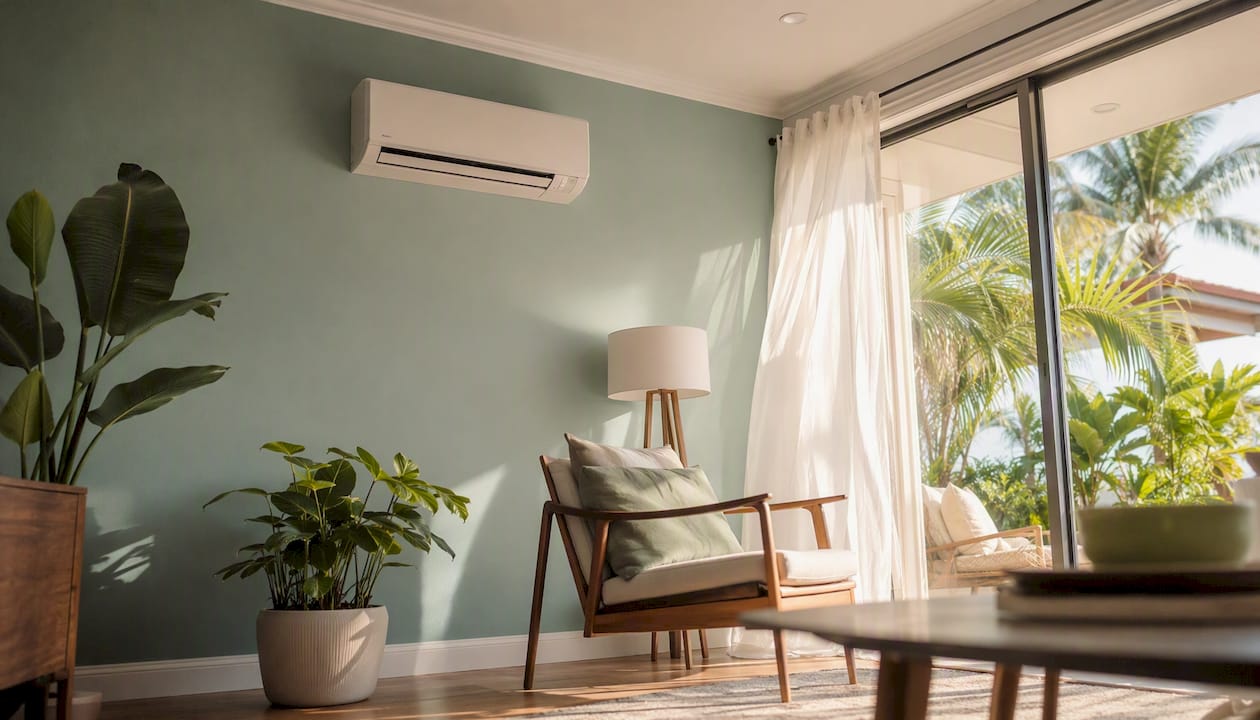
Packaged systems: Common in Florida slab homes where there’s no room for a split-system air handler in the attic. A packaged unit houses everything in one cabinet outside. Inverter-capable packaged models exist and are worth specifying. Older single-stage packaged units are the most common source of chronic humidity complaints in SWFL homes.
Window and portable units: Forbes testing and independent lab data both confirm portable ACs trade efficiency for convenience. They’re fine for a single room, a rental unit, or a temporary fix. For whole-home cooling in Florida, they’re not a real solution.
| System Type | Humidity Control | Efficiency Metric | Typical Cost Tier | Best Use Case |
|---|---|---|---|---|
| Inverter heat pump (ducted) | Excellent | SEER2 / EER2 / HSPF2 | Mid to high | Most Florida homes, new installs, replacements |
| Central split (single/two-stage) | Moderate | SEER2 / EER2 | Entry to mid | Budget replacements, well-sealed existing ducts |
| Ductless mini-split | Excellent | SEER2 / EER2 | Mid to high per zone | No-duct homes, additions, room-by-room control |
| Packaged unit | Moderate to good | SEER2 / EER2 | Entry to mid | Slab homes, limited attic space |
| Window / portable AC | Poor | EER | Low | Single rooms, rentals, temporary use |
For a full breakdown of HVAC system types for Florida homes, including pros and cons by home age and construction type, that resource covers the details in one place.
How to choose the right HVAC for your Florida home
The single biggest mistake Florida homeowners make is letting an installer size a system by square footage alone. That shortcut almost always produces an oversized unit that short-cycles, leaves humidity behind, and wears out faster. Here’s the checklist to use before you sign anything.
- Demand a Manual J load calculation. This is the industry standard for sizing. It accounts for your home’s insulation, window area, orientation, and local climate data. Any installer who quotes a system without one is guessing.
- Check SEER2 and EER2 ratings. SEER2 reflects seasonal efficiency; EER2 reflects peak-load efficiency on the hottest days. Florida’s summers stress peak performance, so updated SEER2/EER2 testing protocols make both numbers meaningful. Don’t evaluate one without the other.
- Specify a variable-speed (inverter) compressor. This is the feature most directly tied to dehumidification and long-term efficiency. See the full cost vs. comfort analysis for variable-speed AC in Florida if you want the numbers.
- Ask about coil coatings for coastal exposure. If you’re within five miles of salt water, factory-applied coil coatings or all-aluminum coils are not optional extras.
- Consider a whole-home dehumidifier. Even the best inverter heat pump has limits during Florida’s shoulder seasons when it’s not hot enough to run the compressor hard but humidity is still high. A dedicated dehumidifier fills that gap.
- Confirm smart thermostat compatibility. Inverter systems require a compatible communicating thermostat. Verify before purchase, not after installation.
Questions to ask any installer:
- What sizing method do you use, and can I see the load calculation?
- Does this equipment carry a factory corrosion coating, or is that an add-on?
- Who registers the warranty, and what voids it?
- Do you install surge protection on the disconnect?
- What’s your service area and typical response time for emergency calls?
Red flags in a quote:
- Sizing based purely on square footage with no site visit
- Ductwork “upgrades” quoted without a duct leakage test
- Warranty terms that say “manufacturer’s standard” with no specifics
- No mention of commissioning or post-install testing
Pro Tip: Ask for the Manual J report as a PDF before you sign the contract. A legitimate installer produces one without hesitation. If they can’t or won’t, that tells you everything.
The Florida Energy Conservation Code sets minimum efficiency and installation requirements that affect which equipment qualifies for permitted work. Your installer should be pulling permits and meeting those minimums as a baseline, not a selling point.
Maintenance expectations, lifespan, and signs you need a replacement
Florida’s climate is hard on HVAC equipment. A system that would last 18–20 years in a mild northern climate might deliver 12–15 years in SWFL under normal conditions, and less if it’s near the coast or was improperly installed.
Recommended maintenance schedule:
- Monthly: Check and replace air filters (1-inch filters in humid climates clog faster than you’d expect)
- Twice yearly: Professional tune-up, ideally in spring before peak cooling season and in fall; includes coil cleaning, refrigerant check, electrical connections, and drain line flush
- Annually for coastal homes: Dedicated corrosion inspection of coils, cabinet, and electrical enclosures
- Every 3–5 years: Duct leakage test to catch developing leaks before they tank efficiency
For a complete HVAC maintenance checklist for Southwest Florida, including seasonal task breakdowns, that resource covers what to schedule and when.
Signs a system needs replacing, not repairing:
- Energy bills climbing year over year with no change in usage habits
- Humidity staying above 55–60% indoors even when the system runs constantly
- Refrigerant leaks or compressor failures recurring within 2–3 years of each other
- Loud cycling, banging on startup, or short on/off cycles under 5 minutes
- System age past 12–15 years with a history of repairs
What coastal Florida homes need beyond a standard install
Salt air is corrosive in ways that aren’t visible until a coil is already failing. Homes within a few miles of the Gulf or Atlantic need specific protections built into the equipment and the installation itself.
Equipment features to require:
- All-aluminum coils or factory-applied coil coatings (look for terms like “BlueEvolution,” “CorrosionShield,” or equivalent OEM coatings from the brand you’re considering)
- Reinforced cabinet finishes rated for coastal environments
- Sealed electrical enclosures to block salt-laden air from contacting terminals
- Sacrificial anodes on applicable components where the manufacturer offers them
Installation practices that extend coastal equipment life:
- Place outdoor units on elevated, anchored concrete pads to reduce ground moisture exposure
- Install hurricane straps or tie-down brackets per local code
- Add a whole-system surge protector at the disconnect; lightning and power surges are a leading cause of premature board failures in SWFL
- Orient the unit so prevailing onshore winds don’t blow directly into the coil face
Warranty note: Many manufacturers reduce warranty coverage or add exclusions for coastal installations unless the equipment carries a specific coastal-grade coating from the factory. Confirm this in writing before purchase.
For SWFL-specific guidance on salt air corrosion protection for HVAC in Cape Coral and surrounding coastal communities, that resource goes deeper on what to look for and what to avoid.
How Ultraairswfl selects and installs systems in SWFL
Ultraairswfl serves Naples, Cape Coral, and Fort Myers with a process built around the specific demands of Southwest Florida’s climate and coastal exposure.
Every job starts with a site visit and a full Manual J load calculation. That calculation drives equipment selection, not square footage. From there, the focus is on three things: humidity performance (latent load capacity), coastal exposure (coil coatings and cabinet protection), and installation quality (sealed ducts, surge protection, proper refrigerant charge).
The installation itself includes:
- Matched system selection (indoor and outdoor units from the same manufacturer’s listed combination)
- Factory or field-applied corrosion coatings verified before installation
- Elevated, anchored outdoor pad placement
- Whole-system surge protection at the disconnect
- Commissioning check: refrigerant charge, airflow measurement, thermostat calibration
- Post-install walkthrough covering filter schedule, thermostat settings, and maintenance plan
After installation, Ultraairswfl offers ongoing maintenance plans that include the twice-yearly tune-ups and corrosion inspections that SWFL equipment needs to reach its full service life.
Pro Tip: Schedule your replacement or new install between September and November. Demand is lower after peak summer, lead times on equipment are shorter, and installers have more time to do the job right rather than rushing between emergency calls.
Key Takeaways
For most Florida homes, an inverter-driven heat pump sized by Manual J load calculation, with coastal coil protection and a proper maintenance plan, delivers the best long-term combination of comfort, efficiency, and durability.
| Point | Details |
|---|---|
| Inverter heat pump is the top choice | Variable-speed compressors remove more moisture and cut energy use compared to single-stage systems. |
| Manual J sizing is non-negotiable | Square-footage guessing produces oversized units that short-cycle and leave humidity behind. |
| Coastal protection extends equipment life | Factory coil coatings, sealed enclosures, and elevated pads are required within miles of salt water. |
| Maintenance schedule matters in Florida | Twice-yearly tune-ups and monthly filter changes are the minimum for near-year-round runtime. |
| Ultraairswfl covers Naples, Cape Coral, and Fort Myers | Site visits, Manual J calculations, and corrosion-ready installs are standard on every job. |
What most homeowners get wrong about Florida HVAC
The conventional wisdom says buy the highest SEER2 rating you can afford. That’s not wrong, but it misses the real issue. The number one problem Ultraairswfl sees in SWFL homes isn’t low-efficiency equipment. It’s oversized equipment installed without a load calculation, sitting in a home with leaky ducts and no coastal protection, maintained on a “call us when it breaks” schedule.
An oversized system cools the air temperature fast but doesn’t run long enough to pull moisture out. You end up with a home that reads 74°F on the thermostat but feels like 78°F because the relative humidity is sitting at 65%. That’s not a comfort complaint. That’s a mold risk.
The second mistake is ignoring ductwork. A high-efficiency inverter heat pump pushing conditioned air through ducts that leak 20–30% of their airflow into the attic is not a high-efficiency system in practice. The equipment rating on the spec sheet means nothing if the delivery system is broken.
Coastal corrosion is the third overlooked factor. Homeowners in Cape Coral or Naples who buy a standard residential unit without coastal coatings and skip the annual corrosion inspection often find themselves replacing coils at year 5 or 6 on a system that should last 14. The cost difference between a coated and uncoated coil at purchase is small. The cost difference at replacement is not.
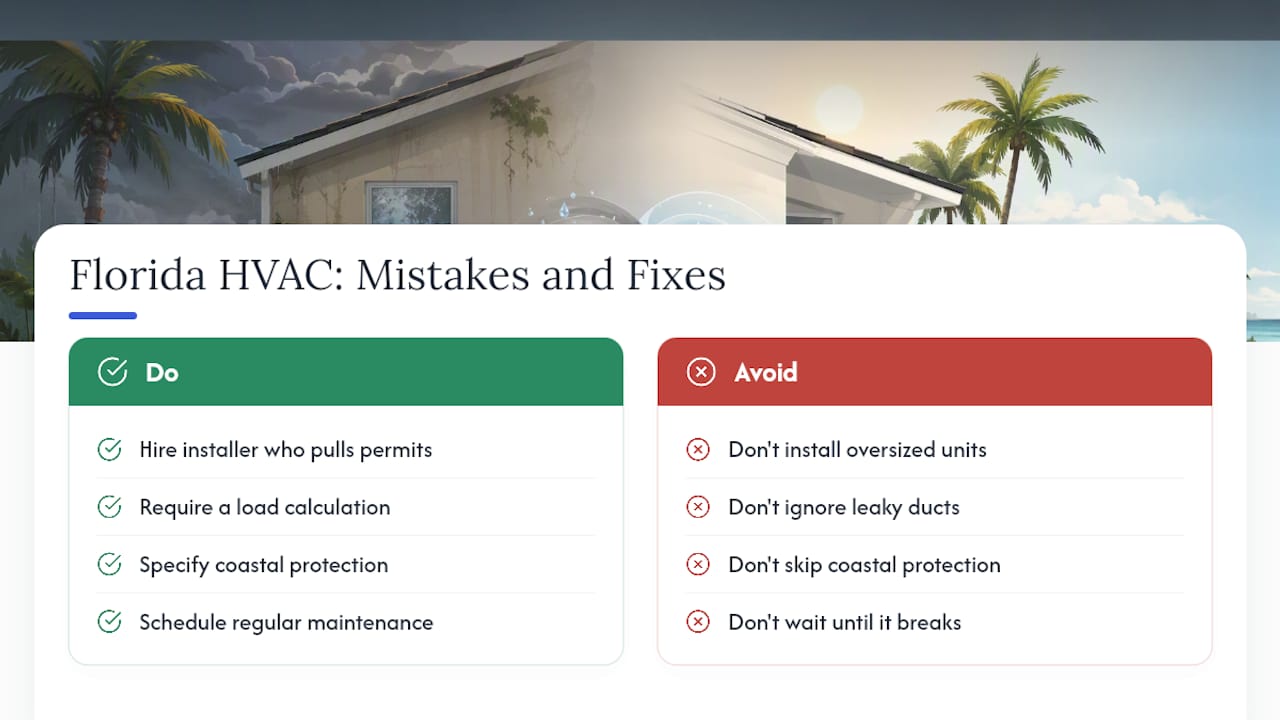
The fix for all three is the same: hire an installer who pulls permits, does the load calculation, specifies the right coastal protections, and shows up for maintenance. That process is what Ultraairswfl is built around.
Ultraairswfl brings local expertise to every SWFL install
Southwest Florida homeowners don’t need a generic HVAC quote. They need a system sized for their specific home, specified for coastal exposure, and installed by a team that knows what a Naples summer actually does to equipment.
Ultraairswfl handles the full process in Naples, Cape Coral, and Fort Myers: Manual J load calculations, inverter heat pump installation, corrosion-ready equipment selection, surge protection, and ongoing heating and cooling maintenance plans that keep systems running through Florida’s long cooling season. Financing options are available so the right system doesn’t have to wait for the wrong moment.
If your current system is struggling with humidity, cycling too often, or pushing past 12 years old, the next step is a site assessment. Contact Ultraairswfl to schedule an on-site evaluation and get a load-calculated proposal for your home.
Useful sources and further reading
These authoritative references cover the technical standards, energy data, and code requirements behind the guidance in this article.
Brand-specific product details, local case studies, and service-level information are available directly on the Ultraairswfl website.
Recommended
- Best HVAC System for Florida Humidity: The 2026 SWFL Buyer’s Guide
- Best Smart Thermostat for Florida Humidity: 2026 SWFL Homeowner’s Guide
- Types of HVAC Systems: Best Fit for Florida Homes
- The Best Smart Thermostat for Florida Humidity: A Buying Guide for Estero Residents – Ultra Air Heating and Cooling