
What is after-hours HVAC management and how should you handle it?
After-hours HVAC management is the set of systems, protocols, and decisions a business uses to handle service requests that come in outside normal operating hours, whether that’s 11 PM on a Tuesday, a Saturday afternoon, or Thanksgiving. The goal isn’t just to answer the phone. It’s to respond to real emergencies quickly, protect your technicians from unnecessary callouts, and keep customers from feeling abandoned.
The three most common handling methods are voicemail, direct lines to on-call technicians, and professional answering services. Each has a place depending on your business size, client mix, and how you define “emergency.” What separates well-run shops from reactive ones is having clear emergency criteria before the phone rings, not after.
Key elements of a solid after-hours strategy:
- Define emergencies in writing before you set up any call routing
- Choose a handling method that matches your technician capacity and client expectations
- Set customer expectations upfront about response times and after-hours fees
- Review your approach seasonally, since a Florida summer and a Minnesota January create very different call volumes
- Track after-hours call data to spot patterns and adjust staffing
Table of Contents
- How to define after-hours calls and set emergency response criteria
- Do you actually need to offer after-hours HVAC service?
- Comparing the most common approaches to handling after-hours calls
- Pricing strategies and customer communication for after-hours calls
- How Ultraairswfl approaches after-hours HVAC management
- Training your staff and technicians for after-hours calls
- Ultraairswfl serves Southwest Florida’s after-hours HVAC needs
- Key Takeaways
How to define after-hours calls and set emergency response criteria
An after-hours call is any service request received outside your posted business hours, including nights, weekends, and holidays. That part is simple. What trips up most HVAC businesses is the next question: which of those calls actually require an immediate response?
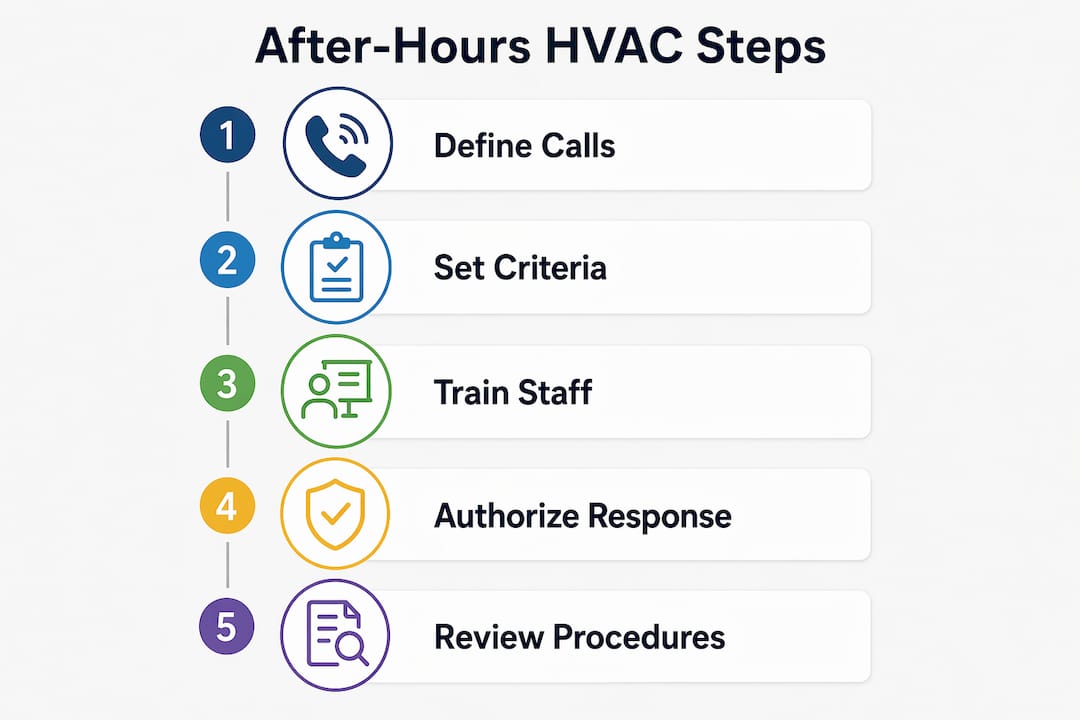
Emergency designation should rest on objective criteria, not on how upset the caller sounds. A homeowner frustrated that their AC is running warm at 10 PM is not the same situation as a family with a newborn and no heat in January. The distinction matters because sending a technician out unnecessarily at midnight burns goodwill fast, and doing it repeatedly leads to burnout and turnover.
Conditions that typically warrant immediate after-hours dispatch:
- Gas leaks or suspected gas odors (advise the caller to leave and call the gas company first)
- Carbon monoxide alarms in occupied spaces
- Total heating failure when outdoor temperatures are dangerous and vulnerable occupants (elderly, infants, medically compromised) are present
- Total cooling failure during extreme heat events with at-risk occupants
- Flooding or active water damage from HVAC-related failures
- Commercial systems with contractual uptime requirements
Conditions that can usually wait until morning:
- Uneven cooling or heating without safety risk
- Noisy equipment with no performance loss
- Thermostat issues where the system is still running
- Routine maintenance requests or quote inquiries
Pro Tip: Document your emergency criteria in a one-page reference sheet and post it wherever your on-call tech can see it. When a call comes in at 2 AM, decision fatigue is real. A written threshold removes the guesswork and protects both your technician and your customer.
Commercial accounts add another layer. Uptime guarantees for commercial HVAC often require multi-channel communication and faster response windows than residential work, so your emergency criteria should be tiered by client type, not just by symptom.
Do you actually need to offer after-hours HVAC service?
The short answer: no. Contractors have no legal obligation to provide 24/7 emergency service. Plenty of successful HVAC businesses operate Monday through Friday, 8 AM to 5 PM, and refer after-hours calls to a voicemail with a clear callback promise for the next business day.
Whether you should offer after-hours coverage depends on a few honest questions about your operation.
Factors that push toward offering after-hours coverage:
- You serve commercial clients with service-level agreements
- Your market has strong competition from shops that already offer 24/7 support
- You’re in a climate where system failure creates genuine safety risk (extreme heat or cold)
- You have enough technicians to rotate on-call duty without burning anyone out
Factors that push toward business-hours-only:
- You’re a small shop with one or two technicians
- Your residential client base skews toward non-emergency maintenance work
- Technician retention is already a challenge
- You’ve tracked your after-hours calls and most aren’t true emergencies
Many HVAC businesses deliberately choose not to provide round-the-clock service to protect their team and maintain sustainable operations. That’s a legitimate business decision, not a failure of customer service. The key is being transparent about it: your voicemail, website, and any service agreements should clearly state your hours and what customers should do in a genuine emergency (call 911, contact the gas company, etc.).
For a deeper look at how 24/7 coverage affects employee workload and customer satisfaction, the 24-hour HVAC repair guide from Ultraairswfl covers the tradeoffs in detail.
Comparing the most common approaches to handling after-hours calls
Three methods dominate how HVAC businesses handle off-hours calls. None of them is universally right.

| Method | Pros | Cons | Cost | Best For | Burnout Risk |
|---|---|---|---|---|---|
| Voicemail | Zero cost, no disruption | Misses emergencies, frustrates callers | Free | Solo operators, maintenance-only shops | Low |
| Direct line to on-call tech | Immediate response, personal | Wakes tech for routine calls, hard to scale | Low direct cost, high indirect cost | Small shops with tight client relationships | High |
| Professional answering service | Screens calls, 24/7 coverage, consistent | Monthly cost, variable script quality | — | Growing shops, commercial-heavy books | Low to medium |
| AI answering service | HVAC-aware triage, tech alerts, scalable | Less nuanced than a human agent | — | Any size shop wanting triage without live staff | Low |
A few things worth knowing before you pick one:
- Voicemail fails hardest in emergencies. Most callers in a genuine crisis won’t leave a message. They’ll call the next company on Google.
- Forwarding directly to your tech’s cell means every routine quote request wakes them up. That’s the fastest path to losing your best on-call person.
- Live answering services vary widely in HVAC knowledge. A generic script that doesn’t ask about thermostat readings, breaker status, or whether vulnerable occupants are home misses the triage detail that matters.
- AI-powered triage tools have gotten specific enough to flag no-heat, no-cool, and gas-smell calls differently. AI triage systems can capture detailed intake and classify calls by urgency, but the final dispatch decision should stay with a human who can weigh emergency priority against technician welfare.
Pro Tip: Whatever method you use, test it yourself. Call your own after-hours line at 9 PM and see what the experience actually feels like. Most business owners haven’t done this.
For businesses exploring how HVAC automation fits into after-hours workflows, the technology has moved well past simple call forwarding.
Pricing strategies and customer communication for after-hours calls
After-hours pricing is one of the most common sources of customer friction in HVAC service. Pricing models vary widely: some shops charge overtime rates on top of standard labor, others use a flat emergency dispatch fee, and some apply uniform pricing regardless of when the call comes in. None of these is wrong. The problem is when customers don’t know which model you use until they’re already committed.
Common after-hours pricing approaches:
- Overtime rate model: Standard labor rate plus a percentage premium (often 1.5x) for nights and weekends
- Flat emergency dispatch fee: A fixed callout charge added to standard labor, regardless of time
- Uniform pricing: Same rate day or night, often used as a marketing differentiator
- Service agreement pricing: Reduced or waived after-hours fees for customers on maintenance contracts
Communication best practices:
- State your after-hours fee structure on your website, not just in the fine print of a service agreement
- Have your answering service or AI system mention the after-hours fee during intake, before a technician is dispatched
- Get verbal authorization for the dispatch fee before rolling a truck
- Send a text or email confirmation of the estimated cost range once a technician is en route
- Train your technicians to explain pricing before starting work, not after
The authorization step is often skipped under pressure, especially when a customer is distressed. Building it into your intake script removes the awkward conversation at the door and protects you from disputed invoices.
How Ultraairswfl approaches after-hours HVAC management
Ultraairswfl, operating as Ultra Air Heating & Cooling across Naples, Cape Coral, and Fort Myers, has built its after-hours protocols around one principle: every call gets a response, but not every call gets a truck. That distinction is what separates a sustainable operation from one that burns through technicians.
Ultra Air’s after-hours approach combines trained intake operators, documented emergency thresholds, and clear customer communication to filter genuine emergencies from calls that can safely wait. Technicians are dispatched based on objective criteria, not caller urgency alone.
Key elements of Ultraairswfl’s after-hours framework:
- Documented emergency criteria reviewed and updated seasonally
- Trained intake staff who ask HVAC-specific questions before escalating
- Tiered response protocols for residential versus commercial accounts
- Technician rotation schedules that distribute on-call burden fairly
- Post-call documentation that feeds back into preventative maintenance planning
- Upfront fee communication built into every after-hours intake script
Preventative maintenance is also a core part of reducing after-hours volume. Identifying issues before they become failures means fewer 2 AM calls for everyone. Ultraairswfl’s maintenance programs are designed with that reduction in mind, not just as a revenue line.
For Southwest Florida owners who want a detailed emergency response framework, the HVAC emergency response checklist covers the specific conditions and protocols relevant to the region.
Training your staff and technicians for after-hours calls
After-hours calls are harder than daytime calls. The customer is more stressed, the technician is more tired, and the margin for miscommunication is wider. Training specifically for that context, not just general HVAC service, is what keeps both sides of the call from going sideways.
What intake staff need to know
Anyone answering after-hours calls, whether a live agent, an AI system, or a forwarded line, needs to be trained on the specific questions that determine urgency. Generic customer service scripts don’t cut it. Intake staff should be able to ask about thermostat readings, breaker status, whether the outdoor unit is running, and whether anyone in the home is medically vulnerable. Those details determine whether a call is a dispatch or a callback.

Intake staff also need clear authority limits. They should know exactly which conditions trigger an immediate tech alert and which ones get queued for morning. Ambiguity at 1 AM leads to either over-dispatching (burnout) or under-dispatching (liability).
What technicians need to know
On-call technicians need more than technical skills. They need a protocol for the first 60 seconds of a callback: how to confirm the situation, how to communicate an estimated arrival window honestly, and how to handle a caller who insists their non-emergency is an emergency. Role-playing these scenarios in training sounds basic, but most shops skip it entirely.
Technicians should also carry a reference card with the company’s emergency criteria. When someone calls at midnight claiming their AC is “completely broken” and it turns out the thermostat battery died, a written threshold gives the technician a professional way to redirect without the customer feeling dismissed.
Legal and safety considerations
After-hours HVAC work carries real liability exposure. Gas leak calls require a specific protocol: advise the caller to leave the building and contact the gas company or 911 before your technician arrives. Sending a tech into an active gas situation without that step creates serious safety and legal risk. Document that advisory in your call log every time.
Workers’ compensation coverage, after-hours labor law compliance, and your service agreement terms all need to reflect the reality of nighttime and weekend work. If your contracts don’t address after-hours response scope and fee authorization, they should.
Ultraairswfl serves Southwest Florida’s after-hours HVAC needs
Running a tight after-hours operation in Southwest Florida means dealing with heat-driven emergencies that don’t wait for business hours. Ultraairswfl serves Naples, Cape Coral, and Fort Myers with heating solutions and cooling support built around the region’s specific demands, including the kind of after-hours protocols this guide covers.
For business owners and facility managers who want a partner that already has the emergency criteria, intake training, and technician rotation figured out, Ultraairswfl offers the operational depth that smaller or newer shops are still building. You get a team that knows the difference between a call that needs a truck tonight and one that needs a callback tomorrow morning, and communicates that clearly to your customers.
If you’re upgrading your commercial HVAC setup or rethinking how your building handles after-hours emergencies, the business heating system upgrade guide is a practical starting point. To talk through your specific situation, contact Ultraairswfl directly through the website.
Key Takeaways
Effective after-hours HVAC management requires documented emergency criteria, the right call-handling method for your business size, and upfront pricing communication before any truck rolls.
| Point | Details |
|---|---|
| Define emergencies in writing | Gas leaks, CO alarms, and system failure with vulnerable occupants are the clearest dispatch triggers. |
| No legal obligation for 24/7 service | Contractors can limit hours; transparency about your policy protects both customers and technicians. |
| Match your method to your capacity | Voicemail, direct lines, live agents, and AI triage each fit different business sizes and call volumes. |
| Communicate pricing before dispatch | Verbal authorization for after-hours fees prevents disputed invoices and builds customer trust. |
| Ultraairswfl’s approach | Ultra Air Heating & Cooling uses documented thresholds, trained intake staff, and technician rotation to handle after-hours calls sustainably across Southwest Florida. |