
HVAC tips for new construction start with one non-negotiable rule: size the system to the actual heat load, not the square footage. In Southwest Florida’s climate, where humidity rivals temperature as the primary comfort threat, getting this wrong costs you money every month for the life of the building. The ACCA Manual J load calculation is the industry standard for a reason. It accounts for insulation levels, window orientation, local climate data, and occupancy, giving you a number you can actually build around. Pair that with Manual D duct design, and you have a system that performs from day one.
1. Why accurate HVAC sizing is the foundation of every new build
Manual J load calculation is the industry standard for HVAC sizing in 2026, replacing the outdated square footage rules that still show up on too many job sites. Those old rules ignore insulation quality, window area, ceiling height, and local climate, all of which matter enormously in Naples or Cape Coral. An oversized system short-cycles, meaning it turns on and off too quickly to remove humidity from the air. In Southwest Florida, that failure shows up as a cold but clammy home.
An undersized system runs constantly and still can’t keep up during peak summer heat. Neither outcome is acceptable in a brand-new home. Manual J and Manual D prevent both problems by matching equipment to precise heat loads, not guesses.
Pro Tip: Ask your HVAC contractor to show you the completed Manual J report before any equipment is ordered. A reputable contractor produces this document as a standard deliverable, not an afterthought.
2. How ductwork design and sealing impact efficiency
Duct design is where many new construction projects quietly lose money. Leaky ductwork loses 20–30% of conditioned air before it reaches the living space. That means your system works harder, your bills run higher, and your rooms never quite reach the set temperature.
Sealing ducts with mastic, a paste-like compound applied at every joint and seam, is far more durable than tape. Tape degrades in heat and humidity, exactly the conditions your attic sees every summer in Southwest Florida. Mastic creates a permanent bond that holds up for decades.
Keeping ductwork inside the conditioned envelope reduces cooling energy losses by 20–30% compared to running ducts through a hot attic. This is a design decision made during framing, not after. If your builder hasn’t discussed duct placement with your HVAC contractor before the walls go up, raise it immediately.
| Duct placement | Energy impact | Best practice |
|---|---|---|
| Inside conditioned space | Minimal energy loss | Preferred for all new builds |
| Unconditioned attic | 20–30% energy loss | Avoid in hot climates |
| Sealed with mastic | Permanent, airtight seal | Required at all joints |
| Sealed with tape only | Degrades over time | Not recommended |
Pro Tip: Request a duct blaster test after rough-in to verify leakage rates before drywall goes up. Fixing leaks at that stage costs far less than cutting into finished walls later.
3. What HVAC system types work best for new Southwest Florida homes
Equipment selection for a new home in Southwest Florida comes down to climate fit and efficiency ratings. The right choice here shapes your utility bills for the next 15–20 years.
- Heat pumps are the preferred base system for this region. Heat pumps are up to 300% efficient because they move heat rather than generate it. Look for units with a SEER2 rating above 16 for meaningful energy savings.
- Dual-fuel hybrid systems pair a heat pump with a gas furnace. The heat pump handles mild weather efficiently, while the furnace takes over during rare cold snaps. This combination works well for builders who want flexibility without sacrificing efficiency.
- Ductless mini-splits solve problems in bonus rooms, garages, or additions where running new ductwork is impractical. They also allow HVAC zoning by room, which cuts energy use in spaces that aren’t occupied all day.
- Coastal-rated equipment matters in areas like Cape Coral and Naples. Salt air accelerates corrosion on standard coils and cabinets. Specify units with coated coils and corrosion-resistant cabinets for any home within a few miles of the water.
- High-efficiency systems often qualify for federal and local rebates, reducing the upfront cost gap between standard and premium equipment. Ask your contractor to identify available incentives before finalizing equipment selection.
4. When and how to coordinate HVAC installation during construction
Timing is the most underrated factor in new construction HVAC. Get the sequence wrong and you pay for rework, delays, and damaged equipment.
- Complete Manual J and D calculations before framing. Finishing design before framing prevents conflicts with plumbing, electrical, and structural elements that are nearly impossible to fix cheaply later.
- Rough-in immediately after framing inspection. Schedule HVAC rough-in before insulation goes in. This is the window when duct paths are accessible and corrections are inexpensive.
- Coordinate with plumbing and electrical trades early. Condensate drain lines, electrical disconnects, and gas lines all need to be planned together. Surprises at this stage push timelines and budgets.
- Delay equipment setting until after dust-producing work. Drywall sanding and concrete work push fine particles into the air. Setting expensive air handlers and condensers before this phase invites clogged coils and warranty headaches.
- Confirm all connections before startup. Verify electrical supply voltage, gas pressure, and refrigerant line integrity before the first test run. A startup on incorrect voltage can damage a compressor immediately.
- Commission the system near project closeout. Proper commissioning includes airflow verification, refrigerant charge checking, thermostat programming, and ventilation testing. This step confirms the system performs as designed and keeps warranties valid.
5. Indoor air quality in tight new homes
Modern new construction is built tight for energy efficiency, and that creates a ventilation problem. Indoor pollutants in tight homes can run 2–5 times higher than outdoor levels without a dedicated ventilation strategy. Off-gassing from new materials, adhesives, and finishes makes this worse in the first year.
An Energy Recovery Ventilator, or ERV, exchanges stale indoor air with fresh outdoor air while transferring heat between the two streams. The result is fresh air without the energy penalty of conditioning unconditioned outside air directly. In Southwest Florida’s humid climate, an ERV also helps manage moisture load, which reduces strain on the air conditioner.
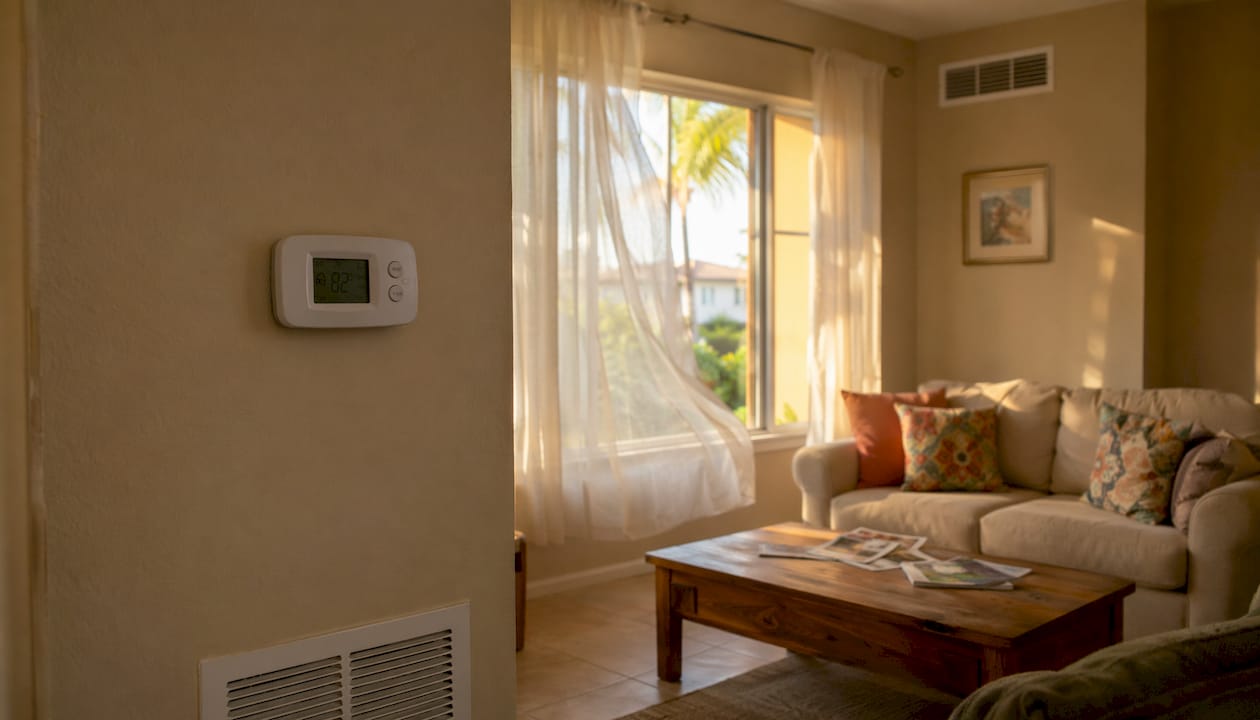
Thermostat placement affects air quality indirectly. Incorrect thermostat location near windows, kitchen appliances, or supply vents causes false temperature readings and erratic system cycling. Place thermostats on interior walls, away from heat sources and direct sunlight, to get accurate readings and consistent comfort. For homeowners concerned about allergens or respiratory health, improving indoor air quality from the start is far easier than retrofitting solutions later.
6. How to maintain HVAC systems in new homes for long-term performance
New homeowners often assume a brand-new system needs no attention for years. That assumption is expensive. Preventive maintenance programs reduce emergency HVAC call-outs by 65% and extend system life by 30–40%. Starting maintenance from day one protects that investment.
- Register your equipment within 60–90 days of installation. Most manufacturers require registration to activate full warranty coverage. Missing this window can cut warranty periods significantly.
- Schedule a post-construction professional cleaning. Construction dust clogs coils and filters faster than normal use. A professional visit after move-in clears debris that accumulated during the build.
- Replace filters on schedule using the correct MERV rating. MERV 8–11 filters balance air quality with adequate airflow for most residential systems. Higher MERV ratings improve filtration but restrict airflow if the system wasn’t designed for them.
- Monitor refrigerant charge and airflow annually. Low refrigerant and restricted airflow are the two most common causes of reduced efficiency and premature compressor failure.
- Set up a structured maintenance plan. Proactive preventive maintenance extends equipment life by decades, a critical fact for new systems that homeowners often mistakenly treat as maintenance-free.
Pro Tip: Schedule your first professional maintenance visit at the six-month mark, not the one-year mark. Six months of Florida heat and humidity puts real stress on a new system, and catching issues early keeps the warranty intact.
Key takeaways
The most effective HVAC strategy for new construction combines Manual J sizing, mastic-sealed ductwork inside the conditioned envelope, climate-matched equipment, and a structured maintenance plan started on move-in day.
| Point | Details |
|---|---|
| Size with Manual J | Use ACCA Manual J calculations, not square footage rules, to size every system. |
| Seal ducts with mastic | Mastic sealing prevents the 20–30% air loss that tape cannot stop long-term. |
| Keep ducts inside conditioned space | Duct placement inside the thermal envelope cuts cooling energy losses by 20–30%. |
| Choose climate-matched equipment | Heat pumps with SEER2 above 16 and corrosion-resistant coils suit Southwest Florida best. |
| Start maintenance immediately | Register equipment within 60–90 days and schedule a six-month professional service visit. |
What I’ve learned after years of new construction HVAC in Southwest Florida
The single most expensive mistake I see on new builds is treating HVAC as a late-stage trade. Builders call the HVAC contractor after framing is done, after plumbing is roughed in, and sometimes after insulation is up. At that point, the duct paths are compromised, the equipment choices are rushed, and the homeowner pays for it in utility bills for the next two decades.
Interdisciplinary coordination with structural, electrical, and thermal envelope design early in the build process is what separates a system that performs from one that merely functions. I’ve seen homes in Cape Coral where the ductwork was routed through the attic because nobody planned for interior chases. Those homeowners run their systems harder and pay more every month.
The other thing I’d push back on is the idea that a new system takes care of itself. New construction generates an enormous amount of dust and debris. That material ends up in coils, filters, and drain pans. A system that isn’t cleaned and checked in the first six months starts its life already working against itself. The AC tips and maintenance habits you build in year one set the pattern for the system’s entire lifespan. Get them right from the start.
— albert
Ultraairswfl’s approach to new construction HVAC in Southwest Florida
Ultraairswfl specializes in new construction HVAC design for homes across Naples, Cape Coral, and Fort Myers. Every project starts with a full Manual J and Manual D calculation, so equipment is sized to your specific home, not a generic formula. Ductwork is designed for placement inside the conditioned envelope wherever possible, and all joints are sealed with mastic for lasting performance.
Ultraairswfl installs high-efficiency heat pumps and hybrid systems with SEER2 ratings built for Florida’s climate, including corrosion-resistant options for coastal properties. Maintenance plans are available from day one to protect your investment and keep warranties valid. Contact Ultraairswfl to review your heating and cooling options before your build breaks ground.
FAQ
What is Manual J and why does it matter for new construction?
Manual J is the ACCA standard method for calculating the precise heating and cooling load of a home based on insulation, windows, climate, and occupancy. Using it prevents oversized or undersized systems that waste energy and fail to control humidity.
How do I know if my ducts are properly sealed?
A duct blaster test measures air leakage in the duct system before drywall is installed. Properly sealed ducts with mastic should show minimal leakage; unsealed or tape-only ducts commonly lose 20–30% of conditioned air.
What SEER2 rating should I look for in a new Southwest Florida home?
A SEER2 rating above 16 is the recommended minimum for new construction in Southwest Florida’s hot, humid climate. Higher ratings reduce monthly energy costs and often qualify for federal or local rebates.
When should I schedule the first HVAC maintenance visit in a new home?
Schedule the first professional maintenance visit at six months after move-in, not one year. Construction dust accumulates in coils and filters quickly, and early service protects both performance and warranty coverage.
Do new construction homes need an ERV or ventilation system?
Yes. Tight modern construction traps indoor pollutants at levels 2–5 times higher than outdoors. An Energy Recovery Ventilator brings in fresh air while recovering energy from the outgoing air stream, maintaining air quality without a large energy penalty.