
A variable speed air conditioner is defined as a cooling system that continuously adjusts its compressor speed to match your home’s exact cooling demand at any given moment. Unlike traditional units that run at full blast or shut off completely, variable speed technology modulates output anywhere from roughly 15% to 100% capacity. The result is tighter temperature control, lower energy bills, and better humidity management. If you want to explain variable speed AC to someone in one sentence: it works like a car’s cruise control, holding your home at a steady temperature instead of constantly braking and accelerating. For homeowners in hot, humid climates like Southwest Florida, this distinction matters enormously.
How does a variable speed air conditioner work?
Variable speed AC relies on inverter technology to control the compressor. A standard fixed-speed compressor runs at one speed: full power. An inverter-driven compressor converts incoming AC power to DC, then back to AC at a variable frequency. That frequency shift is what changes the compressor’s speed.
Inverter-driven frequency control typically operates between 15 and 120 Hz, giving the system a wide range of output levels. At 15 Hz, the compressor runs slowly and quietly, removing just enough heat to maintain your set temperature. At 120 Hz, it runs near full capacity during peak demand, such as a hot afternoon in july.
This continuous modulation is the key difference from older systems. A single-stage unit turns on, runs at 100%, then shuts off when the thermostat is satisfied. That on/off cycle creates temperature swings and wastes energy on repeated startups. A variable speed system simply slows down instead of stopping, which keeps conditions stable and avoids the power surge that comes with every restart.

The technology also includes a variable frequency drive (VFD), which manages the electrical conversion process and protects the motor from stress. The VFD is why variable speed systems start smoothly and run quietly at low loads.
Pro Tip: A variable speed system paired with a compatible smart thermostat learns your home’s thermal patterns and pre-adjusts before temperatures drift, making the efficiency gains even larger.
Here is what happens inside the system during a typical afternoon:
- The thermostat detects the indoor temperature is 0.3°F above the set point.
- The inverter increases compressor frequency slightly, adding just enough cooling capacity.
- The system holds that output until the temperature stabilizes, then reduces speed again.
- No full shutdown occurs unless the home reaches the set point and stays there for an extended period.
- The cycle repeats continuously, consuming only the energy actually needed at each moment.
What are the major benefits of variable speed AC systems?
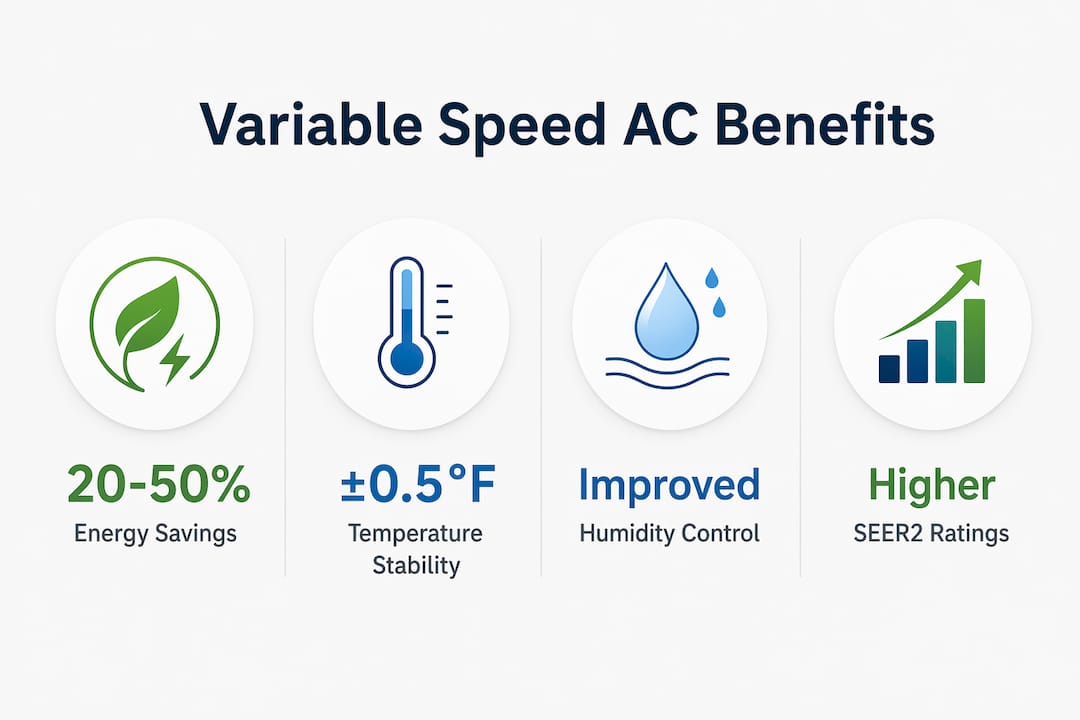
Energy savings are the most cited reason homeowners upgrade to variable speed systems. Switching to variable speed AC can reduce cooling bills by 20–50%, with payback periods typically falling in the 3–7 year range. That range is wide because savings depend on local electricity rates, climate, and how often the system runs.
Temperature stability and comfort
Variable speed systems maintain indoor temperatures within ±0.5°F of the set point, compared to ±3–5°F fluctuations common in single-stage units. That difference is noticeable. A single-stage system lets a room warm up noticeably before kicking on, then overcools before shutting off. A variable speed system holds the temperature so steadily that most homeowners stop noticing the AC is running at all.
Humidity control
Humidity removal is where variable speed systems genuinely outperform. Because the system runs longer at lower speeds, the evaporator coil stays cold for extended periods. Cold coils pull moisture from the air continuously. Humidity removal capacity in variable speed units runs 2–3 times higher than single-speed units, which is critical for mold prevention and air quality in humid climates. For homeowners in Naples, Cape Coral, or Fort Myers, this benefit alone often justifies the upgrade. You can read more about how this connects to indoor air quality in Southwest Florida homes.
Noise and lifespan
Variable speed units operate as quietly as 19–35 dB indoors at low speeds. That is roughly the sound level of a whisper. Single-stage units cycle on with a noticeable thump and run loudly until they shut off. Beyond noise, reduced mechanical stress translates directly to longer equipment life. Variable speed systems last 15–20 years on average, compared to 10–12 years for single-stage units. Fewer start/stop cycles mean less wear on the compressor, the most expensive component in any AC system.
- Energy savings: 20–50% reduction in cooling costs versus fixed-speed systems.
- Temperature precision: Holds within ±0.5°F, eliminating the hot/cold swings of on/off cycling.
- Humidity control: Removes 2–3 times more moisture, reducing mold risk and improving air quality.
- Quiet operation: Runs as low as 19 dB indoors, far below the noise of a standard unit.
- Longer lifespan: 15–20 year service life versus 10–12 years for single-stage systems.
What factors should homeowners consider before choosing a variable speed AC?
Variable speed systems cost more upfront. Installed prices typically run $4,500–$12,000, which is $2,000–$4,000 more than a comparable single-stage unit. That gap narrows over time through energy savings, but homeowners need to evaluate whether their situation supports the payback period.
Climate fit matters most. Hot, humid regions benefit the most from variable speed technology. The system’s humidity control and long run times are most valuable where cooling season lasts six months or more. Homeowners in mild climates with short summers will see smaller savings and longer payback periods.
Pro Tip: Before getting a quote, ask your HVAC contractor to perform a Manual J load calculation. This calculation determines the exact cooling capacity your home needs. Skipping it often leads to an oversized system that short-cycles and defeats the efficiency benefits.
Key considerations before buying:
- Upfront cost: Budget $4,500–$12,000 installed, depending on system size and home layout.
- Payback period: Expect 3–7 years to recover the cost premium through energy savings.
- Ductwork condition: Leaky or undersized ducts limit efficiency gains regardless of system quality. Have ducts inspected before installation.
- Thermostat compatibility: Many variable speed systems require proprietary communicating thermostats for full modulation. Your existing thermostat may not be compatible.
- Homeownership duration: Renters and short-term owners rarely recoup the upfront premium. This technology rewards long-term residents.
- Rebates and incentives: Higher SEER2 ratings (18–26+) often qualify for utility rebates and federal tax credits, which reduce the effective cost.
For a detailed look at whether the numbers work in Florida specifically, the variable speed AC ROI guide from Ultraairswfl breaks down the regional math clearly.
How does variable speed AC compare to single-stage and two-stage systems?
Three compressor types exist in residential AC: single-stage, two-stage, and variable speed. Each represents a different level of output control.
A single-stage compressor runs at 100% capacity or off. It is the simplest and least expensive option. It works, but it creates temperature swings and runs inefficiently because it cannot match partial cooling loads.
A two-stage compressor adds a second speed, typically 65–70% and 100%. This is a meaningful improvement. The system runs at the lower stage most of the time and only shifts to full power on the hottest days. Temperature stability improves and energy use drops compared to single-stage, but humidity control remains limited because run times at low stage are still shorter than a variable speed system.
A variable speed compressor modulates continuously across a wide range. SEER2 ratings for variable speed units typically fall between 18 and 26+, compared to 13–16 for single-stage systems. That efficiency gap is significant over a full cooling season.
| Feature | Single-stage | Two-stage | Variable speed |
|---|---|---|---|
| Compressor speeds | 1 (100%) | 2 (65% and 100%) | Continuous (15%–100%) |
| SEER2 range | 13–16 | 16–20 | 18–26+ |
| Temperature stability | ±3–5°F | ±1–2°F | ±0.5°F |
| Humidity control | Basic | Moderate | Superior |
| Noise level | Highest | Moderate | Lowest |
| Upfront cost | Lowest | Mid-range | Highest |
For homeowners in Southwest Florida, the jump from two-stage to variable speed is often worth it because of the humidity control advantage. For homeowners in cooler climates, two-stage may offer the right balance of cost and performance. Urban homeowners in other regions can find similar guidance through resources like HVAC efficiency comparisons that apply to different climate zones.
What are common myths about variable speed AC technology?
The biggest myth is that “variable speed” simply means the system has multiple fixed speeds to choose from. It does not. Variable speed means the compressor modulates continuously and automatically based on real-time demand. The homeowner does not select a speed. The system manages it entirely.
A second common misconception is that variable speed systems are maintenance-free because they run more gently. They still require regular filter cleaning, coil maintenance, and annual professional service. Repairs on variable speed systems cost 20–40% more than on simpler systems due to complex electronics. Inverter board replacement alone can run $800–$2,000. Replacement parts are also less commonly stocked locally, which can extend repair timelines.
Pro Tip: When choosing a contractor, confirm they have specific experience commissioning variable speed systems. Improper setup during installation is the leading cause of efficiency loss in these units.
Additional facts worth knowing:
- Proper installation requires a Manual J load calculation and duct evaluation. Skipping either step undermines the system’s performance.
- Some variable speed models use proprietary communicating controls that lock you into a specific brand’s thermostat ecosystem.
- Annual maintenance is non-negotiable. The electronics that make these systems efficient are also the components most sensitive to neglect.
Key Takeaways
Variable speed air conditioning delivers superior comfort, energy savings, and humidity control by continuously modulating compressor output, making it the most efficient residential cooling technology available in 2026.
| Point | Details |
|---|---|
| Continuous modulation | The compressor adjusts from 15% to 100% capacity, eliminating wasteful on/off cycling. |
| Energy savings | Homeowners can cut cooling bills by 20–50%, with payback in 3–7 years. |
| Humidity and comfort | Temperature stays within ±0.5°F and moisture removal runs 2–3 times higher than single-stage units. |
| Installation matters | Manual J load calculations and skilled commissioning are required to realize full efficiency benefits. |
| Repair costs are higher | Variable speed electronics cost 20–40% more to repair, so annual maintenance is not optional. |
What I’ve learned after years of seeing these systems in the field
Most homeowners focus on the SEER2 number when shopping for a new AC. That number matters, but it does not tell the whole story. What I have seen repeatedly is that a properly sized and installed variable speed system in a hot, humid climate like Southwest Florida changes how a home feels, not just how much the electric bill costs.
The humidity control is the part that surprises people most. A home that used to feel sticky at 76°F can feel genuinely comfortable at 78°F once the moisture is managed correctly. That shift lets homeowners raise their thermostat set point without sacrificing comfort, which compounds the energy savings.
The mistake I see most often is homeowners choosing the system but not vetting the installer. Variable speed technology requires skilled commissioning. A contractor who installs these units like a standard single-stage system will leave efficiency and comfort on the table. Ask for proof of training and ask specifically whether they perform Manual J calculations on every job.
For renters or homeowners planning to sell within three years, the math rarely works out. The upfront premium needs time to recover. But for anyone planning to stay in a Southwest Florida home for five or more years, the combination of lower bills, better comfort, and longer equipment life makes variable speed the clear choice. The benefits for Southwest Florida homes are especially strong given the length and intensity of the cooling season here.
— albert
Variable speed AC installation and service with Ultraairswfl
Ultraairswfl installs and services high-efficiency variable speed systems across Naples, Cape Coral, and Fort Myers. Every installation starts with a Manual J load calculation to size the system correctly for your home’s specific layout and heat load.
The team at Ultraairswfl also evaluates your existing ductwork and thermostat compatibility before recommending a system, so you avoid the common pitfalls that reduce efficiency after installation. Available rebates and financing options make the upfront cost more manageable for most homeowners. Whether you need a full cooling system installation or want to evaluate your current setup, Ultraairswfl provides personalized quotes with no obligation. Contact the team to schedule an assessment and find out which variable speed system fits your home and budget.
FAQ
What does variable speed mean in an air conditioner?
Variable speed refers to the compressor’s ability to continuously adjust its output between roughly 15% and 100% capacity using inverter technology. The system matches cooling output to real-time demand rather than cycling fully on or off.
How much can a variable speed AC save on energy bills?
Variable speed systems can reduce cooling costs by 20–50% compared to single-stage units. Payback on the higher upfront cost typically occurs within 3–7 years, depending on climate and usage.
Is a variable speed AC worth it for renters?
Renters and short-term occupants rarely recover the upfront cost premium before moving. Variable speed systems deliver the best return for homeowners who plan to stay in place for five or more years.
What SEER2 rating do variable speed ACs typically carry?
Variable speed units typically carry SEER2 ratings between 18 and 26+, compared to 13–16 for single-stage systems. Higher ratings often qualify for utility rebates and federal tax incentives.
Do variable speed ACs require special thermostats?
Many variable speed systems require proprietary communicating thermostats for full modulation capability. Standard thermostats may work but can limit the system’s efficiency and performance range.