
If you own or manage a property with a heating and cooling system, understanding essential HVAC safety equipment is no longer optional. Between evolving EPA regulations, refrigerant handling risks, electrical hazards, and confined space dangers, the stakes for getting this wrong are real. This guide breaks down the specific gear, detection tools, and compliance systems that protect your property, your tenants, and anyone who services your equipment. You will walk away knowing exactly what to look for, what to ask your technician, and where the regulatory lines are drawn in 2026.
Table of Contents
- Key takeaways
- 1. Essential HVAC safety equipment starts with the right PPE
- 2. Gas and refrigerant detection equipment
- 3. Digital tools and compliance equipment for refrigerant tracking
- 4. Hard hats, hearing protection, and fall protection gear
- 5. How to choose the right HVAC safety equipment for your property
- My honest take on what most property owners get wrong
- Stay compliant and protected with Ultraairswfl
- FAQ
Key takeaways
| Point | Details |
|---|---|
| PPE is non-negotiable | Technicians need goggles, cryogenic gloves, and proper footwear before touching any refrigerant system. |
| Detection saves lives | Portable oxygen and refrigerant monitors catch invisible leaks before they become emergencies. |
| 2026 EPA rules changed everything | The refrigerant leak repair threshold dropped to 15 pounds, affecting most residential and commercial systems. |
| Digital compliance tools matter | Manual tracking is no longer reliable enough for audit-ready records under current EPA enforcement. |
| Equipment alone is not enough | Written programs, training, and inspections are what turn safety gear into actual protection. |
1. Essential HVAC safety equipment starts with the right PPE
The baseline for any safe HVAC service call begins with PPE for refrigerant work: safety glasses or goggles, cryogenic-rated insulated gloves, and closed-toe footwear. Each one addresses a distinct hazard, and substituting a cheaper or simpler option creates real exposure.
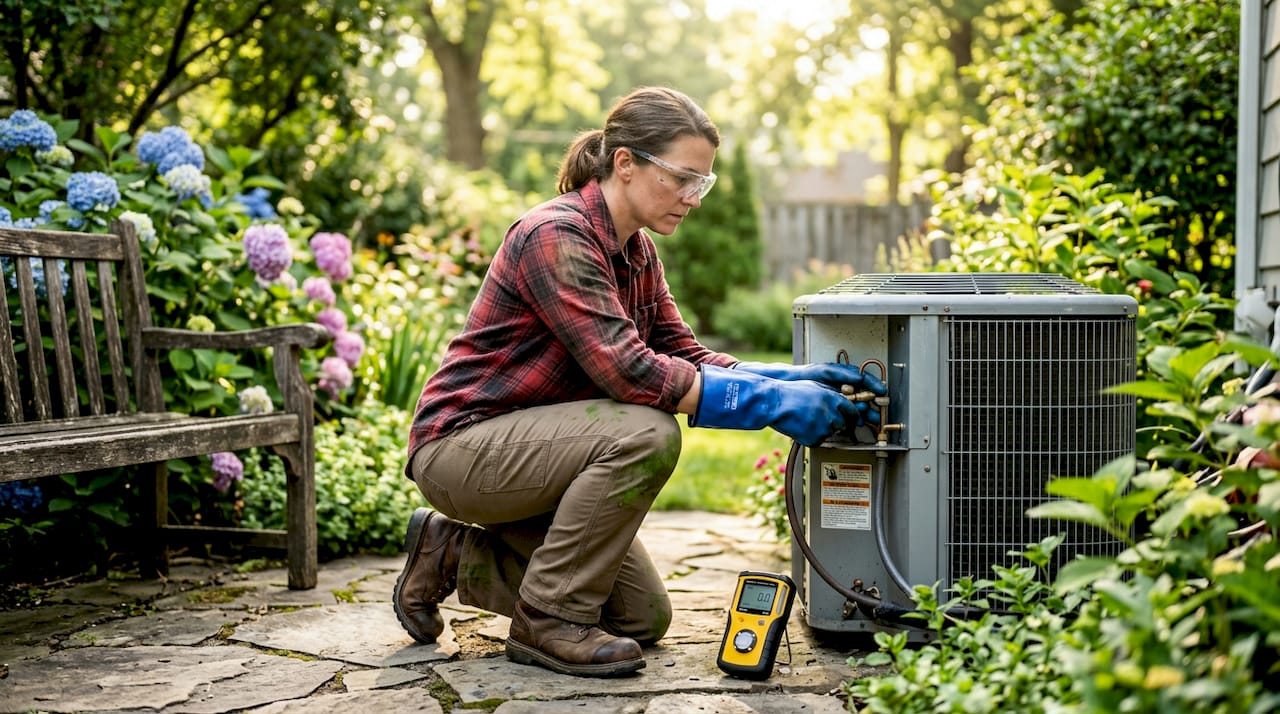
Safety glasses vs. chemical splash goggles. Standard safety glasses protect against debris and flying particles. If your technician is working near refrigerant lines, chemical splash goggles with indirect ventilation are the right call. Liquid refrigerant can reach extremely low temperatures on contact and cause immediate skin and eye injury.
Cryogenic-rated gloves vs. standard work gloves. Regular work gloves offer zero thermal protection against refrigerants. Cryogenic-rated insulated gloves are specifically designed for low-temperature exposure and protect against cold burns when handling refrigerant lines, valves, and cylinders.
Footwear that does the job. Closed-toe, non-slip, steel-toe boots are the standard for HVAC work. Mechanical environments with compressors, heavy equipment, and slick floors require it. Sneakers or open-toe shoes are a genuine liability.
If your system uses A2L flammable refrigerants like R-32 or R-454B, the PPE requirements go further. Anti-static clothing and footwear are required, and metallic accessories should be removed before starting work. The reason is straightforward: A2L refrigerants have a lower flammability limit than older refrigerants, meaning static discharge or a spark can ignite them.
Pro Tip: Ask your technician to show you their PPE before they begin work. If they are not carrying cryogenic gloves and appropriate eye protection, that is a red flag worth addressing.
Tailored PPE selection that matches the specific hazard improves both safety outcomes and technician effectiveness. One-size-fits-all gear is not good practice, and experienced HVAC professionals know the difference.
Regular PPE inspections matter too. Gloves with micro-tears, cracked goggle lenses, or worn boot soles should be replaced before the next job. Damaged PPE often provides false confidence more than actual protection.
2. Gas and refrigerant detection equipment
Refrigerant leaks are invisible. Some refrigerants are odorless. Oxygen displacement in a confined space can incapacitate a person before they realize anything is wrong. That is why portable oxygen monitors and refrigerant concentration monitors are considered critical safety tools, not optional extras.
Oxygen monitors should be placed 3 to 5 feet off the ground and kept at least 3 to 5 feet away from gas cylinders. These placement guidelines exist because refrigerant vapors can displace oxygen at ground level, and monitors placed too close to cylinders may give false high readings.
Refrigerant concentration monitors detect specific refrigerant types and alert users before concentrations reach dangerous levels. For any enclosed mechanical room, basement unit, or rooftop installation with limited airflow, continuous monitoring is the responsible approach. Oxygen deficiency is a silent hazard in confined spaces, and a quality monitor is one of the most cost-effective safety investments available.
Respiratory protection is equally critical. The right respirator depends on the hazard level:
- N95 respirators handle particulate protection during filter changes or dusty duct work
- Half-face respirators with organic vapor cartridges address refrigerant vapor exposure at lower concentrations
- Full-face respirators add eye protection and are used in higher-concentration environments
- Self-Contained Breathing Apparatus (SCBA) is required in Immediately Dangerous to Life or Health (IDLH) environments
Beyond owning the right respirator, OSHA 29 CFR 1910.134 requires written respiratory protection programs covering medical clearance, annual fit testing, training, maintenance, and recordkeeping. Most technicians wear a respirator. Far fewer have a documented program backing it up.
Pre-use respirator inspections are another common gap. Even a properly fit-tested respirator can fail if straps are cracked, valves are damaged, or seals are compromised. A daily documented check takes two minutes and prevents the kind of exposure event that nobody wants to explain to a client or regulator.
Pro Tip: If you hire an HVAC contractor for regular maintenance, ask for their written respiratory protection program. A professional operation should have one on file.
3. Digital tools and compliance equipment for refrigerant tracking
This is where 2026 changed the rules for a lot of property owners and managers. The EPA lowered the leak repair threshold from 50 pounds to 15 pounds of refrigerant. That means most commercial rooftop units, split systems, and many larger residential systems now fall under mandatory leak rate calculation and repair requirements.
What that means practically: if your system holds 15 or more pounds of refrigerant, your HVAC technician must calculate the annual leak rate. If it exceeds the threshold, repairs are required. Documentation must be retained for at least three years and made available for EPA inspection. Violations can reach $44,539 per violation per day, which makes the cost of a digital tracking platform look negligible by comparison.
Here is how manual and digital compliance methods stack up:
| Method | Accuracy | Audit readiness | Time burden | Enforcement risk |
|---|---|---|---|---|
| Manual paper records | Variable | Low | High | High |
| Spreadsheet tracking | Moderate | Moderate | Moderate | Moderate |
| Digital compliance platform | High | High | Low | Low |
| No tracking | None | None | None | Very high |
Digital platforms automate leak rate calculations, generate inspection schedules, flag systems approaching threshold limits, and store records in formats ready for regulatory review. The difference in audit readiness between a digital platform and a folder of handwritten service records is significant.
Verification testing after repairs is also now mandated. A repair is not complete until a follow-up leak test confirms the fix held under operating conditions. If the initial verification fails, a second test is required within 30 days, and EPA notification may be triggered. This workflow needs to be tracked, not memorized.
Pro Tip: Review the HVAC compliance basics for your property type before your next service appointment. Knowing what records you should be getting from your technician puts you in a stronger position.
4. Hard hats, hearing protection, and fall protection gear
PPE for HVAC work goes beyond gloves and goggles. Mechanical environments introduce noise, height, and impact hazards that require additional protective equipment.
Hard hats are required when technicians work in areas with overhead hazards. Rooftop installations, crawlspace access points, and mechanical rooms with low clearance all create head injury risk. A bump cap is not a substitute for a rated hard hat where falling objects are a real possibility.
Hearing protection becomes necessary when working near loud compressors, industrial air handlers, or using power tools for extended periods. Noise-induced hearing loss accumulates over time. Single-use foam earplugs rated for the decibel level of the equipment in use are the baseline standard.
Fall protection gear matters whenever a technician is working at elevation. Rooftop condenser work, climbing ladders to access attic air handlers, or working on elevated mechanical platforms all create fall risk. Harnesses, anchor points, and non-slip footwear work together to address this.
Knee pads may seem minor, but they prevent injury during installation work in crawlspaces or during prolonged crouching near floor-mounted equipment. Small details like this affect how carefully and attentively a technician can work.
- Lockout/tagout kits prevent accidental energization during electrical work. Before any HVAC electrical component is serviced, the power supply must be locked out and tagged to prevent someone from restoring power unknowingly
- Non-contact voltage testers let technicians confirm a circuit is de-energized before touching any wiring
- Refrigerant identifier tools verify the refrigerant type in a system before service, preventing cross-contamination and equipment damage
5. How to choose the right HVAC safety equipment for your property
Not every property needs the same approach. A single-family home with a 3-ton split system has different requirements than a small commercial building with multiple rooftop units. Here is how to think through your specific situation:
- Identify your refrigerant charge. Ask your HVAC contractor how much refrigerant your system holds. If it is 15 pounds or more, you are under the 2026 EPA compliance scope and need documented leak tracking.
- Know your refrigerant type. Older systems use R-22 or R-410A. Newer systems increasingly use A2L refrigerants. Each type has different PPE and handling requirements for the technicians you hire.
- Decide what you want on site vs. what you expect from contractors. Homeowners rarely need to own PPE. However, as a property manager, having on-site detection equipment like oxygen monitors in mechanical rooms is a reasonable investment.
- Budget for compliance, not just equipment. A digital tracking platform subscription costs far less than a single EPA violation. Factor compliance tools into your annual HVAC budget alongside service contracts.
- Schedule regular safety reviews. Your Southwest Florida maintenance checklist should include a review of whether your contractors are meeting current PPE and documentation standards.
Pro Tip: When evaluating HVAC contractors, ask specifically whether they carry A2L-rated PPE and use digital leak tracking. Those two questions will tell you a lot about how current their practices are.
The goal is not to become an HVAC safety expert yourself. The goal is to ask the right questions, recognize when something looks off, and make sure the people working on your system are properly equipped and compliant.
My honest take on what most property owners get wrong
I have seen a lot of HVAC service situations where the equipment was technically present but the program was completely missing. A technician shows up with gloves and safety glasses, which looks professional. But when you ask whether they have a written respiratory protection program, annual fit testing on file, or digital leak rate records for your system, the answer is often silence.
The gap between having safety gear and running a real safety program is where most of the risk lives. Equipment sitting in a truck does not protect anyone. Equipment that is inspected, matched to the specific hazard, and backed by documented procedures does.
What I have learned is that homeowners and property managers have more leverage than they think. Asking about PPE programs, refrigerant tracking systems, and EPA compliance documentation is not being difficult. It is being a responsible owner. Contractors who cannot answer those questions clearly are telling you something important about how they operate.
The 2026 EPA threshold change is not a technicality. It is a real shift in who is on the hook for refrigerant leak management and documentation. If your system holds 15 pounds or more and you do not have records from your last service visit, that is a gap worth closing before your next inspection.
Treat HVAC safety equipment as part of your property’s operating infrastructure. It protects the people inside it, it keeps you compliant, and it prevents the kind of costly emergencies that show up without warning.
— albert
Stay compliant and protected with Ultraairswfl
Navigating 2026 EPA requirements, refrigerant handling risks, and proper safety protocols takes the right partner, not just the right gear. Ultraairswfl serves homeowners and property managers across Naples, Cape Coral, and Fort Myers with professional HVAC maintenance, leak detection, and compliance documentation services.
Whether you need a thorough system inspection, verified leak tracking for your refrigerant-charged equipment, or guidance on selecting appropriate heating and cooling solutions that meet current standards, the team at Ultraairswfl has you covered. You can also explore indoor air quality services for properties where monitoring and air safety are a priority. Schedule your consultation today and get the documentation your property deserves.
FAQ
What PPE is required for HVAC refrigerant work?
Minimum PPE includes safety goggles, cryogenic-rated insulated gloves, and closed-toe footwear. A2L flammable refrigerant systems require anti-static clothing and footwear as well.
Does the 2026 EPA rule affect my home’s HVAC system?
If your system holds 15 or more pounds of refrigerant, it now falls under mandatory EPA leak rate tracking and repair documentation requirements, affecting many residential and light commercial systems.
What type of respirator do HVAC technicians need?
The respirator type depends on the hazard level. N95s handle particulate work, half-face respirators with organic vapor cartridges address refrigerant vapor, and SCBA units are required in IDLH environments.
How long must refrigerant leak records be kept?
Records of leak detection and repairs must be retained for a minimum of three years and made available to EPA inspectors on request, with violations potentially reaching $44,539 per violation per day.
Do I need my own safety equipment as a homeowner?
Most homeowners do not need to own HVAC PPE, but having portable oxygen monitors in enclosed mechanical rooms is worth considering. Your primary responsibility is verifying that your contracted technicians are properly equipped and compliant.