

If you think HVAC compliance is just about buying a unit with a good energy efficiency rating, you’re in good company — and you’re also missing most of the picture. True compliance in Southwest Florida covers a layered web of legal, safety, documentation, and installation requirements that go far beyond any sticker on the side of your equipment. Whether you own a home in Naples, run a commercial property in Cape Coral, or manage a business in Fort Myers, understanding what HVAC compliance actually requires can save you from costly fines, failed inspections, voided warranties, and real safety risks.
Table of Contents
- Understanding HVAC compliance: beyond the label
- The layers of HVAC regulation: federal, state, and local
- Key HVAC compliance requirements in Southwest Florida
- Refrigerant and efficiency rules: what Florida owners must watch
- Common pitfalls and how to stay compliant
- Expert perspective: Why compliance is your greatest protection, not just a hurdle
- Need help with HVAC compliance in Southwest Florida?
- Frequently asked questions
Key Takeaways
| Point | Details |
|---|---|
| Multi-level compliance | HVAC rules come from federal, state, and local governments—owners must meet all levels. |
| Permits and documentation | Passing inspection requires specific paperwork, not just labeled equipment. |
| Efficiency and refrigerant rules | EPA certification and SEER2 efficiency standards are central to Florida compliance. |
| Avoid common pitfalls | Most compliance failures are due to missed paperwork or skipped inspections. |
| Compliance is protection | Treating compliance seriously protects your investment, safety, and peace of mind. |
Understanding HVAC compliance: beyond the label
Before we go further, let’s make sure we’re all speaking the same language. Understanding what HVAC means is the starting point, but compliance goes several layers deeper than the basics.
HVAC compliance means meeting enforceable requirements for an HVAC system’s design, installation, operation, and maintenance under applicable codes, standards, and regulations, which vary by location and building type. That definition alone should shift how you think about the topic. It’s not a one-time checkbox when you buy equipment. It’s a continuous process that runs from the design phase all the way through inspections, maintenance, and documentation.
Think of it this way. You could install the most energy-efficient air conditioner on the market, and still be completely out of compliance if the ductwork was never tested, the permits weren’t pulled, or the contractor used an uncertified technician to handle refrigerant. Compliance is the whole package.
Here’s what HVAC compliance actually covers:
- Legal permits and approvals from local building departments
- Equipment efficiency minimums set by federal and state agencies
- Safe refrigerant handling under federal and state regulations
- Proper system sizing based on load calculations, not guesswork
- Duct construction and leakage standards verified through testing
- Ventilation requirements to protect indoor air quality
- Maintenance records and inspection sign-offs
Failing any one of these requirements can result in noncompliance, even if the equipment itself is top of the line. Many property owners discover this the hard way when an insurance claim is denied or a home inspection reveals unpermitted work before a sale.
Familiarizing yourself with common HVAC terminology makes it easier to ask the right questions and understand what your contractor is responsible for delivering.
The layers of HVAC regulation: federal, state, and local
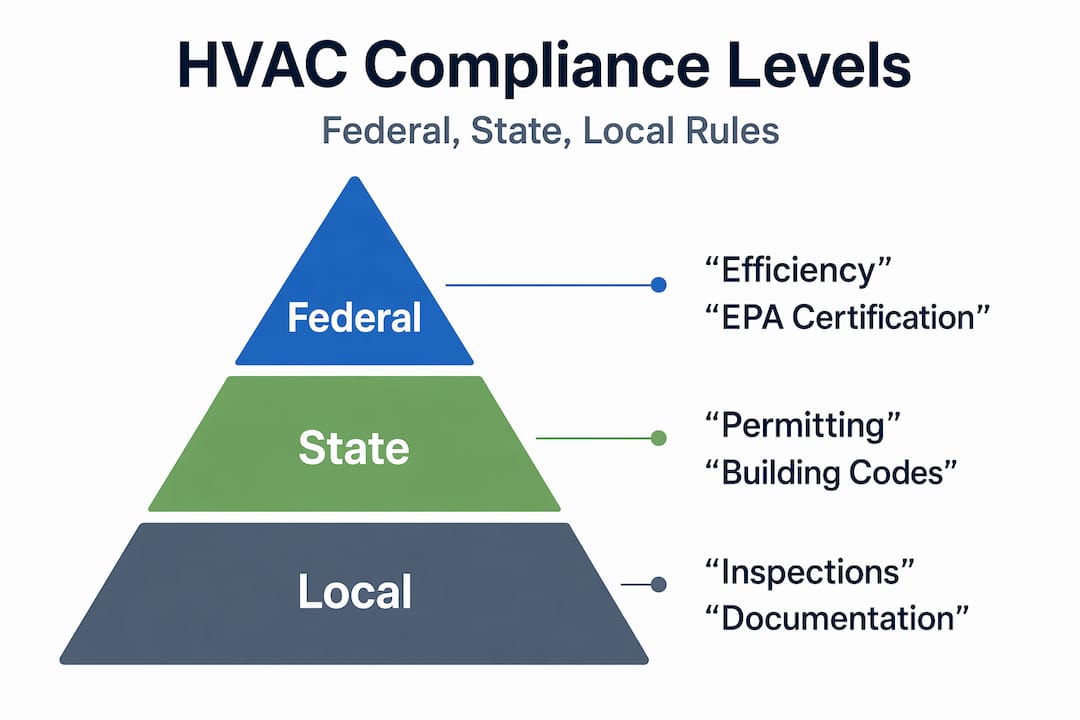
Now that we’ve established compliance as multi-faceted, we need to see how different government authorities each play a part. Most people don’t realize that three separate layers of regulation apply to every HVAC job in Southwest Florida, and each layer has its own rules and enforcement mechanisms.
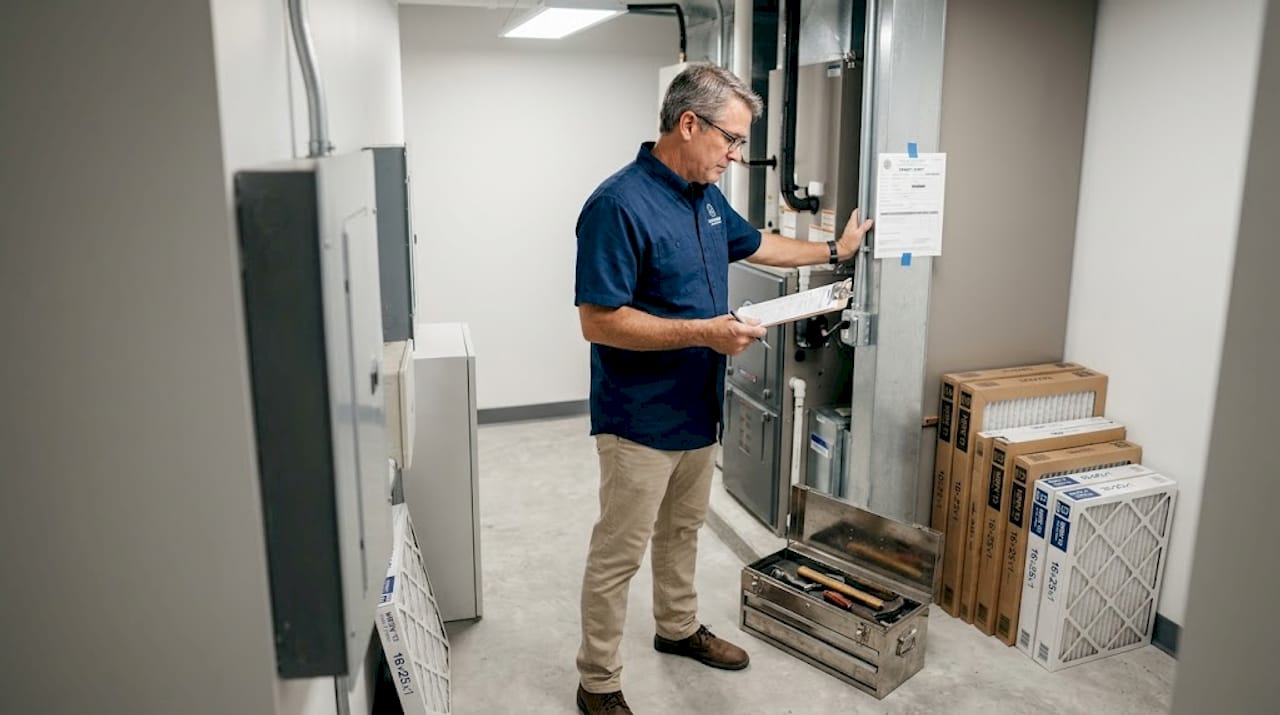
Federal HVAC compliance commonly spans energy efficiency minimums set by the Department of Energy under the Energy Policy and Conservation Act, refrigerant management rules under the EPA’s Clean Air Act Section 608, and workplace safety standards under OSHA. These federal rules apply everywhere in the country, but they’re just the floor, not the ceiling.
Here’s a clear breakdown of how each regulatory layer operates:
| Regulatory level | Key authority | Example requirements |
|---|---|---|
| Federal | DOE, EPA, OSHA | SEER2 efficiency minimums, refrigerant certification, technician safety |
| State (Florida) | DBPR, Florida Building Code | Contractor licensing, permitting, duct standards, load calculations |
| Local (county/city) | Building departments | Permit approvals, inspection scheduling, local code amendments |
To keep it practical, here’s how the regulatory process typically unfolds for a Southwest Florida property owner:
- Federal standards set the baseline for equipment efficiency and refrigerant rules before your contractor even places an order.
- Florida state codes then layer on contractor licensing requirements, permitting processes, and technical installation standards.
- Local building departments in counties like Collier, Lee, and Charlotte handle local enforcement, scheduling inspections and approving permits for specific job sites.
- Final inspection sign-off is required before the system is considered legally compliant at the local level.
Business owners dealing with commercial compliance nuances face even greater scrutiny, since commercial buildings often trigger additional requirements around ventilation rates, system controls, and energy reporting.
Understanding this three-layer system helps you see why compliance isn’t something you can leave entirely to chance or assume was handled just because a crew showed up and installed equipment.
Key HVAC compliance requirements in Southwest Florida
With the regulatory landscape mapped out, let’s look at what compliance specifically means in Southwest Florida homes and businesses.
Florida HVAC compliance is enforced through the Florida Building Code permitting and inspection process, covering requirements for sizing, duct construction, ventilation rates, refrigerant handling, and minimum efficiency. Every one of those elements has a specific documentation trail that must be completed and verified.
Here’s a summary of the core compliance requirements and what they involve:
| Requirement | What it involves | Who verifies it |
|---|---|---|
| Load calculation | Right-sizing the system for your home or building | Contractor, inspector |
| Duct leakage test | Measures air loss in the duct system | Third-party tester or inspector |
| Equipment efficiency | Meets or exceeds minimum SEER2 rating | Inspector checks specs |
| Refrigerant documentation | Proper handling and certified technician records | Contractor and inspector |
| Permit and inspection sign-off | Legal authorization and final approval | Local building department |
What often surprises property owners is this: permit approval and inspections require the correct documentation and installation practices, not just compliant equipment. A system that’s properly sized and efficient can still fail inspection if the contractor didn’t submit the load calculation worksheet or skipped the duct leakage test.
The most common documentation required includes:
- Manual J load calculation reports proving system size matches the building’s needs
- Duct blaster or blower door test results verifying duct tightness
- Equipment specification sheets confirming efficiency ratings
- Signed permit applications submitted before work begins
- Final inspection certificates issued after work is complete
Pro Tip: Before any HVAC work begins, ask your contractor to walk you through the full permitting process and confirm which documents you’ll receive at the end of the job. A reputable contractor will have this process mapped out before the first tool is unpacked. Review the permit requirements specific to your area to know what to expect.
Owners building new construction should also review new construction codes because additional requirements often apply compared to a simple system replacement in an existing home.
Refrigerant and efficiency rules: what Florida owners must watch
Alongside permitting and inspections, refrigerant and efficiency requirements present unique risks and opportunities for local owners. These two areas tend to generate the most confusion and the most costly mistakes.
On the refrigerant side, Florida compliance requires alignment with federal EPA Section 608 technician certification plus Florida contractor licensing and related permitting and documentation at installation and service. This means that anyone handling the refrigerant in your system, whether during installation, repair, or maintenance, must hold current federal certification and appropriate state credentials.
Why does this matter to you as a property owner? Because if an uncertified person handles refrigerant on your system and something goes wrong, you could face liability. More immediately, the work may not pass inspection, leaving you with a system you can’t legally operate. Always verify your contractor’s credentials before any refrigerant work begins.
Here’s how to protect yourself:
- Ask for the EPA Section 608 certification number of any technician who will handle refrigerant at your property.
- Confirm Florida contractor license status through the state’s online license verification tool.
- Request documentation showing what refrigerant was used, how much, and how it was handled.
- Keep copies of all refrigerant records in your property file for future inspections or sales.
On the efficiency side, SEER2 now governs minimum efficiency for central air conditioners and heat pumps rather than the older SEER standard. SEER2, which stands for Seasonal Energy Efficiency Ratio 2, uses a more realistic testing methodology that reflects actual installation conditions. For Florida’s hot and humid climate, this metric has real financial consequences — a system that meets only the minimum standard can cost significantly more to run each month than one rated several points higher.
Pro Tip: When comparing systems, look beyond the SEER2 minimum and ask your contractor for projections on annual energy cost differences between models. Over a 10 to 15 year equipment lifespan in Southwest Florida’s climate, a higher-efficiency unit often pays for its own premium through energy savings. Check out efficiency trends and equipment types to make a more informed choice.
Stat to know: Systems that fail to meet federal SEER2 minimums cannot legally be installed in Florida as of 2023. Your contractor is required to confirm that any new or replacement unit meets the current minimum before it’s ordered and installed.
Common pitfalls and how to stay compliant
Complying with the rules isn’t just about what system you buy — most issues arise during installation and paperwork. This is where a lot of property owners get caught off guard, especially when dealing with partial upgrades or changes to existing systems.
One important distinction: compliance requirements aren’t always “full-system” from scratch. Some permitting and inspection burdens depend on whether the work is a full replacement versus an alteration or partial change. For example, replacing only the air handler while leaving the condenser in place may trigger different inspection requirements than a complete system swap. Your contractor should know exactly which rules apply based on the scope of work.
The most common compliance pitfalls include:
- Skipping the permit because the job seems minor (even small changes can require permits in Florida)
- Missing documentation such as a load calculation or duct test result at the time of inspection
- Using unlicensed subcontractors for electrical, refrigerant, or ductwork portions of the job
- Failing to schedule inspections and just assuming the job was approved
- Incomplete maintenance records that create gaps in the system’s compliance history
Pro Tip: At the end of every HVAC job, request a compliance packet from your contractor. This should include all permits, inspection sign-offs, test reports, equipment spec sheets, and warranty registration confirmation. Store these documents alongside your property’s other legal paperwork. When it’s time to sell or file an insurance claim, you’ll be glad you have them.
The full HVAC installation process in Fort Myers and surrounding areas follows a clear path from permit to final inspection. Understanding each step helps you hold your contractor accountable and avoid nasty surprises later.
Expert perspective: Why compliance is your greatest protection, not just a hurdle
Here’s the take we rarely see in most guides on this topic: property owners who treat compliance as a burden usually end up paying far more than those who treat it as a strategy.
We’ve seen homeowners in Southwest Florida inherit unpermitted HVAC systems from previous owners. When it comes time to sell, the buyer’s inspector flags it, the deal falls apart or renegotiates downward, and the seller ends up spending thousands to retroactively fix documentation that should have cost nothing to get right the first time. Compliance isn’t bureaucracy for its own sake. It’s a paper trail that protects your investment at every future decision point.
The same logic applies even harder to commercial property owners. A business that operates a noncompliant HVAC system risks far more than a fine. It risks insurance coverage gaps, worker comfort and health complaints, and in some cases regulatory shutdowns. Following best compliance practices from day one costs far less than correcting problems discovered under pressure.
Our honest observation after years of working in this market: the owners who push back hardest on permitting and documentation are usually the same ones who call us frustrated when something goes wrong and nobody has a clear record of what was installed or when. Compliance is a form of self-protection. It preserves your warranty rights, supports your insurance claims, and keeps your system legally operable. Treat it as a service you’re entitled to from your contractor, not a formality to bypass.
Need help with HVAC compliance in Southwest Florida?
Navigating HVAC compliance doesn’t have to be overwhelming when you have the right team in your corner.
At Ultra Air Heating & Cooling, we handle the full compliance process for homeowners and business owners across Naples, Cape Coral, and Fort Myers. From pulling permits to scheduling inspections and delivering your compliance documentation, we take care of every step. Explore our HVAC installation guide to understand what a properly managed project looks like, or learn about HVAC commissioning and how it verifies your system is operating correctly after installation. We also offer energy-efficient cooling solutions designed for Florida’s climate. Contact us today to schedule a consultation and make sure your next HVAC project is done right from the first permit to the final inspection.
Frequently asked questions
What documents are required for HVAC compliance in Florida?
Typical documents include load calculation reports, duct leakage test results, equipment specification sheets, and signed permits and inspection records, all required under the Florida Building Code permitting process.
Who is responsible for making sure my HVAC system is compliant?
Both the contractor and the property owner share responsibility for full compliance. Permit approvals and inspections require correct documentation and installation practices, so verify your contractor delivers everything in writing.
Which refrigerant rules apply to Florida homeowners?
Handling HVAC refrigerants requires an EPA Section 608 certified technician plus adherence to Florida contractor licensing and documentation requirements at every service visit.
How do I know if my HVAC contractor is following compliance rules?
Ask for proof of state contractor licensing, EPA Section 608 certification for refrigerant technicians, submitted permit numbers, and copies of all final inspection and test documents before you make final payment.