
Running a commercial property in Southwest Florida means operating in one of the most demanding HVAC environments in the country. Between the relentless summer heat, punishing humidity, and strict Florida Building Code requirements, the margin for error is thin. Get your HVAC strategy right, and you control costs, keep tenants comfortable, and avoid regulatory headaches. Get it wrong, and you’re looking at emergency repair bills, compliance fines, and systems that wear out years before they should. This article walks you through the critical best practices, from regulatory compliance and proactive maintenance to smart controls and system selection, that high-performing property managers in Naples, Cape Coral, and Fort Myers rely on.
Table of Contents
- Understand Florida’s commercial HVAC codes and standards
- Adopt a proactive maintenance strategy
- Maximize HVAC energy efficiency and smart controls
- Select the right HVAC system for Southwest Florida’s climate
- What most property managers overlook about commercial HVAC best practices
- Take the next step: Reliable HVAC solutions for Southwest Florida businesses
- Frequently asked questions
Key Takeaways
| Point | Details |
|---|---|
| Florida codes matter | Compliance with Florida Building Code and ASHRAE standards is required for all commercial HVAC installations. |
| Proactive maintenance pays | Preventive maintenance reduces operating costs and avoids emergencies compared to reactive repairs. |
| Upgrade for efficiency | Smart controls, demand-based ventilation, and routine upgrades can save up to 30% on energy bills. |
| Local climate demands | Southwest Florida’s humidity and heat require special HVAC system selection and sizing. |
| Expert oversight saves | Working with trained professionals and using digital tracking prevents costly oversights and noncompliance. |
Understand Florida’s commercial HVAC codes and standards
Every sound HVAC decision for a commercial property in Southwest Florida starts with knowing the rules. Florida doesn’t simply adopt national building codes unchanged. The state adapts and enforces its own version, meaning what applies in Georgia or Texas may not apply here.
Commercial HVAC compliance requires adherence to the Florida Building Code (FBC) Mechanical and Energy Conservation volumes, ASHRAE 90.1 for efficiency standards (EER/IEER minimums), ASHRAE 62.1 for ventilation, and updated refrigerant regulations covering A2L refrigerant transitions. Permits are required for all new installations and replacements, no exceptions.
Here’s what each standard actually means for your operation:
- Florida Building Code (FBC) Mechanical volume: Governs how HVAC systems are physically installed, including ductwork, equipment clearances, and safety controls.
- FBC Energy Conservation volume: Sets efficiency thresholds for equipment and envelopes. Florida’s version is often more cost-effective than the national IECC baseline.
- ASHRAE 90.1: Specifies the minimum EER (Energy Efficiency Ratio) and IEER (Integrated Energy Efficiency Ratio) for commercial cooling equipment. Systems that fall below these thresholds cannot be legally installed.
- ASHRAE 62.1: Controls how much outside air your ventilation system must deliver to each occupied zone. Under-ventilation creates indoor air quality problems and code violations.
- A2L refrigerant transition: New low-GWP refrigerants like R-32 and R-454B are replacing older options. Equipment and service procedures must align with updated safety classifications.
“Florida’s energy codes have been analyzed against the 2024 IECC, with results showing that the FBC Energy Conservation prescriptive path remains cost-effective for commercial properties, often delivering equivalent or better long-term value.” Florida Building Commission Energy TAC, 2025
For property managers, this regulatory landscape means you can’t rely on a contractor who isn’t current on Florida-specific requirements. Understanding the different HVAC system types available also matters here, because not every equipment category qualifies under current FBC efficiency minimums. Staying updated on Florida HVAC trends helps you anticipate code changes before they affect your next installation or replacement project.
One area many managers overlook: available HVAC efficiency tax credits can offset the cost of upgrading to compliant, high-efficiency equipment. When you’re already required to meet ASHRAE 90.1 minimums, choosing equipment that exceeds those minimums often pays for itself faster than the sticker price suggests.
Permits aren’t just bureaucratic overhead. They create a documented record of compliant installation, which protects you during tenant disputes, insurance claims, and property sales. Never let a contractor skip the permit process to save time or money upfront.
Adopt a proactive maintenance strategy
Once your systems are installed and compliant, the real work begins. Maintenance is where most commercial properties either protect or destroy their HVAC investment. In Southwest Florida’s climate, where cooling systems run nearly year-round, skipping maintenance isn’t a minor oversight. It’s a reliable path to premature equipment failure.
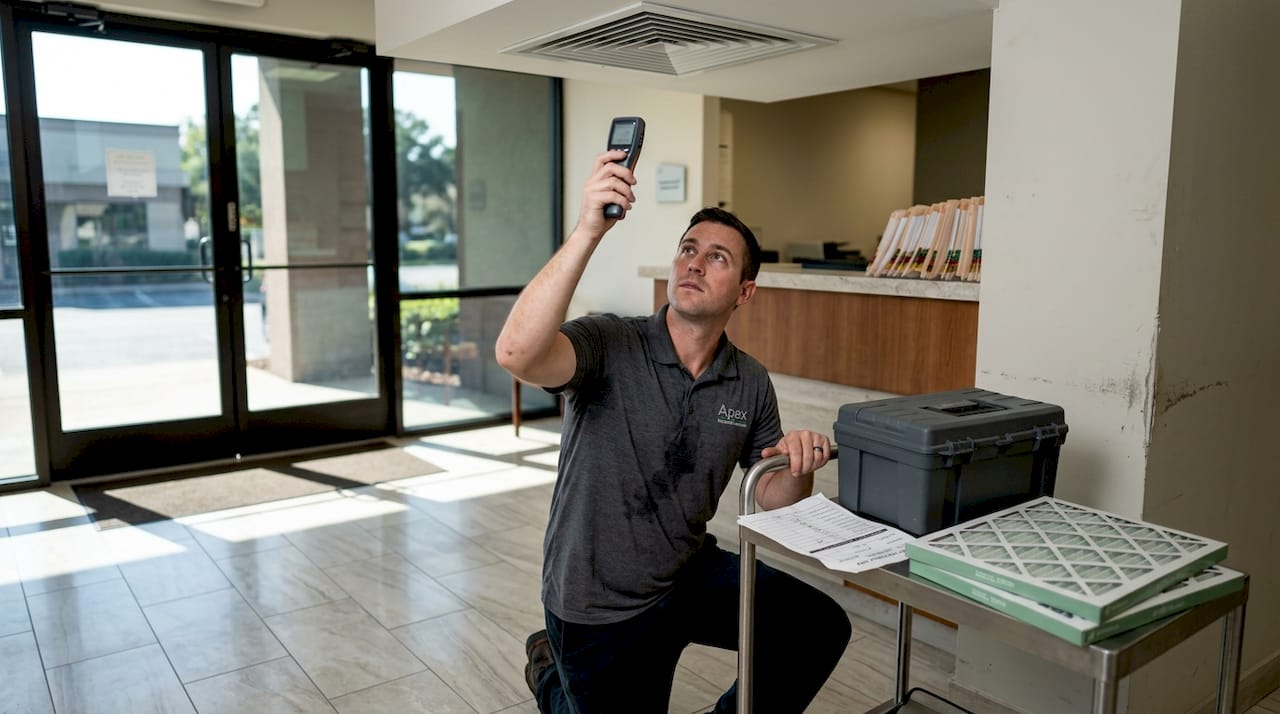
A structured maintenance checklist covers daily, monthly, quarterly, and annual tasks. Daily checks include thermostat settings and airflow readings. Monthly tasks cover filter replacements, electrical connections, and leak inspections. Quarterly maintenance addresses coil cleaning, refrigerant levels, and belt tension. Annual inspections include full system calibration and a complete equipment review.
Here’s a practical breakdown of the maintenance cadence your team should follow:
- Daily: Verify thermostat setpoints, check for unusual noises or airflow reductions, and log any anomalies in your tracking system.
- Monthly: Replace or inspect filters (coastal properties near Naples or Fort Myers may need more frequent changes due to salt and humidity), check electrical connections for corrosion, and inspect refrigerant lines for moisture intrusion.
- Quarterly: Clean evaporator and condenser coils, verify refrigerant charge levels, inspect belts and pulleys for wear, and test economizer operation if applicable.
- Annually: Schedule a certified technician for full system calibration, duct integrity testing, damper inspection, and a complete equipment assessment.
| Frequency | Key tasks |
|---|---|
| Daily | Thermostat check, airflow observation, noise log |
| Monthly | Filter change, electrical inspection, leak scan |
| Quarterly | Coil cleaning, refrigerant check, belt inspection |
| Annual | Full calibration, duct test, damper review |
The cost difference between reactive and preventive maintenance is significant. Reactive maintenance typically runs 50 to 100 percent more than planned maintenance when you factor in overtime labor, emergency service rates, and tenant disruption costs. A system that receives consistent care also lasts years longer and operates more efficiently throughout its life.
A computerized maintenance management system (CMMS) removes the guesswork from task tracking. Platforms like MaintainX or UpKeep let your team log completed tasks, flag issues, and schedule upcoming service from a mobile device. When a system goes down at 2 a.m. during a Florida summer, you want a paper trail that shows every service visit and repair, because that documentation is what helps technicians diagnose problems fast.
Pro Tip: Train your building staff to recognize the early warning signs of HVAC trouble, including ice on refrigerant lines, musty smells from vents, and unusual spikes in energy consumption. Catching these signs early can mean a $200 repair instead of a $6,000 compressor replacement.
Explore formal maintenance agreements with a qualified HVAC provider to ensure consistent service without depending on internal scheduling alone. Providers offering expert HVAC maintenance across Southwest Florida can handle the technical tasks while your team handles daily observations. A detailed HVAC maintenance checklist gives your staff a clear reference for the tasks they can manage in-house.
Maximize HVAC energy efficiency and smart controls
Maintaining systems well is necessary, but not sufficient. The next level of performance comes from actively optimizing how those systems use energy. In a commercial building, HVAC often accounts for 40 to 60 percent of total energy consumption. Even modest improvements in efficiency create measurable savings.
The numbers are compelling. Suboptimal HVAC operations waste up to 30 percent of energy in commercial buildings, according to data from the EIA and PNNL. Regular maintenance and system re-tuning alone can yield 10 to 30 percent savings on cooling costs. Add demand-controlled ventilation (DCV), and you can reduce ventilation energy by 9 to 33 percent in occupied office spaces.
Smart controls take this further. A Building Automation System (BAS) integrates HVAC, lighting, and other building systems into a single platform with real-time monitoring and automated adjustments. When combined with Model Predictive Control (MPC), BAS integration delivers 40 to 65 percent demand flexibility and cost savings under Florida’s dynamic energy pricing structures.
Here’s how the main smart control options compare:
| Control type | Function | Best for | Estimated savings |
|---|---|---|---|
| Smart thermostat | Schedules and remote access | Smaller buildings | 10-15% |
| Demand-controlled ventilation | Adjusts airflow to occupancy | Office and retail | 9-33% |
| Building automation system | Full integration across systems | Large multi-zone properties | 20-40%+ |
| BAS with MPC | Predictive, cost-optimized control | Large commercial, dynamic pricing | 40-65% |
To get the most from any efficiency upgrade, start by benchmarking your current energy consumption. Use utility data and ENERGY STAR Portfolio Manager to establish a baseline, then track improvements quarter over quarter. Without this data, you can’t know whether an upgrade is actually delivering results.
Key efficiency practices to implement now:
- Set HVAC schedules that match actual occupancy patterns, not assumed schedules.
- Use variable-speed drives on fan and pump motors to reduce energy draw at partial load.
- Seal and insulate ductwork. Leaky ducts can lose 20 to 30 percent of conditioned air before it reaches the occupied space.
- Upgrade to high-efficiency filters that don’t dramatically increase static pressure, which forces fans to work harder.
Pro Tip: Florida’s utility providers, including FPL, offer demand response programs that pay commercial customers to reduce consumption during peak periods. A properly configured BAS can automate participation and capture those credits without affecting tenant comfort.
The latest HVAC efficiency trends in Florida increasingly favor integrated smart systems over standalone upgrades. If you’re planning a system replacement in the next two years, spec it with BAS compatibility from the start rather than retrofitting later at higher cost.
Select the right HVAC system for Southwest Florida’s climate
All the maintenance and efficiency optimization in the world won’t compensate for a system that was wrong for your building from day one. Selecting the right commercial HVAC system for Southwest Florida requires understanding both the local climate demands and the code requirements that govern equipment choices.
Southwest Florida presents a specific combination of challenges: high ambient temperatures from May through October, humidity levels that regularly exceed 80 percent, and salt-laden coastal air in properties near the Gulf. Systems that work well in drier climates often underperform here and corrode faster than expected.
“Florida’s building energy code analysis confirms that ASHRAE-compliant load calculation methods outperform rule-of-thumb sizing approaches, delivering better efficiency outcomes and longer equipment life across commercial applications.” Florida Building Commission, 2025
The sizing requirement is critical. ASHRAE-compliant sizing means conducting a full Manual N (or equivalent) load calculation for every commercial space, not estimating based on square footage alone. Oversized systems short-cycle, meaning they cool quickly but don’t run long enough to remove humidity. The result is a space that feels cold and damp, with faster equipment wear and higher long-term costs.
Here’s a comparison of the main commercial system types suited to Southwest Florida:
- Packaged rooftop units (RTUs): Cost-effective for single-story retail and office buildings. Easy to service, but exposed to salt air and UV, so corrosion-resistant coatings are essential in coastal areas.
- Split systems: Flexible for mid-size buildings. Allow indoor unit placement in conditioned space, which protects compressors somewhat. Require careful refrigerant line management.
- Variable refrigerant flow/variable refrigerant volume (VRF/VRV): Ideal for multi-zone buildings like hotels, medical offices, or mixed-use properties. Offer precise zone control and strong part-load efficiency, but higher upfront cost.
- Chilled water systems: Standard for larger commercial buildings. Require more infrastructure but deliver the best efficiency at scale, particularly when combined with BAS controls.
For humidity management specifically, look for systems with enhanced dehumidification modes or dedicated energy recovery ventilators (ERVs). In Southwest Florida, latent load (humidity) often rivals sensible load (temperature), and undersizing the dehumidification capacity leads to air quality problems and mold risk.
Always consult a licensed HVAC engineer or specialist for a custom load analysis before specifying equipment. The range of HVAC system options available today includes configurations optimized specifically for high-humidity coastal climates, and an expert can match the right system to your building’s actual conditions rather than general assumptions.
What most property managers overlook about commercial HVAC best practices
After years of working with commercial properties across Southwest Florida, one pattern stands out clearly: the managers who consistently control HVAC costs treat these systems as a business process, not a facilities problem to hand off and forget.
The real cost of skipped maintenance isn’t just the repair bill. It’s the compounding effect of reduced efficiency, shortened equipment life, and potential code violations that accumulate quietly until they become a crisis. A system running at 85 percent efficiency instead of 100 percent costs you money every single day, and you may not notice until the next utility statement.
Many property managers also underestimate how much noncompliance costs. A failed permit inspection or an unregistered refrigerant transition can delay a construction project by weeks and carry significant fines.
The most effective approach we’ve seen: build HVAC best practices directly into your standard operating procedures and lease agreements. Define maintenance responsibilities clearly, specify minimum filter change intervals, and require documented service records. When systems run at peak efficiency and warning signs get caught early, the total cost of ownership drops substantially and tenant satisfaction follows.
Training your facilities staff to understand basic HVAC indicators, and giving them a clear escalation process, closes the gap between scheduled service visits and prevents costly surprises.
Take the next step: Reliable HVAC solutions for Southwest Florida businesses
If you want expert support for implementing these best practices, you don’t have to do it alone.
Ultra Air Heating & Cooling works with commercial property owners and managers across Naples, Cape Coral, and Fort Myers to deliver code-compliant installations, proactive maintenance agreements, and energy efficiency consultations tailored to Southwest Florida’s unique climate demands.
Whether you’re planning a new HVAC installation in Fort Myers, evaluating indoor air quality services for your tenants, or looking to stay ahead of the latest Florida HVAC trends before they affect your next equipment cycle, our team is ready to help. Contact Ultra Air Heating & Cooling to schedule a site audit or discuss a maintenance agreement that keeps your systems running at peak performance year-round.
Frequently asked questions
What are the most important HVAC codes for commercial properties in Florida?
The key codes are the Florida Building Code Mechanical and Energy Conservation volumes, ASHRAE 90.1 for energy efficiency, and ASHRAE 62.1 for ventilation requirements. All commercial installations and replacements also require proper permits under the FBC.
How often should commercial HVAC systems be inspected or serviced in SWFL?
A structured maintenance schedule includes daily thermostat and airflow checks, monthly filter and leak inspections, quarterly coil and refrigerant reviews, and a full annual inspection with calibration. Southwest Florida’s humidity and salt air make strict adherence to this schedule especially important.
What impact does preventive HVAC maintenance have on building costs?
Reactive maintenance costs 50 to 100 percent more than preventive approaches when you factor in emergency labor rates, equipment damage, and tenant disruption. Consistent preventive maintenance also extends equipment life and keeps efficiency higher throughout the system’s operating years.
Which smart controls deliver the best ROI for commercial HVAC?
Building automation systems (BAS) paired with Model Predictive Control deliver 40 to 65 percent in demand flexibility and cost savings under dynamic energy pricing. Demand-controlled ventilation and smart thermostats offer strong returns for smaller or single-zone commercial spaces.
How do I size a commercial HVAC system for SWFL?
ASHRAE-compliant load calculations are required under Florida code, and they consistently outperform rule-of-thumb sizing. Work with a licensed HVAC engineer to conduct a full load analysis that accounts for Southwest Florida’s high humidity, solar exposure, and occupancy patterns specific to your building type.
Recommended
- Best Practices for Ultra Air Heating and Cooling in Southwest Florida – Ultra Air Heating and Cooling
- Florida HVAC Trends: Boost Efficiency and Comfort in 2026
- Ultra Air Heating and Cooling Strategies for Growth in Southwest Florida – Ultra Air Heating and Cooling
- Commercial AC Setup: Step-by-Step Guide for SWFL Owners