
What if your air conditioner is actually working against you? In Southwest Florida, a relative humidity level above 60% is the exact moment comfort turns into a sticky, expensive nightmare. You know the feeling of waking up to damp sheets or catching that first whiff of a musty closet. It’s frustrating when your AC runs 24/7 but the air still feels heavy. We agree that your home should be a sanctuary, not a tropical greenhouse.
This 2026 guide reveals professional strategies on how to reduce humidity in house Florida settings to protect your property and your peace of mind. You’ll discover how to lower indoor moisture, cut energy costs, and stop mold before it starts. We’re breaking down everything from advanced dehumidification systems to simple maintenance steps that ensure Ultra comfort all year long. As Ultra Air Heating and Cooling, a family-owned team, we’re here to help you beat the heat and reclaim a dry, healthy living space.
Key Takeaways
- Understand why Southwest Florida’s unique tropical climate requires a focus on relative humidity rather than just the temperature on your thermostat.
- Learn how to reduce humidity in house Florida by making immediate, simple adjustments to your thermostat settings and exhaust fan usage.
- Discover the science behind how your air conditioner’s evaporator coil and condensate line work together to extract excess moisture from your air.
- Compare the long-term energy efficiency and pint-removal capacity of whole-home dehumidifiers versus portable units for maximum comfort.
- Find out how professional IAQ assessments and duct cleaning provide the “Ultra” solution for removing moisture-trapping debris from your home.
Why Indoor Humidity is a Constant Battle in Southwest Florida
Living in Cape Coral, Naples, or Bonita Springs in 2026 means facing a tropical climate that never truly sleeps. Our local dew points frequently hover above 72 degrees, creating that heavy, “soupy” air feeling that defines SWFL summers. You might notice your thermostat says 74 degrees, but you still feel sticky and restless. This occurs because the temperature on your wall doesn’t account for the water vapor surrounding you.
This happens because temperature is only half the story. The scientific definition of humidity explains how much moisture the air holds relative to its capacity at a given temperature. When your indoor air hits 60 percent humidity or higher, your sweat can’t evaporate, leaving you hot and uncomfortable. Understanding these levels is the first step in learning how to reduce humidity in house Florida.
To better understand why your home feels damp, watch this helpful video:
High moisture isn’t just about comfort; it’s a structural threat. When humidity exceeds 60 percent, mold spores activate and dust mite populations explode. We’ve seen Naples estates where high moisture levels led to significant structural damage within just a few months. Our family owned and operated team knows that keeping these levels in check is vital for your peace of mind and your home’s longevity.
The Ideal Humidity Range for SWFL Homes
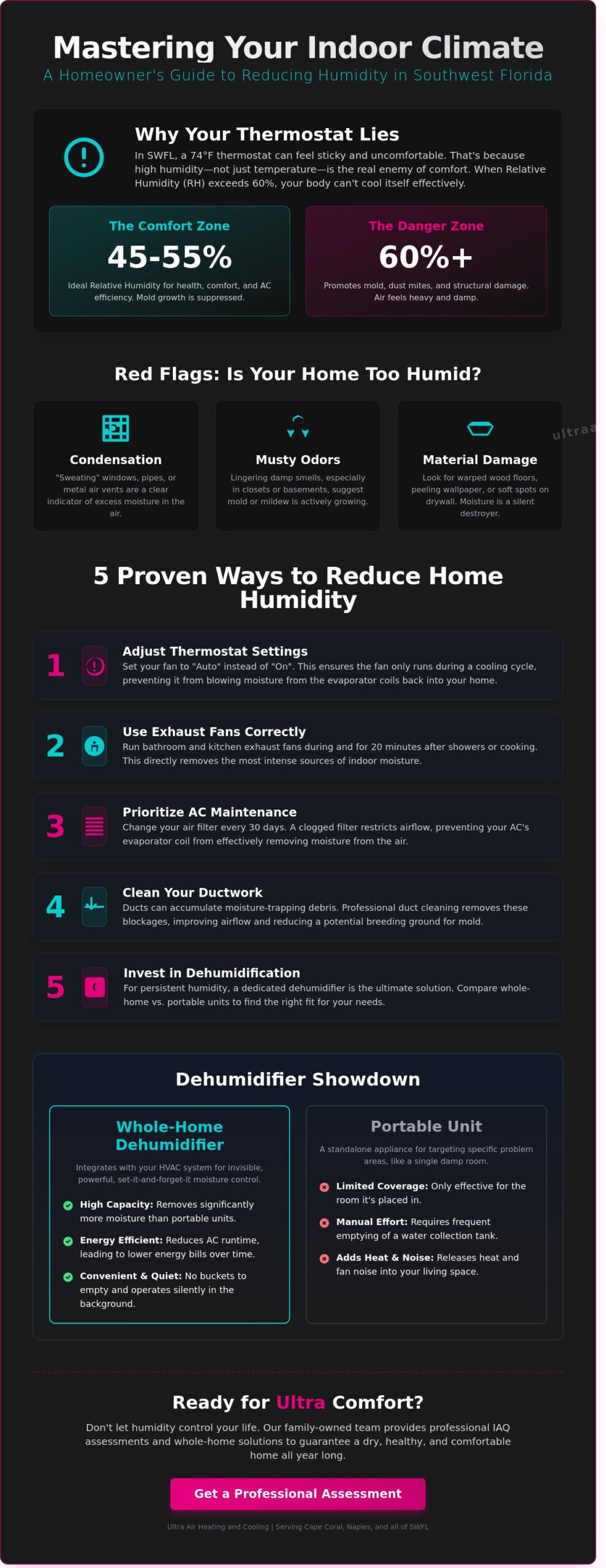
Maintaining your home between 45 percent and 55 percent humidity is the sweet spot for your health and your AC system’s efficiency. You can get an accurate reading today by placing a digital hygrometer in a central living area away from the kitchen or bathroom. The ideal humidity range for Florida homes is a consistent level between 45 and 55 percent to prevent mold growth and maximize cooling efficiency.
Signs Your SWFL Home Has a Moisture Problem
Don’t wait for a mold breakout to take action. If you’re wondering how to reduce humidity in house Florida, first look for these red flags in your home:
- Condensation: Water droplets on window glass or “sweating” metal air vents are clear signs of excess vapor.
- Lingering Odors: Musty, damp smells that persist even after you deep clean your floors or carpets.
- Material Damage: Warped wooden floorboards, soft spots in drywall, or peeling wallpaper in high-end Naples estates.
How Your Air Conditioner Controls Humidity (And Why It Fails)
Your air conditioner does more than just lower the temperature; it acts as a giant dehumidifier for your Southwest Florida home. The process starts at the evaporator coil. As warm, humid air from your Cape Coral living room passes over these freezing cold coils, the moisture “squeezes” out of the air. This is basic physics. The water vapor turns into liquid droplets, much like the sweat on a cold glass of sweet tea. If your system is working correctly, it’s one of the most effective ways to control moisture and maintain a healthy indoor environment.
However, this process relies on consistent airflow. When you have a dirty air filter, it restricts the volume of air reaching the coils. This causes the moisture to stay trapped inside the air handler or, in some cases, causes the coils to freeze over entirely. Learning how to reduce humidity in house Florida often starts with a simple filter change every 30 days. Without that airflow, the water that should be leaving your home stays stuck in your vents.
The Link Between AC Short-Cycling and High Humidity
A common mistake in SWFL is installing a unit that’s too powerful for the square footage. If an AC is oversized, it reaches the target temperature in five minutes and shuts off. This is called short-cycling. Your AC needs to run for at least 10 to 15 minutes to actually pull moisture from the air. If the cycle is too short, the air gets cold, but the humidity remains high, leaving you feeling clammy.
Modern 2026 high-efficiency systems handle this differently. They use variable-speed technology to run longer, slower cycles that prioritize dehumidification. These “Ultra comfort” systems are specifically designed to keep your home dry without the constant stopping and starting of older, single-stage units. If your unit is 25% larger than your home requires, it will never properly manage the Florida dampness.
Why Clogged Drain Lines Trap Moisture Indoors
In the intense heat of Naples, algae and “sludge” grow rapidly in your condensate drain line. This line is responsible for carrying all that “squeezed” water out of your house. When this line clogs, the water has nowhere to go. It backs up into the drain pan and can even force humidity back into your ductwork through evaporation. This creates a cycle of dampness that leads to mold growth in as little as 48 hours.
Regular air conditioning maintenance near me ensures these lines stay clear of biological growth. As a Family Owned & Operated business, we’ve seen how a simple 8-ounce flush of the drain line prevents a major humidity spike. If you’re struggling to beat the heat and the dampness, a professional check is the first step toward restoring your home’s comfort and protecting your indoor air quality.
5 Proven Ways to Reduce Humidity in Your House Today
High indoor moisture levels in Southwest Florida do more than make your skin feel sticky. Excess humidity can lead to mold growth and structural damage if left unchecked. If you want to know how to reduce humidity in house Florida residents often struggle with, start with these five actionable steps. We designed these tips to help you regain control of your indoor climate and achieve Ultra comfort immediately.
- Step 1: Switch your thermostat fan setting from ‘On’ to ‘Auto.’ This is the simplest fix for immediate relief.
- Step 2: Utilize exhaust fans in high-moisture zones. Always run fans in kitchens and bathrooms during and after use.
- Step 3: Seal the ‘Envelope.’ Check weatherstripping around doors and windows, especially in older Cape Coral homes.
- Step 4: Reduce internal moisture sources. Shorten your showers and avoid grouping large clusters of indoor plants together.
- Step 5: Schedule a professional coil cleaning. Clean coils are essential to restore the heat transfer efficiency your system needs to dehumidify properly.
Optimizing Your Thermostat for Moisture Removal
Many homeowners believe leaving the AC fan ‘On’ provides better circulation. In reality, this setting often increases humidity. When the cooling cycle ends, the evaporator coil remains wet. If the fan stays on, it blows that evaporated moisture back into your home before it can drain away. Modern smart thermostats often include a ‘Dehumidification Mode’ that slows the fan speed to pull more moisture from the air. The ‘Auto’ setting stops the fan when the cooling cycle ends to let water drain away, whereas the ‘On’ setting keeps the fan running and blows that trapped moisture right back into your living space.
Sealing the Envelope: Keeping the SWFL Air Out
Your home’s envelope is the barrier between your air-conditioned living space and the sweltering Estero heat. Sliding glass doors are a major culprit for leaks in our region. Maintaining energy-efficient moisture control requires a tight seal between your living space and the humid Florida outdoors. Air leaks in your attic can also trigger the ‘stack effect,’ where heavy, humid air is pulled into your home as cool air escapes through the roof. You can identify these leaks by performing a simple ‘smoke test’ with an incense stick near door frames and window sills. If the smoke wafts horizontally, you have a gap that needs sealing.
Beyond basic DIY fixes, remember that your air conditioner is your primary dehumidifier. According to EPA data, dirty evaporator coils can reduce system efficiency by 21 percent, severely limiting your AC’s ability to remove water vapor. As a family owned and operated business, Ultra Air recommends professional maintenance to ensure your system can beat the heat effectively. We provide the technical mastery needed to keep your home dry and healthy all year long.
Whole-Home Dehumidifiers vs. Portable Units: Which is Best?
Choosing the right equipment depends on your home’s size and your specific comfort goals. If you are researching how to reduce humidity in house Florida properties, you will likely choose between two main options: portable units or integrated whole-home systems. While portables offer a quick fix for a single room, they often fall short in the relentless SWFL climate. Whole-home systems provide a comprehensive solution by treating every cubic foot of air moving through your ducts.
- Capacity: A standard portable unit typically removes 20 to 50 pints of moisture per day. In contrast, professional whole-home systems can extract between 70 and 155 pints daily.
- Energy Efficiency: Whole-home dehumidifiers are designed for high-efficiency operation. They often remove 6.0 to 8.0 pints of water per kilowatt-hour, whereas portables are significantly less efficient and can spike your monthly electric bill.
- Maintenance: Portables require you to manually empty heavy water buckets once or twice a day. Whole-home units use a dedicated drainage line, offering a true “set it and forget it” experience.
When a Portable Dehumidifier Isn’t Enough
Portable units have strict limitations regarding square footage and airflow. Because they are localized, they cannot pull moisture from behind walls or from distant bedrooms. A major drawback is that portables vent warm air back into the room as they work. This heat gain forces your air conditioner to run longer, which can lead to premature wear and a need for ac repair cape coral services. These units are best reserved for small, isolated spaces like a walk-in closet or a laundry room in a Naples condo. For an entire residence, they simply cannot keep up with the 90 percent humidity levels common in Southwest Florida.
The Ultra Comfort of Integrated Dehumidification
Ultra Air specializes in installing whole-home systems that integrate directly with your existing HVAC ductwork. This setup ensures that every room stays at your desired moisture level, usually between 45 and 55 percent. Our technicians calibrate these systems to work in tandem with your air conditioner, which prevents the “over-cooling” often used to combat dampness. This synergy protects your home from mold growth and preserves the integrity of your wood flooring and furniture. We provide the technical mastery needed to ensure your indoor air quality remains high year-round. You get Ultra Comfort without the hassle of moving heavy plastic units from room to room.
Stop fighting the Florida humidity with small fixes. Contact Ultra Air today for a professional whole-home dehumidification consultation.
Professional Solutions for Lasting Comfort in Cape Coral and Naples
Ultra Air takes a technical, data-driven approach to indoor air quality (IAQ). We don’t rely on guesswork. Our team performs comprehensive IAQ assessments to identify exactly where your home is failing to manage moisture. This professional analysis provides the clearest path for homeowners wondering how to reduce humidity in house Florida climates. We analyze airflow patterns and equipment sizing to ensure your system is actually built for the SWFL heat. A system that is too large or too small will never manage humidity correctly, leading to that heavy, damp feeling in your living room.
- Duct Cleaning: Dust and debris in your ventilation act as a sponge. This trapped moisture leads to biological growth and musty odors. Our deep-cleaning process removes these contaminants to ensure your air stays dry and clean. It also reduces the workload on your blower motor, extending the life of your equipment.
- UV Germicidal Lights: We install specialized UV lights directly on your evaporator coils. These lights neutralize mold and bacteria that thrive on damp surfaces. This prevents spores from entering your living space and keeps your coils running efficiently.
- The Ultra Guarantee: As a family owned & operated business, we stand behind our craftsmanship. We focus on technical mastery and honest communication with every neighbor we serve. You get the peace of mind that comes with certified expertise and a commitment to your comfort.
Why Regular Maintenance is Your Best Defense
Preventative checks catch humidity issues before they evolve into costly mold problems. During our Ultra service visits, we pay close attention to refrigerant levels. If your system is low on charge by even 10 percent, it loses its ability to pull moisture from the air effectively. Your house will feel sticky even if the temperature is low. This proactive approach is the most cost-effective way to learn how to reduce humidity in house Florida homes without replacing entire units prematurely. We recommend signing up for a 2026 preventative maintenance plan now to secure your comfort for the coming years.
Contact Ultra Air for a Cool, Dry Home
We provide expert HVAC services across Cape Coral, Naples, Bonita Springs, and Estero. When high humidity leads to a total HVAC failure, you need a fast response. We offer 24/7 emergency support to restore your home’s climate immediately. Our technicians arrive with the tools and parts needed to get the job done right the first time. Our goal is to reduce your anxiety by providing a permanent fix rather than a temporary patch. Don’t let a sticky, uncomfortable house ruin your day. Beat the heat and humidity with Ultra Air and experience the difference of a truly professional, local service.
Take Control of Your Indoor Climate Today
Living in Southwest Florida means battling outdoor humidity levels that frequently exceed 90%. To maintain a healthy environment, the Florida Solar Energy Center recommends keeping indoor relative humidity between 45% and 55%. You now understand that while your AC is a vital tool, it often needs the support of a whole-home dehumidifier to handle the heavy lifting during our tropical summers. Mastering how to reduce humidity in house Florida is the secret to protecting your home from mold and ensuring your family stays comfortable year round.
Ultra Air has served as a Family Owned & Operated business since 2018. Our certified Southwest Florida HVAC experts specialize in localized solutions for Cape Coral and Naples residents. We offer 24/7 emergency AC repair across Lee and Collier County because we know that moisture problems don’t follow a schedule. It’s time to stop guessing and start feeling the difference that professional moisture control provides. You deserve a home that feels like a true sanctuary from the Gulf Coast heat.
Schedule your Ultra Air Humidity Assessment today!
Frequently Asked Questions About Controlling Florida Humidity
What should the ideal humidity be in a Florida house during summer?
You should maintain a relative humidity level between 45% and 55% in your Southwest Florida home. Keeping levels under 60% is critical because mold spores can begin to colonize surfaces within 24 to 48 hours once moisture exceeds that limit. Our Ultra Air experts recommend using a digital hygrometer to monitor these levels daily. This precise range ensures your home remains a comfortable sanctuary while protecting your drywall and flooring from moisture damage.
Can a dirty air filter cause high humidity in my house?
A dirty air filter definitely causes high humidity by restricting the volume of air flowing over your evaporator coil. When airflow drops, the system can’t pull moisture out of the air effectively, leaving your home feeling sticky. We suggest checking your filter every 30 days during the peak SWFL cooling season. Replacing a clogged filter can improve your system’s operating efficiency by 5% to 15% according to Department of Energy statistics.
Why does my house feel humid even though the AC is set to 72 degrees?
Your house feels humid at 72 degrees because your air conditioner is likely “short cycling,” which means it cools the air too fast to remove moisture. This often happens when a system is too powerful for the home’s actual square footage. Learning how to reduce humidity in house Florida settings requires a system that runs long, steady cycles to wring out the water. If your unit only runs for 8 or 10 minutes at a time, the air stays damp.
Is it cheaper to run a dehumidifier or the AC to lower humidity?
It’s generally more cost-effective to use a dedicated dehumidifier to manage moisture than to keep lowering your AC thermostat. A portable dehumidifier typically uses between 280 and 700 watts, while a central AC system can pull over 3,500 watts per hour. By running a dehumidifier, you can often raise your thermostat by 3 degrees and feel just as cool. This strategy reduces the heavy mechanical load on your cooling system during July and August.
How do I know if my AC unit is too big for my home?
You can tell your AC unit is too big if it reaches your thermostat’s target temperature in less than 15 minutes. This rapid cooling prevents the system from completing a full dehumidification cycle, which leaves the indoor air feeling clammy. Our team looks for signs like uneven temperatures between different rooms or frequent on-off cycling. An oversized unit often leads to energy bills that are 20% higher than necessary due to the high power draw of constant startups.
What happens if I don’t fix the high humidity in my Florida home?
Ignoring high humidity leads to mold growth and dust mite infestations within 48 hours of sustained moisture accumulation. Prolonged exposure to humidity levels above 60% can warp wood furniture and cause expensive wallpaper to peel away from the walls. You’ll also likely notice a “musty” odor that permeates your clothing and upholstery. Addressing these issues early with Ultra service protects your family’s health and prevents long-term structural damage to your property.
Does a whole-house dehumidifier use a lot of electricity?
A whole-house dehumidifier is highly efficient and typically costs less to operate than the extra energy your AC would use to fight the same moisture. Most units consume between 500 and 700 watts while running, but they allow your main cooling system to run less frequently throughout the day. This setup can reduce your overall monthly cooling costs by up to 15% because dry air feels cooler at higher temperatures. It’s a smart investment for consistent Ultra comfort.
Can plants really increase the humidity inside my house?
Indoor plants increase humidity through a process called transpiration, where they release 97% of the water they absorb back into the surrounding air. If you have a collection of 10 or more large tropical plants, they can significantly raise the moisture levels in a single room. This is a common factor when homeowners research how to reduce humidity in house Florida environments. We recommend grouping your plants in well-ventilated areas or near exhaust fans to keep the air fresh.