

Professional air balancing typically runs $300–$1,500 for a whole home, with most contractors also quoting $75–$150 per register when pricing by opening. According to Family Handyman, per-opening quotes commonly fall in that $75–$150 range, and whole-home jobs can reach $2,000 on larger or more complex properties. If your home has persistent hot and cold spots, rooms that never seem to cool down no matter how low you set the thermostat, or an HVAC system that runs constantly without evening out temperatures, a professional balance is almost always worth the price. The comfort improvement is immediate, and the reduction in equipment runtime tends to pay back a meaningful portion of the cost over time.
Two pricing models dominate the market:
- Per-opening (per-register): Each supply or return register is measured and adjusted individually. Expect roughly $75–$150 per opening.
- Whole-home or project price: A flat fee covering the full diagnostic, all adjustments, and a written report. Most single-family homes fall between $350 and $1,200, with larger or multi-zone properties pushing higher.
Discovery repairs, such as duct leaks or a failing damper, are priced separately and can add several hundred dollars to the total. Budget for them upfront rather than treating the balancing quote as the final number.
Key Takeaways
Professional air balancing costs $300–$1,500 for most single-family homes, with per-register pricing around $75–$150 and discovery repairs the most common reason final costs run higher than the initial quote.
| Point | Details |
|---|---|
| Typical price range | Whole-home balancing runs $300–$1,500; per-register quotes average $75–$150. |
| Top cost drivers | Number of registers, duct condition, access difficulty, and discovery repairs like duct sealing add the most to the final bill. |
| DIY limits | Cleaning registers and replacing filters are safe; closing multiple registers or adjusting dampers without measuring static pressure risks blower damage. |
| What to ask for | Request a written report with before/after CFM readings and TESP measurements for every job. |
| Ultraairswfl | Provides full diagnostic balancing with written reports and repair services across Naples, Cape Coral, and Fort Myers. |
Table of Contents
- What does air balancing actually do for your home?
- How do you know your home needs air balancing?
- What does a professional balancing visit actually involve?
- How much does air balancing cost, and what drives the price?
- DIY vs. professional: where’s the line?
- How long does a balancing job take, and how should you prepare?
- Ultra Air Heating & Cooling: a real balancing job in Southwest Florida
- When air balancing is the right next step, and when it is not
- Ultraairswfl covers air balancing across Southwest Florida
- Sources
What does air balancing actually do for your home?
Air balancing is the process of measuring and adjusting the volume of conditioned air delivered to each room or zone so that every space receives the cubic feet per minute (CFM) it was designed to get. The goal is not simply to make every room “feel similar.” It is to match actual airflow to the load each room places on the system, which varies by square footage, sun exposure, insulation, and window area.
When airflow is correctly distributed, four things happen:
- Temperatures stabilize across rooms because each space gets the right volume of conditioned air.
- Coil airflow stays within spec, protecting the heat exchanger and refrigerant circuit from strain.
- Equipment runtime drops because the system reaches setpoint faster and holds it without cycling repeatedly.
- Indoor air quality improves because proper pressure relationships between zones reduce infiltration of unconditioned air and allergens.
Industry organizations AABC (Associated Air Balance Council) and NEBB (National Environmental Balancing Bureau) publish standards and quality assurance programs that define how a professional balance should be performed and documented. When a contractor references these standards, it signals they are measuring to a defined target rather than guessing.
Pro Tip: Resist the urge to simply close registers in rooms that feel too cold. Restricting supply airflow without measuring static pressure can push total external static pressure (TESP) above the blower’s rated limit, straining the motor and reducing airflow everywhere. A professional air balancing visit costs far less than a blower replacement.
How do you know your home needs air balancing?
Some symptoms are obvious. Others are easy to misread as equipment failure when the real problem is airflow distribution. Run through this quick self-check before calling anyone.
Common symptoms that point to an imbalance:
- Rooms that are consistently 3°F or more warmer or cooler than the thermostat setting
- Registers with noticeably weak airflow compared to others on the same floor
- The system runs for long cycles but never reaches setpoint in certain rooms
- Unusual whistling or rushing sounds at registers (often a sign of high static pressure)
- Humidity that feels uneven between rooms, especially in Florida’s climate
Quick homeowner diagnostic checklist:
- Set the system to cooling and let it run for 15 minutes.
- Hold a thermometer 6 inches from each supply register and note the readings.
- Check return grilles for blockages, furniture pushed against them, or heavy dust buildup.
- Walk each room and note which feel noticeably warmer or cooler than the thermostat setting.
- Listen for any whistling or rushing sounds at registers when the blower is running.
A temperature spread of more than 3–4°F between rooms, or any register with clearly weaker airflow than its neighbors, strongly predicts a balancing problem. Unusual noises at registers often indicate high static pressure, which can signal duct restrictions or a system that was never properly commissioned. Today’s Homeowner lists hot and cold spots and weak airflow as the most reliable indicators that professional balancing is needed.
For a deeper look at symptoms that point to larger duct or equipment issues, the warning signs of HVAC problems guide covers what to watch for before calling a technician.
What does a professional balancing visit actually involve?
Understanding the process helps you evaluate a quote and know whether a contractor is doing the job properly. A thorough visit follows a defined sequence, not a quick walk-through with a screwdriver.
Step-by-step professional workflow:
- System run-in: The technician runs the system for 15–20 minutes to stabilize temperatures and airflow before taking any measurements.
- Total external static pressure (TESP) test: A dual-port manometer measures supply and return static pressure at the air handler. This single reading tells the technician whether the system is operating within the blower’s rated range.
- Airflow traverses: Using a flow hood or anemometer, the technician measures CFM at every supply and return register, recording actual versus designed airflow.
- Damper tuning: Based on traverse data, the technician adjusts manual or motorized dampers in the ductwork to redirect airflow toward underserved zones.
- Register adjustment: Supply registers are fine-tuned after damper work to distribute airflow within each room.
- Retest: All measurements are repeated after adjustments to confirm the system now delivers target CFM to each zone.
Tools a properly equipped technician brings:
- Flow hood (capture hood): Placed directly over a register to measure CFM precisely.
- Anemometer: Measures air velocity at the register face; CFM is calculated from velocity and register area.
- Dual-port manometer: Measures static pressure at the air handler and across the filter, coil, and duct sections.
- Thermometer or thermal camera: Confirms temperature delivery after airflow adjustments.
ACHR News describes this workflow, including traverses, static pressure testing before and after, and damper tuning, as the accepted professional standard. Contractors affiliated with AABC or NEBB follow documented procedures for each step.
A written report should include a before/after CFM table for every register, TESP readings before and after adjustments, any recommended repairs not completed during the visit, and the technician’s license number. If a contractor cannot produce this report, the work is not verifiable.
| Measurement | Tool Used | What It Tells You |
|---|---|---|
| CFM per register | Flow hood or anemometer | Whether each room receives its designed airflow volume |
| Total external static pressure | Dual-port manometer | Whether the blower is working within its rated operating range |
| Supply/return temperature split | Thermometer | Whether the coil is transferring heat at the correct rate |
| Duct leakage (if tested) | Duct blaster or pressure pan | How much conditioned air is escaping before reaching rooms |
How much does air balancing cost, and what drives the price?
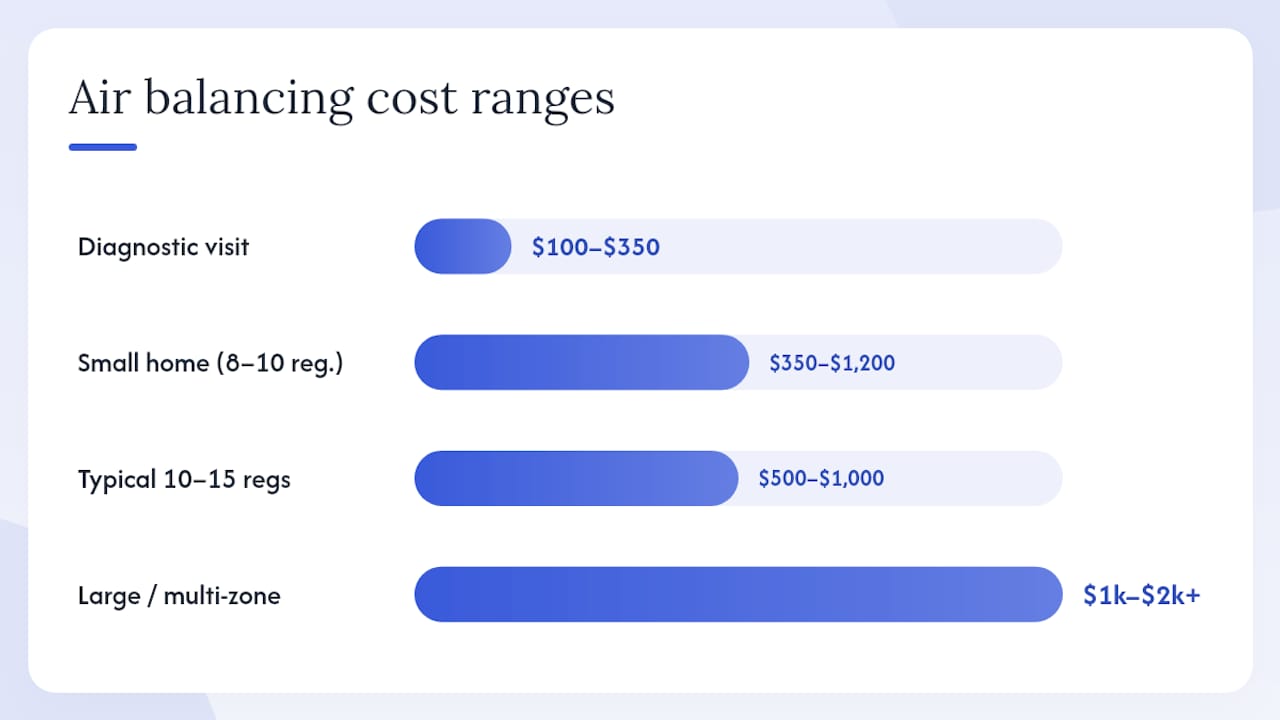
The Current Cost breakdown puts diagnostic visits at $100–$350, with damper adjustments adding $50–$350 per zone. This Old House cites roughly $100 per opening as a widely used trade rule of thumb. Put those together and a typical single-family home with 10–15 registers lands between $500 and $1,000 for a full balance, before any discovery repairs.
Sample budget ranges by job type:
| Job Type | Typical Range | Notes |
|---|---|---|
| Diagnostic visit only | $100–$350 | Measurements and report; no adjustments included |
| Small home (8–10 registers) | $350–$1,200 | Includes adjustments; assumes accessible ducts |
| Average single-family (10–15 registers) | $350–$1,200 | Full balance with written report |
| Large or multi-zone home | $1,000–$2,000+ | Motorized dampers, zoning controller work, or duct repairs |
What pushes the price up:
- Number of registers and zones: More openings mean more measurements and more adjustment time.
- Duct access: Ducts buried in a slab or inaccessible attic spaces add labor hours.
- Duct condition: Leaking, collapsed, or undersized ducts require sealing or replacement before balancing can hold. Duct sealing alone commonly adds $300–$1,000 to a job.
- Motorized dampers or zoning systems: Installing or reprogramming zone controllers adds parts and programming time.
- System sizing errors: A significantly oversized or undersized system may need a Manual J load calculation before balancing can be targeted correctly.
- Discovery repairs: Blower issues, failed damper actuators, or collapsed duct sections found during the visit are priced separately.
Budget a contingency of $300–$500 for discovery repairs on any home older than 10 years. Duct problems are the most common reason a balancing quote grows after the technician opens the system.
Pro Tip: Ask for a separate line item for the diagnostic fee versus the adjustment work. This helps clarify what portion of your payment covers measurements compared to labor.
DIY vs. professional: where’s the line?
There are a few things you can safely do yourself, and several things that will make the problem worse if you try them without measurement tools.
Safe DIY steps:
- Clean supply and return registers with a vacuum and damp cloth.
- Remove furniture, rugs, or curtains blocking return grilles.
- Replace the air filter if it has not been changed in the past 30–60 days.
- Slightly adjust register louvers in a room that is marginally warmer than others, then wait 24 hours to assess the effect.
Actions to avoid without measurement tools:
- Closing more than one or two registers at a time. Each closed register raises static pressure across the whole system.
- Forcing a manual damper in the ductwork without measuring TESP before and after. You can push the blower past its rated static pressure limit.
- Adjusting blower speed at the air handler without testing. Increasing speed raises airflow but also raises static pressure, which can trip a high-limit switch or overheat the motor.
- Sealing registers with tape as a “fix” for a room that gets too much air. This is a common mistake that creates backpressure and uneven humidity.
Lifehacker notes that unbalanced systems increase equipment runtime and energy use, and that professional balancing is the right call when simple DIY steps do not resolve uneven temperatures. This Old House is direct about the risk: improper vent manipulation creates backpressure and strains the blower.
Call a professional when you have persistent hot or cold spots after a filter change and basic register cleaning, when you can feel a clear difference in airflow between registers, when TESP is unknown and the system is running long cycles, or when duct sealing or blower work is suspected. For a practical walkthrough of homeowner-level airflow checks before calling a pro, the airflow balancing guide covers each step in detail.
Safety note: Never attempt to adjust ductwork dampers, blower speed settings, or refrigerant-side components without a licensed HVAC technician. Improper work can void equipment warranties and create safety hazards.
How long does a balancing job take, and how should you prepare?
Typical timelines:
- Diagnostic-only visit: 1–2 hours. The technician measures every register and produces a report with recommendations.
- Full balance with minor adjustments: 2–4 hours for a standard single-family home.
- Multi-zone or discovery-repair job: 4–8 hours or a return visit if parts are needed.
Homeowner prep checklist:
- Clear a 3-foot path around every supply and return register before the technician arrives.
- Unlock or provide access to the attic, mechanical closet, and any crawl space where ductwork runs.
- Write down which rooms feel too hot, too cold, or have noticeably weak airflow. The technician will start measurements there.
- Pull together recent utility bills if you have them. A spike in runtime costs can help the technician quantify the efficiency gain after balancing.
- Make sure the system has a clean filter installed. A clogged filter skews static pressure readings and can make a well-balanced system look like it has a duct problem.
In Southwest Florida, HVAC contractors are busiest from April through September. Scheduling a balancing visit in late fall or winter typically means shorter lead times and, in some cases, slightly better pricing. If your system is due for a maintenance tune-up, bundling it with a balancing visit saves a service call fee.
Ultra Air Heating & Cooling: a real balancing job in Southwest Florida
Here is a representative example of what a professional balance looks like in practice, drawn from the type of work Ultraairswfl performs regularly in the Naples and Cape Coral area.
Project overview:
A 1,850-square-foot single-story home in Cape Coral with a 3-ton split system. The homeowner reported that the master bedroom and a rear guest room were consistently 5–7°F warmer than the living area, even with the thermostat set to 74°F. The system was running nearly continuously during afternoon hours.
Diagnostic findings:
- TESP measured at 0.82 in. w.g., well above the air handler’s rated 0.50 in. w.g. maximum.
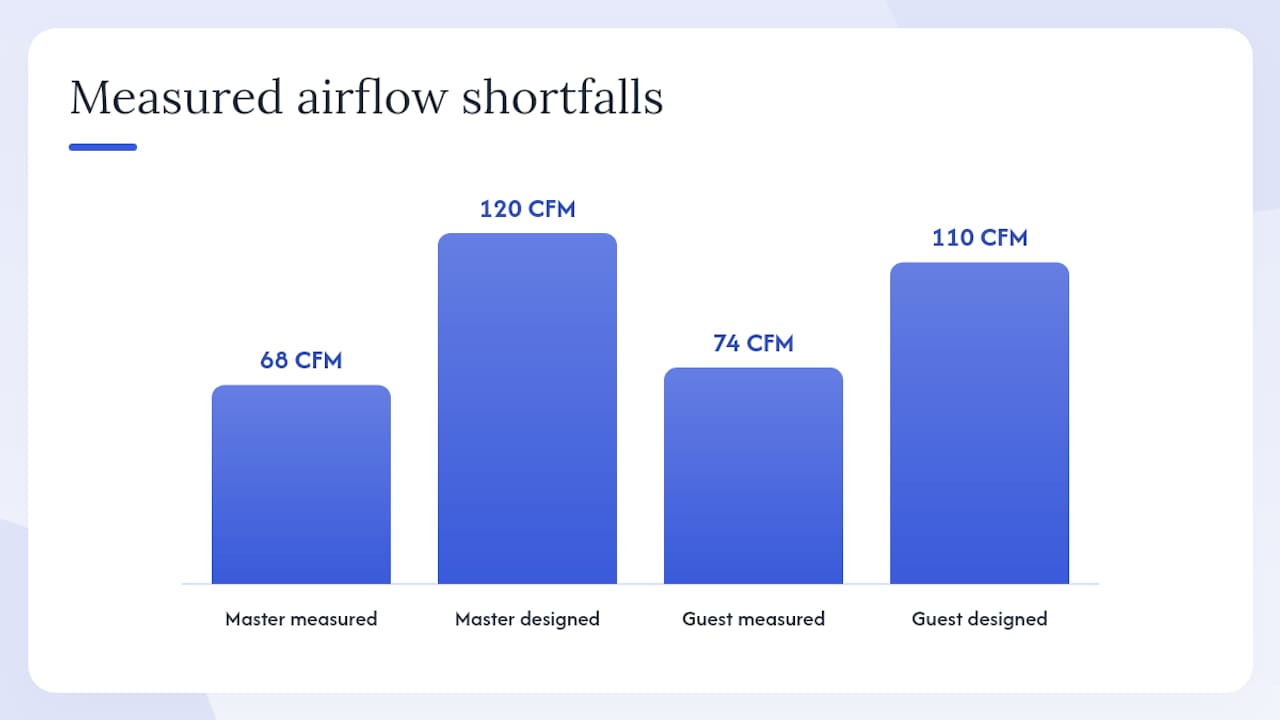
- Master bedroom supply register: 68 CFM measured versus 120 CFM designed.
- Guest room supply register: 74 CFM measured versus 110 CFM designed.
- Two supply duct connections in the attic showed visible gaps at the flex duct collars, leaking conditioned air into the attic space.
Corrective actions:
- Sealed both leaking flex duct collar connections with mastic and foil tape.
- Adjusted three manual dampers in the main trunk to redirect airflow toward the rear of the home.
- Fine-tuned register louvers in the living area to reduce oversupply.
Before/after results:
Cost and time summary: The diagnostic and full balance took approximately 3.5 hours. The duct sealing added about 45 minutes and modest materials cost. Total job cost fell in the $650–$800 range, consistent with the mid-range estimates for a home of this size. Discovery repairs, in this case the duct leaks, were identified during the diagnostic and quoted before work began.
Ultraairswfl serves Naples, Cape Coral, Fort Myers, and surrounding Southwest Florida communities. For homes with uneven cooling that has persisted through multiple seasons, a documented balance like this one is typically the fastest path to a comfortable home. Note that actual results vary by home size, duct condition, and system age; the figures above are illustrative of a typical mid-complexity job.
When air balancing is the right next step, and when it is not
Air balancing makes the most sense when the system itself is correctly sized and in reasonable mechanical condition, but airflow distribution is the bottleneck. If your home has moderate hot and cold spots, the system runs longer than it should but has no refrigerant or mechanical failures, or you have recently made layout changes such as added walls, new flooring, or insulation upgrades, balancing is the logical first move. Attic insulation improvements, in particular, can shift thermal loads enough to require a re-balance; attic insulation upgrades are one of the most common triggers for a follow-up balancing visit.
Balancing is not the right first investment when the system is severely undersized for the home’s actual load, when ductwork has major structural failures like collapsed sections, or when the equipment is at end of life and replacement is already overdue. Spending $800 on a balance for a system that needs replacement in 12 months is money that would be better applied toward the new installation.
For property managers, the most practical approach is to bundle air balancing with the annual maintenance visit. A technician already on-site can take baseline CFM readings at minimal added cost, flag any zones drifting out of spec, and document the results. That written report also has real value at lease renewal or sale: a documented, balanced system signals that the property has been maintained to a measurable standard, not just serviced when something breaks.
Ultraairswfl covers air balancing across Southwest Florida
Comfort problems that linger through season after season usually have a measurable cause, and Ultraairswfl finds it. Every balancing visit includes a full diagnostic with CFM measurements at each register, TESP testing at the air handler, a written before/after report, and clear recommendations for any repairs the diagnostic uncovers. No guesswork, no “let’s try adjusting a few vents and see what happens.”
Ultraairswfl serves Naples, Cape Coral, Fort Myers, and the surrounding Southwest Florida area. If balancing reveals a deeper issue, such as duct leaks, a blower problem, or a system that needs a retrofit, the same team handles it without a second contractor. For older homes where HVAC efficiency is already a concern, a balancing visit is often the fastest way to quantify what is being lost before committing to a larger upgrade. Request a quote or book an inspection at Ultraairswfl.
Sources
The price ranges and technical methods in this article draw from the following sources. Each one is worth bookmarking if you want to verify figures or dig deeper into the methodology.
- What Is HVAC Balancing? Improve Airflow & Efficiency
- Air Balancing: What it is and How it’s Done – This Old House
- Cost to Balance HVAC System: Price Ranges for Ductwork, Zoning, and Dampers 2026 – Current Cost
- Air balancing: achieving harmony in an HVAC system (ACHR News)
- How to Balance Your HVAC System | Lifehacker
- HVAC Balancing: What It Is, How It Works, and When You Need It (Today’s Homeowner)