
A furnace filter is the flat media panel installed in your HVAC system’s return-air path that traps airborne particles before they reach the blower motor, heat exchanger, and evaporator coil. It sits between the air coming back from your home and the sensitive internal components that would otherwise collect dust, pollen, and debris with every cycle.
TL;DR:
- A furnace filter’s primary job is equipment protection, not air purification.
- It does improve indoor air quality as a secondary benefit, but it is not a whole-house air cleaner.
- Inspect it monthly. Replace it based on condition, not just the calendar.
- Match the MERV rating to what your blower can actually handle.
- HVAC filtration systems are one piece of a larger indoor air quality strategy.
Table of Contents
- Why does a furnace filter matter for your HVAC system and home air?
- Where is the furnace filter located, and how do you find the right size?
- What types of furnace filters will you find at the store?
- What do MERV ratings mean, and how do you pick the right one?
- How do you choose the right furnace filter for your home?
- How often should you replace a furnace filter, and what does it cost?
- How do you replace a furnace filter safely, step by step?
- What are the signs your filter needs replacing, and what happens if you ignore it?
- How should you dispose of used furnace filters?
- Common misconceptions about furnace filters and their effectiveness
- Key Takeaways
- The filter is maintenance, not magic
- Ultra Air Heating & Cooling can handle your filter upgrade the right way
- Authoritative sources and further reading
Why does a furnace filter matter for your HVAC system and home air?
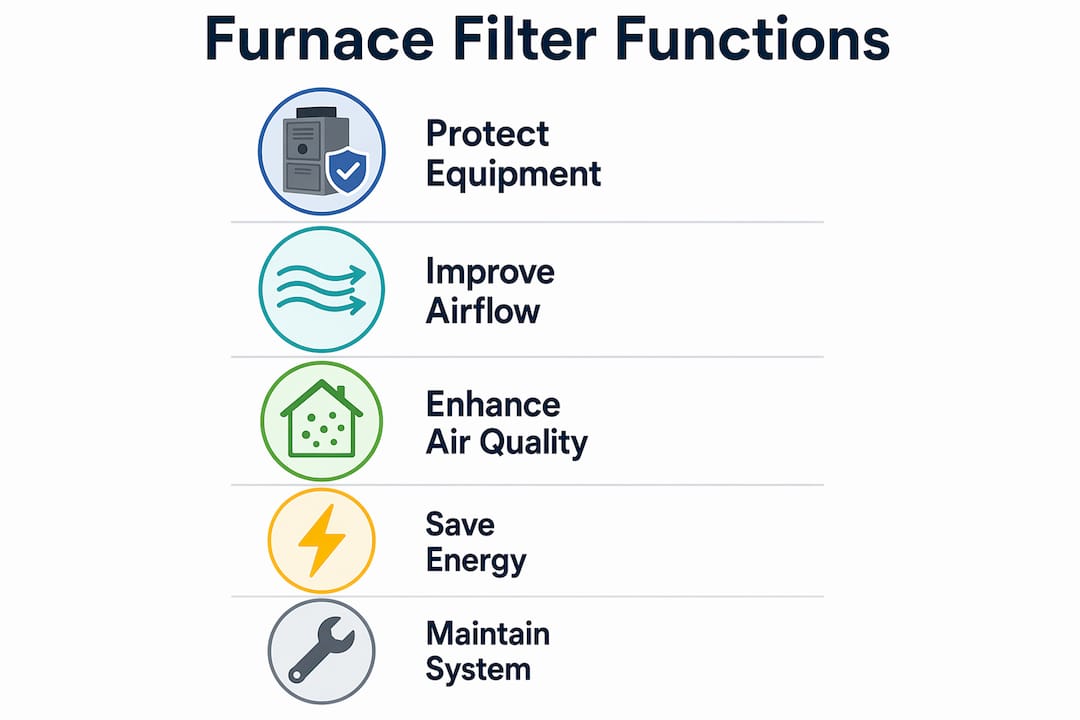
The filter’s first job is protecting your equipment. Everything else is secondary. When air returns through your ducts, it carries fine particles that would coat the blower wheel, clog the evaporator coil, and gradually choke the heat exchanger if nothing stopped them. The filter is that stop.
A clogged filter restricts airflow, which raises static pressure inside the system. The blower motor works harder to pull the same volume of air, drawing more electricity and generating more heat. In cooling season, restricted airflow across the evaporator coil can cause it to freeze solid, which shuts down your AC entirely. Over time, that sustained stress shortens the life of the blower motor and can crack a heat exchanger.
The air-quality benefit is real but limited. The EPA acknowledges that central HVAC filtration reduces indoor particle levels, but it works best as a supplement to source control and ventilation, not a replacement for them. If someone in your home has severe asthma or allergies, a standard furnace filter alone will not solve the problem.
Pro Tip: Don’t wait for your calendar reminder. If your energy bills tick up or certain rooms feel stuffy, pull the filter and look at it. A gray, matted surface tells you more than any schedule.
Where is the furnace filter located, and how do you find the right size?
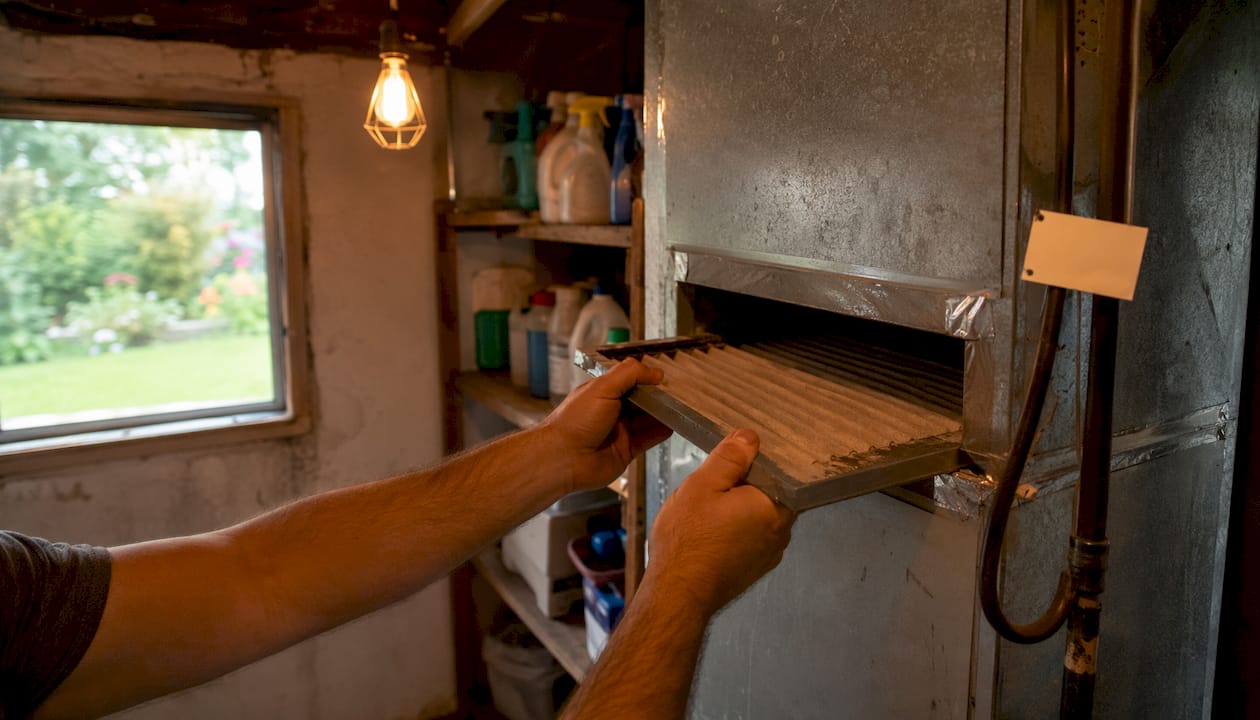
Most residential systems use a single filter, typically located either at the main return-air grille on a wall or ceiling, or in a dedicated slot at the air handler or furnace cabinet itself. Knowing which layout you have before you buy a replacement saves a wasted trip.
Here is how to locate and measure yours:
- Turn off the HVAC system at the thermostat before opening any cabinet panel. If you are accessing the furnace cabinet directly, switch off the power at the disconnect or breaker.
- Check the return-air grille first. Look for a large louvered grille on a wall or ceiling, usually in a hallway or central room. If it has a latch or hinges, the filter slides in behind it.
- Check the furnace or air handler cabinet. If there is no filter at the grille, look for a slot on the side or bottom of the unit where the return duct connects.
- Slide out the existing filter carefully. Note which direction the airflow arrow points before you remove it.
- Measure width × height × thickness. A common size is 16×20×1, but sizes vary widely. Write the dimensions on a piece of tape and stick it to the unit so you never have to guess again.
- Confirm the airflow direction. The arrow printed on the filter frame must point toward the furnace or air handler, not back toward the return duct.
Pro Tip: Photograph the old filter in place before removing it. You will have the size, the arrow direction, and the brand all in one image on your phone.
What types of furnace filters will you find at the store?
The five types you will encounter are fiberglass, pleated disposable, washable/reusable, 4-inch media, and high-efficiency electrostatic or HEPA-style filters. Most household filters are disposable pleated or fiberglass media in 1-inch configurations, though some systems use 4-inch media cabinets for deeper, longer-lasting filtration.
Here is what each type actually means for you:
- Fiberglass (1-inch): The cheapest option, typically a few dollars per filter. Captures large particles like lint and dust bunnies but misses most fine particles. Good for equipment protection in a pinch; not meaningful for air quality.
- Pleated disposable (1-inch, MERV 7–13): The standard choice for most homes. The accordion-style media has far more surface area than fiberglass, capturing pollen, mold spores, and fine dust. Costs more per filter but delivers a real balance of protection and air quality. Replace every 1–3 months depending on conditions.
- 4-inch media filters: Require a dedicated cabinet installed in the return-air path. The extra depth means dramatically more surface area and a longer service life, often 6–12 months. If your system has a media cabinet, this is usually the best option. If it does not, you cannot simply swap in a 4-inch filter.
- Washable/reusable filters: Marketed as eco-friendly and cost-saving over time. In practice, they often carry lower MERV ratings than pleated disposables and must be completely dry before reinstallation. A damp filter in a warm air handler is a mold risk. Check your manufacturer’s documentation before using one, and never reinstall it wet.
- High-efficiency electrostatic or HEPA-style: These capture the smallest particles, including some bacteria and fine smoke. HEPA filters can capture up to 99.97% of particles as small as 0.3 microns, which is genuinely impressive. The catch: most standard residential blowers cannot move enough air through that level of resistance without modification. Professional installation and a blower capacity check are required.
For households with pets or allergy concerns, a Florida-specific filter guide can help narrow the choice based on local conditions.
What do MERV ratings mean, and how do you pick the right one?
MERV stands for Minimum Efficiency Reporting Value, the industry-standard metric for how well a filter captures particles of different sizes. Higher MERV means finer filtration. It also means higher airflow resistance, which is the tradeoff every homeowner needs to understand before upgrading.

| MERV Range | Typical Particle Capture | Common Residential Use Case |
|---|---|---|
| 1–4 | Large particles: lint, dust, carpet fibers | Basic equipment protection only |
| 5–8 | Mold spores, dust mites, pet dander | Standard residential filtration |
| 9–12 | Fine dust, auto emissions, Legionella | Homes with pets, mild allergies |
| 13–16 | Bacteria, smoke, fine particles | High-IAQ homes, allergy/asthma households |
The EPA recommends aiming for MERV 13 or higher for removing smaller particles, provided the system can accommodate it. That last clause matters enormously. A MERV 13 filter in a system designed for MERV 8 can restrict airflow enough to freeze coils, overheat the blower, and drive up energy costs.
How to check compatibility: look up your air handler’s model number and find the manufacturer’s maximum static pressure rating. A technician can measure actual static pressure with a manometer during a service visit. If your system cannot handle MERV 13 in a 1-inch slot, a 4-inch media cabinet is often the right upgrade path. For Southwest Florida homeowners, a MERV rating guide for Florida allergies covers local humidity and pollen considerations in detail.
How do you choose the right furnace filter for your home?
Pick the highest-efficiency filter your system can reliably handle, then factor in replacement frequency and your household’s specific air-quality needs. Here is a practical checklist:
- Confirm your filter slot thickness before buying anything. A 4-inch filter will not fit a 1-inch slot.
- Check MERV compatibility. If you do not know your blower’s static pressure limit, start at MERV 8–11 and ask a technician before going higher.
- Account for pets and allergies. One dog or cat typically warrants MERV 8–11 at minimum. Severe allergies or asthma may justify MERV 13 with a system check first. The role of HVAC in allergy relief explains when filtration upgrades make a measurable difference.
- Factor in replacement cost and cadence. A MERV 13 pleated filter costs more per unit and may need replacing more often. Budget accordingly.
- Consider a dedicated air cleaner for serious health needs. Central filtration helps, but portable air cleaners and central filters each have limits. If someone in your home has a diagnosed respiratory condition, a standalone air purifier or UV system may be a better investment than pushing your furnace filter to its limit.
- Ask a technician these questions before upgrading: Can my blower handle MERV 13? Do I have a media cabinet, or can one be installed? Is my duct system sealed well enough for higher-efficiency filtration to matter?
How often should you replace a furnace filter, and what does it cost?
The standard rule of thumb is to replace 1-inch pleated filters every few months and 4-inch media filters less frequently, depending on conditions. But that range is wide for a reason. A single-occupant home with no pets and low HVAC runtime might stretch a pleated filter to 90 days without issue. A household with two dogs, a smoker, and the AC running around the clock in a Florida summer may need a new filter every three to four weeks.
Factors that shorten filter life significantly:
- Pets (especially heavy shedders)
- Nearby construction or renovation work, which is a good reason to change filters more frequently during home projects
- High HVAC runtime (common in Southwest Florida’s long cooling season)
- Smokers in the household
- Recent duct cleaning that dislodged accumulated debris
Rough price ranges by filter type:
Economy fiberglass (1-inch): roughly $1–$5 per filter. Standard pleated (1-inch, MERV 8–11): roughly $8–$20 per filter. Premium pleated (1-inch, MERV 13): roughly $15–$30 per filter. 4-inch media filters: roughly $20–$50 per filter, with less-frequent replacement.
These are broad market ranges, not brand-specific prices. Buying in multi-packs typically reduces the per-unit cost.
The most reliable replacement trigger is visual inspection, not the calendar. Pull the filter monthly, hold it up to a light source, and look at the media. A lightly gray filter still has life. A dark, matted surface with visible debris means it is time, regardless of when you last changed it.
How do you replace a furnace filter safely, step by step?
Turn off the HVAC system, remove the old filter, note the airflow arrow direction, insert the new filter with the arrow pointing toward the furnace or air handler, and restore power. That is the whole job. Here is the safe, complete sequence:
- Set the thermostat to “off” or switch the system off at the disconnect. Never change a filter while the blower is running.
- Locate the filter slot at the return grille or furnace cabinet (see the location section above if you are unsure).
- Open the grille or access panel. Most return grilles unlatch or unscrew. Furnace cabinet panels often slide or clip off.
- Slide out the old filter slowly. It will likely be dusty. Have a trash bag ready to drop it in immediately.
- Inspect the old filter. Note how dirty it is and whether it was seated correctly. A filter that was installed backward or had gaps around the edges means unfiltered air bypassed it entirely.
- Check the new filter’s airflow arrow. The arrow must point toward the furnace or air handler, in the direction of airflow, not back toward the return duct.
- Slide the new filter in firmly. It should fit snugly with no visible gaps at the edges. Gaps let unfiltered air bypass the media.
- Close and latch the panel or grille.
- Restore power and set the thermostat.
- Record the replacement date. Write it on the filter frame with a marker, or set a phone reminder.
Pro Tip: Stick a piece of masking tape on the side of the furnace cabinet and write the filter size, MERV rating, and last replacement date on it. Future you will be grateful.
For a detailed visual walkthrough, the step-by-step air filter check guide covers the full process with SWFL-specific context.
What are the signs your filter needs replacing, and what happens if you ignore it?
The most reliable warning signs are reduced airflow from vents, uneven temperatures between rooms, rising energy bills without a change in usage, visible dust accumulation on supply vents, and the furnace or AC cycling on and off more frequently than usual. Any one of these is worth a filter check before calling for service.
Ignoring a clogged filter sets off a predictable chain of problems. Restricted airflow forces the blower motor to work harder, drawing more current and generating excess heat. In cooling mode, reduced airflow across the evaporator coil causes it to drop below freezing, forming ice that eventually blocks airflow entirely. A frozen coil means no cooling and potential water damage when it thaws. On the heating side, a heat exchanger that cannot shed heat properly runs hotter than designed, which accelerates metal fatigue and can eventually cause cracks. A cracked heat exchanger is a carbon monoxide risk and typically means replacing the furnace.
Blower motor strain from a chronically clogged filter is one of the most common causes of preventable HVAC repair calls. The filter costs a few dollars. The blower motor does not.
If you notice any of the warning signs above, swap in a fresh filter immediately. If airflow does not improve within a cycle or two, or if the system is making unusual noises, reduce the thermostat setpoint to lower the load and contact a licensed technician. Do not run a system you suspect has a frozen coil or a damaged blower.
How should you dispose of used furnace filters?
Most disposable furnace filters, including fiberglass and pleated media, go in the regular household trash. Seal the used filter in a plastic bag before tossing it to keep the trapped dust, pollen, and debris from re-entering your home’s air during disposal.
A few considerations worth knowing:
- Fiberglass filters contain glass fibers that can irritate skin and lungs. Handle them with gloves and avoid shaking them out.
- Pleated filters are typically a mix of polyester or cotton media bonded to a cardboard frame. Neither component is easily recyclable through standard curbside programs. Some specialty recycling programs accept them, but they are not widely available.
- Washable filters reduce landfill waste over time, which is their genuine environmental advantage. The tradeoff is the filtration performance and mold risk discussed earlier.
- 4-inch media filters produce more material per disposal event but need replacing far less often, so the net waste over a year is comparable to monthly 1-inch filter changes.
There is no EPA-mandated special disposal process for standard residential furnace filters unless the filter has been used in a setting with known hazardous contaminants. For typical household use, bagged trash disposal is the accepted method.
Common misconceptions about furnace filters and their effectiveness
“A thicker filter always means better protection.” Not exactly. A thicker filter has more media, which can mean better filtration and longer life, but only if your system has the blower capacity to pull air through it. A 4-inch MERV 11 filter in a system designed for 1-inch filters can restrict airflow more than a 1-inch MERV 8 filter would. Thickness and efficiency both matter, but so does system compatibility.
“A higher MERV rating is always better for your home.” This is the most common mistake homeowners make when upgrading filters. MERV 13 captures more particles than MERV 8, but if your blower cannot overcome the added resistance, you end up with poor airflow, higher energy bills, and accelerated wear on the motor. Better filtration at the cost of system health is not a good trade.
“Washable filters save money and are just as effective.” Washable filters do reduce ongoing filter costs, but most carry lower MERV ratings than comparable pleated disposables. They also require thorough drying before reinstallation, which many homeowners skip. A damp filter installed in a warm air handler creates conditions for mold growth inside the system.
“The furnace filter cleans all the air in your home.” The filter only treats air that passes through the return-air system. Air in rooms with closed doors, near-floor air in rooms with ceiling returns, and air in areas with poor duct coverage may circulate without ever passing through the filter. Treat the furnace filter as equipment maintenance that also helps air quality, not as a substitute for dedicated air-cleaning devices when health needs require them.
“One filter per system is always enough.” It is, as long as it is the right filter in the right place. Adding a second filter at a return grille when a primary filter already exists at the furnace creates unnecessary resistance and reduces efficiency. Verify your system layout before adding any additional filtration media.
Key Takeaways
A furnace filter’s primary job is protecting your HVAC equipment, and matching the MERV rating to your system’s actual capacity is the single most important decision you will make about it.
| Point | Details |
|---|---|
| Equipment protection first | The filter’s primary function is keeping blower, coil, and heat exchanger clean, not purifying air. |
| Inspect monthly, replace by condition | Visual inspection beats calendar rules; replace when the media is dark and matted. |
| Match MERV to blower capacity | Higher MERV improves filtration but raises static pressure; confirm compatibility before upgrading. |
| Typical replacement intervals | 1–3 months for 1-inch pleated filters; 6–12 months for 4-inch media filters, adjusted for pets and runtime. |
| Ultraairswfl for upgrades and checks | Ultra Air Heating & Cooling offers blower capacity assessments and media cabinet installation for Southwest Florida homeowners. |
The filter is maintenance, not magic
Most homeowners buy the cheapest filter they can find or the most expensive one on the shelf, and neither approach is quite right. The cheap fiberglass filter protects equipment at a basic level but does almost nothing for air quality. The premium MERV 16 filter looks impressive on the package but can quietly strangle a blower motor that was never designed to pull air through that much resistance.
The honest framing is this: treat the furnace filter the way you treat an oil filter in a car. Its job is to keep contaminants out of the machinery. Done well, it extends equipment life, keeps energy costs reasonable, and provides a modest but real improvement in the air you breathe. Done poorly, or ignored entirely, it becomes the single most preventable cause of HVAC repair calls.
The homeowners who get the most out of their systems are the ones who check the filter when something feels off, not just when the calendar says to. They match the MERV rating to what their blower can actually handle. And when they want to go beyond basic filtration, they call a technician to assess whether the system can support the upgrade rather than guessing.
Ultra Air Heating & Cooling can handle your filter upgrade the right way
Knowing what filter to buy is one thing. Knowing whether your system can actually handle it is another. Ultraairswfl offers filter-compatibility checks, blower capacity assessments, and professional installation of 4-inch media cabinets for Southwest Florida homeowners who want better filtration without risking their equipment.
If your system has been running on the wrong filter size, or if you have been putting off a MERV upgrade because you are not sure the blower can take it, that is exactly the kind of diagnostic Ultraairswfl handles in a single visit. Property managers with multiple units benefit from a scheduled maintenance plan that tracks filter replacement across properties and flags systems showing early signs of airflow restriction.
For homeowners dealing with allergy complaints or indoor air quality concerns, Ultraairswfl can also assess whether a dedicated air-purification upgrade makes more sense than pushing the furnace filter harder. Explore heating solutions and IAQ services or get a local repair and assessment in Naples, Cape Coral, or Fort Myers. Book a diagnostic visit today and get a straight answer about what your system can actually handle.
Authoritative sources and further reading
The claims in this article draw on guidance from the U.S. Environmental Protection Agency, the U.S. Department of Energy, and established HVAC industry resources. For deeper reading or to verify specific points, the following sources are worth bookmarking:
“Portable air cleaners and central furnace/HVAC filters can both reduce indoor particle levels; longer run times increase total filtration, but longer HVAC run times can raise energy costs and affect humidity control.” — U.S. Environmental Protection Agency, Guide to Air Cleaners in the Home
- U.S. EPA, Guide to Air Cleaners in the Home: The primary federal reference for indoor air quality, MERV guidance, and the limits of central filtration. epa.gov
- U.S. Department of Energy, Maintaining Your Air Conditioner: Practical guidance on filter maintenance as part of overall AC system care. energy.gov
- Bryant, Furnace Filters: Types, MERV Ratings & Replacement Guide: A manufacturer-level overview of filter types and MERV selection for residential systems. bryant.com
- Filterbuy, Types of Furnace and HVAC Air Filters: A practical breakdown of filter types with homeowner-focused pros and cons. filterbuy.com
For system-capacity questions, the EPA and the Department of Energy both recommend consulting a licensed HVAC technician rather than relying on filter packaging alone. A technician can measure actual static pressure and confirm whether your blower can support a higher-MERV or thicker filter before you commit to the upgrade.