
Variable refrigerant flow (VRF) is an HVAC technology that modulates refrigerant delivery from one or more outdoor units to multiple indoor zones, giving each zone exactly the conditioning it needs at any given moment. Rather than blasting a fixed amount of cooled or heated air through the whole building, a VRF system reads each zone’s demand and adjusts refrigerant flow in real time. The result is precise comfort, far less energy waste at partial loads, and, in heat-recovery configurations, the ability to heat one room while cooling another simultaneously. Daikin introduced the concept under the trademark VRV (Variable Refrigerant Volume) in 1982; the industry now uses VRF and VRV interchangeably since the underlying technology is identical. Independent researchers at Slipstream and the U.S. General Services Administration have both studied VRF performance in real buildings, and the findings consistently show meaningful efficiency gains over conventional systems. Ultraairswfl installs and services VRF systems across Southwest Florida, including Naples, Cape Coral, and Fort Myers.
Key facts at a glance:
- VRF varies refrigerant flow to match zone demand rather than running at fixed capacity.
- An inverter-driven compressor is the core enabling technology.
- Heat-recovery configurations allow simultaneous heating and cooling between zones.
- Industry summaries report energy savings of roughly 25%–55% versus conventional unitary or chiller-based systems.
- VRF suits hotels, offices, multi-family buildings, and retrofits where ductwork is limited.
Table of Contents
- How variable refrigerant flow systems actually work
- What are the main components of a VRF system?
- What types of VRF configurations are available?
- Why do building owners choose VRF?
- Where VRF can fall short
- Where VRF makes the most sense
- What energy performance should you realistically expect?
- What drives VRF installation costs?
- Real-world field notes on VRF performance
- How to decide if VRF is right for your building
- Routine maintenance and common troubleshooting
- Key Takeaways
- A practical perspective on VRF
- VRF installation and service in Southwest Florida
- Useful sources for further reading
How variable refrigerant flow systems actually work
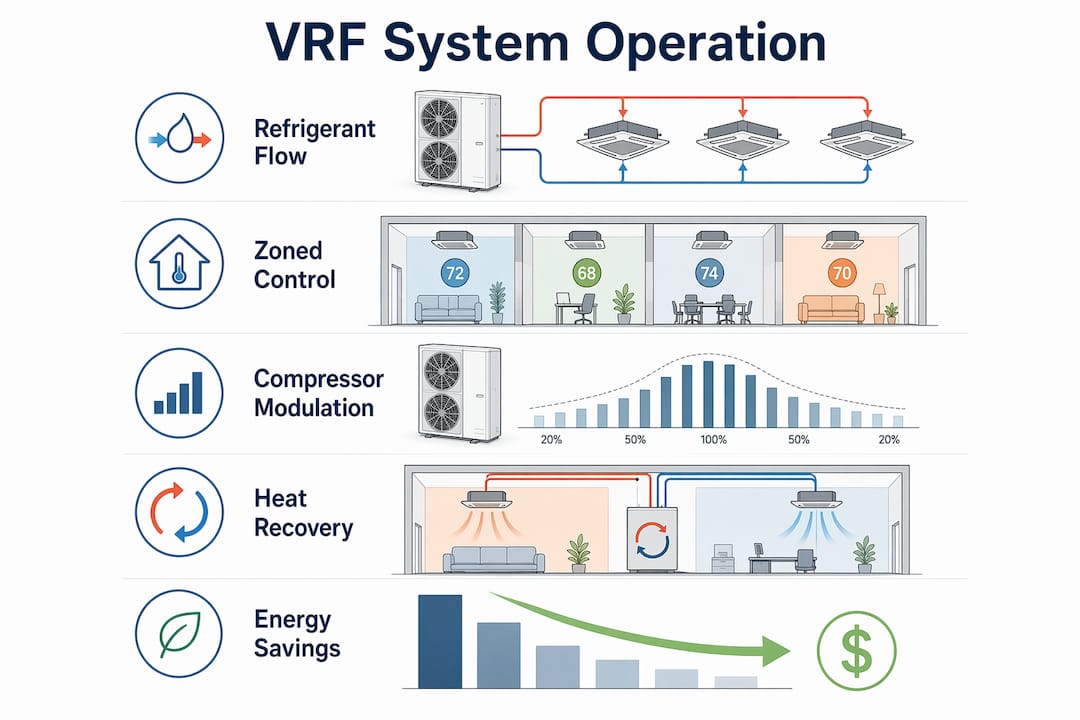
The inverter-driven compressor is the system’s engine. Unlike a conventional compressor that cycles fully on or fully off, an inverter compressor ramps its motor speed up or down continuously to match the aggregate cooling or heating demand across all connected zones. That continuous modulation eliminates the energy spike of repeated start-up cycles and keeps the system running at its most efficient point most of the time.
“The compressor’s inverter allows continuous speed modulation rather than simple on/off operation, reducing cycling losses and enabling proportional refrigerant delivery to match load.” — Daikin and Mitsubishi Electric manufacturer documentation
Refrigerant travels from the outdoor condensing unit through insulated copper lines to each indoor evaporator. At each indoor unit, an electronic expansion valve (EEV) meters refrigerant flow based on signals from the zone’s thermostat and sensors. Branch selector units, used in heat-recovery systems, act as traffic directors: they can route refrigerant in either direction so one zone receives hot gas while another receives liquid refrigerant for cooling. The outdoor unit’s controls read all zone demands simultaneously and set compressor speed accordingly.
A single outdoor unit can connect to up to 50 indoor units, depending on the manufacturer and system capacity. That topology is what makes VRF practical for large, multi-zone buildings without a central air-handling unit and extensive ductwork.
Two-pipe heat-pump systems move refrigerant in one direction at a time: the whole system is either in heating or cooling mode. Three-pipe heat-recovery systems add a dedicated hot-gas line so individual zones can independently call for heating or cooling at the same moment. The control system integrates zone thermostats, occupancy sensors, and often a building management system (BMS) to orchestrate everything automatically.
What are the main components of a VRF system?
Understanding the hardware makes it much easier to read a specification sheet or have a productive conversation with a contractor.
Outdoor unit(s)
- Houses the inverter-driven compressor, condenser coil, and fans.
- Multiple outdoor units can be combined (piped together) to serve larger buildings.
- Capacity is measured in tons; most commercial outdoor units range from 2 to 20+ tons per module.
Indoor units
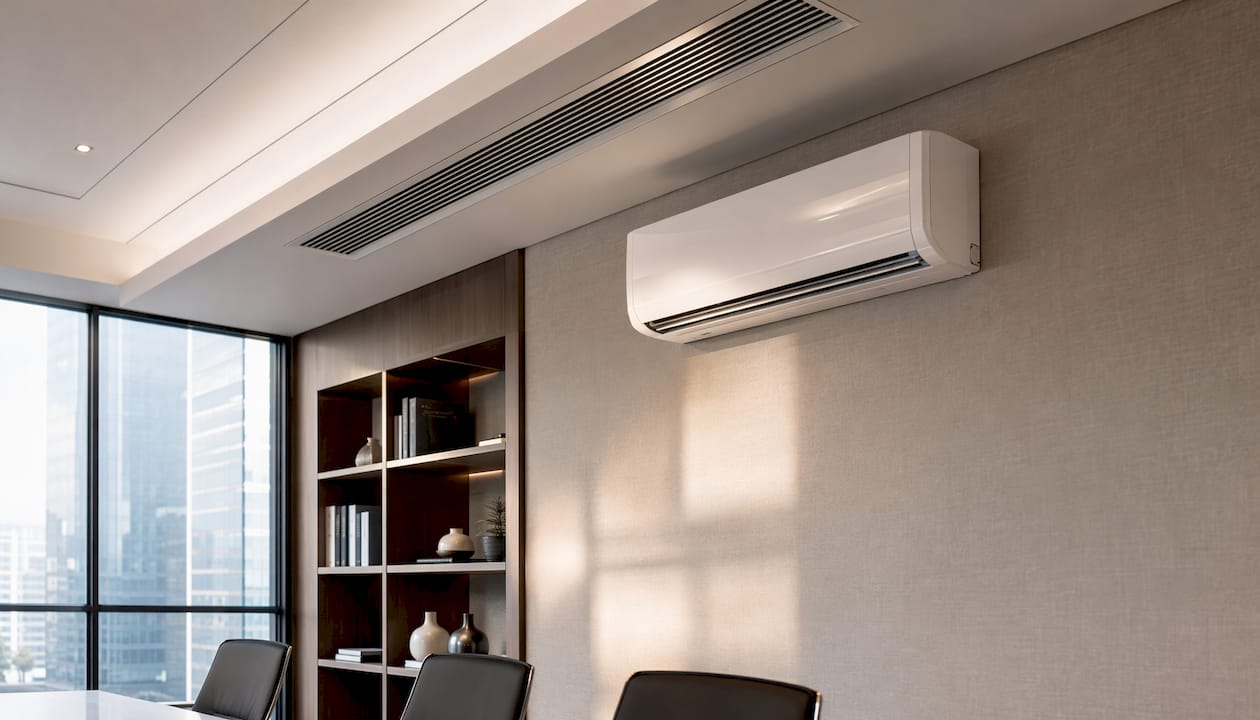
- Available in several form factors: ductless wall-mounted, ceiling cassette, concealed ducted (low-static), and floor-standing fan coil.
- Each contains an evaporator coil, a local EEV, and a control board that communicates with the outdoor unit.
- Ductless units are installed by refrigerant piping specialists; ducted coils may also involve a sheet-metal contractor for the short duct runs.
Refrigerant piping and fittings
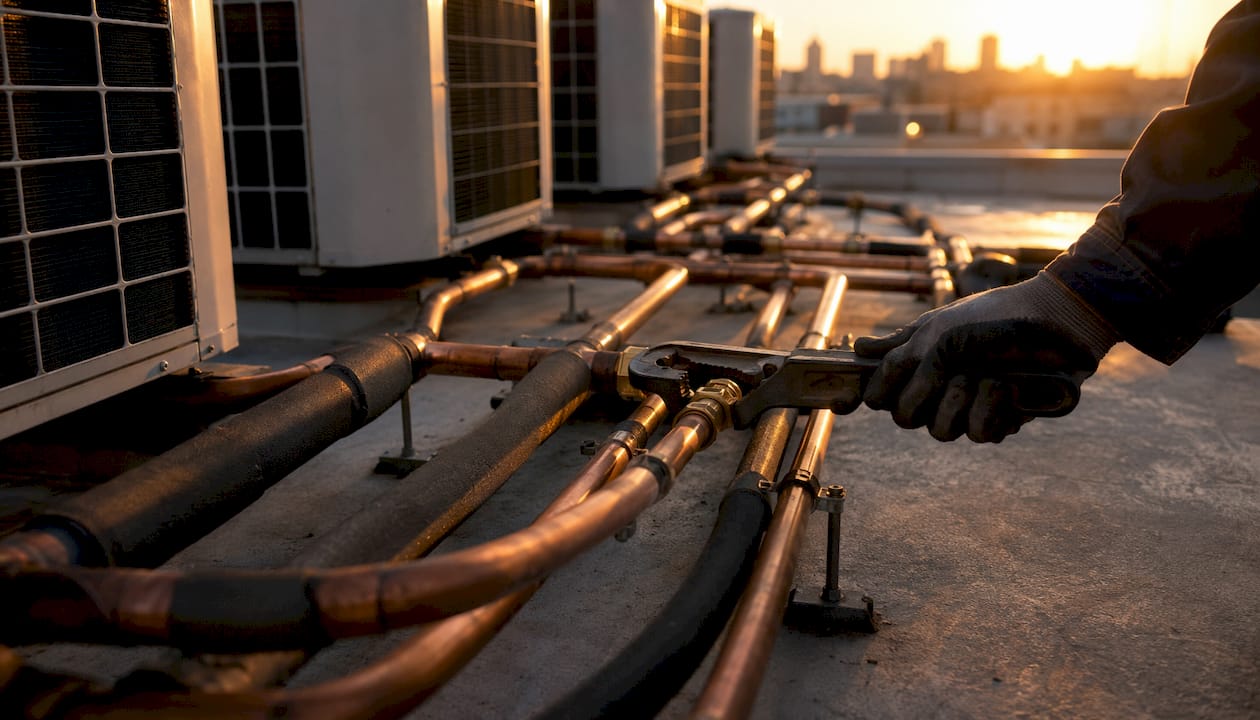
- Insulated copper lines carry refrigerant between outdoor and indoor units.
- Line lengths and elevation changes affect system capacity and must stay within manufacturer limits.
- Service valves at each indoor unit allow isolation for maintenance without shutting down the whole system.
Branch controllers and expansion devices
- Branch selector and expansion valve technology varies by vendor and directly affects piping options and service complexity.
- In heat-recovery systems, branch controllers route refrigerant direction per zone; in heat-pump systems, EEVs alone handle metering.
Control systems
- Zone thermostats or remote controllers at each indoor unit.
- A central controller or BMS integration point for scheduling, setback, and diagnostics.
- Proprietary communication wiring (low-voltage signal cable) connects all units; this wiring is separate from power wiring and requires careful routing.
Pro Tip: Ask your contractor to provide a wiring diagram and a refrigerant piping schematic before installation begins. These documents are your best reference for future service calls and warranty claims.
What types of VRF configurations are available?
| Configuration | How it works | Best for | Key tradeoff |
|---|---|---|---|
| Heat-pump (two-pipe) | All zones heat or cool simultaneously; refrigerant flows in one direction at a time | Buildings with uniform seasonal loads | Cannot heat one zone while cooling another |
| Heat-recovery (three-pipe) | Branch controllers route hot gas or liquid refrigerant independently to each zone | Hotels, mixed-use, offices with diverse loads | Higher equipment and piping cost |
| Ductless indoor units | Refrigerant lines connect directly to wall or ceiling units; no ductwork | Retrofits, historic buildings, open floor plans | Visible wall units; limited air distribution range |
| Ducted indoor units | Short duct runs from a concealed coil; grilles in ceiling or walls | New construction, spaces needing hidden equipment | Requires ceiling plenum; more installation labor |
| Multi-outdoor (modular) | Multiple outdoor units piped together for large capacity | Large commercial buildings | Requires careful load calculation and piping design |
Heat-recovery is the configuration that generates the most interest, and for good reason. When a hotel’s south-facing rooms need cooling while north-facing rooms need heat, a heat-recovery system extracts the heat from the cooled zones and delivers it to the heated zones. That energy reuse can produce effective performance significantly higher than either heating or cooling alone, because you are not generating heat from scratch.
The choice between ducted and ductless indoor units often comes down to ceiling plenum depth and aesthetics. Ductless cassettes are faster to install in a retrofit but are visible on the ceiling or wall. A concealed ducted coil with grilles looks like a conventional system from inside the room but needs at least 10–12 inches of plenum space above the ceiling.
Why do building owners choose VRF?
The efficiency case starts with the inverter compressor. Because it never fully cycles off, it avoids the energy penalty of repeated cold starts and runs at the lowest speed that satisfies demand. At partial load, which is where most buildings spend most of their operating hours, that translates to real savings.
- Precise zoning: Each indoor unit controls its own setpoint independently. Individual zone control reduces wasted conditioning and can improve comfort and indoor air quality by limiting cross-zone recirculation.
- Energy savings: Industry figures show savings of roughly 25%–55% compared to conventional unitary or chiller-based systems, depending on baseline and configuration.
- Simultaneous heating and cooling: Heat-recovery systems reuse rejected heat between zones, which is particularly valuable in buildings with diverse exposures or internal heat loads.
- Smaller mechanical footprint: No large air-handling units, no extensive duct shafts. Refrigerant lines are small-diameter copper, which routes through spaces where ductwork cannot.
- Electrification potential: VRF systems are fully electric-driven and can replace fossil-fuel heating as part of a decarbonization strategy when paired with cleaner grid electricity.
- Retrofit flexibility: Refrigerant lines can thread through existing walls and ceilings where duct shafts would be impossible. This makes VRF a strong candidate for HVAC retrofit projects in older buildings.
- Reduced distribution losses: Refrigerant carries more energy per pound than conditioned air, so line losses are far lower than the duct leakage typical in large-duct systems.
The GSA has documented 34% energy savings compared to older conventional systems in federal building evaluations, which is a credible, independently verified data point rather than a manufacturer claim.
Where VRF can fall short
VRF is not the right answer for every building. Knowing the limitations upfront saves a lot of frustration later.
“VRF installation pitfalls include improper refrigerant charging and incorrect control setup; commissioning is not optional — it is the difference between a system that performs and one that generates service calls.” — Mitsubishi Electric installation guidance
Higher first cost. Outdoor units, branch controllers, refrigerant piping, and proprietary controls cost more upfront than a simple packaged rooftop unit or split system. The payback depends on energy savings over time, which requires an honest lifecycle cost analysis, not just a sticker-price comparison.
Service complexity. VRF systems require technicians trained specifically in refrigerant piping, inverter drives, and proprietary control diagnostics. A general HVAC technician without VRF-specific training can make things worse. Proprietary communication protocols mean that diagnostic tools are often manufacturer-specific.
Cold-climate limitations. Historically, VRF systems lost significant heating capacity below about 17°F. Newer cold-climate models, available since roughly 2017, are rated to approximately -22°F, which makes VRF viable in colder U.S. regions. Buildings in climates with extended sub-zero periods may still need supplemental heat.
Refrigerant volume and leak risk. Large VRF systems contain substantial refrigerant charges spread across long piping runs. A leak anywhere in the system can be difficult to locate and may trigger code-required refrigerant monitoring in occupied spaces. Current refrigerant regulations under EPA Section 608 and evolving low-GWP refrigerant requirements (such as the AIM Act transition to A2L refrigerants like R-32 and R-454B) add another layer of compliance complexity.
Pro Tip: Before signing a VRF proposal, ask the contractor for a refrigerant charge calculation and a leak-detection plan. Systems with more than 150 lbs of refrigerant in occupied spaces may require continuous monitoring under ASHRAE 15.
Where VRF makes the most sense
VRF performs best when zone loads are diverse, meaning different spaces need different amounts of conditioning at the same time. That diversity is what lets the system run efficiently and, in heat-recovery mode, reuse energy between zones.
Strong fits:
- Hotels: Individual guestroom control is the textbook VRF application. Guests set their own temperatures; unoccupied rooms condition minimally; the system never over-conditions a floor because one guest complained.
- Multi-family housing: Each unit controls its own comfort without affecting neighbors, and the building owner gets one outdoor system to maintain rather than dozens of individual split systems.
- Mixed-use and office buildings: Interior zones often need cooling year-round while perimeter zones need heat in winter. Heat-recovery VRF handles that mix efficiently.
- Retrofits with limited ductwork: Refrigerant lines thread through spaces where duct shafts cannot go. This is one of VRF’s clearest advantages over conventional systems in older buildings.
- High-comfort residences: Large homes with multiple wings or floors benefit from HVAC zoning that a single-zone split system cannot provide.
Less optimal situations:
- A single room or small apartment where a standard mini-split is sufficient and far cheaper.
- Buildings with highly uniform loads where all zones heat or cool at the same time and heat recovery adds no value.
- Facilities where refrigerant expertise is unavailable locally, making long-term service difficult.
What energy performance should you realistically expect?
The 25%–55% savings range cited in industry summaries is real, but the spread is wide for a reason. Where a building lands in that range depends on several factors.
| Performance factor | Effect on savings |
|---|---|
| Baseline system | Savings vs. old packaged units are higher than vs. a modern chiller plant |
| Load diversity | Higher diversity (mixed heating/cooling zones) boosts heat-recovery gains |
| Climate | Moderate climates favor VRF; extreme cold reduces heating efficiency |
| Controls and commissioning | Poorly commissioned systems can underperform by 20%+ |
| Occupant behavior | Frequent manual setpoint changes reduce efficiency gains |
The GSA’s federal building evaluations found 34% energy savings versus older conventional systems, which aligns with the lower-to-middle portion of the industry range. The upper end of the range (near 55%) typically requires a heat-recovery configuration with high zone diversity and a poor baseline system as the comparison point.
Coefficient of Performance (COP) for VRF systems in heating mode typically ranges from about 2.5 to 4.5 depending on outdoor temperature and load, meaning the system delivers 2.5–4.5 units of heat energy for every unit of electrical energy consumed. Seasonal efficiency ratings (SEER for cooling, HSPF for heating) vary by product line and climate zone; Daikin, Mitsubishi Electric, and Carrier all publish rated efficiencies in their technical documentation, and those figures should be compared on an equal basis using AHRI-certified ratings rather than manufacturer marketing sheets.
VRF’s role in electrification is worth noting separately. Because these systems run entirely on electricity, they can contribute to a building’s decarbonization goals when the grid becomes cleaner over time, without any equipment replacement.
What drives VRF installation costs?
First cost is the most common sticker shock in VRF projects. Several factors drive the number up or down.
- System capacity and zone count: More indoor units mean more piping, more branch controllers, more control wiring, and more commissioning time.
- Piping complexity: Long line sets, multiple elevation changes, and tight routing paths add labor and material cost. Manufacturer limits on total pipe length and elevation difference must not be exceeded.
- Branch controllers: Heat-recovery systems require branch selector units at each junction, which add both equipment and installation cost.
- Control integration: Connecting VRF to a building management system (BMS) or a building automation platform adds engineering and programming time.
- Commissioning: Proper refrigerant charging, control setup, and system verification are not optional extras. Commissioning is critical to performance and is a common source of field issues when skipped or rushed.
- Retrofit constraints: Ceiling plenum height, structural penetrations, and interstitial routing for refrigerant lines all add cost in existing buildings.
Pro Tip: When comparing VRF bids, ask each contractor to break out equipment cost, piping labor, controls/commissioning, and startup separately. A low total bid that buries commissioning in a line item often means it will be skipped.
Checklist items to confirm before signing a VRF contract:
- Contractor holds manufacturer-specific VRF certification (Daikin D1, Mitsubishi Diamond, or Carrier equivalent).
- Bid includes a written commissioning plan with refrigerant charge verification.
- Warranty terms specify who performs warranty service and what voids coverage.
- Piping design stays within manufacturer-specified maximum line lengths and elevation limits.
- Refrigerant type is confirmed and compliant with current EPA and AIM Act requirements.
Real-world field notes on VRF performance
Field experience with VRF systems reveals a consistent pattern: the gap between a well-commissioned system and a poorly commissioned one is larger than most owners expect.
“Occupant behavior matters more than most people realize. VRF systems perform best when thermostats are set and the system modulates automatically. Frequent manual setpoint changes can defeat the control logic and drive up energy use.” — Mitsubishi Electric field guidance
Common observations from VRF installations:
- Systems commissioned with incorrect refrigerant charge often show reduced capacity in the first summer and generate nuisance alarms that are misdiagnosed as equipment failures.
- Communication wiring errors between indoor and outdoor units are a frequent startup issue; they are easy to fix if caught during commissioning and expensive to diagnose after walls are closed.
- Occupants who treat VRF thermostats like conventional thermostats, cranking setpoints to extremes to speed up conditioning, often report dissatisfaction even when the system is working correctly.
Practical checklist for owners after installation:
- Verify that the commissioning report includes measured refrigerant charge and superheat/subcooling values.
- Confirm all indoor units communicate correctly with the outdoor unit before the contractor leaves.
- Ask for a copy of the control system programming, including any scheduled setbacks.
- Schedule a performance check at 3 months and again at 12 months to catch any drift in refrigerant charge or control settings.
- Keep manufacturer technical manuals and warranty documentation in a single accessible location.
Ultraairswfl’s technicians in Southwest Florida follow a structured commissioning verification process on every VRF installation, which catches the majority of startup issues before they become service calls.
How to decide if VRF is right for your building
VRF is not a universal upgrade. The decision comes down to a few concrete criteria.
Decision framework:
- Zone diversity: If different parts of your building regularly need different conditioning at the same time, VRF’s zoning and heat-recovery capability pays off. If the whole building heats and cools together, a simpler system may be more cost-effective.
- Retrofit constraints: Limited ceiling plenum, no existing duct shafts, or historic building restrictions all favor VRF’s small-diameter refrigerant lines over ductwork.
- Budget: First cost is higher than conventional systems. A lifecycle cost analysis comparing 15-year energy and maintenance costs is the only honest comparison.
- Simultaneous heating and cooling: If your building has interior zones that need cooling while perimeter zones need heat, heat-recovery VRF is one of the few systems that handles this efficiently.
Questions to ask vendors:
- What manufacturer certification do your installers hold, and can you provide references from completed VRF projects of similar size?
- What does your commissioning plan include, and will you provide a written commissioning report?
- How do you handle refrigerant leak detection and what monitoring do you recommend for this system size?
- What are the warranty terms, and who performs warranty service?
- Can you provide a lifecycle cost estimate alongside the first-cost proposal?
Evaluation checklist for comparing proposals:
- Scope of work clearly defines piping design, commissioning, and control integration.
- Equipment is AHRI-certified and refrigerant type is specified.
- Commissioning is a separate line item, not buried in installation labor.
- Measurement and verification plan is included if energy savings are part of the justification.
Routine maintenance and common troubleshooting
VRF systems are reliable when maintained properly, but they do have specific needs that differ from conventional equipment.
Routine maintenance tasks:
- Filter cleaning/replacement: Indoor unit filters collect dust quickly, especially in high-traffic spaces. Most manufacturers recommend cleaning every 4–6 weeks in commercial applications.
- Condensate drain check: Each indoor unit has a condensate drain or pump. Blocked drains cause water damage and trigger safety shutoffs.
- Outdoor coil cleaning: Dirt and debris on the condenser coil reduce heat rejection capacity. Annual cleaning is the minimum; twice yearly in dusty or coastal environments.
- Refrigerant pressure check: A certified technician should verify system pressures annually and after any major service event.
- Control system health check: Review error logs, communication status, and setpoint schedules at least annually.
- Electrical connection inspection: Inverter drives and control boards are sensitive to loose connections; annual inspection of terminal blocks is good practice.
Common troubleshooting symptoms:
- Reduced cooling or heating capacity: Usually indicates low refrigerant charge, dirty filters, or a blocked outdoor coil. Requires a certified technician for refrigerant diagnosis.
- Refrigerant alarm codes: Most VRF systems display manufacturer-specific fault codes. These require a technician with manufacturer diagnostic software; do not attempt to clear codes without identifying the root cause.
- Communication errors between units: Often a wiring issue or a failed control board. Check communication wiring continuity before replacing boards.
- One zone not responding: Could be a failed EEV, a communication fault, or a tripped local breaker. Start with the breaker and control board status before calling for service.
- Unusual noise from outdoor unit: Inverter compressors are quieter than conventional compressors; any new grinding or rattling warrants immediate inspection.
Owner-level tasks (no certification required): filter cleaning, condensate drain clearing, and resetting tripped breakers. Everything involving refrigerant, control board replacement, or inverter diagnostics requires a certified VRF technician.
Key Takeaways
VRF systems deliver their strongest value in buildings with diverse zone loads, where the inverter-driven compressor and heat-recovery capability work together to reduce energy waste and improve comfort simultaneously.
| Point | Details |
|---|---|
| Core efficiency mechanism | The inverter-driven compressor modulates speed continuously, eliminating on/off cycling losses at partial load. |
| Energy savings range | Industry data shows roughly 25%–55% savings versus conventional unitary or chiller-based systems, depending on baseline and configuration. |
| Best-fit applications | Hotels, multi-family, mixed-use offices, and retrofits with limited ductwork benefit most from VRF’s zoning and piping flexibility. |
| Commissioning is non-negotiable | Improper refrigerant charging and control setup are the leading causes of poor VRF field performance; always require a written commissioning plan. |
| Ultraairswfl VRF service | Ultraairswfl installs and commissions VRF systems across Naples, Cape Coral, and Fort Myers with manufacturer-certified technicians. |
A practical perspective on VRF
The conversation around VRF often splits into two camps: enthusiasts who treat it as the answer to every HVAC problem, and skeptics who focus on first cost and service complexity. Both miss the point.
VRF is a precision tool. It performs exceptionally well when the building’s load profile matches what the technology does best: variable, diverse, multi-zone demand. Drop it into a building where every zone heats and cools in unison, and you have paid a premium for capability you will never use. That is not a VRF failure; it is a specification failure.
The detail most people underestimate is commissioning. A VRF system that is 10% undercharged with refrigerant will run, it will condition the space, and it will look fine on a cursory inspection. It will also consume more energy than it should, wear the compressor faster, and generate intermittent fault codes that get blamed on the equipment rather than the installation. The difference between a VRF system that delivers its promised efficiency and one that disappoints almost always traces back to what happened during startup, not to the equipment itself.
For Southwest Florida specifically, the climate is nearly ideal for VRF. The region’s mild winters mean cold-climate heating limitations are irrelevant, and the long cooling season is exactly where inverter-driven efficiency shines. Buildings with mixed exposures, like a hotel facing the Gulf or an office building with significant east-west solar load variation, are natural candidates.
The practical advice: get a lifecycle cost analysis, not just a first-cost comparison. Require a written commissioning scope before you sign. And make sure the contractor’s certification is current with the specific manufacturer whose equipment is being installed, because VRF diagnostics are proprietary and a Daikin-certified tech cannot always service a Mitsubishi system effectively.
VRF installation and service in Southwest Florida
If you have read this far and are wondering whether VRF makes sense for your home or building in Southwest Florida, the next step is a site assessment, not a quote.
Ultraairswfl serves Naples, Cape Coral, and Fort Myers with manufacturer-certified VRF installation, commissioning, and ongoing service. The team’s approach starts with a load calculation and zone diversity analysis before any equipment is specified, which is the only way to know whether VRF’s efficiency advantages will actually materialize for your specific building. For commercial readers, the office HVAC installation guide covers the full evaluation process for facility managers. Homeowners comparing VRF to other heating and cooling options can review the heating solutions page for a side-by-side look at what each system type offers in the Southwest Florida climate. Contact Ultraairswfl to schedule a site visit and get a lifecycle cost estimate alongside any equipment proposal.
Useful sources for further reading
The following primary sources and independent studies back the claims in this article and are worth reviewing if you want to go deeper on technical specifications or performance data.
- GSA Variable Refrigerant Flow evaluation: GSA VRF technology page — federal building performance data including the 34% savings finding.
- Slipstream Cold Climate VRF Study: Slipstream final report (PDF) — independent evaluation of cold-climate VRF performance and low-temperature ratings.
- Mitsubishi Electric “Getting Started with VRF” white paper: Mitsubishi Electric white paper — covers installation requirements, commissioning, and electrification positioning.
- Daikin VRF knowledge center: Daikin VRF explained — manufacturer technical overview of inverter-driven compressor operation and system design.
- Wikipedia VRF article: Variable refrigerant flow — useful consolidated summary of system types, savings ranges, and heat-recovery configurations.
- COMNET VRF modeling guidance: COMNET 2.11 VRF — technical modeling standards for VRF energy performance in commercial building simulations.
- Ultraairswfl local resources: HVAC zoning explained and HVAC efficiency standards for Southwest Florida context.