
When your heat or air conditioning fails, you have real legal options. Tenant HVAC complaint resolution is the process of formally notifying your landlord, documenting the failure, and exercising your statutory remedies if repairs don’t happen on time. Most U.S. states tie these rights to habitability laws, which means a broken HVAC system isn’t just an inconvenience. It can be a code violation that gives you the power to withhold rent, deduct repair costs, or walk away from your lease without penalty.
Here’s what you need to do right away:
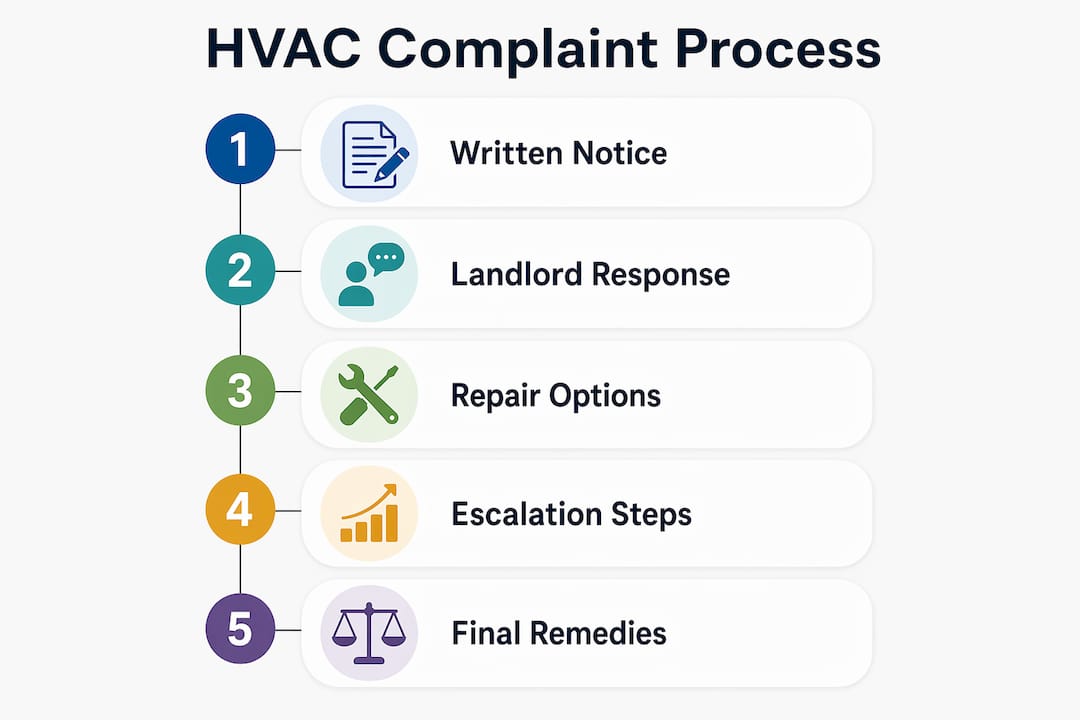
- Notify your landlord in writing the moment the HVAC system fails. Verbal complaints don’t create a legal record.
- Use certified mail or email with a read receipt so you have proof of delivery if the dispute goes to court.
- Specify the exact problem and a repair deadline in your notice. “Reasonable time” is vague; a written deadline is not.
- Keep every receipt for any costs you incur, including hotel stays, portable cooling units, or temporary heating.
- Do not attempt repairs yourself. In many states, including Arizona under ARS § 33-1364(H), self-repair voids your right to deduct costs or sue.
- Know your state’s repair window. Arizona, for example, gives landlords 10 days for standard repairs, shortened to 5 days when temperatures exceed 100°F or a health risk exists.
- Document the unit’s condition with dated photos, temperature logs, and any communications from your landlord.
If the landlord misses the deadline, your remedies typically include repair and deduct, rent withholding, lease termination, or a lawsuit for damages. Each option carries different risks and state-specific rules, which vary widely.
What landlords are legally required to do when HVAC fails
Landlords in every U.S. state carry a legal duty to maintain rental units in a habitable condition. That duty almost always covers heating and cooling systems. Under Arizona’s Residential Landlord and Tenant Act, for instance, landlords must maintain all electrical, heating, ventilating, and air conditioning systems in good and safe working order per ARS § 33-1324(A). Most other states have parallel statutes, and local housing codes often add a second layer of obligation.
What makes a rental unit legally uninhabitable?
A unit crosses into uninhabitable territory when the HVAC failure creates a genuine health or safety risk. Extreme heat without functioning air conditioning, a broken furnace during winter, or a system leaking carbon monoxide all qualify in most jurisdictions. Courts and housing inspectors look at whether a reasonable person could safely live in the space, not just whether the tenant finds it uncomfortable.
Landlord responsibilities typically include:
- Repairing HVAC systems within the statutory timeframe after receiving written notice
- Complying with all city and state building codes that affect health and safety (ARS § 9-1303)
- Maintaining the system proactively, not just responding to tenant complaints
- Covering repair costs when the failure stems from normal wear and tear or system age
What landlords are NOT required to cover:
- Damage caused by the tenant, a household member, or a guest (ARS § 33-1364(H))
- Upgrades or replacements beyond what the lease or local code requires
- Repairs for systems that were never part of the rental agreement
One critical point: a landlord cannot legally refuse to fix an HVAC system because the tenant is behind on rent. Under Arizona law, withholding repairs as leverage for unpaid rent is itself a violation, and if the refusal is deliberate, the tenant may recover actual housing costs up to one month’s rent or terminate the lease and recover two months’ rent. Florida tenants can find a detailed breakdown of landlord AC obligations specific to their state’s rules for 2026.
How tenants should notify landlords about HVAC problems
The way you report an HVAC problem matters as much as the problem itself. A phone call or hallway conversation gives you nothing to stand on legally. A written notice with confirmed delivery is the foundation of every remedy you might need later.
What your written notice should include
Your notice doesn’t need to read like a legal brief. It needs to state the problem clearly, reference the date it started, and set a specific repair deadline. Something like “The central air conditioning unit stopped functioning on [date]. Please repair it within 10 days of this notice” is enough to start the clock. If your state has a shorter window for health and safety issues, say so explicitly.
Effective notice checklist:
- Date and address of the rental unit
- Description of the HVAC problem and when it began
- A specific repair deadline (not just “as soon as possible”)
- Your contact information
- A request for written confirmation of the repair timeline
Delivery methods that create admissible evidence:
- Certified mail with return receipt requested
- Email with a read receipt or delivery confirmation
- Text message, if your state accepts electronic notice (Arizona does under ARS § 33-1313)
Pro Tip: Save a screenshot of every sent email and text, including the timestamp and the recipient’s address or number. Courts have dismissed tenant claims because the landlord denied receiving a text, and a screenshot alone doesn’t prove delivery. A read receipt or a landlord reply does.
Common mistakes tenants make
Reporting the problem verbally and then waiting is the most common error. The second is sending a vague notice without a deadline, which lets landlords argue they were still within a “reasonable” repair window. A third pitfall: tenants who attempt minor fixes themselves, even something as simple as replacing a thermostat, can inadvertently void their right to deduct costs or pursue damages in states that prohibit tenant self-repair.
What you can legally do when your landlord ignores HVAC repairs
Once the repair deadline passes without action, you have options. The right choice depends on your state’s laws, the severity of the problem, and how much financial risk you’re willing to take on.
Repair and deduct
This remedy lets you hire a licensed contractor to fix the HVAC system and subtract the cost from your next rent payment. Most states cap the deductible amount, often at one month’s rent or a fixed dollar limit. You must provide your landlord with the receipt before or at the time you deduct. In some states, tenants can purchase a portable AC unit and deduct the cost after providing the receipt to the landlord. The key condition: you must have sent proper written notice first and the landlord must have missed the repair window.
Rent withholding
Rent withholding is riskier than repair and deduct. Some states allow it; others, including Arizona, explicitly prohibit it and require tenants to use the statutory remedies instead. If you withhold rent in a state that doesn’t authorize it, you can be evicted for nonpayment. Before going this route, check your state’s specific statute or consult a tenant rights organization.
Temporary housing deduction
If the unit becomes genuinely uninhabitable, you can move to a hotel or short-term rental and deduct the cost from your rent. In Arizona, tenants staying in hotels due to AC failure can deduct the reasonable daily cost plus 25% from their rent after providing proof of the hotel bill to the landlord. If the landlord’s failure to act is willful rather than logistical, you may recover the full actual cost of alternative housing.
Lease termination
Every major U.S. habitability statute includes a provision allowing tenants to terminate the lease without penalty when the landlord fails to repair a condition that makes the unit uninhabitable. You still need to have sent proper written notice and given the landlord the statutory repair window. Walk out before that window closes, and you may owe the remaining rent.
Suing for damages
A lawsuit is the right move when the landlord’s neglect caused you measurable harm: medical bills from heat-related illness, property damage from a failed heating system, or documented lost wages. Small claims court handles most residential HVAC disputes without requiring an attorney. For larger claims or cases involving willful landlord conduct, a tenant rights attorney can help you pursue actual damages plus, in some states, attorney’s fees.
Statistic callout: Jurisdictions vary on the time landlords have to correct mechanical code violations, with shorter windows for health and safety failures such as broken AC during extreme heat conditions.
How to escalate an unresolved HVAC dispute
Not every landlord responds to a written notice. When they don’t, you have a clear escalation path that moves from informal resolution to formal legal action.
Start with direct negotiation
Before filing anything, try one more direct conversation with your landlord, this time in writing. Lay out the timeline: when you reported the problem, what the repair deadline was, and what it has cost you so far. Landlords who understand you’ve documented everything and know your rights often move faster than those who think you’ll give up. Transparent communication and concrete repair deadlines are the single most effective tool for keeping a dispute out of court.
File a complaint with housing authorities
If direct negotiation fails, contact your local housing authority or code enforcement agency. An inspector will visit the property, document the HVAC failure, and issue a violation notice to the landlord. That notice creates an official record and starts a mandatory cure window. Once a code violation is on file, the landlord faces civil penalties if they don’t act. For HVAC code violation resolution in New York City, the Department of Buildings handles mechanical violations through its Buildings Information System, and tenants can file complaints directly through the city’s 311 system.
Use mediation or arbitration
Many cities and counties offer free or low-cost landlord-tenant mediation programs. A neutral mediator helps both parties reach an agreement without going to court. California’s Department of Real Estate, for example, encourages tenants and landlords to use dispute resolution programs because they resolve disputes faster and at lower cost than litigation. If your lease includes an arbitration clause, you may be required to use that process before filing suit.
Escalating steps at a glance:
- Send a second written notice referencing the missed deadline and your intent to exercise legal remedies
- File a complaint with your local housing authority or code enforcement office
- Contact a tenant advocacy organization or legal aid clinic for free guidance
- Attempt mediation through a city or county dispute resolution program
- File in small claims court for costs under your state’s limit
- Hire a tenant rights attorney for larger claims or willful landlord conduct
When to call a tenant advocacy group
Tenant advocacy organizations know your local laws in detail and can often resolve disputes with a single letter on official letterhead. The New York Attorney General’s office, for instance, provides legal services and code enforcement resources specifically for tenants. Most states have equivalent programs, and many offer free consultations.
Practical advice from HVAC professionals on avoiding and resolving complaints
HVAC professionals who work in rental properties see the same patterns repeatedly. Most disputes that end up in court could have been avoided with two things: a written record at move-in and a landlord who responds within the first 48 hours of a complaint.
Inspect the system before you sign
Walk through the HVAC system during your pre-lease inspection. Turn on the heat and the AC, check the filter condition, and ask when the system was last serviced. If the unit is visibly old or the landlord can’t produce a recent maintenance record, put a clause in the lease requiring a professional inspection within 30 days of move-in. That documentation protects you if the system fails in month two and the landlord claims you caused the damage.
Pro Tip: Request a copy of the HVAC system’s maintenance history before signing the lease. A system that hasn’t been serviced in three or more years is a liability. Knowing that upfront gives you negotiating power and sets a clear baseline for what “normal wear and tear” looks like.
Recognize signs of a deeper system problem
Recurring HVAC complaints usually indicate deeper balancing or control system issues that patch repairs won’t fix. If your landlord has sent a technician three times in six months and the problem keeps coming back, the system likely needs a professional diagnostic evaluation, not another band-aid fix. Document each service visit, including the technician’s name, the date, and what was done. That record becomes evidence of a pattern if you eventually need to pursue a habitability claim.
What to watch for:
- Uneven temperatures across rooms despite a functioning thermostat
- Short cycling (the system turns on and off rapidly without reaching the set temperature)
- Unusual noises or odors from vents or the outdoor unit
- Utility bills that spike without a change in usage habits
- The same component failing more than once within a lease term
Get professional documentation when it counts
If your HVAC issue has reached the point where you’re considering legal action, a written assessment from a licensed HVAC technician carries real weight. That report should identify the specific failure, its likely cause, and whether the condition poses a health or safety risk. Tenants in Southwest Florida dealing with AC failures during summer can get a professional assessment from Ultraairswfl, whose technicians serve Naples, Cape Coral, and Fort Myers and can document system conditions in writing for tenant records.
Advocate for a maintenance contract in your lease
Third-party maintenance contracts, where a licensed HVAC company handles all scheduled service and emergency calls independently of the landlord, remove a major source of dispute. When a neutral contractor is responsible for the system’s upkeep, the landlord can’t claim ignorance of a known problem. If you’re renewing a lease, ask your landlord to include a maintenance agreement with a named HVAC provider as a lease addendum. It’s a reasonable request, and many landlords will agree to avoid the liability of an unserviced system.
Key Takeaways
Tenant HVAC complaint resolution requires written notice, documented evidence, and knowledge of your state’s specific repair deadlines and legal remedies before you can act.
| Point | Details |
|---|---|
| Written notice is mandatory | Send notice by certified mail or email with read receipt before exercising any legal remedy. |
| Repair windows vary by severity | Landlords typically have 10 days for standard repairs, shortened to 5 days for health or safety failures in states like Arizona. |
| Self-repair voids your rights | Attempting HVAC repairs yourself can eliminate your right to deduct costs or sue the landlord in many jurisdictions. |
| Escalation follows a clear path | Move from direct negotiation to code enforcement, then mediation, then small claims court if the landlord remains unresponsive. |
| Documentation wins disputes | Dated photos, temperature logs, receipts, and service records are the evidence that determines outcomes in court or mediation. |
If you’re a renter or property owner in Southwest Florida dealing with an HVAC system that needs professional assessment or repair, Ultraairswfl serves Naples, Cape Coral, and Fort Myers with licensed technicians who can document system conditions, provide written repair assessments, and get your system back to code. Explore HVAC repair and heating solutions or check the HVAC emergency response checklist to know exactly what to do when your system fails.