
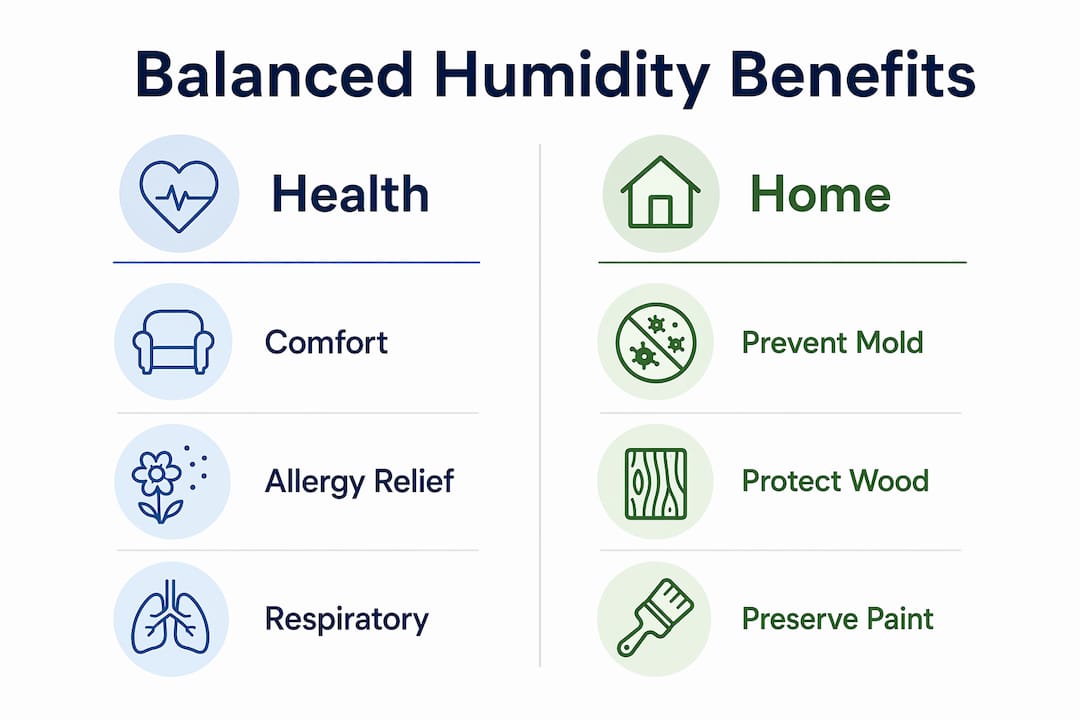
Keeping indoor relative humidity between 30% and 50% is one of the most effective things you can do for your health, your comfort, and the long-term condition of your home. Too dry and your sinuses crack, your wood floors gap, and static electricity becomes a daily annoyance. Too humid and mold moves in, dust mites multiply, and your air conditioner works overtime. The EPA and ASHRAE both set this range as the standard for a reason.
Here is what balanced humidity actually does for you:
- Reduces respiratory irritation and supports mucosal defenses
- Controls mold growth and dust mite populations
- Protects wood floors, furniture, and structural materials
- Keeps your home feeling comfortable without overworking your HVAC system
- Lowers static electricity and prevents dry skin
What humidity is and how you measure it indoors
Relative humidity (RH) is the percentage of moisture in the air compared to how much the air could hold at that temperature. When outdoor air is cold and gets pulled inside and heated, its RH drops sharply, sometimes below 20% in deep winter. That is the physics behind why your home feels like a desert in january even when it is warm inside.
Measuring it is straightforward. Key tools include:
- Digital hygrometer: A $15–$20 device that gives you an accurate RH reading in any room
- Smart thermostat with humidity sensor: Monitors and logs humidity alongside temperature automatically
- Whole-house humidistat: Controls humidifiers or dehumidifiers based on a set RH target
Absolute humidity measures the actual mass of water vapor in the air, while relative humidity measures it as a percentage of capacity. For homeowners, RH is the number that matters because it tells you how the air actually feels and behaves in your space.
Why balancing home humidity matters for health and your house
Low and high humidity each cause real damage, just in different directions.
Humidity below 30% pulls moisture from your skin, your sinuses, and the organic materials in your home. Wood floors develop gaps. Furniture cracks. Your body’s mucosal defenses weaken, making you more susceptible to airborne infections. Static electricity builds up on synthetic carpets and can damage sensitive electronics.
Stat to know: Dust mites and mold thrive above 50% RH, while air below 30% causes dryness that harms both health and home structure.
On the other end, humidity above 60% creates a breeding ground for mold, mildew, and bacterial growth. Wallpaper peels. Paint blisters. Doors stick. Your body cannot shed heat efficiently through sweat evaporation, so 78°F at 65% RH feels far worse than 78°F at 45% RH. The importance of home humidity control goes well beyond comfort.
Signs your humidity is off:
- Too dry: Dry eyes, nosebleeds, cracked wood trim, static shocks
- Too humid: Musty smell, condensation on windows, sticky air, visible mold
How to maintain balanced humidity year-round
The right tools and habits make humidity control in homes manageable for any homeowner.
Core practices:
- Monitor with a hygrometer in at least two rooms, including the bedroom
- Run a humidifier during dry months when RH drops below 30%
- Use a dehumidifier when RH climbs above 55–60%, especially in basements
- Run exhaust fans in kitchens and bathrooms during and after cooking or showering
- Vent your clothes dryer outdoors — an indoor-vented dryer dumps gallons of moisture into your home daily
- Fix plumbing leaks promptly since even slow drips raise ambient moisture levels
Proper ventilation and source control are the foundation. Devices like humidifiers and dehumidifiers are tools, not substitutes for addressing where moisture comes from in the first place.
Pro Tip: Adjust your humidity target based on outdoor temperature, not a fixed number. When it is below freezing outside, keep indoor RH closer to 30% to prevent condensation from forming inside wall cavities where you cannot see it.
Seasonal humidity management: summer vs. winter
Your target RH shifts with the seasons, and so should your approach.
Winter:
- Target 30–50% RH, leaning toward 30% on the coldest days
- Over-humidifying in winter causes hidden condensation on cold surfaces inside walls, which leads to mold growth you will not discover until it is severe
- Open interior doors to improve air circulation around cold surfaces
Summer:
- Keep RH below 55–60%; above 60% RH the air feels clammy and mold risk rises sharply
- In hot, humid climates, a standard AC unit may not dehumidify adequately on mild days when it short-cycles
- Standalone dehumidifiers or variable-speed HVAC systems handle the latent load that a single-stage AC misses
Spring and fall:
- These transition seasons need weekly monitoring
- Crack windows on mild days to ventilate naturally
- Watch for the humidity creeping up in spring or dropping in fall as heating kicks back on
How balanced humidity improves indoor air quality
Keeping RH in the 30–50% range directly improves the air you breathe every day. Mold spores need sustained surface moisture to colonize, and mid-range humidity between 40–60% also reduces influenza virus survival on surfaces. That is a meaningful benefit during respiratory virus season.
Indoor air quality benefits of balanced humidity:
- Mold and mildew stay dormant without the moisture they need to grow
- Dust mite populations drop when RH stays below 50%
- Airborne allergen and bacteria levels fall
- Your respiratory tract retains the mucosal moisture it needs to filter pathogens
- The air simply smells cleaner, with no musty odor from biological activity
For homeowners dealing with allergy or asthma symptoms, humidity control is often the single most impactful change they can make indoors. High humidity is also hard on paint and finishes; the impact of humidity on paint includes blistering, peeling, and adhesion failure that shortens the life of any interior or exterior coat.
Expert insights on humidity management and indoor comfort
Modern airtight homes trap moisture from cooking, bathing, breathing, and laundry. Without active humidity management, that moisture accumulates invisibly inside wall assemblies and under flooring until the damage is already done. Temperature control alone is not enough.
Stat to know: Relative humidity above 60% impairs the body’s ability to shed heat through evaporation, making air feel sticky even at a comfortable temperature.
A few things most homeowners get wrong:
- Over-humidifying in winter thinking it protects wood floors. Keeping RH between 25–60% year-round is sufficient; going higher creates hidden condensation problems.
- Neglecting humidifier maintenance. Dirty humidifiers introduce biological pollutants and raise energy costs, negating the air quality benefit entirely.
- Relying on AC alone in humid climates. In places like Southwest Florida, an AC sized for cooling may short-cycle and leave plenty of moisture behind. A standalone dehumidifier or a variable-speed system solves this.
Proper device placement matters too. Whole-house dehumidifiers need louvered closet doors for airflow and a drain connection so a full tank does not trigger a shutdown.
Pro Tip: Clean your humidifier weekly during active use and replace filters on schedule. A neglected humidifier can become a mold source itself, spreading spores directly into your air supply.

If you want professional help dialing in your home’s humidity, Ultraairswfl serves Naples, Cape Coral, and Fort Myers with HVAC installation, maintenance, and indoor air quality solutions built for Southwest Florida’s demanding climate. Their team can assess your current system, recommend the right dehumidification setup, and keep your home in the 30–50% RH sweet spot year-round.

Contact Ultraairswfl to schedule an assessment and get your indoor humidity where it needs to be.
Key Takeaways
Balanced indoor humidity between 30% and 50% protects your health, preserves your home’s structure, and keeps your HVAC system running efficiently year-round.
| Point | Details |
|---|---|
| Optimal RH range | Keep indoor humidity between 30% and 50%, per EPA and ASHRAE standards. |
| Health protection | Humidity below 30% irritates sinuses and skin; above 50% triggers mold and dust mites. |
| Seasonal adjustment | Target 30–50% in winter and stay below 50% in summer to prevent condensation and mold. |
| Device maintenance | Clean humidifiers weekly; a dirty unit introduces biological pollutants instead of removing them. |