

A mini split system is a ductless HVAC solution that heats and cools specific rooms or zones without relying on any ductwork. The industry term is “ductless mini split,” and it describes a two-part setup: an outdoor compressor unit and one or more indoor air handlers connected by refrigerant lines and electrical wiring. Because there are no ducts, mini splits avoid the 20–30% energy loss that traditional central systems waste through leaky ductwork. Inverter technology takes that efficiency further, making ductless mini splits 50–70% more efficient than conventional HVAC. For homeowners and renters weighing their heating and cooling options, this is the most important number to understand.
What is a mini split system and how does it work?
A ductless mini split moves heat rather than generating it. The outdoor unit contains a compressor, a condenser coil, and a fan. The indoor air handler holds an evaporator coil and a blower. Refrigerant lines run between the two through a small wall penetration, carrying heat energy in or out of the room depending on the season.
The heat pump at the core of the system transfers heat instead of creating it, which is why mini splits consume far less energy than electric resistance heaters or gas furnaces. In cooling mode, the system pulls heat from inside your home and releases it outdoors. In heating mode, it reverses the process, extracting heat from outdoor air and delivering it inside. This works even in cold weather. Many heat pump models operate effectively down to -13°F, making them viable year-round in most American climates.

Inverter technology is what separates modern mini splits from older HVAC equipment. A traditional compressor runs at full speed or shuts off completely. An inverter compressor modulates speed continuously, matching output to the room’s actual demand. The result is steadier temperatures, lower electricity bills, and significantly less noise.
Key operational advantages of inverter-driven mini splits:
- Quiet operation: Indoor units run at 19–30 decibels, quieter than a whispered conversation.
- Zone control: Each indoor unit operates independently, so you only condition occupied rooms.
- Year-round use: A single system handles both heating and cooling without seasonal swaps.
- Faster response: Inverter compressors reach target temperatures quickly without the temperature swings of on/off cycling.
Pro Tip: Set each indoor unit to a slightly higher temperature in rooms you use less often. That small adjustment compounds into real savings on your monthly bill.
What are the main components and installation requirements?
A ductless mini split has two physical parts and a connecting conduit. Understanding each one helps you plan where the system will fit and what your installer needs to do.
The outdoor unit sits on a concrete pad or a wall bracket outside your home. It houses the compressor and condenser fan. Placement matters: the unit needs adequate clearance for airflow and should not be positioned where debris or flooding can reach it. In Southwest Florida, wall brackets are common because they keep the unit elevated above storm surge risk.
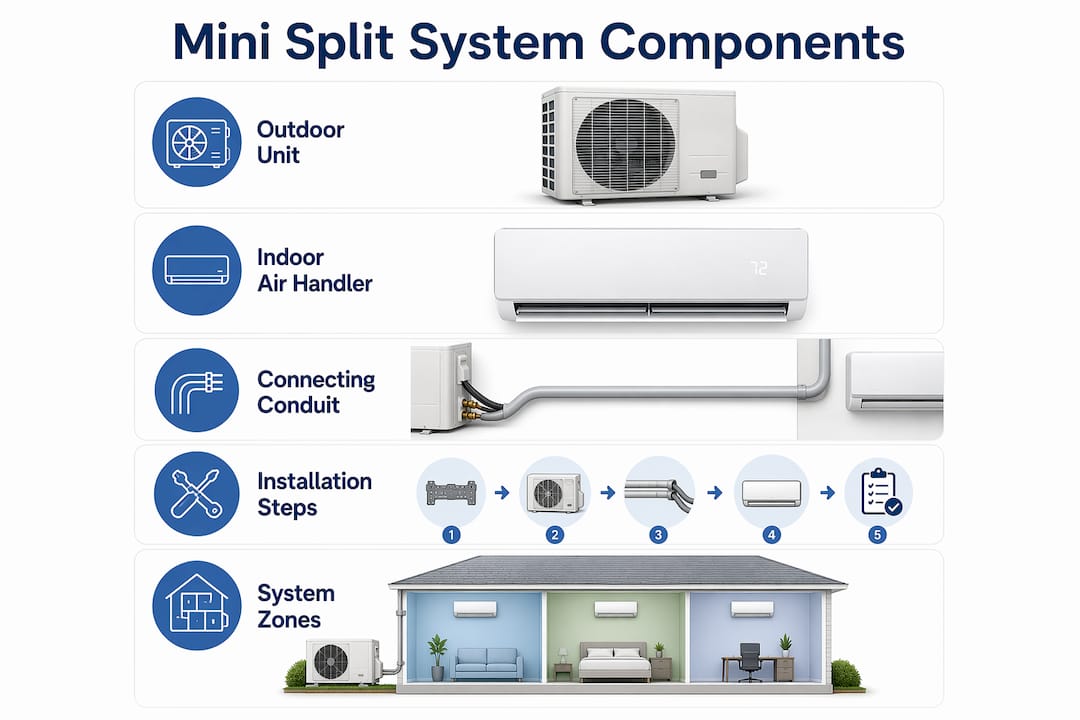
The indoor air handler mounts on a wall, ceiling, or floor depending on the model type. Wall-mounted units are the most common choice for bedrooms and living rooms. Ceiling cassette units distribute air in four directions and work well in open-plan spaces. Floor-mounted units suit rooms where wall space is limited or where low-level airflow is preferred.
Installation steps for a standard single-zone system:
- Choose locations for both the indoor and outdoor units, confirming line-set distance and electrical access.
- Mount the indoor unit on a wall bracket at the correct height for even air distribution.
- Drill a single 3-inch hole through the wall for the refrigerant lines, electrical wiring, and condensate drain.
- Run the conduit from the indoor unit to the outdoor compressor.
- Connect refrigerant lines and pressure-test the system for leaks.
- Wire the electrical connection from your panel to the outdoor unit.
- Commission the system and verify heating, cooling, and remote control functions.
A single-zone installation can be completed in as little as one day. Multi-zone systems take longer because each additional indoor unit requires its own line set and careful planning around refrigerant line length limits and elevation differences.
Pro Tip: Before your installer arrives, decide which rooms you want to condition and measure the distance from each room to the planned outdoor unit location. That information directly affects system sizing and cost.
What does it cost to install a mini split system?
Cost is the most common barrier homeowners cite, and the range is wide. A single-zone ductless mini split runs $1,500 to $4,500 installed. A multi-zone system serving three or four rooms costs $4,000 to $18,000 depending on the number of indoor units, line-set lengths, and site conditions.
Several factors push costs up or down:
- Number of zones: Each additional indoor unit adds equipment and labor costs.
- Line-set distance: Longer runs between indoor and outdoor units require more refrigerant line and conduit.
- Electrical upgrades: Older homes may need a dedicated circuit or panel upgrade.
- Mounting complexity: Ceiling cassettes and concealed-duct units cost more to install than standard wall mounts.
- Brand and efficiency rating: Higher SEER-rated units carry a higher upfront price but lower operating costs.
| System type | Installed cost range | Typical timeline |
|---|---|---|
| Single-zone | $1,500–$4,500 | 1 day |
| Two-zone | $4,000–$8,000 | 1–2 days |
| Three to four zones | $8,000–$18,000 | 2–3 days |
Compare those numbers to a full central HVAC installation, which often runs $10,000 to $20,000 or more when ductwork is included. For homes without existing ducts, a mini split installation is frequently the more affordable path.
How do mini splits compare to central air and window units?
The clearest difference between a ductless mini split and central air is where energy goes. Central systems push conditioned air through ducts, and those ducts leak. The U.S. Department of Energy estimates duct losses account for 20–30% of a system’s total output. Mini splits eliminate that loss entirely.
Zone-specific temperature control is the second major advantage. A central system conditions your entire home to one temperature, whether every room is occupied or not. A ductless system lets you set the bedroom to 72°F while leaving the guest room off. That kind of HVAC zoning is a primary driver of long-term efficiency.
Window air conditioners are cheaper upfront but noisier, less efficient, and limited to cooling only. A window unit blocks natural light, creates a security gap, and must be removed seasonally in colder climates. Mini splits handle both heating and cooling, operate at a fraction of the noise level, and require no seasonal removal.
Mini splits are the best fit for:
- Homes without existing ductwork
- Room additions, garages, and basements where extending ducts is impractical
- Spaces with persistent hot or cold spots that central systems cannot resolve
- Renters or homeowners who want independent temperature control per room
What are the benefits and limitations of mini splits for homes?
The benefits of a ductless mini split are concrete and measurable. Energy savings of 50–70% over traditional systems are the headline figure. That gap comes from inverter technology, the absence of duct losses, and the ability to condition only occupied spaces. For a homeowner running a system year-round in Southwest Florida, those savings add up fast.
Quiet operation is a benefit that homeowners consistently underestimate until they experience it. At 19–30 decibels, an indoor unit is barely audible. That makes mini splits the right choice for bedrooms, home offices, and nurseries where noise disrupts sleep or concentration.
Limitations are real and worth knowing before you commit:
- Upfront cost is higher than a window unit and comparable to or above a basic central system for multi-zone setups.
- Aesthetic impact: Wall-mounted indoor units are visible. Some homeowners find them intrusive in living spaces.
- Multi-zone complexity: Larger systems require careful design. Piping length limits and elevation differences affect performance if not planned correctly.
- Maintenance: Filters in indoor units need monthly cleaning. Outdoor units need annual professional service.
- Outdoor unit placement: The compressor needs clear space and protection from flooding, which matters in Florida.
Pro Tip: Clean your indoor unit’s air filter every 30 days during heavy-use months. A clogged filter forces the system to work harder, raising your energy bill and shortening the unit’s lifespan.
Key Takeaways
A ductless mini split system is the most energy-efficient heating and cooling option for homes without ductwork, delivering 50–70% energy savings through inverter technology and zone-specific control.
| Point | Details |
|---|---|
| Core definition | A mini split is a ductless HVAC system with an outdoor compressor and one or more indoor air handlers. |
| Energy efficiency | Inverter technology and no duct losses make mini splits 50–70% more efficient than traditional systems. |
| Installation cost | Single-zone systems cost $1,500–$4,500 installed; multi-zone systems range from $4,000–$18,000. |
| Best use cases | Ideal for homes without ducts, room additions, garages, and spaces with uneven temperatures. |
| Key limitation | Multi-zone systems require careful design planning to meet refrigerant line length and elevation requirements. |
Why I think most homeowners underestimate mini splits
After years of working with homeowners across Southwest Florida, I keep seeing the same pattern. A homeowner calls about a hot back bedroom or a garage that is unbearable in july. They assume the fix is a window unit or a duct extension. Nine times out of ten, a single-zone mini split is the better answer, and they had no idea it was an option at that price point.
The inverter technology story is the part that surprises people most. They expect HVAC equipment to sound like HVAC equipment. When they hear a mini split running at 22 decibels in a quiet room, the reaction is almost always the same: disbelief. That silence is not a gimmick. It is the result of a compressor that never slams on at full power.
My honest advice on single-zone versus multi-zone comes down to one question: do you need whole-home coverage or targeted comfort? If you have a central system that mostly works but has two problem rooms, two single-zone mini splits will cost less and perform better than ripping out your existing setup. If you are starting from scratch in a home without ducts, a properly designed multi-zone system can handle everything. The key word is “properly designed.” I have seen multi-zone installs fail because the line sets were too long or the elevation change between indoor and outdoor units was not accounted for. That is not a product problem. It is a planning problem.
Mini splits complement existing HVAC more often than they replace it. That nuance matters when you are budgeting. Do not overbuy a six-zone system when three targeted units will solve your actual problem.
— albert
Ultraairswfl’s mini split services for Southwest Florida homes
Ultraairswfl has installed ductless mini split systems across Naples, Cape Coral, and Fort Myers for homeowners who need targeted comfort without the cost and disruption of full duct installation. Every project starts with a site assessment to match system size, indoor unit type, and outdoor placement to your home’s specific layout.
Whether you need a single-zone solution for a problem room or a multi-zone system for a home without existing ductwork, Ultraairswfl designs each installation around your actual usage patterns. The team handles electrical requirements, refrigerant line routing, and commissioning so the system performs correctly from day one. Flexible financing options make heating solutions accessible without a large upfront payment. Contact Ultraairswfl to schedule a consultation and get a system sized for your home.
FAQ
What is a ductless mini split system?
A ductless mini split is a two-part HVAC system with an outdoor compressor and one or more indoor air handlers connected by refrigerant lines. It heats and cools specific rooms without requiring ductwork.
How much does a mini split system cost to install?
Single-zone systems cost $1,500–$4,500 installed, while multi-zone configurations range from $4,000–$18,000 depending on the number of units and installation complexity.
Are mini split systems energy efficient?
Mini splits are 50–70% more energy efficient than traditional HVAC systems. That gain comes from inverter technology and the elimination of duct energy losses.
Can a mini split heat a room in cold weather?
Heat pump mini splits operate effectively down to -13°F, making them a reliable heating source in most American climates, including mild winters in Southwest Florida.
What types of homes benefit most from mini splits?
Homes without existing ductwork, room additions, garages, and spaces with persistent temperature problems benefit most from ductless mini split systems.