
An AC emergency shutdown procedure is the method of quickly and safely turning off your air conditioning system to stop harm and prevent further damage during a hazardous situation. Whether you are a homeowner in Naples or a property manager overseeing a commercial building in Fort Myers, knowing this procedure before an emergency happens is the difference between a controlled response and a dangerous mistake. The core steps involve your thermostat, circuit breaker, outdoor disconnect, and gas shutoff valve. This guide walks you through each one with clarity and confidence.
What is the AC emergency shutdown procedure?
An AC emergency shutdown procedure is a defined sequence of steps that cuts power and fuel to your HVAC system safely. The industry term for this process is an “emergency de-energization procedure,” and it applies to both residential split systems and commercial rooftop units. Three situations demand an immediate shutdown: you smell gas or rotten eggs, you see smoke or fire near the unit, or you notice water pooling around the indoor air handler. Each hazard carries a different risk, but the shutdown sequence starts the same way every time.
Emergency shutdown preparation is a safety practice that homeowners and property managers often overlook until a crisis forces the issue. Treating it as a routine part of home safety, the same way you treat fire extinguisher checks, puts you ahead of the risk.
What tools and preparations do you need before a shutdown?
Preparation before an emergency is what makes the actual shutdown fast and safe. Identifying your HVAC disconnects ahead of time prevents dangerous delays when seconds matter. Gather the following before any emergency occurs:
- Flashlight or headlamp: Power outages often accompany electrical emergencies.
- Insulated gloves: Protect your hands when touching breakers or disconnect handles.
- Permanent marker and labels: Mark every shutoff point clearly.
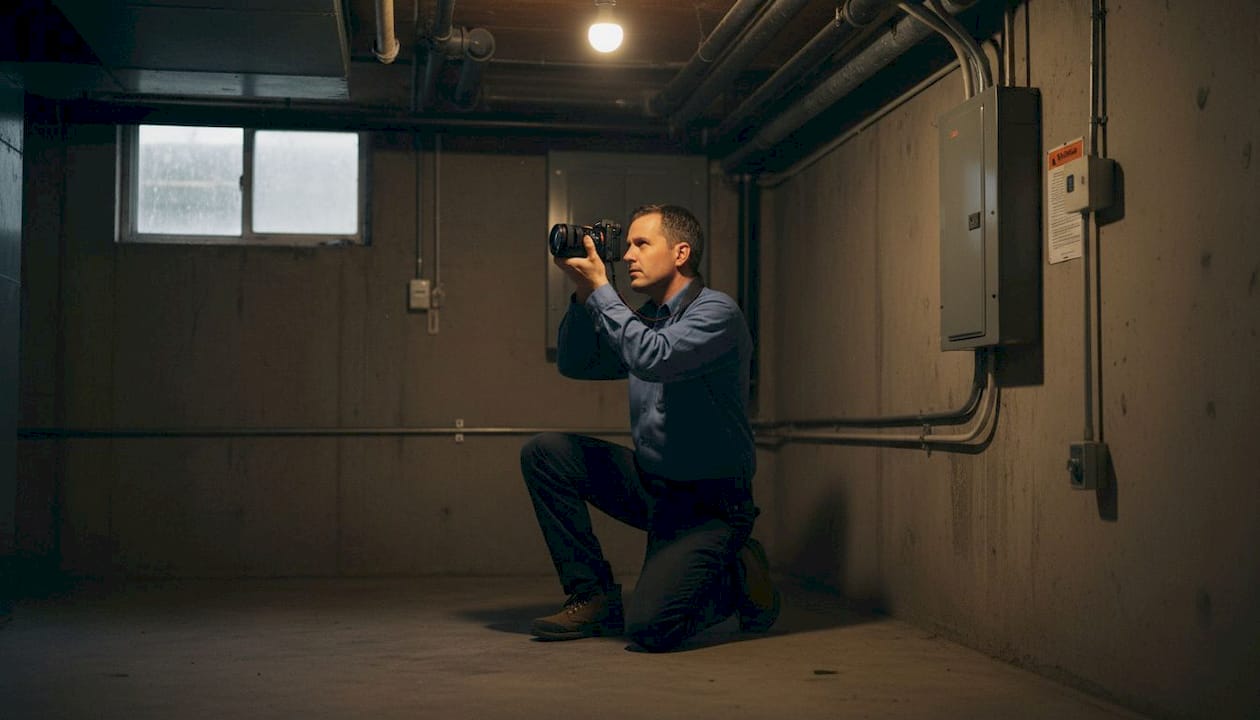
- Simple shutdown diagram: A hand-drawn map of your thermostat, breaker panel, indoor service switch, and outdoor disconnect posted near the panel saves critical time.
- Gas shutoff wrench: Required for quarter-turn gas valves near furnaces.
Know exactly where these five points are located in your home or building: the thermostat, the indoor air handler service switch (usually a red switch near the unit), the HVAC circuit breaker in your main panel, the outdoor disconnect box mounted near the condenser, and the gas shutoff valve near the furnace or heat pump.
Pro Tip: Photograph each shutoff point with your phone and save the images in a labeled album. Share that album with every adult in the household or every manager on your property team.
Step-by-step AC emergency shutdown for common hazards
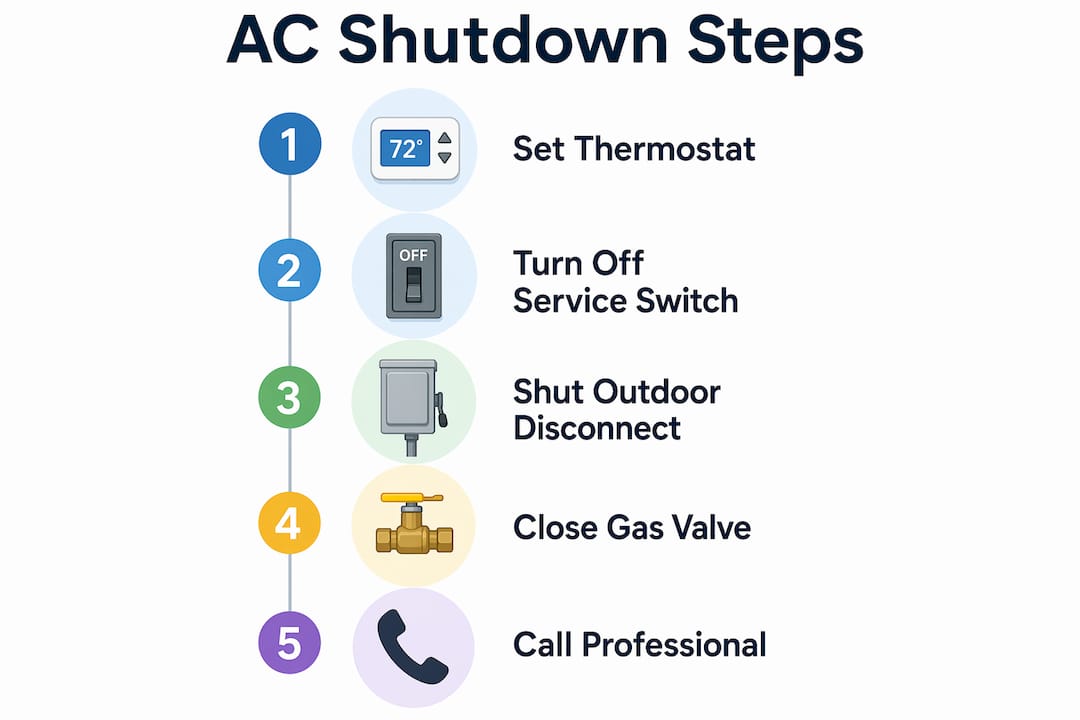
The standard manual shutdown sequence is: turn off the thermostat, flip the HVAC circuit breaker to Off, then pull the disconnect handle near the outdoor condenser. Follow this sequence for most hazards. Adjust based on the specific situation using the steps below.
For electrical issues, water leaks, or mechanical failure
- Set the thermostat to Off. This stops the system from calling for cooling and prevents an automatic restart.
- Flip the indoor service switch to Off. The red switch near your air handler cuts power to the blower and control board.
- Turn off the HVAC breaker at the main panel. Locate the breaker labeled “AC,” “Air Handler,” or “Condenser” and switch it to the Off position.
- Pull the outdoor disconnect handle. Open the gray box mounted near your outdoor condenser and pull the handle or cartridge straight out.
- Check for water. Water pooling around the indoor unit signals potential short circuit risk. Shut off power at the service switch immediately if you see standing water, and do not touch the unit until power is confirmed off.
For gas odor or suspected gas leak
- Do not touch any electrical switches. A spark from a switch can ignite gas.
- Evacuate all occupants immediately. In any HVAC emergency involving gas odor, occupants must leave the building at once and call 911 from outside.
- Close the gas valve only if you can do so safely. The gas shutoff valve near the furnace requires a quarter-turn to reach the perpendicular position, which stops fuel flow. Attempt this only if you can reach it without entering a gas-filled room.
- Leave doors open as you exit to help disperse gas and reduce concentration.
For smoke or fire near the unit
- Evacuate first. Always.
- Call 911 before touching anything.
- Do not attempt to shut down the system yourself if fire is visible or smoke is heavy.
| Hazard | First action | Power step | Gas step |
|---|---|---|---|
| Water leak | Shut indoor service switch | Flip HVAC breaker Off | Not required |
| Electrical fault | Set thermostat to Off | Flip HVAC breaker Off | Not required |
| Gas odor | Evacuate immediately | Do not touch switches | Quarter-turn valve if safe |
| Smoke or fire | Evacuate immediately | Call 911 | Call 911 |
Pro Tip: Post a laminated copy of this table inside your breaker panel door. Property managers should place copies in every mechanical room.
How do you confirm a successful AC shutdown?
Verifying the shutdown is complete prevents the system from restarting unexpectedly. Check each of the following after completing the shutdown steps:
- Thermostat display: The screen should be blank or show “Off.” If it still shows a temperature setpoint, the system may still have power.
- Breaker position: The HVAC breaker handle should sit firmly in the Off position. A tripped breaker sits in the middle, not fully Off. Push it fully to Off before assuming power is cut.
- Outdoor disconnect status: The disconnect handle or cartridge should be fully removed or in the Off position. Listen for any hum or vibration from the condenser. Silence confirms power is cut.
- Indicator lights: Many air handlers have a status LED. A dark LED confirms the control board has no power.
- Heat from components: Touch the side of the air handler cabinet (not electrical terminals) after two minutes. Residual warmth is normal. Increasing heat is not.
Do not restart the system after an emergency shutdown without a professional inspection. Industry safety standards forbid blind restarts after emergency shutdowns because the original cause must be diagnosed before power is restored. Restarting without inspection risks secondary damage to the compressor, control board, and refrigerant lines.
What mistakes do people make during an AC emergency shutdown?
The most common mistake is skipping steps under pressure. Homeowners often go straight to the breaker and skip the thermostat, which leaves the control board in an active state and can cause a lockout error when power is restored.
- Rapid breaker flipping: Control boards require 10–30 minutes after power-down to fully discharge. Flipping the breaker off and back on quickly often fails to reset the system and can leave it in a lockout state.
- Attempting to reach a hard-to-access disconnect: If the outdoor disconnect is blocked or corroded, do not force it. Cut power at the main breaker instead.
- Ignoring persistent odors: If a gas smell remains after you have closed the valve and evacuated, do not re-enter. Call your gas utility and 911.
- Restarting after a water leak without drying the unit: Mold can begin growing within 24–48 hours in humid climates after a water leak. In Southwest Florida’s heat and humidity, that window is even shorter.
Pro Tip: If you smell burning from your vents before a full shutdown, follow a burning odor safety protocol before touching any switches. Burning smells can indicate an electrical fault that makes standard shutdown steps dangerous.
Call a qualified HVAC professional immediately after any emergency shutdown. Call 911 if gas, fire, or smoke is involved. Do not wait to see if the problem resolves on its own.
Special considerations for commercial and critical environments
Commercial properties and critical facilities require a more structured HVAC shutdown protocol than a residential home. The stakes are higher and the systems are more complex.
Data center server inlet temperatures above 95°F trigger automatic shutdowns within 10–15 minutes. That narrow window means a delayed or unplanned shutdown can cause catastrophic equipment loss. Commercial property managers should address the following:
- Documented emergency plans: Every facility needs a written HVAC shutdown protocol posted in mechanical rooms and distributed to all relevant staff.
- Regular drills: Practice the shutdown sequence at least twice a year. Staff who have never performed a shutdown will hesitate under pressure.
- Escalation roles: Assign a primary and backup shutdown technician for every shift. Define who calls the HVAC contractor and who contacts building management.
- Backup cooling priorities: Identify which zones are critical (server rooms, food storage, medical areas) and which can tolerate a temperature rise. Portable cooling units, such as a dual-hose portable AC, can bridge a critical zone during an extended shutdown.
- Automatic thermal shutdowns: Know the setpoints for your building management system. Do not override automatic shutdowns without understanding why they triggered.
Residential shutdowns are simpler, but the underlying principle is the same: preparation before the emergency determines the outcome during it. Property managers overseeing multiple units should review the office HVAC installation guide for additional protocol guidance.
Key Takeaways
A safe AC emergency shutdown requires knowing your shutoff points, following the correct sequence, and never restarting the system without a professional inspection.
| Point | Details |
|---|---|
| Follow the correct sequence | Always start with the thermostat, then the service switch, then the breaker, then the outdoor disconnect. |
| Evacuate first for gas or fire | Never touch switches if you smell gas. Leave immediately and call 911 from outside. |
| Verify the shutdown completely | Check the thermostat display, breaker position, outdoor disconnect, and indicator lights before assuming the system is off. |
| Avoid blind restarts | Industry standards require professional diagnosis before restoring power after any emergency shutdown. |
| Prepare before emergencies happen | Label all shutoff points, create a diagram, and practice the steps with everyone in the household or on your property team. |
What I’ve learned after years of HVAC emergency calls
The homeowners and property managers who handle AC emergencies best are never the ones who read about it after the fact. They are the ones who walked through their home or building on a calm Tuesday afternoon and found every shutoff point before they ever needed it.
I have seen the other scenario too many times. A water leak starts at 2:00 AM, and the homeowner spends 20 minutes searching for the service switch while the air handler sits in standing water. By the time power is cut, the control board is fried and mold has a head start. That outcome is not bad luck. It is the result of skipping preparation.
The step that most people skip is the outdoor disconnect. They cut the breaker and assume the job is done. The outdoor condenser has its own disconnect for a reason. Skipping it leaves the condenser energized, which is a real hazard for any technician who arrives to inspect the unit.
My honest recommendation: spend 15 minutes this week walking through the HVAC emergency response checklist for your property. Label every switch. Take photos. Then call Ultraairswfl for a post-summer inspection so a professional can confirm your system is in good shape before the next season puts it under stress. Shutdown readiness is not a separate skill from home safety. It is home safety.
— albert
Ultraairswfl is ready when your AC system needs expert attention
When an AC emergency leaves your system shut down and your home or building without cooling, the next call matters. Ultraairswfl provides fast, professional HVAC emergency response across Naples, Cape Coral, and Fort Myers, including post-shutdown inspections, electrical diagnostics, and full system restoration.
A shutdown is only the first step. Getting your system safely back online requires a trained technician who can identify the root cause and confirm the repair is complete. Ultraairswfl’s team handles heating and cooling system services from emergency diagnostics through full installation, with flexible scheduling and financing options for residential and commercial clients. Contact Ultraairswfl to schedule an inspection after any emergency shutdown and get your system running safely again.
FAQ
What is the first step in an AC emergency shutdown?
Set the thermostat to Off first. This stops the system from calling for a cooling cycle and prevents an automatic restart while you work through the remaining steps.
Should I shut off my AC if I smell gas?
Do not touch any switches if you smell gas. Evacuate immediately, call 911 from outside, and only close the gas valve if you can reach it safely without entering a gas-filled room.
How long should I wait before restarting my AC after a shutdown?
Do not restart the system without a professional inspection. Industry safety standards require diagnosing the original cause before restoring power to avoid secondary damage or safety hazards.
What does the outdoor disconnect do?
The outdoor disconnect cuts power directly to the condenser unit. Turning off the main breaker does not always de-energize the condenser, so pulling the outdoor disconnect handle is a required step in a complete HVAC shutdown protocol.
How do I know my AC is fully shut down?
Confirm the thermostat display is blank or shows Off, the HVAC breaker is fully in the Off position, the outdoor disconnect handle is removed or switched Off, and no hum or vibration comes from the condenser or air handler.