

Central air conditioning is a whole-home cooling system that delivers consistent, energy-efficient comfort by circulating cooled air through a network of ducts and vents. 66% of U.S. homes use central air as their primary cooling method, making it the dominant standard for residential comfort. In Southwest Florida, where summer heat and humidity are relentless from april through october, the reasons to choose central air go well beyond convenience. This guide covers the real advantages, sizing requirements, maintenance realities, and climate-specific factors that matter most for homeowners and renters in Naples, Cape Coral, and Fort Myers.
Why choose central air over window units and mini splits?
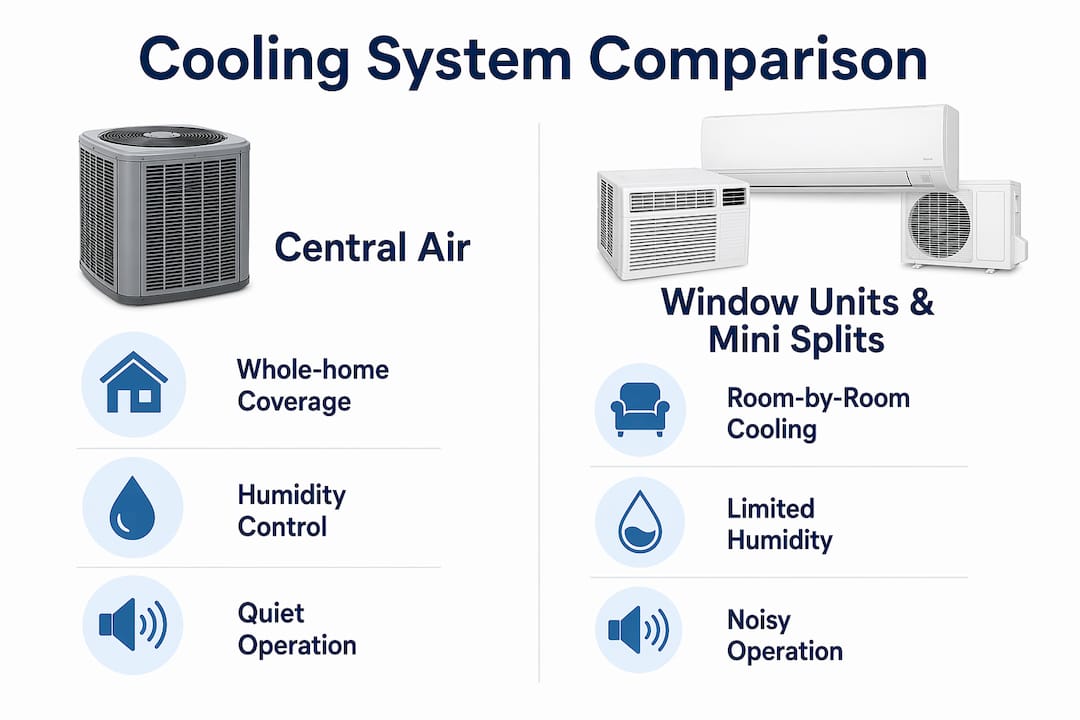
Central air conditioning delivers what individual units cannot: consistent temperature, filtration, and humidity control across every room in your home simultaneously. That unified performance is the core reason most homeowners choose a central air system over alternatives.
Whole-home coverage and comfort
Window units and portable ACs cool one room at a time. Central air treats your entire home as a single climate zone, so your bedroom, kitchen, and living room all reach the same target temperature without you moving equipment or adjusting multiple controls. One thermostat manages everything. That simplicity is not just convenient; it also prevents the uneven cooling that makes some rooms stuffy while others feel cold.
Air quality across the whole house
MERV-rated filters in a central air system capture allergens, dust, and airborne contaminants from every cubic foot of air that circulates through your home. Window units filter only the air in one room, and their filters are often thin and rarely replaced. For households with asthma or allergy concerns, whole-home filtration with MERV 8–13 filters is a meaningful health advantage. You can read more about the connection between filtration and indoor air quality for Southwest Florida homeowners.
Quiet operation and humidity control
Central air systems place the compressor outside, so the indoor noise level is far lower than a window unit rattling in your wall. Humidity control is equally important in Southwest Florida. Central air runs long enough during each cycle to pull moisture from the air, keeping indoor humidity at a comfortable level. Window units and mini splits can struggle with this in large open floor plans.
| Feature | Central Air | Window Units | Mini Splits |
|---|---|---|---|
| Whole-home coverage | Yes | No | Partial (by zone) |
| Humidity control | Excellent | Limited | Good |
| Indoor noise level | Low | High | Low |
| Air filtration | MERV-rated, whole-home | Basic, single-room | Basic, per unit |
| Single thermostat control | Yes | No | No |
| Installation disruption | Moderate (ducts required) | Minimal | Minimal |
Pro Tip: If you already have ductwork in your Southwest Florida home, central air is almost always the more cost-effective long-term choice compared to installing multiple mini split heads throughout the house.
How does sizing affect central air performance in Southwest Florida?
Correct sizing is the single biggest factor in whether your central air system performs well or causes problems. The Department of Energy recommends approximately 20 BTUs of cooling capacity per square foot of living space as a starting point. Southwest Florida’s intense heat and high humidity push that number higher for many homes.
Why Manual-J calculations matter
A Manual-J load calculation accounts for your home’s square footage, ceiling height, insulation quality, window area, sun exposure, and local climate data. Skipping this step and guessing at system size is the most common installation mistake. Proper Manual-J load calculations during installation are critical to system efficiency and long-term comfort. An HVAC contractor who sizes your system based only on square footage is cutting corners.
The oversizing problem
An oversized central air unit cools your home quickly but shuts off before completing a full dehumidification cycle. Oversized units cause poor humidity control through short cycling, which is one of the most common comfort complaints in Florida homes. The result is a house that feels cold but clammy. Undersized systems run constantly, drive up your electric bill, and wear out faster.
| Home Size (sq ft) | Baseline BTU Needed | Florida Climate Adjustment |
|---|---|---|
| 1,000 | 20,000 BTU | Add 10–15% for heat and humidity |
| 1,500 | 30,000 BTU | Add 10–15% for heat and humidity |
| 2,000 | 40,000 BTU | Add 10–15% for heat and humidity |
| 2,500 | 50,000 BTU | Add 10–15% for heat and humidity |
For a detailed breakdown of sizing for typical Southwest Florida homes, the HVAC sizing workflow guide covers local climate adjustments in practical terms.
Pro Tip: Always ask your HVAC contractor to show you the Manual-J calculation report before agreeing to a system size. Any reputable installer will have one ready.
What maintenance does central air require compared to other systems?
Maintaining one central air system is far simpler and more cost-effective than managing multiple window units or portable ACs. That gap in effort and cost grows larger the more rooms you need to cool.
Central air maintenance comes down to a short list of recurring tasks:
- Filter replacement: Change your air filter every 30–60 days in Southwest Florida. The high pollen count and year-round operation mean filters load up faster here than in cooler climates.
- Coil cleaning: The evaporator and condenser coils need annual cleaning to maintain heat transfer efficiency. Dirty coils force the system to work harder and raise your energy bill.
- Condensate drain check: Florida humidity means your drain line can clog with algae and mold. Flush it quarterly with a diluted bleach solution.
- Annual professional tune-up: A licensed HVAC technician checks refrigerant levels, electrical connections, and system pressures once a year. This catches small problems before they become expensive repairs.
- Thermostat calibration: Verify your thermostat reads accurately, especially if you notice rooms feeling warmer than the set temperature.
With window units, you repeat the filter cleaning and coil inspection for every unit in the house. Each unit also needs seasonal installation and removal if you store them during cooler months. Maintaining multiple units results in higher cumulative time and replacement costs than a single central system over the long run.
Both central air and mini splits last 15–20 years with proper scheduled maintenance. Window units rarely reach 10 years. The math on long-term cost strongly favors central air when your home already has ductwork. The 2026 AC maintenance checklist for Florida homeowners covers every task in detail, including seasonal timing specific to Southwest Florida.
Is central air the right choice for Southwest Florida’s climate and homes?
Southwest Florida’s climate makes central air conditioning less of a luxury and more of a necessity. Temperatures regularly exceed 90°F from may through september, and relative humidity stays above 70% for much of the year. Central air handles both heat and moisture removal in a way that window units simply cannot match at whole-home scale.
Here are the key considerations specific to this region:
-
Ductwork readiness: Most homes built in Southwest Florida after 1980 already have duct systems installed. If your home has existing ducts in good condition, central air is the clear choice. Leaky or poorly insulated ducts reduce efficiency, so have them inspected before installation.
-
Retrofit costs for older homes: Retrofitting a full duct network is costly and disruptive. If your home lacks ductwork entirely, the installation cost rises significantly and may make mini splits a better fit for certain rooms or additions.
-
Humidity removal as a health factor: In high-humidity climates, a properly sized central air system removes more moisture per hour than any collection of individual units. Sustained indoor humidity above 60% encourages mold growth, which is a real concern in Florida homes.
-
Hybrid system option: A hybrid approach combining central air with mini splits works well for homes with additions, garages converted to living space, or rooms that the main duct system does not reach effectively. Central air handles the main living areas, and one or two mini split heads cover the outlier zones.
-
Home resale value: Central air can increase home resale value by 5–10% in warm climates. Buyers in Southwest Florida expect central air. A home without it faces a smaller buyer pool and lower offers.
The right choice depends on your home’s existing infrastructure. For most Southwest Florida homes with ducts already in place, central air delivers the best combination of comfort, air quality, and long-term value.
Key Takeaways
Central air conditioning is the most effective whole-home cooling solution for Southwest Florida homes with existing ductwork, offering superior humidity control, air quality, and long-term value over window units or mini splits.
| Point | Details |
|---|---|
| Whole-home performance | Central air delivers consistent temperature and humidity control across every room simultaneously. |
| Sizing is critical | Use a Manual-J calculation to avoid oversizing, which causes poor humidity removal and short cycling. |
| Maintenance is simpler | One central system requires less cumulative time and cost than maintaining multiple individual units. |
| Florida climate fit | High humidity and heat make central air the strongest choice for homes with existing ductwork. |
| Resale value boost | Central air can increase home resale value by 5–10%, a real financial advantage in Southwest Florida. |
What I have learned from years of central air recommendations in Southwest Florida
The homeowners I see struggle most with their cooling systems share one thing in common: they either skipped the sizing calculation or ignored maintenance until something broke. Both mistakes are avoidable, and both cost far more to fix than to prevent.
The detail that surprises most people is the humidity issue with oversized systems. A homeowner in Naples once told me her new system felt worse than the old one. The house cooled down fast, but it felt damp and uncomfortable. The installer had put in a unit that was too large for the square footage. The fix required replacing the system. That is an expensive lesson.
Central air also does something for indoor air quality that rarely gets enough attention. A properly filtered central system running MERV 11 or MERV 13 filters removes a meaningful portion of airborne allergens, mold spores, and fine dust from your entire home continuously. That matters in a state where outdoor air quality varies and pollen seasons overlap. The home air quality improvement benefits alone justify the investment for many families.
My honest recommendation: if your Southwest Florida home has existing ductwork in decent condition, choose central air. Get the Manual-J calculation done by a licensed contractor. Change your filter every month during peak season. Schedule a professional tune-up once a year. Do those three things, and your system will run well for 15–20 years.
— albert
Ultraairswfl: central air expertise for Southwest Florida homeowners
Ultraairswfl serves homeowners and renters across Naples, Cape Coral, and Fort Myers with central air installation, repair, and maintenance built around Southwest Florida’s specific climate demands.
The team at Ultraairswfl performs Manual-J load calculations on every installation, so your system is sized correctly from day one. Maintenance plans keep your central air running at peak performance year after year, reducing the risk of mid-summer breakdowns when you need cooling most. Whether you are installing a new system, replacing an aging unit, or scheduling a tune-up, Ultraairswfl’s heating and cooling solutions are designed for the conditions Southwest Florida homeowners actually face. Contact Ultraairswfl to schedule an assessment and get a system that fits your home.
FAQ
What is the main reason to choose central air in Florida?
Central air provides whole-home humidity control and consistent cooling that individual units cannot match. In Southwest Florida’s high-heat, high-humidity climate, that performance difference is significant for both comfort and indoor air quality.
How long does a central air system last in Southwest Florida?
A properly maintained central air system lasts 15–20 years. Regular filter changes, annual professional tune-ups, and quarterly condensate drain maintenance are the key factors in reaching that lifespan.
Is central air worth it if my home lacks ductwork?
If your home has no existing ductwork, retrofitting ducts is costly and disruptive. In that case, a mini split system or a hybrid approach may be more practical. A licensed HVAC contractor can assess your home and give you an accurate cost comparison.
How does central air affect home resale value in Southwest Florida?
Central air can increase resale value by 5–10% in warm climates. Southwest Florida buyers expect central air, and homes without it typically sell for less and sit on the market longer.
What MERV filter rating should I use for central air in Florida?
MERV 8–13 filters offer the best balance of air quality and airflow for most residential central air systems. MERV 11 or MERV 13 is recommended for households with allergy or asthma concerns, as these ratings capture finer particles including mold spores and pollen.