

The HVAC system sizing workflow is the structured process of calculating heating and cooling loads, selecting matched equipment, and verifying field performance to deliver reliable comfort and energy efficiency. In Southwest Florida, where Naples, Cape Coral, and Fort Myers face extreme heat and relentless humidity for eight or more months each year, getting this process right is not optional. A system that is too large short-cycles and leaves your home clammy. A system that is too small runs constantly and still fails to cool. The industry standard term for the core calculation in this workflow is the Manual J load calculation, and every credible sizing process starts there.
What tools, standards, and data drive the HVAC system sizing workflow?
The HVAC system sizing workflow depends on three foundational standards published by ACCA: Manual J for load calculations, Manual S for equipment selection, and Manual D for duct design. Each standard builds on the previous one, so skipping any step creates compounding errors downstream.
Manual J is the professional standard for residential load calculations, built on precise building data entered into approved software. Most contractors complete a Manual J calculation in about 15 minutes using field measurements and digital templates. That speed matters because it removes the excuse of skipping it.

Software tools contractors use for Manual J
Two widely used Manual J software platforms are Wrightsoft Right-J and CoolCalc. Both accept the same core data inputs and produce ACCA-compliant load reports. The table below compares their main features:
| Software | Platform | Best for | Cost model |
|---|---|---|---|
| Wrightsoft Right-J | Desktop and cloud | Full residential and light commercial | Subscription |
| CoolCalc | Web browser | Residential quick calculations | Free and paid tiers |
| Carrier HAP | Desktop | Commercial zone-by-zone simulation | Licensed |
| Trane TRACE | Desktop | Large commercial hourly simulation | Licensed |
The data inputs that drive accuracy include building dimensions, insulation R-values, window U-factors and solar heat gain coefficients, infiltration rates, and local climate design temperatures. For Southwest Florida, the design cooling temperature and the outdoor humidity ratio are especially critical because they directly size the latent (moisture) portion of the load.
Field verification requires a separate set of instruments: digital manometers for static pressure, psychrometers for wet-bulb and dry-bulb temperature readings, and refrigerant probes for suction and discharge pressure. These tools confirm that the installed system performs what the calculations predicted.
Pro Tip: Before any contractor starts your Manual J, ask them which software they use and request a sample output page. A legitimate calculation produces a room-by-room load report, not a single whole-house number.
How to perform the HVAC sizing workflow step-by-step for residential properties
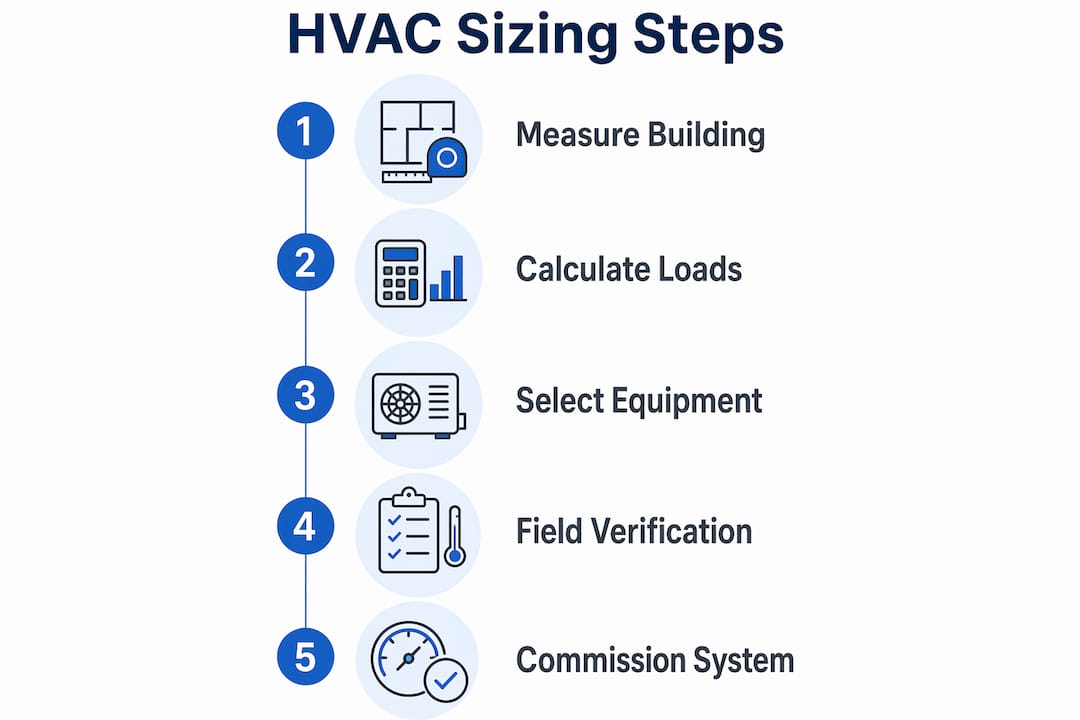
The residential HVAC design process follows a defined sequence. Deviating from the order, or skipping steps, is one of the most common HVAC sizing mistakes contractors make in the field.
Here are the core steps in order:
- Measure the building envelope. Collect room dimensions, ceiling heights, wall construction, insulation R-values, window sizes, orientations, and glazing types.
- Enter data into Manual J software. Input climate design temperatures for your specific Florida location, not generic state averages.
- Separate sensible and latent loads. Sensible load is the heat that raises temperature. Latent load is the moisture that raises humidity. Both must be calculated independently.
- Select equipment using Manual S. Match the unit’s sensible and latent capacity to the Manual J outputs. Cooling capacity must not exceed 115% of the Manual J cooling load to avoid oversizing and the comfort problems that follow.
- Size registers and grilles using Manual T. Correct register sizing controls airflow velocity and noise.
- Design ductwork using Manual D. Duct sizing determines whether conditioned air actually reaches each room at the calculated flow rate.
- Document everything. The load report, equipment selection rationale, and duct design become the commissioning baseline.
Separating sensible and latent cooling loads is especially critical in hot-humid climates like Florida, where a system sized only for temperature control will leave excess moisture in the air. That excess moisture causes mold growth, musty odors, and occupant discomfort even when the thermostat reads 74°F.
Common mistakes at this stage include reusing load calculations from a previous system without rechecking the building envelope, using square-footage rules of thumb instead of Manual J, and ignoring window orientation. A west-facing wall of glass in Naples generates a dramatically different afternoon load than a north-facing wall of the same size.
Pro Tip: Request a room-by-room load report from your contractor. If they provide only a total tonnage figure, the load calculation was likely not done correctly.
What are the key differences between residential and commercial HVAC sizing workflows?
Commercial HVAC sizing uses ASHRAE heat-balance methods and ventilation standards, specifically ASHRAE 62.1, for zone-specific hourly load calculations. This is a fundamentally different process from residential Manual J work, and the two should not be confused.
The table below summarizes the main differences:
| Factor | Residential | Commercial |
|---|---|---|
| Load calculation standard | ACCA Manual J | ASHRAE heat-balance method |
| Ventilation standard | ACCA Manual J infiltration inputs | ASHRAE 62.1 occupancy-driven rates |
| Simulation type | Single peak-load calculation | Hourly simulation with diversity factors |
| Software examples | Wrightsoft, CoolCalc | Carrier HAP, Trane TRACE |
| Coordination required | Homeowner and contractor | Architects, engineers, and multiple trades |
Hourly simulation matters in commercial work because occupancy, plug loads, and solar gain shift dramatically throughout the day. A conference room that holds 40 people at 10 a.m. and zero people at 3 p.m. requires a zone design that accounts for that swing. Oversizing based on peak occupancy alone wastes energy during the other 22 hours.
Ventilation rates per space type are critical in humid climates and directly influence equipment and duct sizing. In Southwest Florida, outdoor air introduced for ventilation carries enormous latent load. A commercial system that does not account for this will struggle to maintain indoor humidity below 60% relative humidity, the threshold above which mold risk rises sharply.
Pro Tip: For any commercial property in Naples, Cape Coral, or Fort Myers, ask your HVAC engineer to show you the ventilation load as a separate line item in the load report. It should represent a significant share of the total latent load.
How to verify and commission your HVAC system after sizing
Verification is where the HVAC system sizing checklist meets the real world. A load calculation is a prediction. Commissioning confirms whether the installed system delivers what was predicted.
ACCA’s Quality Installation checklist mandates documented Manual J load calculations and equipment selection verification to prevent oversizing or undersizing. Installation teams must verify airflow, ductwork, and refrigerant levels using specialized instruments. This process is now integrated into digital workflows like measureQuick, which uses Bluetooth-connected probes to capture pressure and temperature data automatically.
Most installations complete ACCA QI certification in about 30 minutes using measureQuick’s guided workflow. The app walks the technician through each measurement, flags out-of-range readings, and generates a performance certificate that the homeowner receives as documentation. That certificate is your proof that the system was installed correctly, not just that it was installed.
Here is what a proper verification checklist covers:
- Measured total external static pressure compared to the equipment’s rated maximum
- Actual airflow at each supply register compared to Manual D design values
- Refrigerant suction and discharge pressures confirming correct charge
- Temperature split across the coil confirming sensible capacity
- Wet-bulb temperature measurements confirming latent capacity
- Documentation of Manual J report, Manual S equipment selection, and duct design
Skipping Manual J often misses humidity and latent loads, causing underperformance even when the thermostat appears satisfied. Callbacks for “the house feels humid” or “the system runs all day” almost always trace back to a sizing or commissioning failure, not a mechanical defect.
Pro Tip: After any new HVAC installation, ask your contractor for the commissioning documentation including the Manual J report, the Manual S equipment selection sheet, and the measureQuick or equivalent performance certificate. If they cannot provide all three, the job is not complete.
Key takeaways
A correct HVAC system sizing workflow requires Manual J load calculations, Manual S equipment matching, and field-verified commissioning. Skipping any step produces systems that waste energy, fail to control humidity, and generate costly callbacks.
| Point | Details |
|---|---|
| Manual J is non-negotiable | Every residential and commercial sizing job must start with a documented load calculation, not a rule-of-thumb tonnage estimate. |
| Latent load drives Florida sizing | Separating sensible and latent loads is critical in Southwest Florida because humidity control determines real comfort. |
| Manual S prevents oversizing | Cooling capacity must not exceed 115% of the Manual J load to avoid short-cycling and poor dehumidification. |
| Commissioning closes the loop | Field measurements with tools like measureQuick confirm the installed system matches the calculated design. |
| Documentation protects you | Homeowners and property managers should request the full load report, equipment selection sheet, and commissioning certificate after every installation. |
Why I think most HVAC sizing problems in Southwest Florida are workflow problems, not equipment problems
After years of working with homeowners and property managers across Naples, Cape Coral, and Fort Myers, the pattern is consistent. The complaint is almost never “the equipment failed.” It is “the house never feels right” or “the humidity is always high even when it’s cool.” Nine times out of ten, the root cause is a workflow failure that happened before the first screw was turned.
The most common failure I see is contractors reusing load calculations from the old system. Reusing load calculations from old systems without accounting for envelope or duct modifications violates best practice. Every replacement requires a fresh Manual J. A home that added impact windows, spray foam insulation, or a room addition since the last system was installed has a completely different load profile. Plugging in the same tonnage is guesswork dressed up as experience.
The second failure is treating commissioning as a formality. I have seen installations where the technician checked the thermostat, confirmed the system was blowing cold air, and called it done. That tells you nothing about static pressure, refrigerant charge, or actual airflow distribution. A system can blow cold air and still be 30% undersized for latent load. In Florida, that 30% gap is the difference between a comfortable home and a mold problem.
The fix is not complicated. It requires contractors who follow the full ACCA workflow and property managers who know enough to ask for documentation. Verified workflows that include load documentation, equipment matching, and field measurements are the standard, not a premium service. If your contractor treats them as optional extras, find a different contractor.
— albert
Get the sizing right with Ultraairswfl

Ultraairswfl serves homeowners and property managers across Naples, Cape Coral, and Fort Myers with HVAC installations built on ACCA Manual J and Manual S standards from the first measurement to the final commissioning certificate. Every installation includes a documented load calculation, equipment selection justification, and a measureQuick performance report you can keep. If you manage a commercial property and need zone-by-zone load analysis and ASHRAE 62.1 ventilation compliance, the office HVAC installation guide is a strong starting point. Contact Ultraairswfl to schedule a sizing consultation and get a system that actually fits your building.
FAQ
What is the HVAC system sizing workflow?
The HVAC system sizing workflow is the step-by-step process of calculating heating and cooling loads using ACCA Manual J, selecting equipment with Manual S, designing ductwork with Manual D, and verifying performance through field commissioning. It produces a documented, verifiable result rather than a rule-of-thumb estimate.
How do I calculate HVAC capacity for my Florida home?
HVAC capacity is calculated using Manual J software such as Wrightsoft Right-J or CoolCalc, which factors in building dimensions, insulation values, window characteristics, infiltration rates, and local climate design temperatures. In Southwest Florida, the latent (humidity) load must be calculated separately because it significantly affects equipment selection.
What are the most common HVAC sizing mistakes?
The most common mistakes are skipping Manual J entirely, reusing old load calculations without rechecking the building envelope, and selecting equipment based on square footage alone. Room-by-room load reports and documented window orientation data are the clearest signs a proper calculation was performed.
What should I ask for after an HVAC installation?
Request the Manual J load report, the Manual S equipment selection sheet, and a commissioning certificate from a tool like measureQuick. These three documents confirm the system was sized correctly and installed to ACCA Quality Installation standards.
How does commercial HVAC sizing differ from residential?
Commercial sizing uses ASHRAE heat-balance methods and ASHRAE 62.1 ventilation standards instead of ACCA Manual J, and requires hourly simulation software like Carrier HAP or Trane TRACE to account for occupancy diversity and varying internal loads across zones.