
HVAC efficiency standards 2026 set mandatory minimum SEER2, EER2, and HSPF2 ratings by U.S. region, backed by DOE load-calculation rules and EPA refrigerant requirements that apply to every new installation this year. These are not brand-new federal mandates. The SEER2/HSPF2 framework was adopted starting January 1, 2023, and 2026 compliance builds directly on that foundation. What makes 2026 distinct is the convergence of stricter enforcement, refrigerant transition updates from the EPA, and IRC 2024 sizing requirements that now govern permits across most jurisdictions. Whether you own one home or manage a portfolio of rental properties, understanding these rules before you buy or install any equipment saves you money, avoids failed inspections, and positions you for available rebates.
What are the regional SEER2 minimums under 2026 HVAC guidelines?
The DOE divides the U.S. into three climate regions, and the minimum efficiency rating your equipment must meet depends entirely on where the system is installed, not where your contractor is headquartered. This distinction trips up more property managers than any other compliance detail.
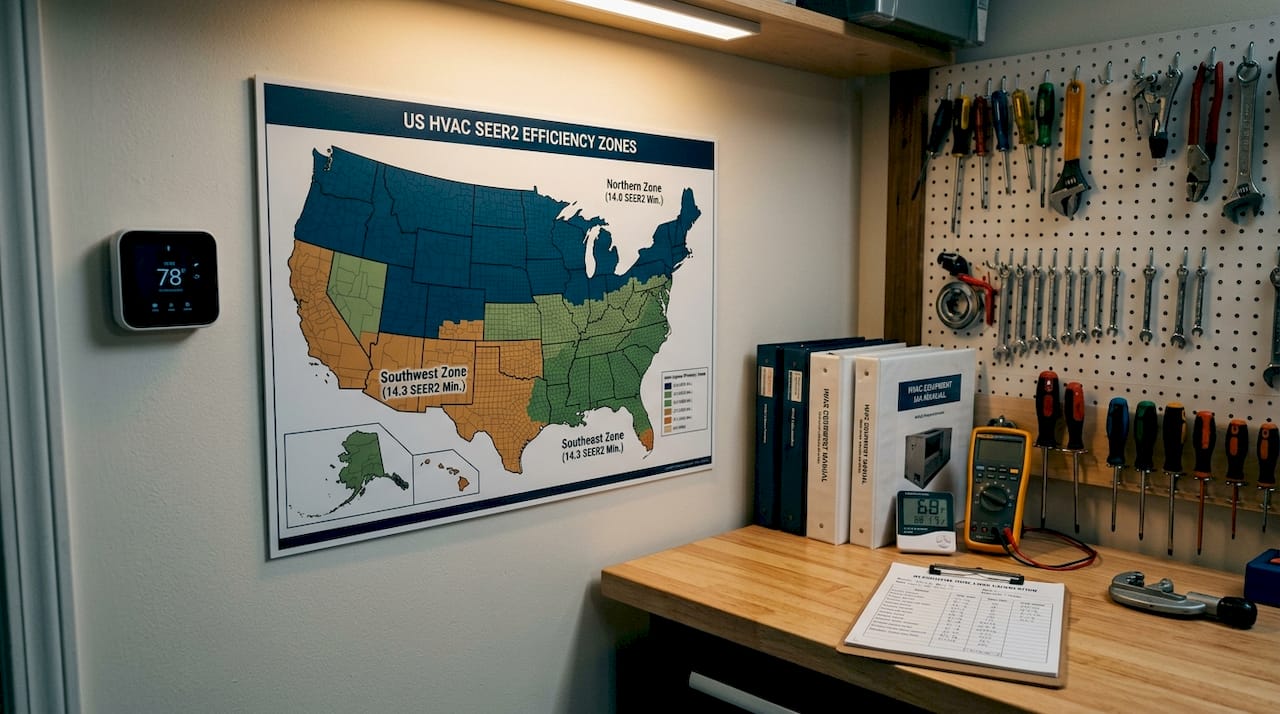
The DOE’s three-region map sets the following minimums for split-system central air conditioners:
| Region | Unit Size | Minimum SEER2 |
|---|---|---|
| North | All sizes | 13.4 |
| Southeast / Southwest | Under 45,000 BTU/h | 14.3 |
| Southeast / Southwest | 45,000 BTU/h and above | 13.8 |
| Nationwide (heat pumps) | All sizes | 14.3 |
Heat pumps carry a unified 14.3 SEER2 minimum regardless of location. That single national floor makes heat pump compliance simpler to track, but it also means the bar is higher than what northern states require for straight cooling equipment. Southern regions, including Florida, also apply EER2 minimums for peak-load performance, which matters most during the hottest months when grid demand spikes.
A few practical points worth knowing before you purchase:
- ZIP code governs compliance. A contractor based in Georgia installing a system in a northern state must meet the northern minimum, not Georgia’s.
- Ductless mini-splits follow separate efficiency tiers and often qualify for higher rebate thresholds than ducted systems.
- Replacing only the outdoor unit without matching the indoor coil can invalidate the rated SEER2 value, creating a compliance gap even when the nameplate looks correct.
Pro Tip: Ask your contractor to show you the DOE region map for your specific ZIP code before any equipment is ordered. A five-minute check prevents a costly return trip.
How do EPA refrigerant rules affect HVAC installations in 2026?
The EPA’s 2023 Technology Transitions rule targeted a shift to low-GWP refrigerants, with R-410A in the crosshairs. The original plan included a January 1, 2026, deadline banning installation of equipment using refrigerants with a GWP above 700. That deadline no longer stands.
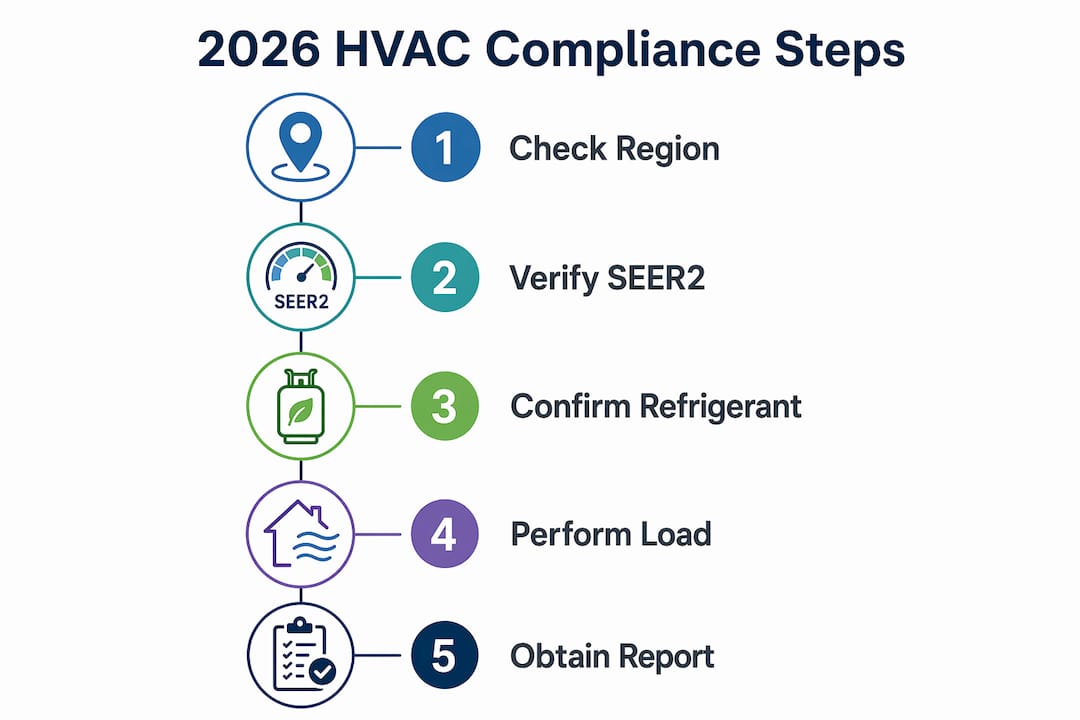
On May 21, 2026, the EPA removed the R-410A installation deadline, allowing contractors to install legacy inventory manufactured or imported before 2025 until that stock is depleted. This is a meaningful shift for both contractors and homeowners. Contractors who stocked R-410A equipment before the 2025 cutoff can legally install it in 2026 without penalty.
What this means in practice:
- Equipment manufactured before January 1, 2025, using R-410A can still be installed legally in 2026.
- Equipment manufactured after that date must use a lower-GWP refrigerant such as R-32 or R-454B.
- Homeowners and landlords should ask their installer to confirm the manufacture date and refrigerant type before work begins.
- Newer refrigerants require updated tools, fittings, and technician certifications, which can add to installation costs.
The refrigerant compliance picture in 2026 depends on manufacture and import dates rather than a hard calendar cutoff. That nuance is easy to miss, and a contractor who gets it wrong can leave you with equipment that fails a future inspection or creates liability during a property sale.
Pro Tip: Request a written statement from your installer confirming the refrigerant type, the equipment manufacture date, and EPA compliance status. Keep this with your property records.
Why do load calculations determine whether your system actually meets 2026 standards?
A SEER2 rating on a label means nothing if the equipment is the wrong size for the space it conditions. IRC 2024 Section M1401.3 requires Manual J or an approved equivalent for all residential heating and cooling load calculations. Rule-of-thumb sizing, such as “one ton per 500 square feet,” is explicitly prohibited under this code.
The full design workflow that drives true compliance runs through three ACCA manuals:
- Manual J calculates the actual heating and cooling load for the building, accounting for insulation, window area, orientation, occupancy, and local climate data.
- Manual S uses the Manual J output to select equipment that matches the calculated load within acceptable tolerances.
- Manual D designs the duct system to deliver conditioned air efficiently to every room, preventing pressure imbalances and energy losses.
Skipping or shortcutting any of these steps produces predictable problems. An oversized system short-cycles, meaning it runs in brief bursts that never allow the coil to dehumidify the air properly. In Southwest Florida, where humidity is the primary comfort driver, an oversized system can leave a home feeling clammy even when the thermostat reads 72°F. An undersized system runs continuously, fails to reach setpoint on peak days, and wears out faster.
Pre-installation documentation packets containing load calculation reports and equipment specs are now required in many jurisdictions to pass inspections. In markets where ENERGY STAR or utility rebate programs apply, these records are also required to claim incentives. Skipping the paperwork does not just risk a failed permit. It can cost you hundreds of dollars in rebates you would otherwise qualify for.
Pro Tip: Before signing any installation contract, ask the contractor to provide a written Manual J report. If they quote a size without one, that is a red flag worth acting on.
What do 2026 HVAC compliance requirements cost, and what can offset them?
Nationwide, HVAC replacement costs range from $5,000 to $28,000 in 2026, depending on system type, home size, efficiency tier, and local labor rates. A central air conditioner and furnace replacement in a mid-size home typically lands in the $8,000 to $15,000 range before incentives.
Several factors push costs toward the higher end of that range:
- Refrigerant transition equipment using R-32 or R-454B costs more upfront due to newer component designs and installer certification requirements.
- Ductwork upgrades are often needed when replacing older systems, particularly when Manual D analysis reveals undersized or leaking ducts.
- Electrical panel upgrades may be required for heat pumps replacing gas furnaces, adding $1,500 to $4,000 to the project.
- Higher SEER2 tiers carry premium price tags but qualify for rebates that can offset a significant portion of the difference.
Rebate programs like Sonoma Clean Power set efficiency thresholds above DOE minimums for eligibility. For example, split systems may need to reach SEER2 15.2 or higher to qualify, while ductless mini-splits face even higher bars. ENERGY STAR certification is a common baseline requirement across most utility and state rebate programs.
Checking available tax credits before selecting equipment is worth the time. The difference between a 14.3 SEER2 unit and a 16 SEER2 unit might be $800 in equipment cost but $1,200 in rebate eligibility, making the higher-efficiency unit the better financial choice even before you factor in lower utility bills.
How can property managers handle HVAC compliance across multiple locations?
Managing HVAC compliance across a portfolio of properties in different states or DOE regions is not a task you can handle with a single equipment spec sheet. Regional variance requires tailored procurement and verification for each installation address.
The practical challenges multiply quickly:
- A property in Ohio requires 13.4 SEER2 minimum, while a property in Florida requires 14.3 SEER2. Ordering the same unit for both fails compliance at the Florida location.
- Rebate overlays from local utilities may require SEER2 levels well above the DOE floor, meaning the compliant unit is not always the rebate-eligible unit.
- Contractors serving multi-state portfolios may default to their home-state standards unless explicitly directed otherwise.
The most reliable approach is to build a compliance checklist for each property that includes the DOE region, the applicable SEER2 and HSPF2 minimums, the local utility rebate thresholds, and the required documentation for permits. Request a copy of the Manual J report, the equipment spec sheet showing rated efficiency, and the refrigerant compliance confirmation for every installation. Store these records by property address.
Non-compliance carries real consequences. Failed inspections delay occupancy, trigger reinspection fees, and can void manufacturer warranties. Lost rebates represent direct cash left on the table. And an improperly sized or installed system generates maintenance calls and tenant complaints that cost far more over time than getting the installation right the first time.
Key takeaways
HVAC efficiency compliance in 2026 requires matching region-specific SEER2 minimums, verifying refrigerant status, and documenting load calculations for every installation.
| Point | Details |
|---|---|
| Regional SEER2 minimums apply | Northern states require 13.4 SEER2; southern states require 14.3 for smaller units and 13.8 for larger ones. |
| Refrigerant rules depend on manufacture date | R-410A equipment made before 2025 can still be installed in 2026; confirm dates in writing before work begins. |
| Manual J is legally required | IRC 2024 prohibits rule-of-thumb sizing; load calculations are mandatory for permits and rebate eligibility. |
| Costs range from $5,000 to $28,000 | Higher-efficiency equipment often qualifies for rebates that offset the premium over minimum-compliant units. |
| Portfolio managers need property-specific records | DOE minimums, rebate thresholds, and code requirements vary by installation address, not by portfolio average. |
Why 2026 is really about execution, not new rules
I’ve watched homeowners and landlords get tripped up by HVAC compliance not because the rules changed overnight, but because the details compounded quietly. The 2023 SEER2 framework, the refrigerant transition, and the IRC 2024 sizing requirements all arrived at different times. By 2026, they’re all active simultaneously, and the contractors who understand how they interact are worth paying a premium for.
The single biggest mistake I see is treating SEER2 as a pass/fail sticker rather than the output of a correctly designed system. A 16 SEER2 unit installed with undersized ducts and no Manual J calculation will underperform a 14.3 SEER2 unit installed correctly every time. The rating describes potential. The installation determines reality.
For landlords managing properties across multiple states, the refrigerant update is the most underappreciated compliance detail right now. The removal of the January 2026 installation deadline sounds like good news, and it is, but only if you verify manufacture dates. Installing a non-compliant unit because your contractor assumed the old deadline still applied is a problem that shows up at resale or during a code audit, not at the time of installation.
My advice: demand documentation before the job starts, not after. A contractor who cannot produce a Manual J report and a refrigerant compliance statement before pulling a permit is not a contractor you want on a compliance-sensitive project.
— albert
Get your 2026 HVAC installation done right with Ultraairswfl
Ultraairswfl serves homeowners, landlords, and property managers across Naples, Cape Coral, and Fort Myers with HVAC installations built to meet 2026 DOE and EPA requirements. Every project starts with a proper load calculation, region-verified equipment selection, and full documentation for permits and rebates. If you’re replacing aging equipment or expanding a rental portfolio, the team at Ultraairswfl understands the regional compliance details that generic contractors overlook. Explore heating system options built for Southwest Florida’s climate and efficiency requirements, or review the HVAC installation guide for facility and property managers navigating 2026 compliance across multiple sites.
FAQ
What is the minimum SEER2 rating required in 2026?
The minimum SEER2 rating depends on your region. Northern states require 13.4 SEER2, while southern states require 14.3 SEER2 for units under 45,000 BTU/h and 13.8 for larger units. Heat pumps require 14.3 SEER2 nationwide.
Can R-410A equipment still be installed in 2026?
Yes, with conditions. The EPA removed the January 2026 installation deadline, so R-410A equipment manufactured before January 1, 2025, can still be legally installed in 2026 until existing inventory is depleted.
Is a Manual J load calculation required for a new HVAC installation?
IRC 2024 Section M1401.3 requires Manual J or an approved equivalent for all residential HVAC sizing. Rule-of-thumb methods are prohibited, and most jurisdictions require the calculation report as part of the permit application.
How much does a compliant HVAC replacement cost in 2026?
Replacement costs range from $5,000 to $28,000 depending on system type, size, efficiency tier, and whether ductwork or electrical upgrades are needed. Rebate programs tied to ENERGY STAR thresholds can offset a meaningful portion of the total.
Do HVAC efficiency requirements differ for rental properties in different states?
Yes. DOE minimums apply based on the installation address, not the property owner’s location. A landlord with properties in both Ohio and Florida must meet different SEER2 minimums at each site and document compliance separately for each property.